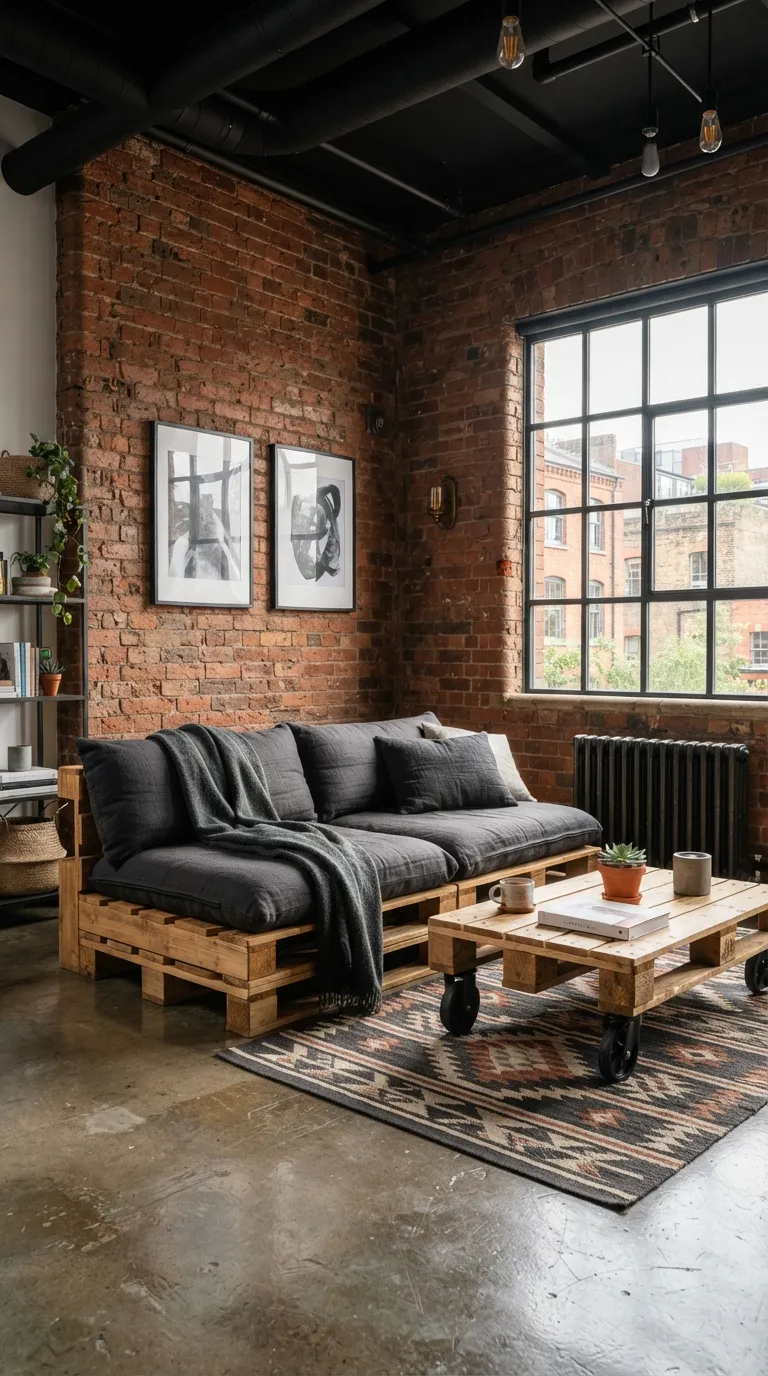
16 Industrial Pallet Furniture Ideas for Modern Lofts
Pallet wood earns its place in a loft only when it’s sanded, sealed, and set against steel and brick instead of stacked like a shipping yard. These 16 industrial pallet furniture ideas for modern lofts cover finishes, color, lighting, seating, sleeping, and zoning, each with one detail worth copying before you pick up a saw.
Low window light rakes across raw grain. Black steel keeps the boards from tipping into rustic cabin. Concrete stays cool underfoot while the wood above it holds warmth. Rough edges, on purpose.
Jump To
- Why Industrial Pallet Furniture Ideas Work So Well in Modern Lofts
- The Ideas, Quick Fixes First and Big Builds Last
- How to Start Your Industrial Loft Transformation
- Ready to Create Your Dream Industrial Loft?
Why Industrial Pallet Furniture Ideas Work So Well in Modern Lofts
Industrial style grew out of converted warehouses and factory floors, and pallet wood is the native material of those buildings. Honey-oak and weathered gray boards, black iron pipe, matte black steel, and concrete-gray walls make up the palette.
Open plans with brick and tall windows need warmth that clean-lined furniture can’t supply, and reclaimed wood supplies it cheaply. Smaller lofts can carry the look too: keep pieces low and start with one anchor, a coffee table or a sofa base.
Style at a Glance
| Element | Reclaimed Pallet Wood | Steel and Concrete |
|---|---|---|
| Philosophy | Keep the marks: saw kerfs, nail holes | Structure on show, nothing hidden |
| Materials | Sanded deck boards, matte sealer | Black iron pipe, steel, poured concrete |
| Color palette | Honey oak, weathered gray, charcoal wash | Matte black, gunmetal, cool concrete gray |
The Ideas, Quick Fixes First and Big Builds Last
1. Sanded Deck Boards Sealed Matte So the Grain Stays Raw
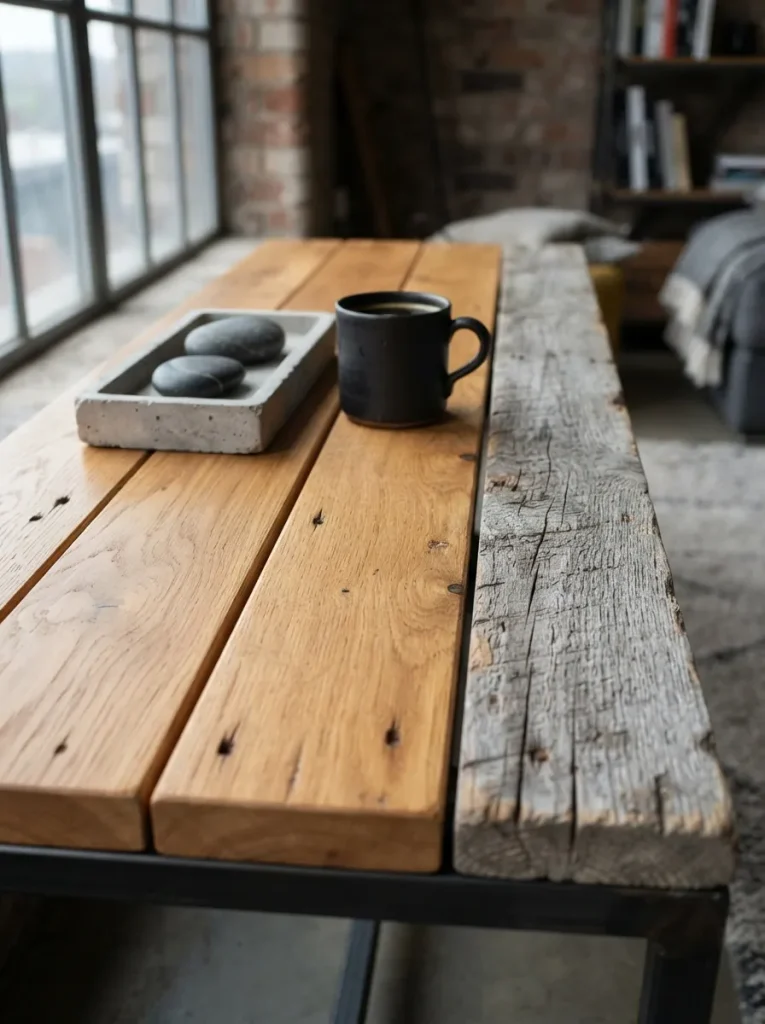
Bare pallet wood looks dusty and splintery. Sanded and sealed, it reads as custom millwork with the character left in: saw marks, nail holes, maybe a faded stamp. Sand at 80 grit to knock down splinters, finish at 120, and wipe with a damp cloth before sealing.
Choose a matte water-based polyurethane, since oil-based versions amber over time and push the boards warmer than most loft palettes want. Two or three thin coats, with a light 220-grit pass between them, handle the grain that water-based finish raises on the first coat. For sourcing on a tight budget, start with these budget pallet furniture ideas. Anything bare feet or forearms will touch belongs here first.
Warning: Check the stamp before you haul a pallet home. HT means heat-treated, which is fine for indoor pieces. MB means methyl bromide fumigation, so leave it outside, along with any board that smells of chemicals or shows oil stains.
2. Charcoal Stain Against Red Brick
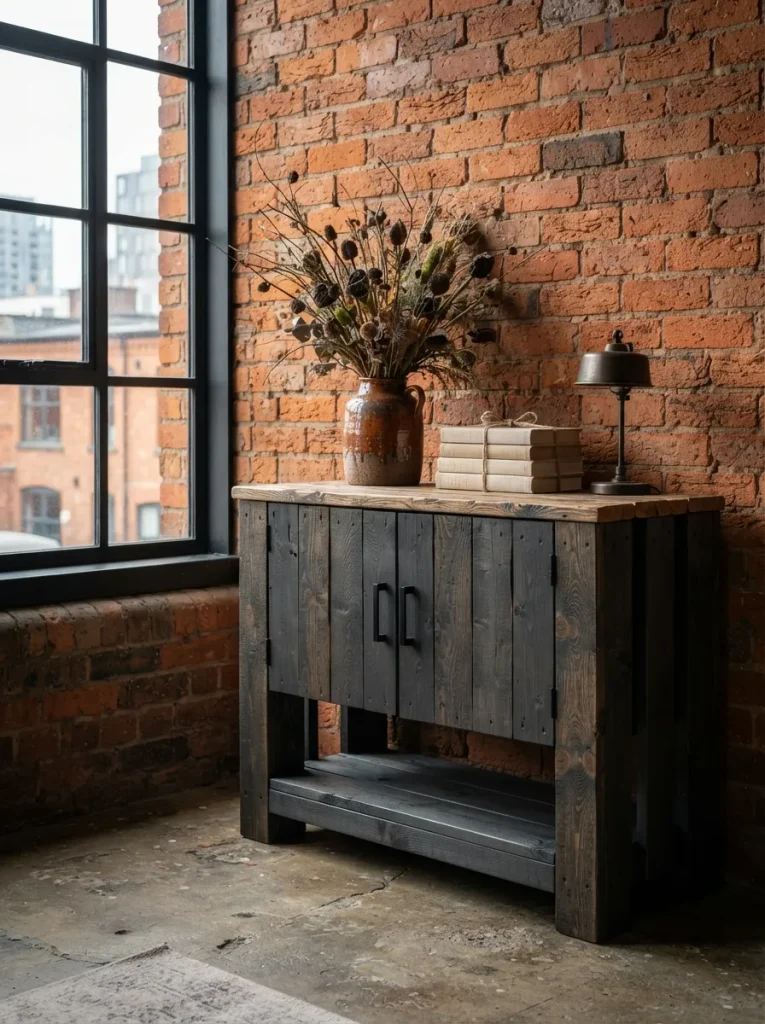
Dark reads sharper against warm than against dark. Charcoal-stained pallet boards beside red brick set up that contrast: the brick’s orange undertone makes a cool charcoal look inkier. Use gel stain rather than paint so the grain still shows, and wipe back each coat, because pallet boards drink stain unevenly.
Two thin coats beat one heavy one. Keep the charcoal to a single piece, a sideboard or a bench, and let the brick carry the rest of the wall. For more dark-palette moves, try these black moody styling ideas. Suits lofts where brick or ductwork already does the warm work.
Pro Tip: Stain the end grain last and wipe it back harder. It soaks up far more stain than the faces and turns nearly black if left alone.
3. A Low Coffee Table on Locking Casters
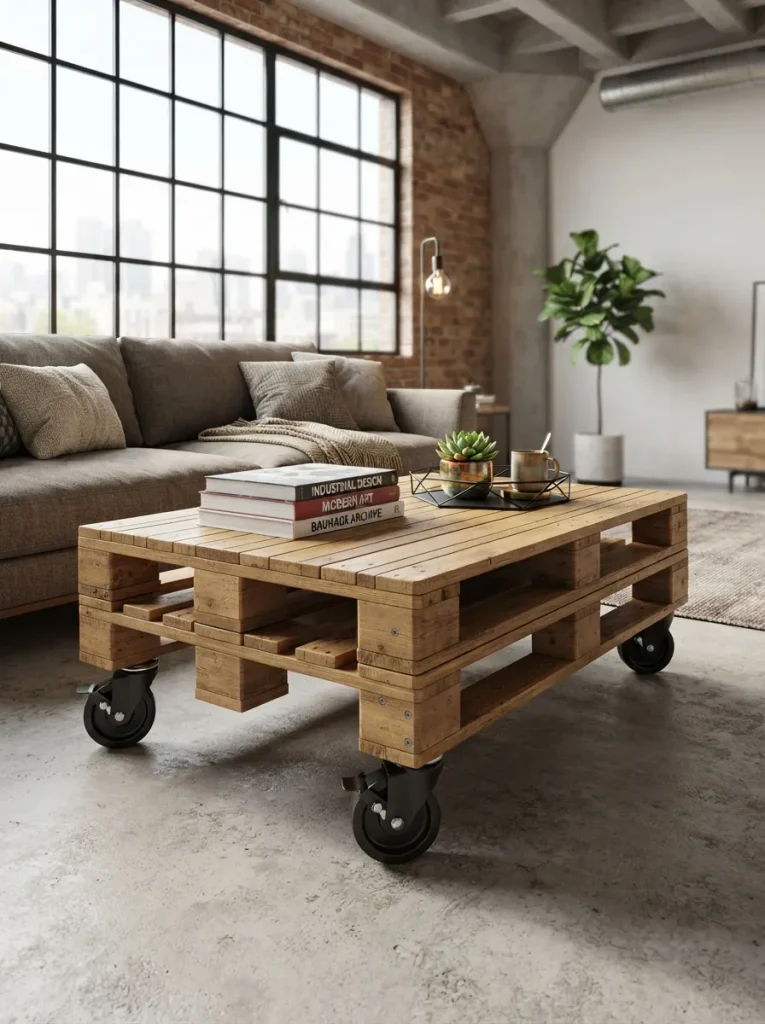
Stack two pallets, about 11 inches together, screw through the top deck into the stringers below, and bolt a locking swivel caster into each corner. With 4-inch casters the finished height lands around 15 inches, roughly 2 inches under a 17-inch sofa seat, which is where a coffee table wants to sit.
Pick pallets whose top decks have boards set close together, or fill the gaps with strips cut from a spare board, so phones and glasses don’t tip through. A full 48 × 40-inch pallet suits an 8-foot sofa; against anything shorter, trim it. Casters let the whole table roll clear when guests arrive.
Light a pallet console from above and the grain goes flat. Light it from behind and the brick starts to glow.
4. A Floating Console Backlit With Warm LED
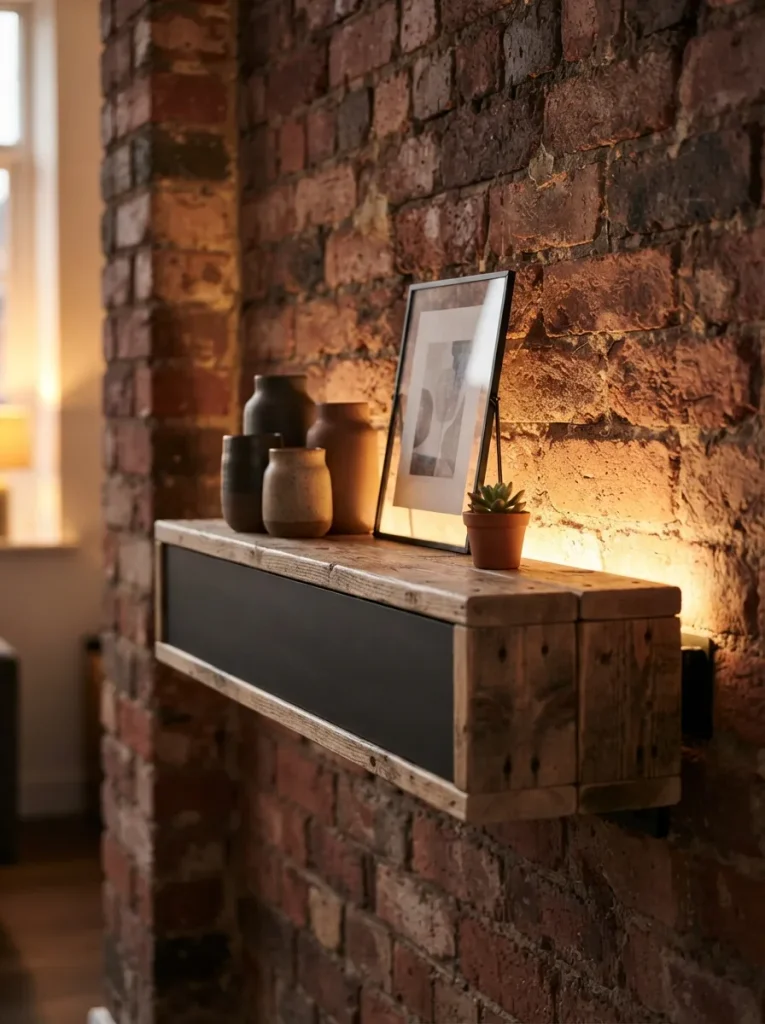
Hang a shallow pallet-board console on brick with masonry anchors rated for its weight, then tuck a warm-white LED strip into an aluminum channel along the back edge so the light washes up the wall instead of dotting it. Aim for 2700 to 3000K; anything cooler than about 4000K turns the wood gray and flat.
Backlighting also makes the console look as if it floats. Works best where brick is the star of the room. Renters can skip drilling: stand the console on a low steel base and tape the channel to the back rail.
Quick Win: Tape the strip in place and check the glow at dusk before committing to fixings. Moving it an inch changes where the wash lands on the brick.
5. A Pallet Sofa With a Tilted Back and Deep Cushions
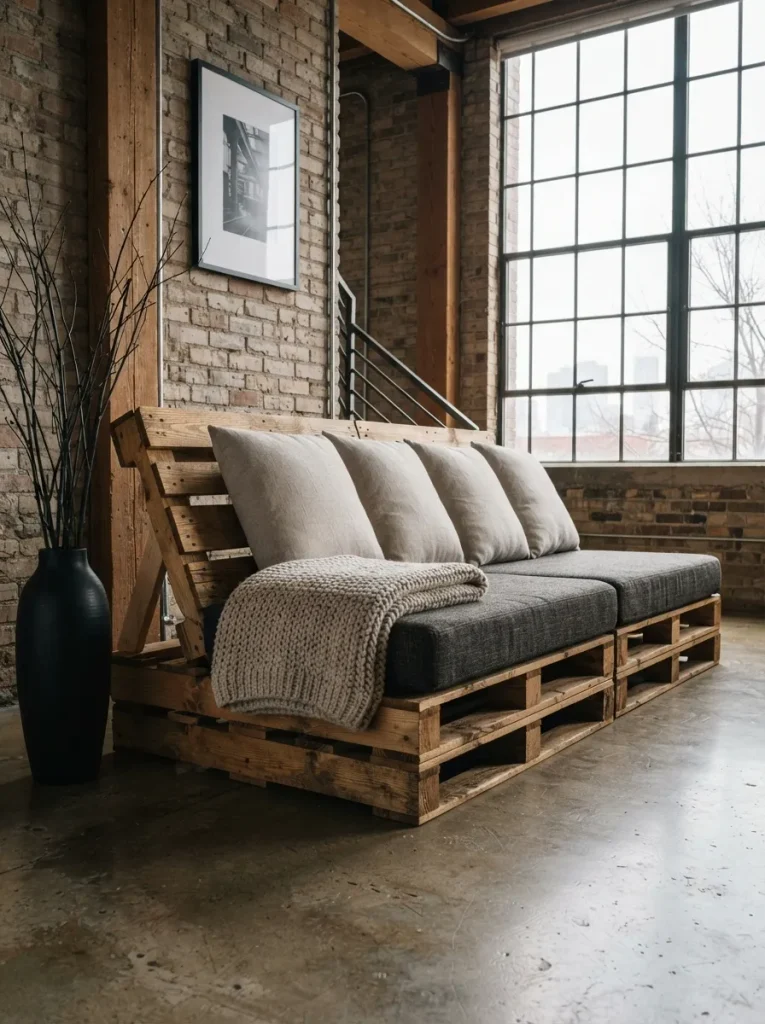
Most pallet sofas fail the same way: a stiff bench, a thin cushion, a bolt-upright back. Build the base two pallets high, about 11 inches, and two wide for a run of roughly 8 feet, then add a 6-inch cushion for a seat height near 17 inches.
Tilt the back pallet away from vertical with a wood wedge behind it, since an upright back pushes sitters forward. At 40 inches deep the seat invites sprawling, so lean bolsters against the back to shorten it. Suits lofts with enough floor for something substantial.
Important: Fasten stacked pallets with 2½-inch wood screws through the top deck into the stringers rather than trusting the original nails. Seat frames take sideways shoves that freight never did.
Shop This Look
| Product |
|---|
| Removable-cover foam seat cushions in charcoal canvas, sized to your pallet frame |
| Oversized bolster pillows in rough linen |
| Chunky knit throw blanket in oatmeal |
6. A Fold-Down Desk That Disappears Into the Wall
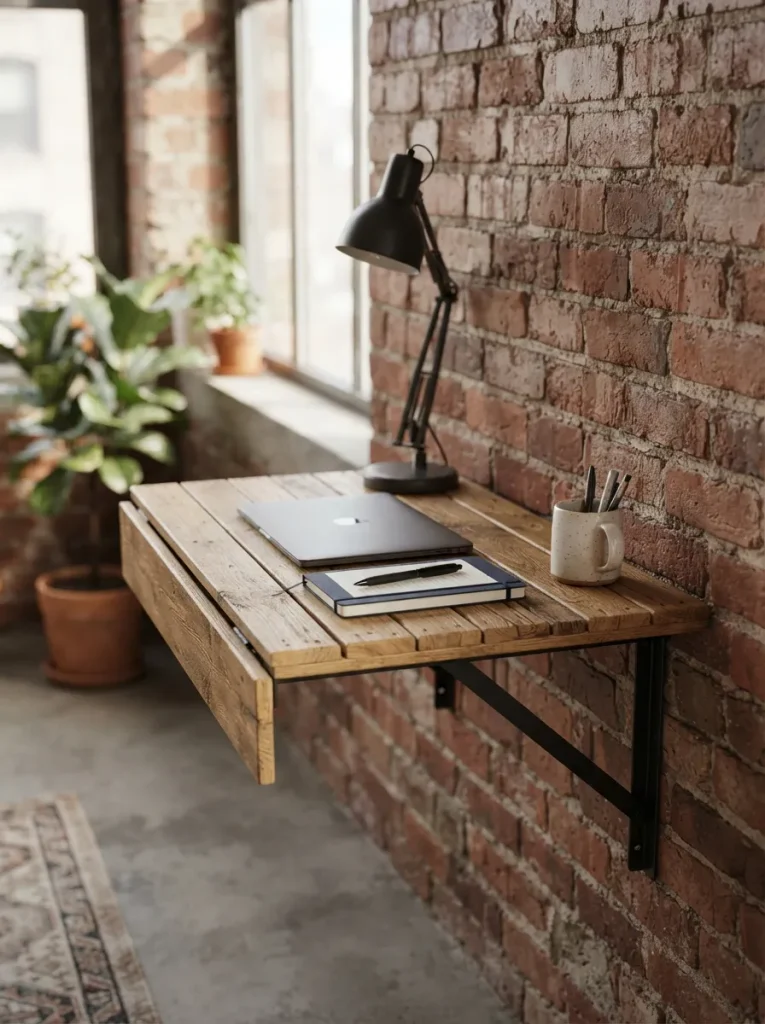
Folded up, it’s a slatted panel about 5½ inches deep on the wall. Folded down, it’s a desk. Hinge one pallet along its bottom edge, trimmed to roughly 24 inches deep for legroom, and hold it level with chains or steel drop-leaf brackets when open.
A full pallet often weighs around 30 to 50 pounds, so anchor the hinge line into studs or masonry with fasteners rated well above that, never drywall anchors alone. Suits lofts too tight for a permanent desk. More compact builds are in these tiny house pallet furniture ideas.
Concrete floors bounce sound as easily as light, and the textile that fixes it is bigger than the one you’d instinctively buy.
7. A Flat-Weave Rug That Quiets the Concrete
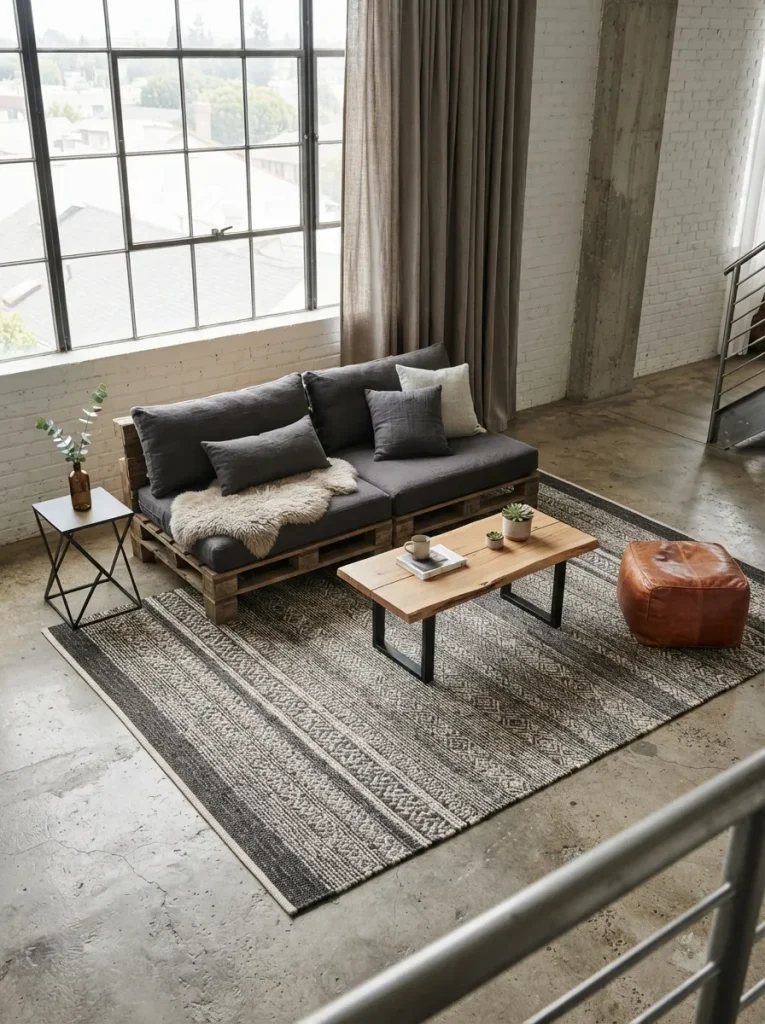
Hard surfaces reflect sound, and a loft is mostly hard surfaces: concrete, brick, steel, glass. A large flat-weave rug is the quickest fix, and it gives the seating group a visible boundary. Size it so at least the front legs of the sofa and every chair sit on it, which in most lofts means 8 × 10 feet or larger.
Flat weave matters: casters roll across it, and it won’t snag on rough pallet edges the way loops and pile do. Sand the underside edges of every piece anyway. Works best in open plans with polished concrete underfoot.
Pro Tip: Hang heavy linen curtains at the window nearest the seating. Fabric on a vertical surface absorbs echo that a rug can’t reach.
Shop This Look
| Product |
|---|
| Flat-weave rug in charcoal and cream, 8 × 10 feet or larger |
| Cognac leather pouf |
| Heavy linen curtain panels in warm gray |
8. Pallet-Wood Dining Table on Black Iron Pipe Legs
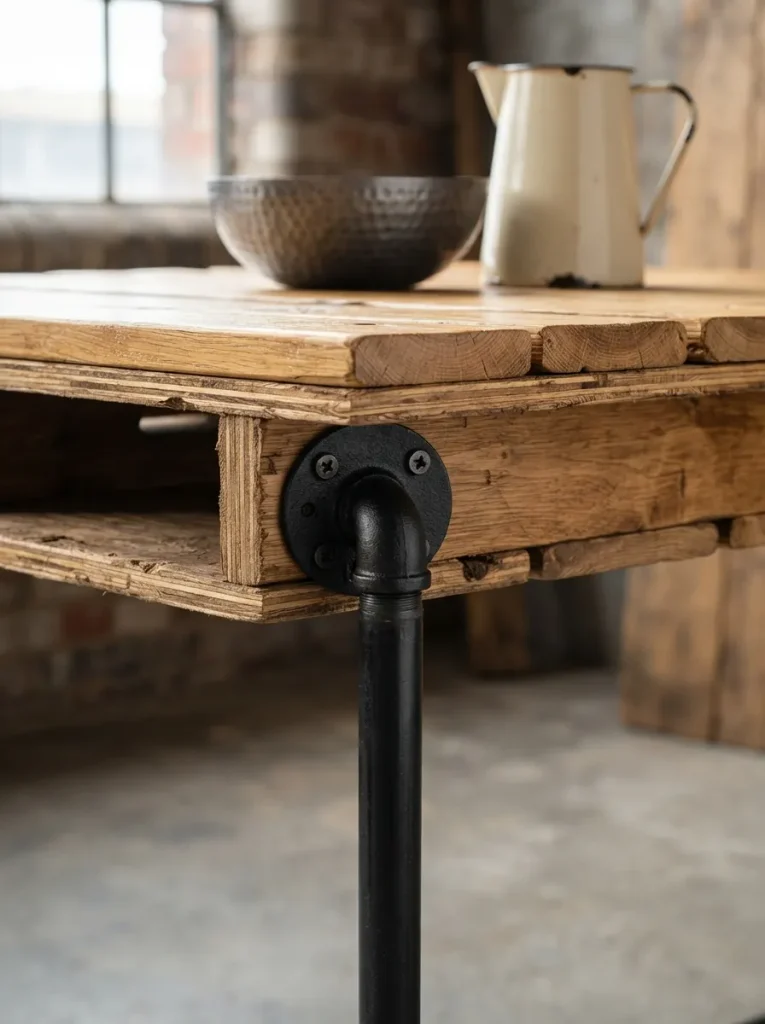
For anyone who wants a dining table that seats six without looking like a crate. Salvage deck boards from two or three pallets, fasten them edge to edge onto a plywood substrate for a 96 × 40-inch top, and set it on black iron pipe legs from the plumbing aisle.
Deck boards are usually under an inch thick, so an unsupported top will bow. Wipe each pipe fitting with mineral spirits first, since new pipe ships with an oily coating that transfers to hands and linen. Size the legs so the finished top lands near 30 inches.
✅ Table Build Order:
- [ ] Sand and seal the loose boards
- [ ] Fasten them edge to edge onto plywood
- [ ] Wipe every pipe fitting with mineral spirits
- [ ] Attach the flanges and legs, then check the top sits near 30 inches
9. Cage Pendants Hung Low Over the Table
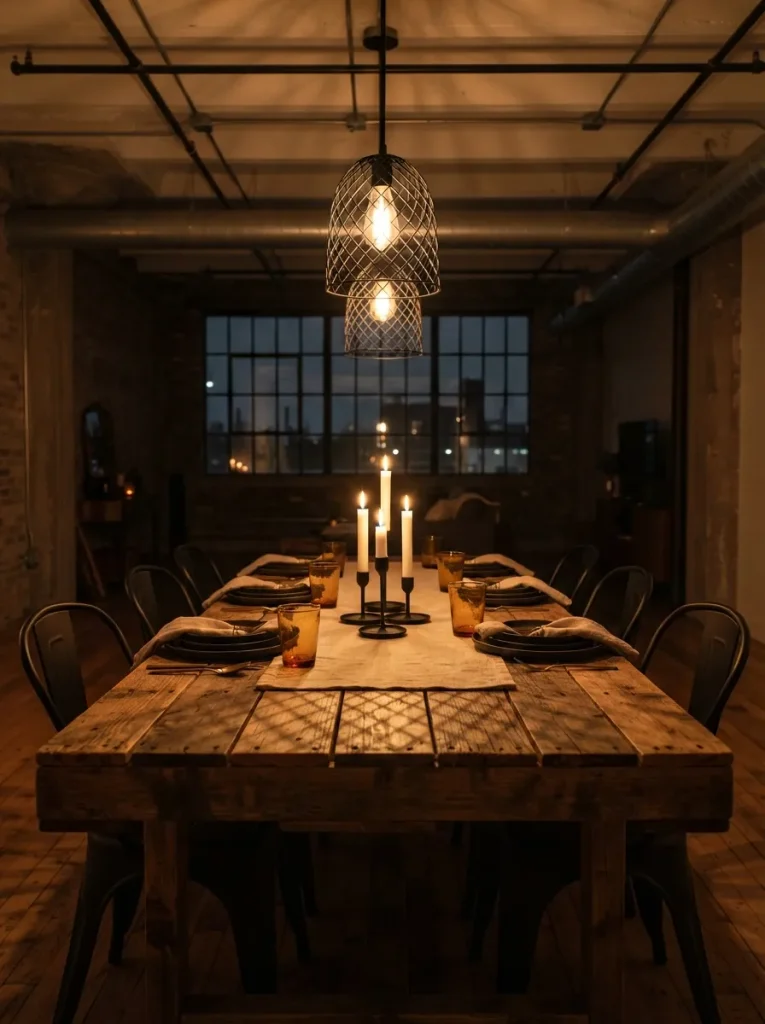
A lone bare bulb over a long table looks like a construction site. Black cage pendants fix that: the lattice throws a grid of soft shadow across the boards and echoes the steel window frames. Hang the bottom of each fixture 30 to 36 inches above the tabletop, measured from the table rather than the ceiling, which in a tall loft means a long cord or downrod.
Size each cage at about half to two-thirds of the table’s width, so 20 to 26 inches over a 40-inch top, and hang two along a 96-inch table. Warm-white bulbs only.
Shop This Look
| Product |
|---|
| A pair of black steel cage pendant lights, 20 to 26 inches wide |
| Matte black metal dining chairs |
| Natural linen table runner |
A room divider usually costs you daylight. Pallets stood on edge with their slats open cost almost none.
10. A Zigzag Pallet Divider That Splits the Loft Without Blocking Light
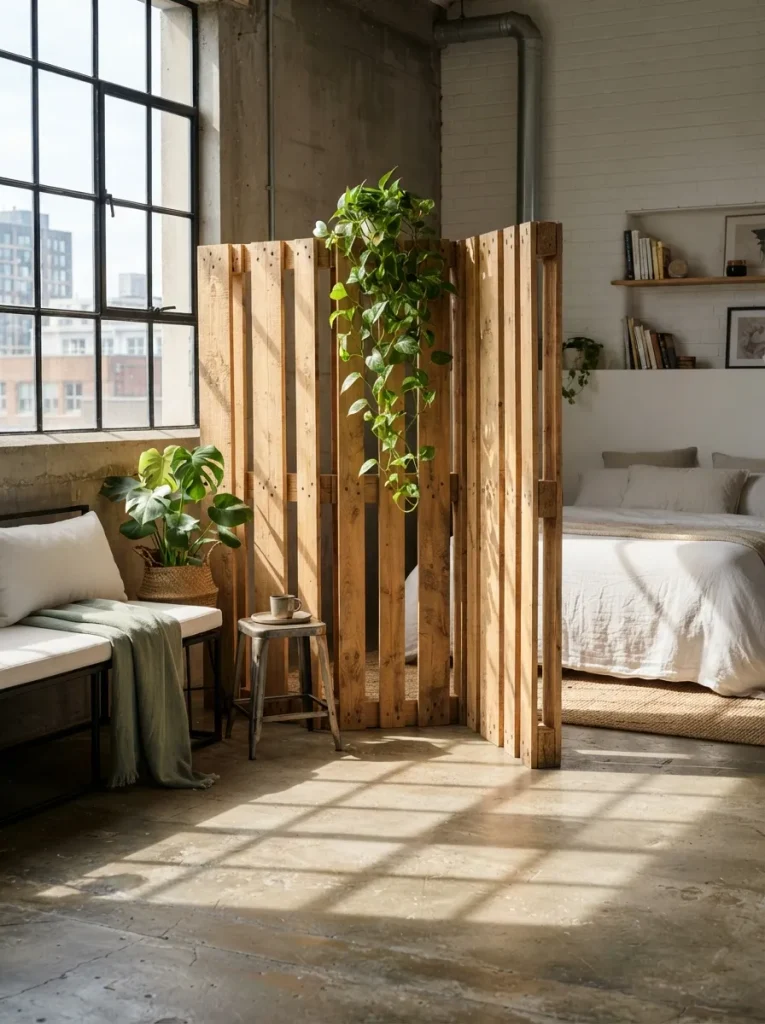
Stand three pallets on their 48-inch edges in a zigzag, angling each panel away from the last, and screw the joints together. The divider braces itself at a 48-inch height: low enough to keep sightlines open, high enough to mark off a sleeping or work zone.
Open slats let daylight travel deeper into the plan, so the far side isn’t left in shadow. Best for open lofts with one bed and no bedroom. More ways to split a single space are in these room divider ideas.
Warning: A pallet on its edge is only about 5½ inches thick and tips with a bump. Screw every joint, and anchor the two end panels to the floor or a wall before anyone leans on it.
11. Whitewashed Pallet Shelving to Lift a Dark Corner
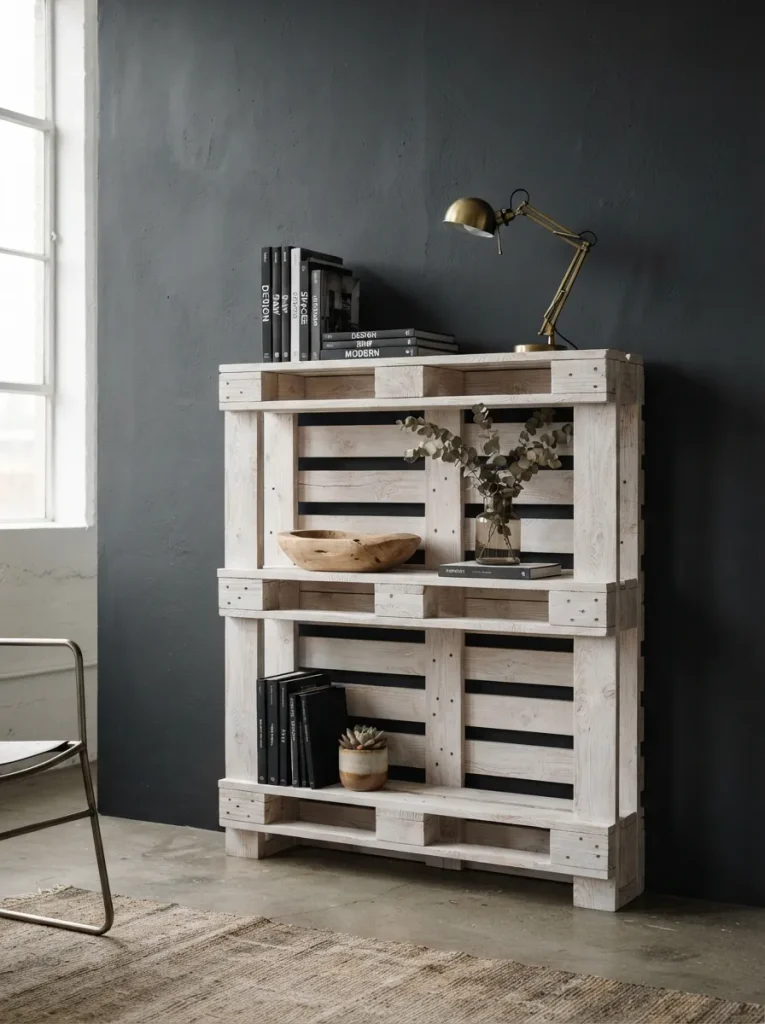
A pale wash on a pallet shelving unit lifts a dark corner without hiding the grain. Thin white or warm-gray paint with about an equal part water, brush it on, wipe back with a rag, and test on a scrap board first, since every pallet takes wash differently.
Set the unit against a charcoal or brick wall: the light finish bounces daylight back into the room, and the wall behind keeps it from vanishing. Leave gaps between boards unfilled so their shadows read as lines. Suits lofts with one window wall and a gloomy far end.
Budget Version: A small can of flat white or warm-gray paint, a cheap brush, and a few cotton rags come to roughly $20–$40, and a flat finish keeps the wash from turning glossy.
12. A Leaning Steel-Framed Mirror That Catches Window Light
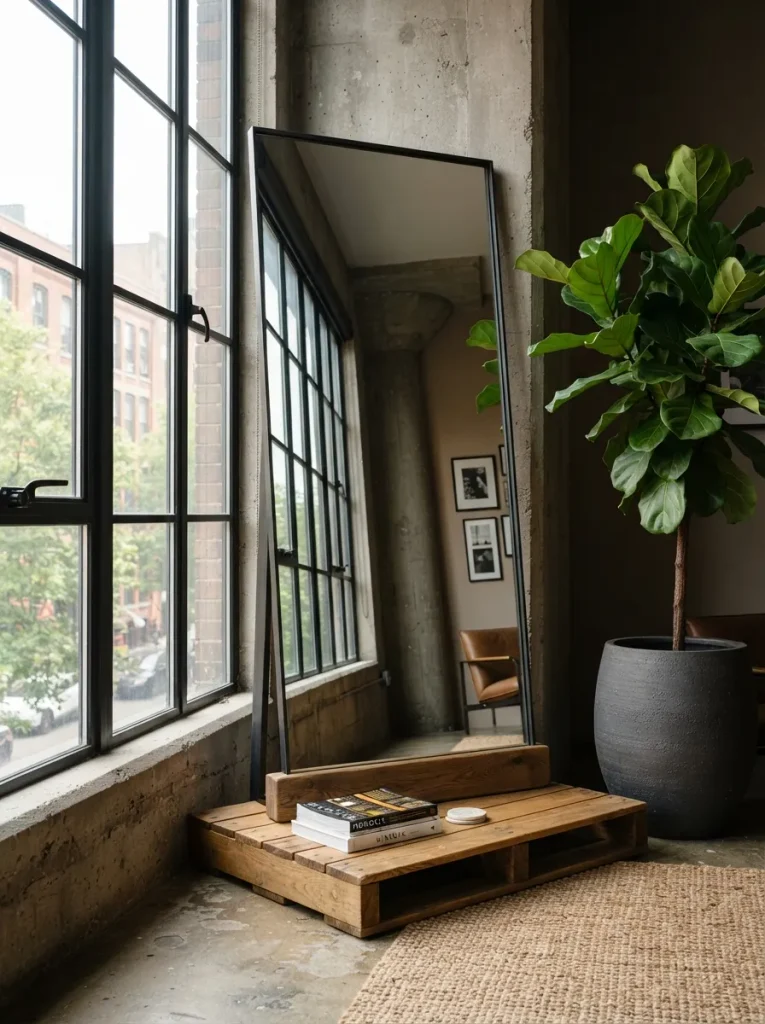
What it does: A steel-framed leaning mirror on the wall beside or facing a window throws daylight into the darker half of the plan and repeats the window’s grid, which suits the style.
How to place it: Rest it on a low pallet plinth with a cleat along the front lip so the bottom edge can’t slide, and add an anti-tip strap to a stud. Who it’s for: lofts with one window wall and a dim far end.
Small-Space Tip: In a narrow loft, lean the mirror at the far end of the long axis. The reflection makes the room read deeper.
Shop This Look
| Product |
|---|
| Steel-framed leaning floor mirror |
| Oversized ceramic floor planter |
| Tall leafy floor plant |
Every pallet has about four inches of empty space between its decks, and a sheet of glass turns that gap into a display case.
13. A Glass-Topped Pallet That Doubles as a Display Case
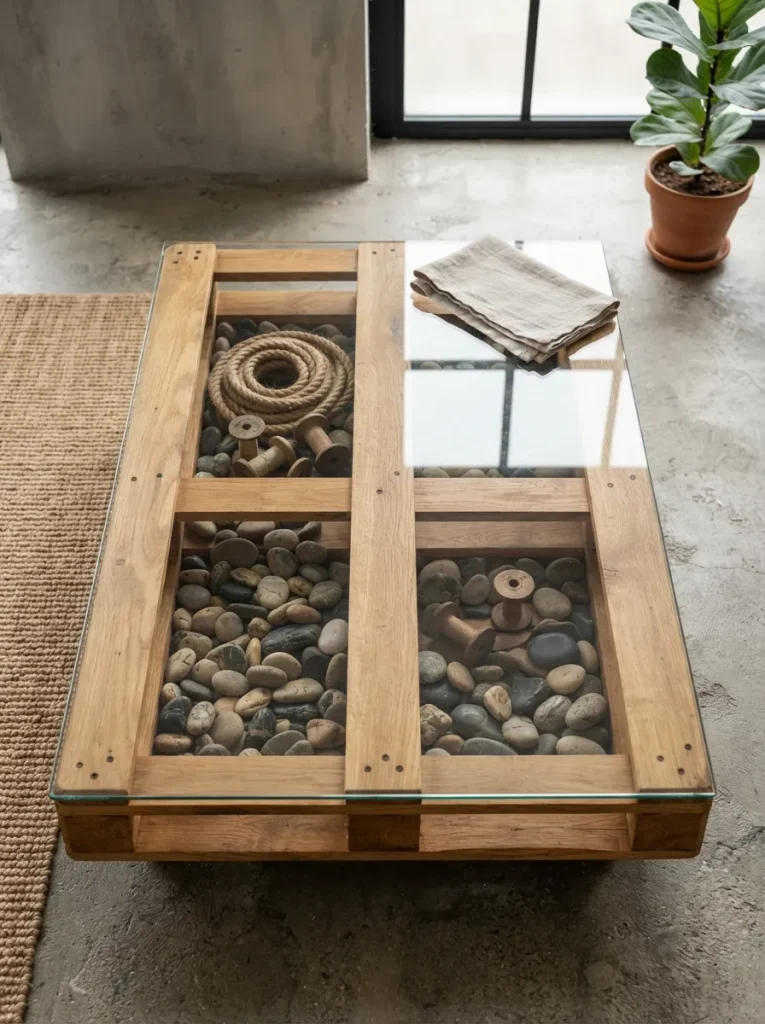
A solid slab top wastes the one thing a pallet has that a board doesn’t: a hollow. Remove the upper deck boards from a single pallet and the frame leaves roughly 4 inches of depth above the bottom deck, enough for river stones, a coil of rope, or old wooden spools.
Sand and seal everything inside first, because nobody can reach in to fix it later. Cap it with tempered glass. For closed storage instead, see these pallet storage furniture ideas.
Important: Tempered glass can’t be cut, drilled, or reshaped after it’s made. Finish and level the frame completely, measure it, then order the glass.
14. A Bar-Height Counter That Softens the Kitchen Edge
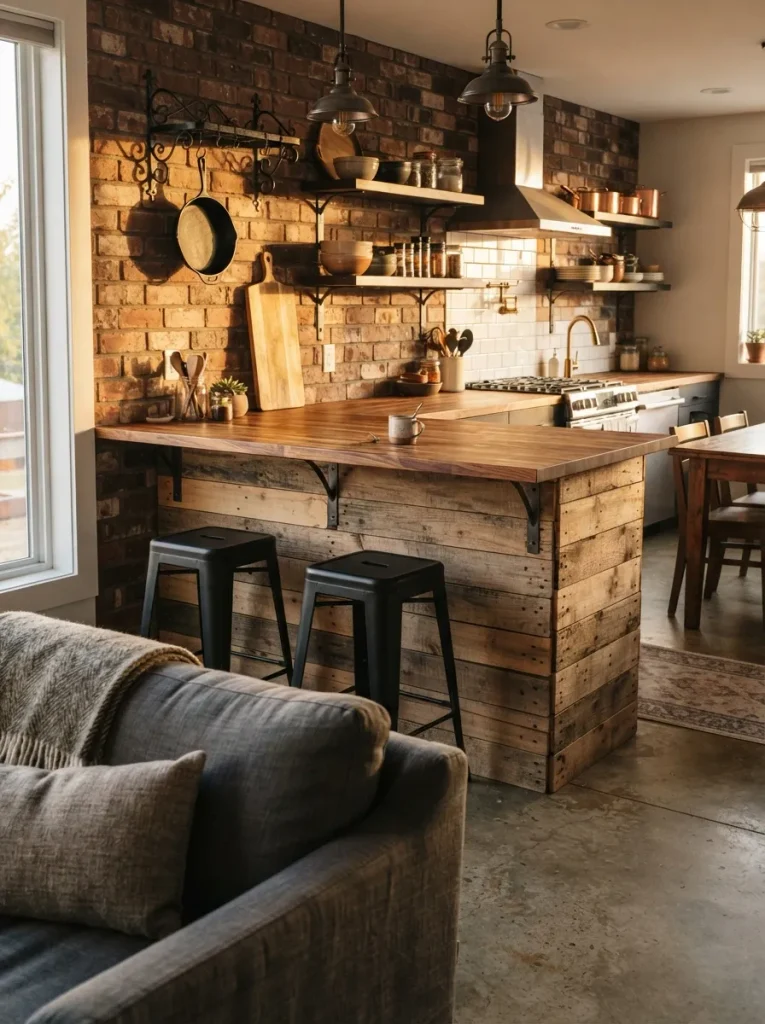
Build: Frame a counter from 2×4s at roughly 42 inches tall, clad the front in pallet boards, and top it with butcher block or a sealed plank top. The front is a facing, not structure, so thin boards work.
Watch the overhang: Leave about 12 inches on the seating side for knees; a counter with no overhang looks tidy and seats nobody.
Best for: open plans where the kitchen needs a soft edge instead of a wall. Layouts vary, so see these kitchen island layouts for footprints.
Insider Observation
Most guides skip this: in a loft with 12-foot ceilings, one pallet piece on its own looks like a delivery someone forgot to collect. Scale up instead of scattering. Two pallets side by side already give you a 96-inch run, and grouping table, sofa, and rug into a single mass reads as a room. Smaller pieces belong clustered on one rug or one wall, never spread across the floor.
15. A King-Size Pallet Platform Bed With Storage Underneath
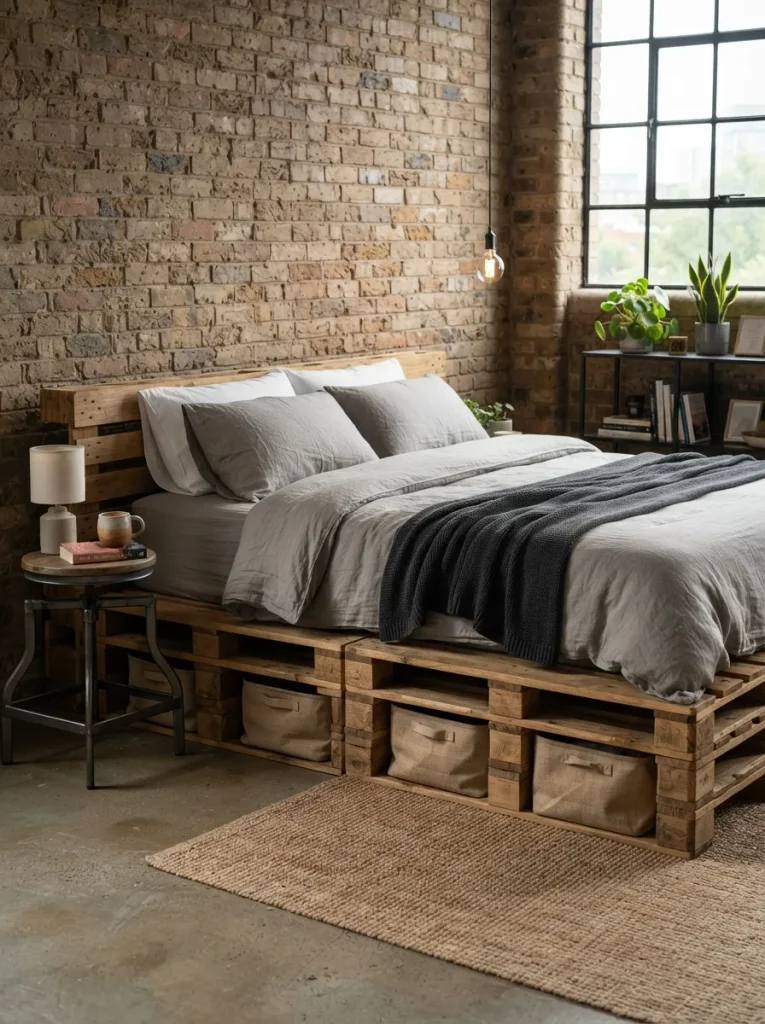
Lay two rows of two pallets with their 48-inch sides across, and the platform measures 96 × 80 inches. A king mattress (76 × 80) leaves about 10 inches of ledge on each side, enough for a stool and a book. Stack two layers, about 11 inches, and screw them together through the stringers so the bed doesn’t creep when someone climbs in.
Add a mattress and the top lands roughly where a conventional bed frame would. Gaps under the frame are useful, since canvas bins slide straight in. Suits lofts with room for a bed but no bedroom.
Pro Tip: Many foam-mattress warranties specify support gaps of roughly 3 inches or less, and pallet decks can run wider. Screw ½-inch plywood over the top layer, then check your mattress’s terms.
Shop This Look
| Product |
|---|
| Linen duvet cover set in stone gray |
| Woven canvas under-bed storage bins |
| Steel-and-wood bedside stool |
Boards from six different pallets usually clash. One rule about tone makes the mismatch look planned.
16. A Three-Tone Patchwork Wall Built on a Plywood Backer
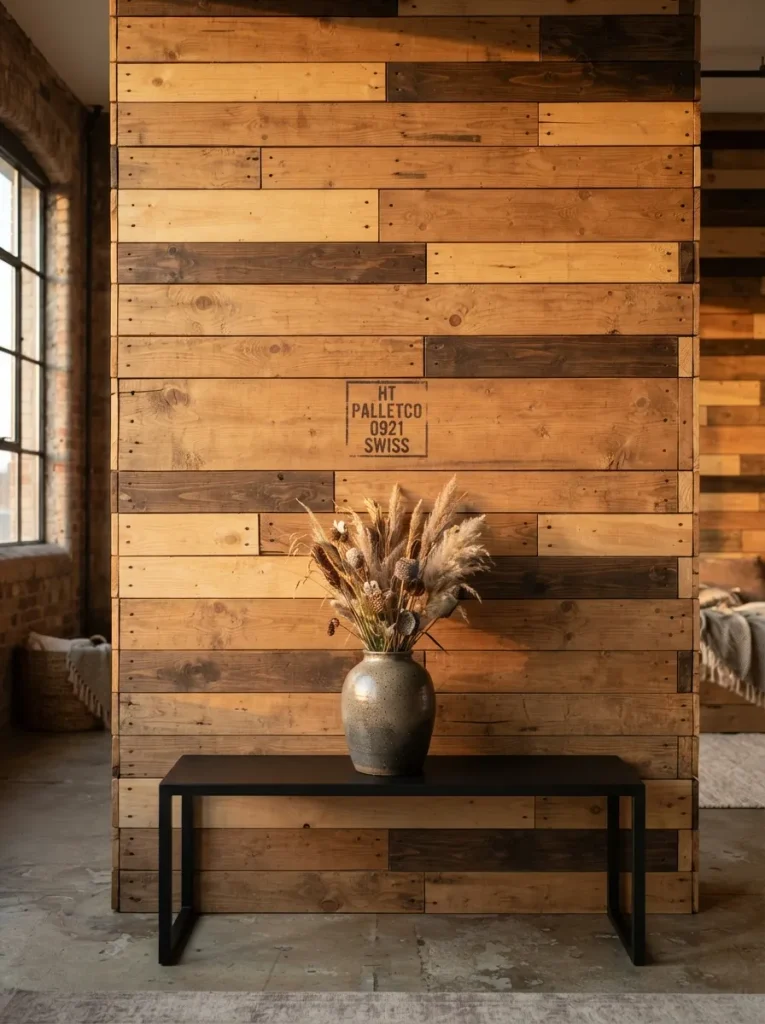
Boards from different pallets never match, so the goal is to make the mismatch look deliberate. Sort them into three tones from one undertone family, say pale honey, warm mid-brown, and dark walnut, and borrow the 60/30/10 rule: mostly the mid-tone, light boards as the second voice, dark boards as accents.
Stagger the joints so no two seams line up within two rows. Build the wall on a ½-inch plywood backer, which lets a renter unscrew the whole panel and take it along. Suits the wall behind a sofa or bed. For pairings beyond wood tones, see these home color combinations for modern homes.
Styling Note: Keep one stamped board, HT mark and all, at eye level. It’s the closest thing this wall gets to a signature.
How to Start Your Industrial Loft Transformation
Start here: a two-pallet coffee table on locking casters, sanded to 120 grit and sealed matte. One weekend and one project teach the whole method, from checking stamps to screwing into stringers to choosing a finish, and every later piece reuses that finish, so the room starts to match itself.
Mixing finishes is the beginner error that breaks the look fastest. A charcoal table, a whitewashed shelf, a honey-toned bar, and a patchwork wall in one sightline read as a sample board. Pick one main finish for most pieces and one accent, then repeat the accent at least twice so it looks chosen.
Three items usually sit under $50 each, though prices vary: a set of four 4-inch locking swivel casters, black steel corner braces for anchoring dividers and wall desks, and a pack of warm-white filament bulbs for whatever fixture you hang.
Give yourself a weekend for a coffee table or console and two to three months of weekends for a full loft. Sealer needs its drying window between coats, so the slow part is waiting, not building. Budget roughly $50–$150 for a starter piece and $800–$2,000 for a full loft with cushions, rug, lighting, and glass; both ranges are approximate. The platform bed, patchwork wall, and bar counter are the multi-weekend jobs.
Ready to Create Your Dream Industrial Loft?
Sixteen industrial pallet furniture ideas for modern lofts add up to a wide toolkit: finishes and color, seating and sleeping, light, and ways to split one big room into zones. Nobody needs all of them, and a single sanded, sealed coffee table already changes how a loft sits.
Today, check the stamp on one pallet and set a sander beside it. Finished, the space should feel grounded and unhurried, with cool concrete underfoot, warm boards within reach, and steel keeping everything honest. Pin the ideas you keep returning to, so next weekend’s project is already chosen.
Keep Exploring
- 12 Industrial Loft Storage Ideas That Hide Clutter Without Adding Walls
- 15 Industrial Kitchen Island Ideas With Reclaimed Wood and Black Steel
- 10 Warm Wood and Charcoal Color Combinations for Modern Homes