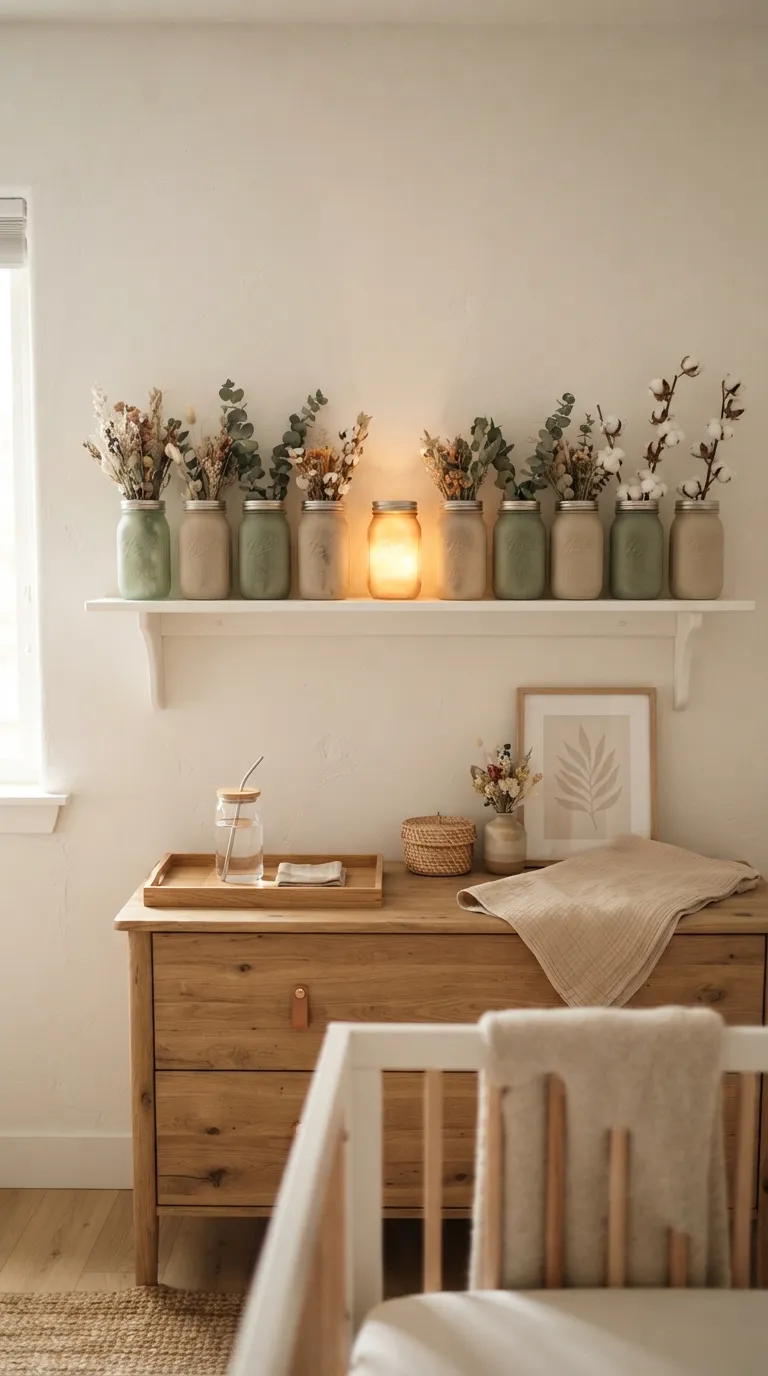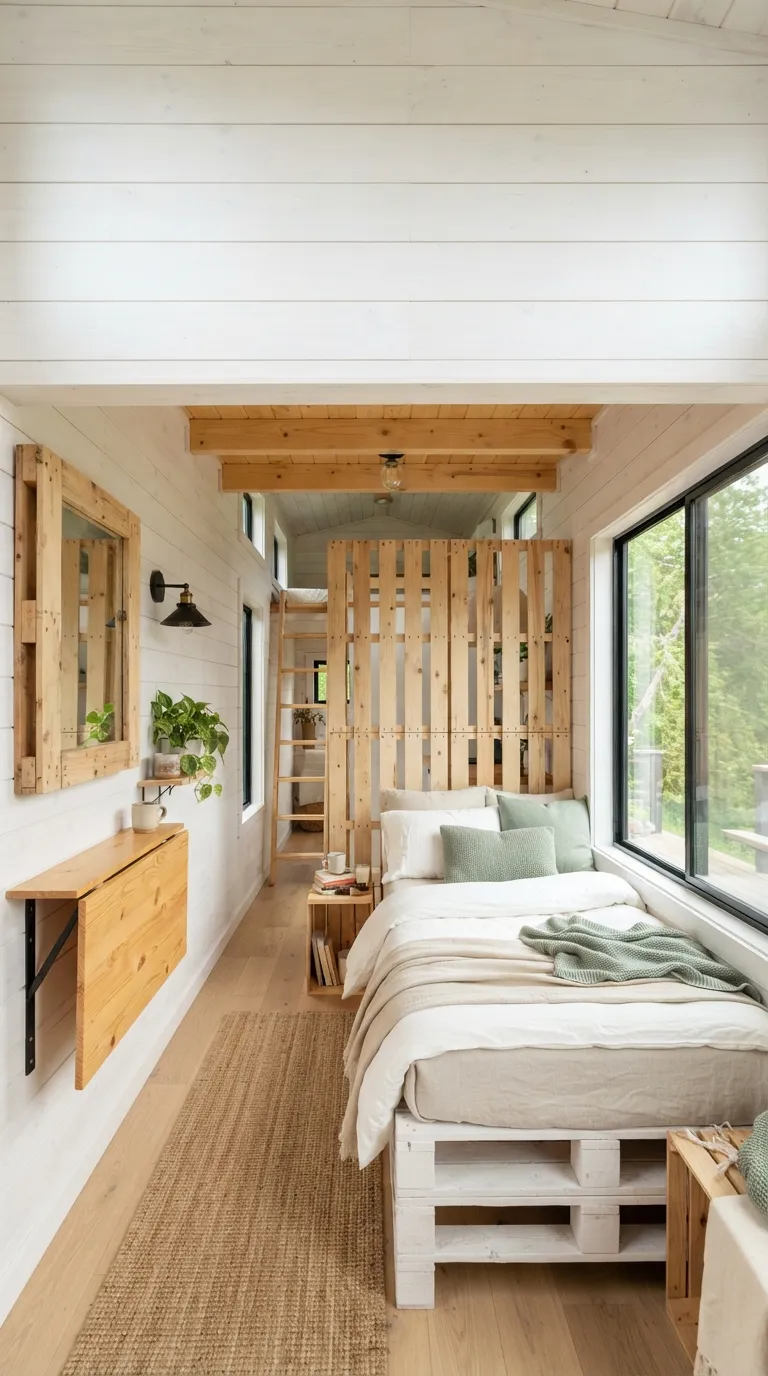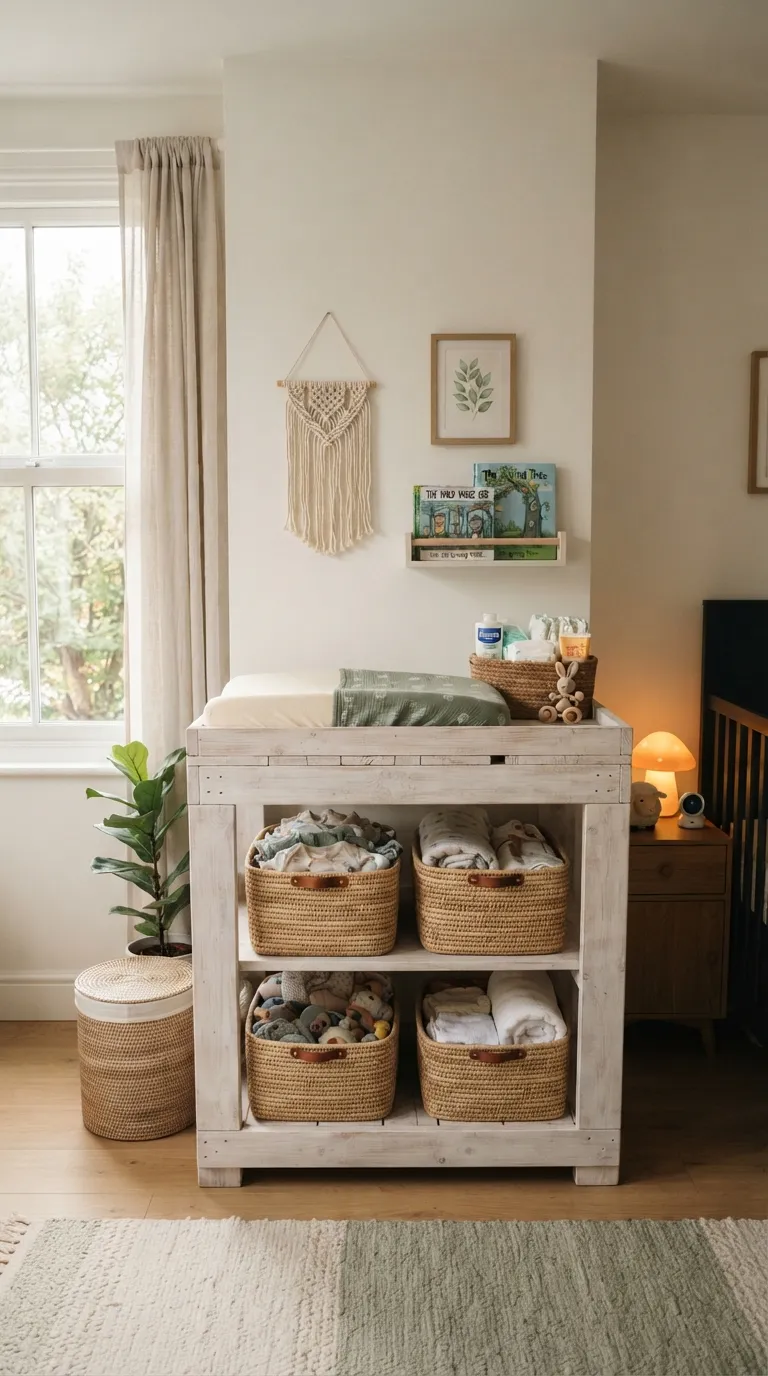
21 Dorm Room Ideas That Make Small Rooms Bigger
A cramped dorm room isn’t really about square footage it’s about how much of that footage you can see and use. This guide walks through 21 practical ideas that make a small dorm room look and feel noticeably bigger, from furniture height to light placement.
Done right, a tiny room stops feeling like a storage unit and starts feeling like an actual place to live in floor visible, air moving, mind a little quieter. Every idea here is built for shared walls, no-paint policies, and moving-out day, not a full renovation. Small changes, real difference. Let’s get into it.
Quick Navigation
- Why Small-Space Solutions Make Such a Difference
- 21 Dorm Room Ideas That Make Small Rooms Bigger
- How to Start Your Small-Space Transformation
- Ready to Create a Bigger-Feeling Dorm Room?
Why Small-Space Solutions Make Such a Difference
Small-space thinking isn’t a style it’s a set of decisions about where visual weight sits in a room. In a dorm, that means picking bed risers over a low frame, warm white or soft greige tones over dark saturated color, and slim silhouettes over anything bulky.
It matters more now than ever, since most dorm rooms average under 130 square feet and have to double as bedroom, closet, and study space. If you only do one thing first, lift the bed and clear the floor everything else builds from there.
| Best starting point | Lift the bed with risers and clear the floor beneath it |
| Biggest impact area | Vertical wall space above the desk and bed |
| Budget to start | $75–$150 |
| Time to complete | One afternoon to one full weekend |
21 Dorm Room Ideas That Make Small Rooms Bigger
1. Bed Risers to Reclaim the Floor
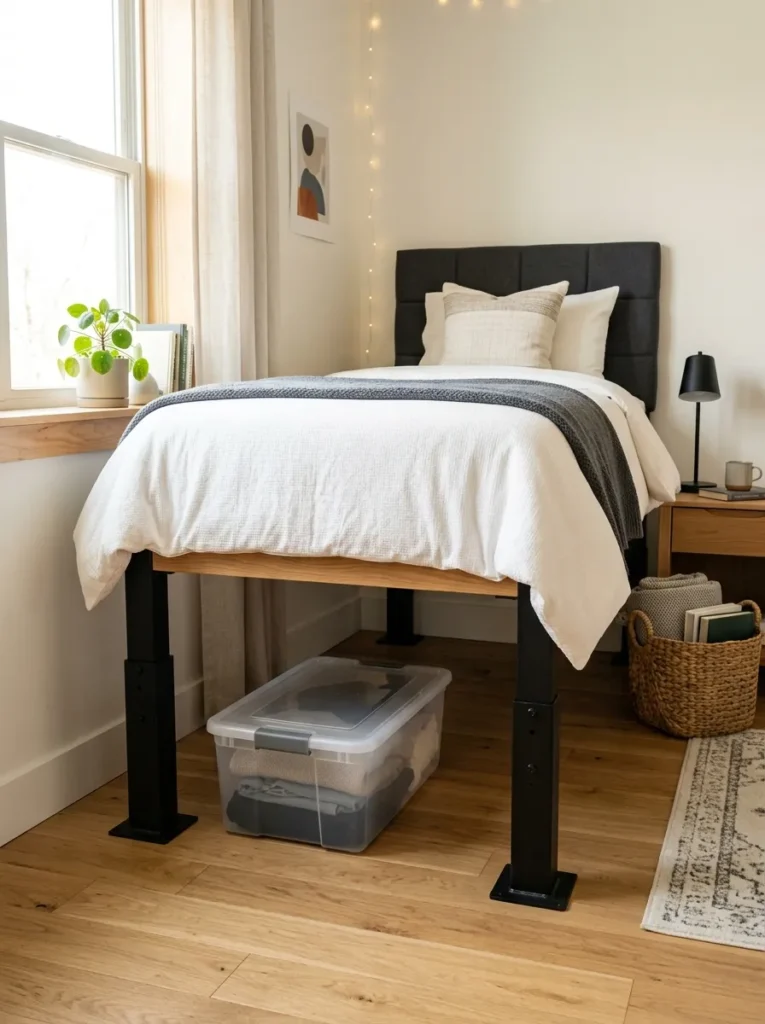
A bed that sits noticeably higher than standard, with a clean gap underneath instead of a dust-collecting shadow. Raw floor space, suddenly visible. Risers change the room’s usable footprint without touching a single wall. Every square foot under the mattress becomes storage or floor, and a room reads bigger the moment you can see across it uninterrupted.
Buy risers rated for at least 300 lbs per leg, confirm they clear your specific bed frame style (some don’t fit metal dorm frames well), and raise all four corners evenly so the mattress stays level. This one suits anyone whose dorm-issued bed sits low to the ground with almost no clearance underneath.
Before You Buy: Dorm Bed Riser Checklist
- [ ] Check your dorm’s furniture policy for bed height restrictions
- [ ] Measure the gap between mattress frame and floor
- [ ] Confirm riser weight rating covers your bed frame plus mattress
- [ ] Test stability by sitting on the bed edge before loading storage underneath
Shop This Look
| Product |
|---|
| Heavy-duty plastic bed risers (4-pack, rated 300+ lbs each) |
| Adjustable-height metal bed risers with cord channel |
| Under-bed storage bin with rolling wheels |
| Bed frame extender kit for lofted dorm beds |
| Non-slip riser pads for tile or laminate floors |
2. Under-Bed Storage Bins to Kill Clutter
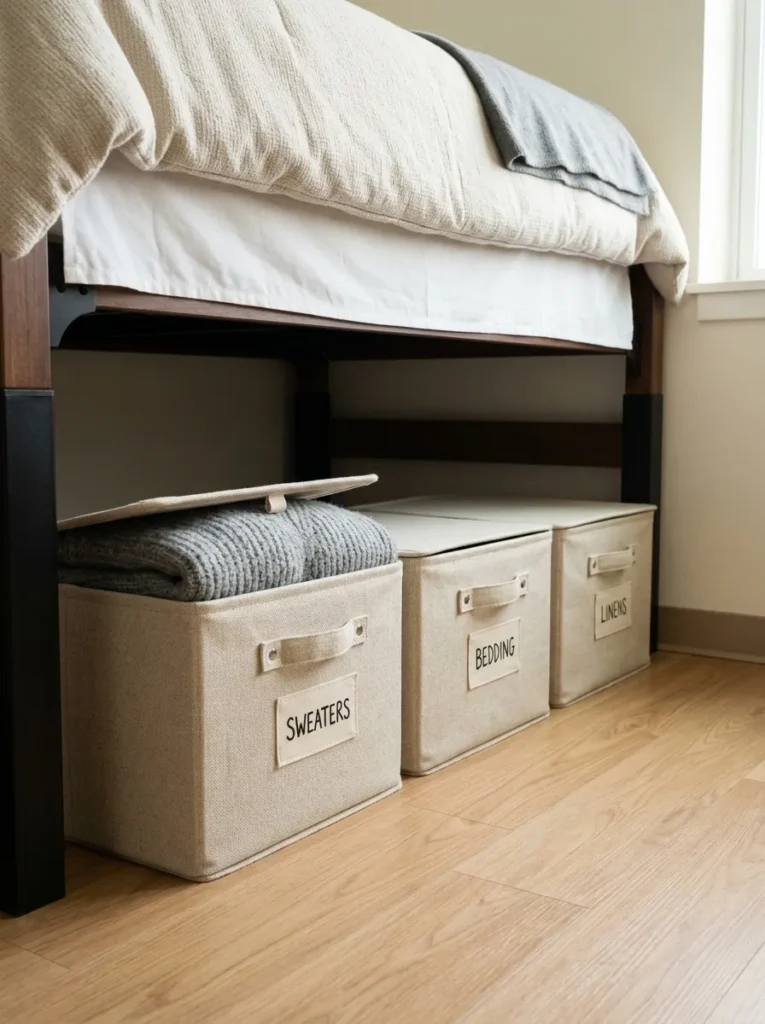
Clutter is the fastest way to make a small room look smaller, and most of it is clothing and off-season items with nowhere else to go. Sliding it under a lifted bed removes it from view entirely without giving up a single inch of floor plan.
The principle here is visual weight, not actual square footage a room with fewer visible objects reads as larger even when the measurements haven’t changed. Concealed storage does that job better than any open shelf, the same logic behind most IKEA nursery storage hacks hide the volume, keep the surface calm.
Pick bins two inches shorter than your riser gap, use flat-lidded ones over open baskets so dust and stray items don’t collect, and sort by category off-season clothes, extra linens, school supplies so nothing has to be pulled out to find one item.
This one’s for anyone sharing a room where a dresser and closet combined still aren’t enough storage.
Budget Version: Skip matching bins entirely a few $1 cardboard file boxes from a dollar store, labeled with a marker, do the same job under a bed no one else sees.
3. Mirrored Closet Doors or a Leaning Mirror Panel
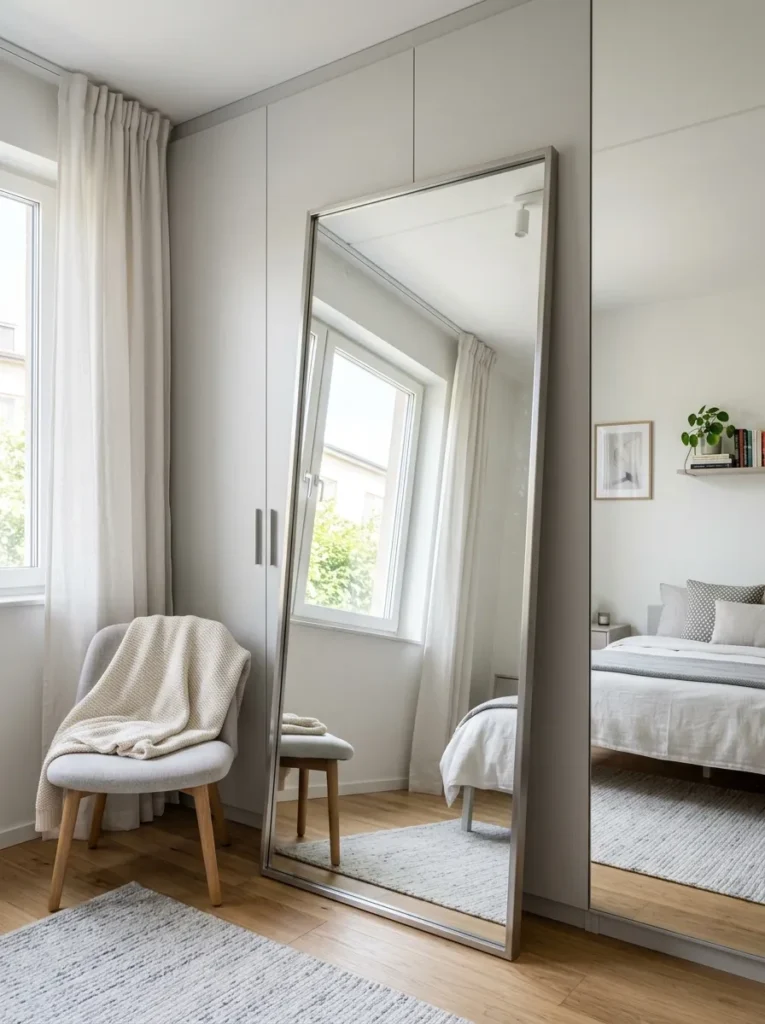
Glass that doubles the room’s visible depth a second version of the window, the ceiling, and every warm-toned object in the space. Mirrors bounce available light back into the room instead of letting it dead-end at a wall, and they trick the eye into reading a doubled sense of depth. It’s optical, not decorative the effect holds up even in a windowless corner.
A leaning floor mirror needs zero wall damage and can angle to catch the most light in the room. Place it opposite not beside the main window for the strongest effect. This one suits renters worried about deposit-friendly options, and anyone in a room with only one small window.
Pro Tip: If your closet doors are painted metal or laminate, adhesive mirror film applies directly over them and peels off clean at move-out no drilling, no deposit risk.
Up next: the color decision that quietly does more work than any single piece of furniture.
4. A Monochromatic Warm-White Palette
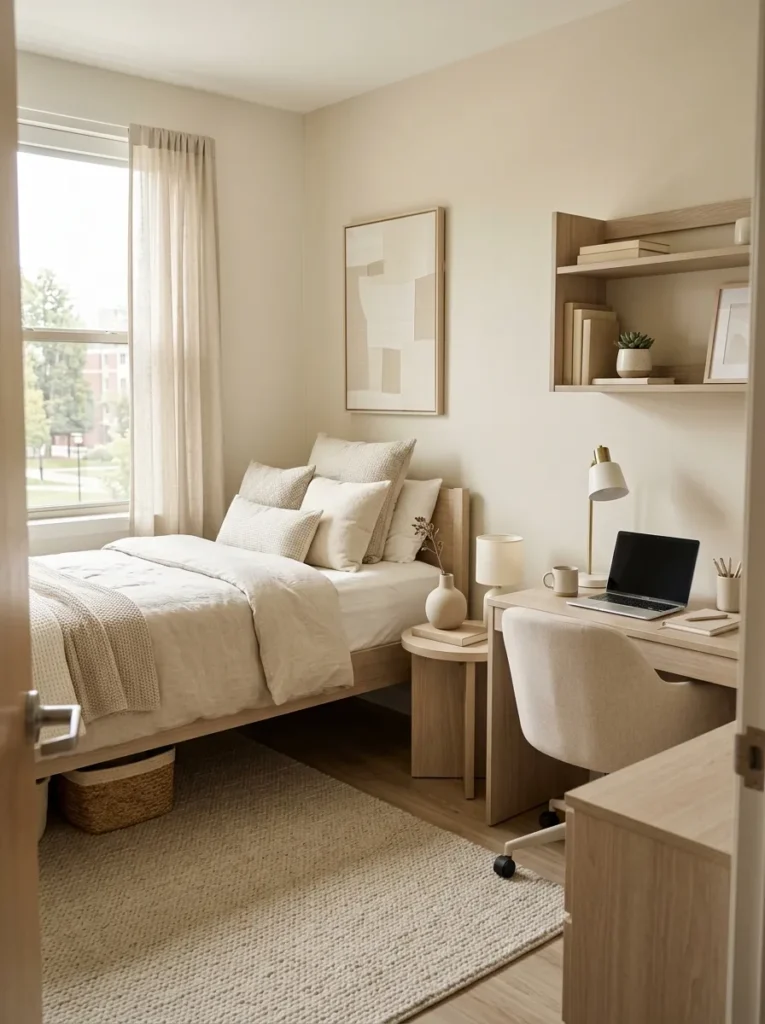
A room where nothing fights for attention walls, bedding, and furniture all sit in the same narrow tonal range instead of competing colors. Contrast is what defines edges to the eye. Remove the hard color contrast between a dark dresser, bright bedding, and a stark white wall, and those visual boundaries soften, which reads as more open space.
Choose one dominant tone warm white, soft greige, or pale oat and keep at least 70% of visible surfaces within two shades of it, saving darker accents for small items only. This one suits small-space decorators who want the effect without buying a single new large piece.
Small-Space Tip: Stick to two tones total one wall/textile color plus one metal or wood accent since every extra color reads as visual clutter in under 130 square feet.
5. Layered Lighting Instead of One Overhead Bulb
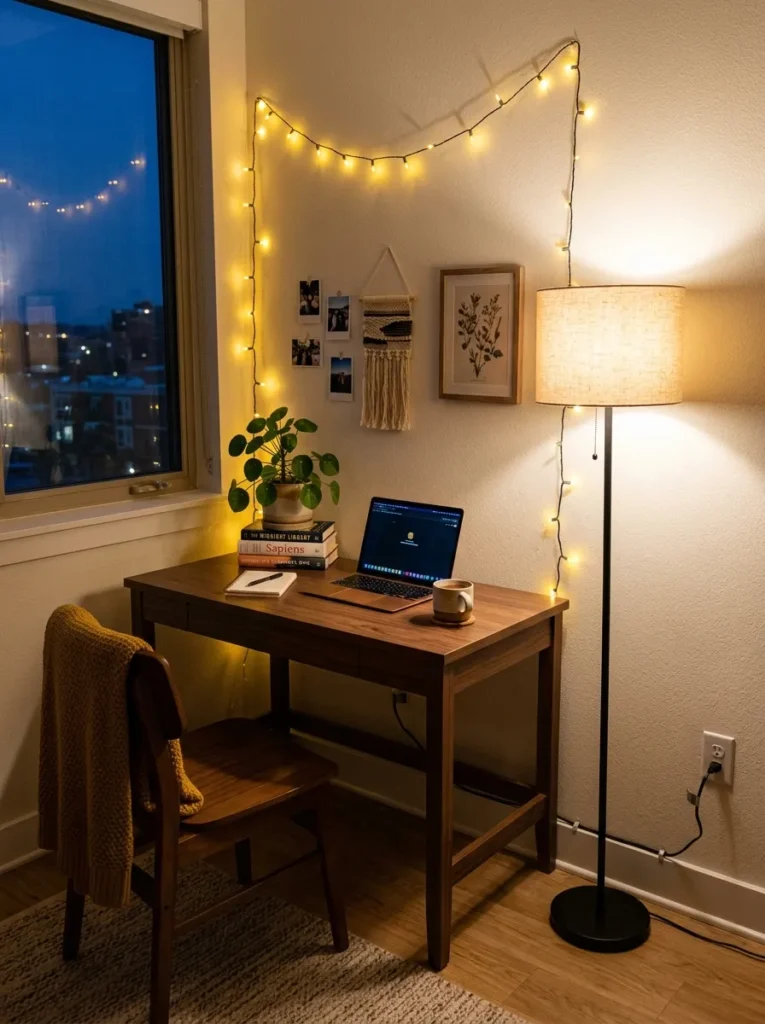
A single ceiling fixture flattens a room one harsh source, one hard shadow line, nothing to suggest depth. Layered lighting fixes that by putting light at different heights: floor lamp low, string lights along a shelf, task lamp on the desk.
The eye reads depth through shadow variation, not brightness. A room lit from three different heights has more visual layers than one lit from a single point on the ceiling, even with the exact same total wattage.
Add a slim floor lamp in one corner, string lights along a shelf edge or headboard, and a clip-on desk lamp for task light then turn the main overhead off most of the time.
Best for anyone whose dorm-issued lighting is a single bright, unflattering ceiling fixture.
Warning: Many dorms prohibit incandescent string lights or anything with exposed bulbs check your housing handbook before buying, since a confiscated light strand is a wasted $15 and a possible fire-code violation on your record.
Shop This Look
| Product |
|---|
| Warm white LED string lights, battery or USB powered |
| Adjustable clip-on desk lamp with warm bulb |
| Slim floor lamp with fabric drum shade |
| Plug-in dimmer switch for string lights |
| Battery-operated puck lights with remote |
6. Slim Nesting Side Tables
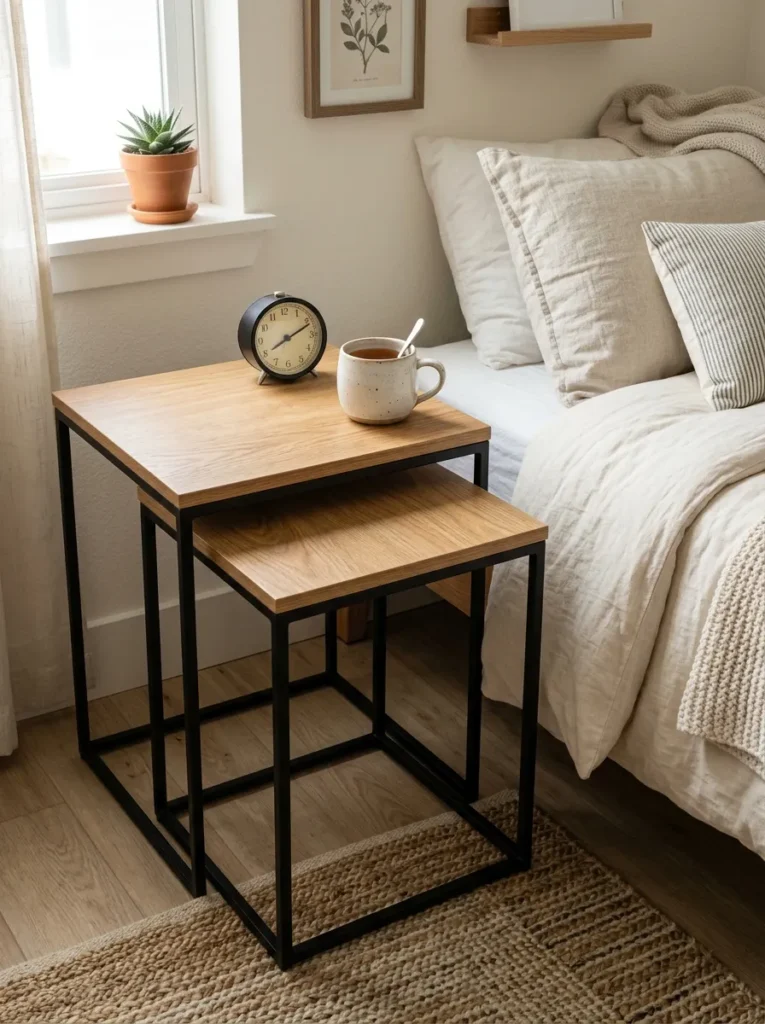
Two surfaces that collapse into the visual footprint of one a small table tucked entirely beneath a slightly larger one. A standard nightstand occupies fixed floor space whether you need one surface or two. Nesting tables scale to the moment full footprint when you’re studying with a friend, half footprint the rest of the time.
Pull the smaller table out only when you need the extra surface, then push it fully back under afterward the habit matters more than the furniture itself. This one suits roommates who occasionally need extra surface space but not permanently.
Styling Note: Nest the smaller table fully under the larger one when not in use the point isn’t just two surfaces, it’s one surface most of the time.
The next idea costs nothing and takes ten minutes most people just never think to do it.
7. Floating Wall Shelves Instead of a Bookshelf
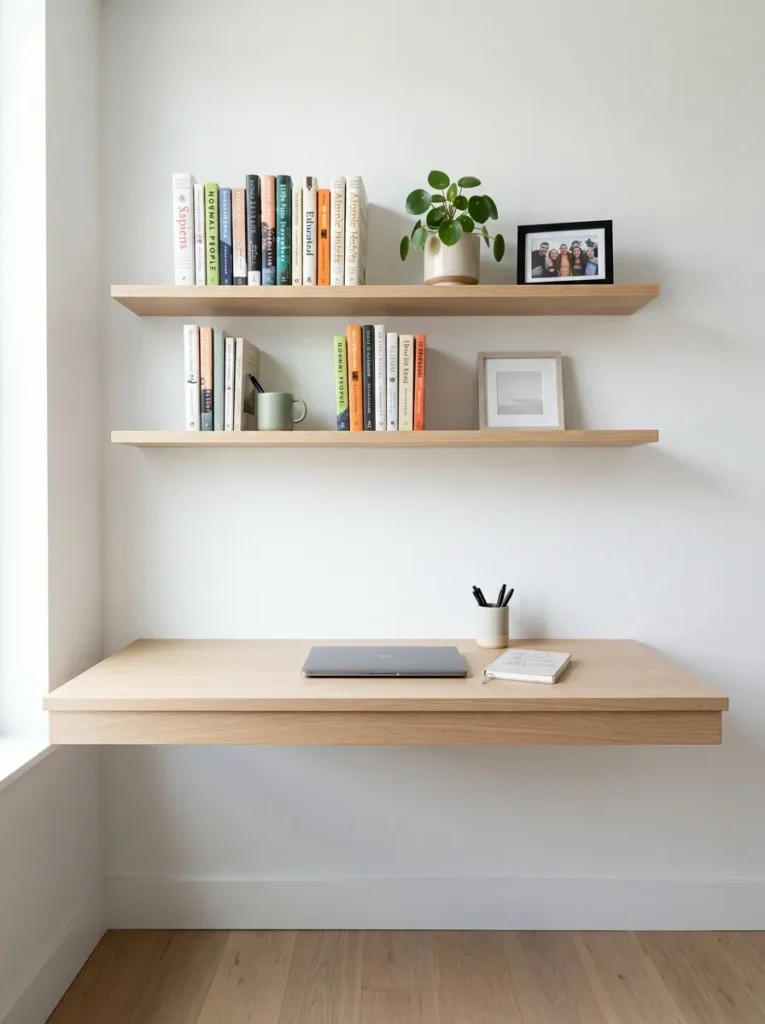
Storage that lives entirely above eye level, leaving the floor and desk surface below completely open. A freestanding bookshelf claims floor space a room can’t spare. Moving that same storage capacity onto the wall keeps the footprint at zero while adding real capacity the room gains storage without losing an inch of usable floor, the same trade-off behind most Kallax shelf styling setups people use in living rooms.
Mount two shelves at staggered heights rather than one long shelf it breaks up the wall visually and keeps any single shelf from looking overloaded. This one suits anyone whose dorm room came with a bulky assigned bookshelf they’d rather not use.
Important: Most adhesive shelf brackets max out around 10–15 lbs per shelf check the rating before loading it with textbooks, since overloading is the #1 reason these shelves fail.
8. A Light, Cool-Toned Area Rug
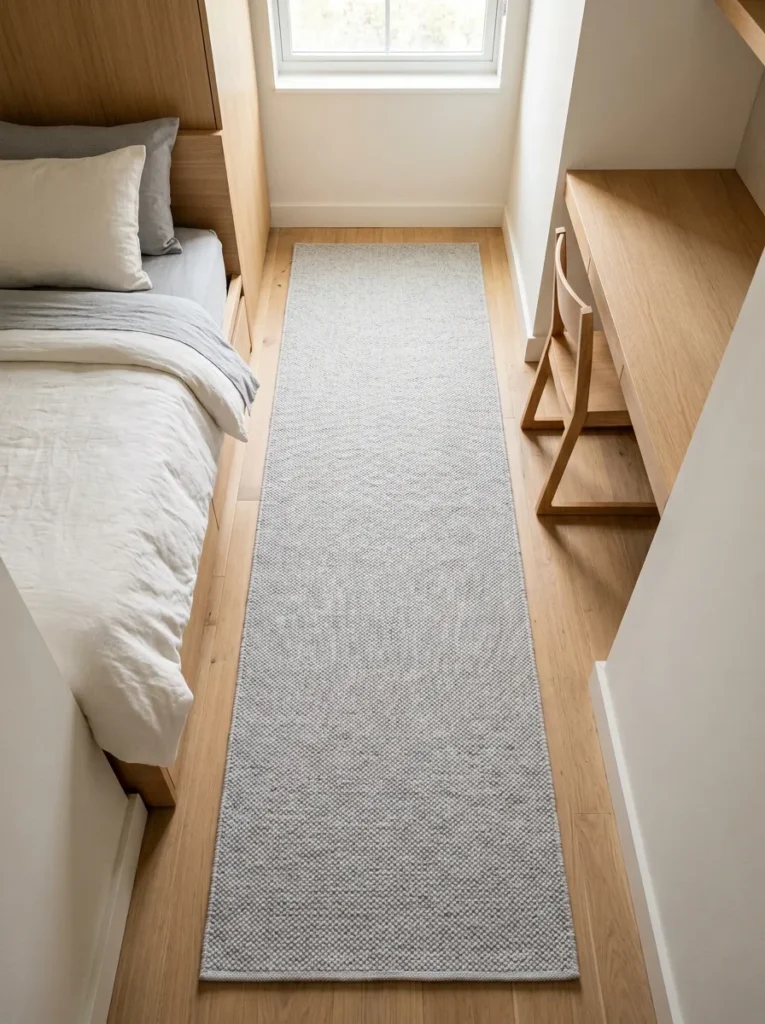
A soft, pale rug that runs the long way down a narrow room instead of sitting centered like an afterthought. Dark flooring or a patchy dorm carpet reads visually heavy and chops the floor into segments. A single light-toned rug unifies the whole floor plane into one continuous surface, which the eye reads as more floor, period.
Orient the rug along the room’s longest wall rather than centered under the bed direction changes the perceived shape of the room more than the rug itself. This one suits rooms with dark or heavily patterned dorm-issued flooring.
Quick Win: A 5×7 rug run lengthwise, not centered, makes a narrow dorm room read longer than it is measure your floor plan before choosing the rug’s orientation.
9. Sheer, Lightweight Curtains
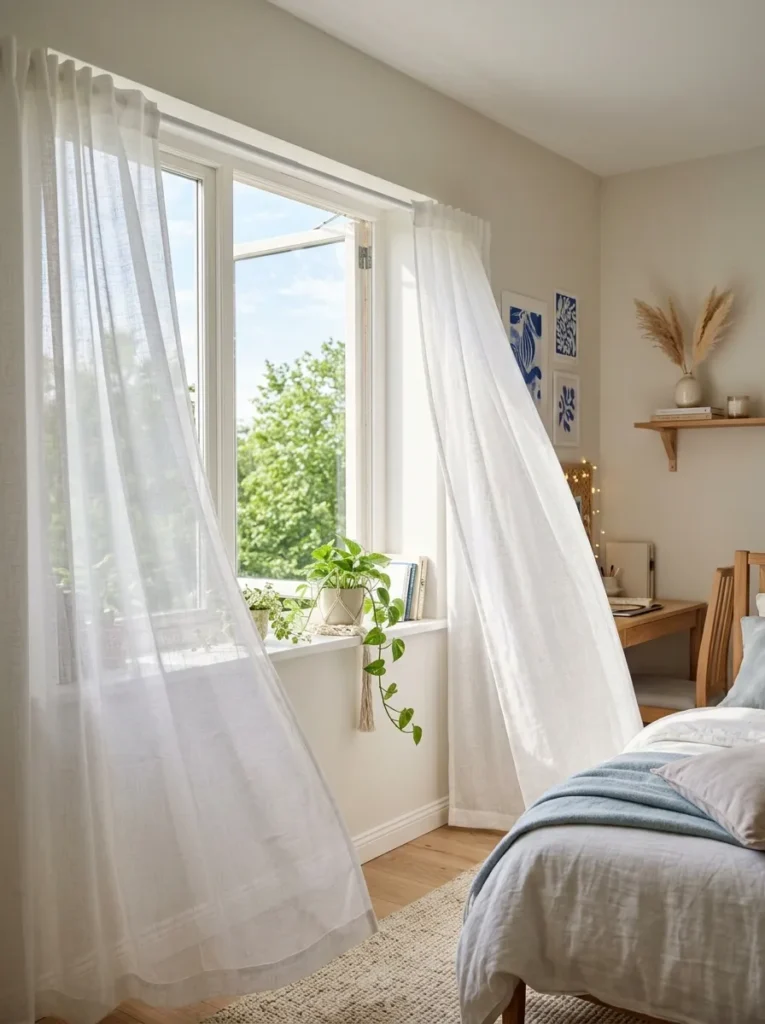
Heavy curtains the kind most dorms come with block light and visually shrink a window’s presence in the room. Sheer, lightweight fabric does the opposite: it filters light instead of blocking it, and the window stays a visible, open feature rather than a shrouded rectangle.
Light behavior matters more than fabric choice here. A window is one of the few natural “expansion points” a small room has, and covering it in dense fabric closes that expansion off almost entirely.
Swap the standard dorm curtain for a sheer linen-look panel on a tension rod, and skip the blackout liner unless you need it for sleep most people don’t, and it defeats the purpose.
Best for anyone whose dorm window faces a decent amount of natural light during the day.
Pro Tip: Hang curtain rods on tension mounts inside the window frame rather than outside it it skips the drilling debate with your RA entirely and still reads intentional.
Shop This Look
| Product |
|---|
| Sheer linen-look curtain panels, 84-inch length |
| Tension curtain rod, no-drill mount |
| Curtain clip rings for quick hanging |
| Blackout liner panel for layering under sheers |
| Adhesive curtain tiebacks |
This next one solves the closet problem nobody wants to deal with on move-in day.
10. A Tension-Rod Curtain to Zone Off Storage
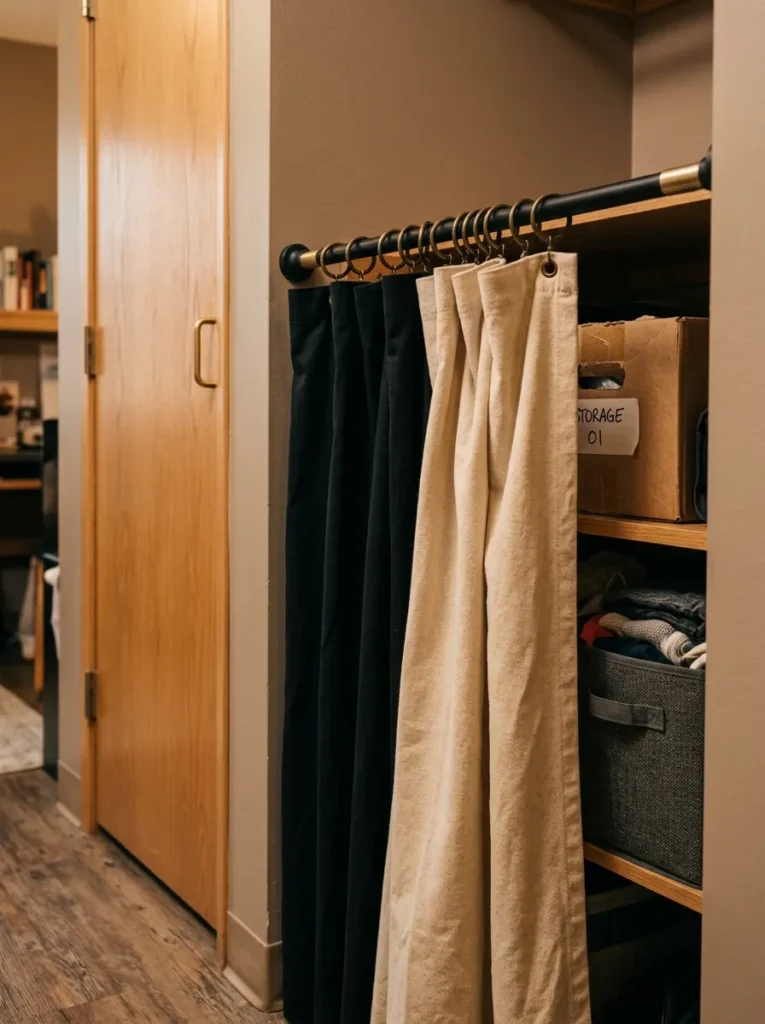
A simple fabric panel hung on a tension rod, hiding an open shelving unit or overflow storage nook behind it. Open storage even organized open storage still registers as visual clutter from across a room. A single curtain converts that same storage into a flat, calm plane the eye skips right over the same trick shows up in a lot of craft closet organization setups, where a curtain does more visual work than a door ever could.
Mount the tension rod inside a closet opening or across an awkward alcove, then let the curtain hang loose rather than pulled taut for a softer look. This one suits rooms with an odd nook, exposed shelving, or a closet with no door.
Mistake to Avoid: Hanging the curtain too close to stored items blocks airflow and traps musty smells leave at least 3 inches of clearance behind the fabric.
11. Under-Shelf Puck Lighting
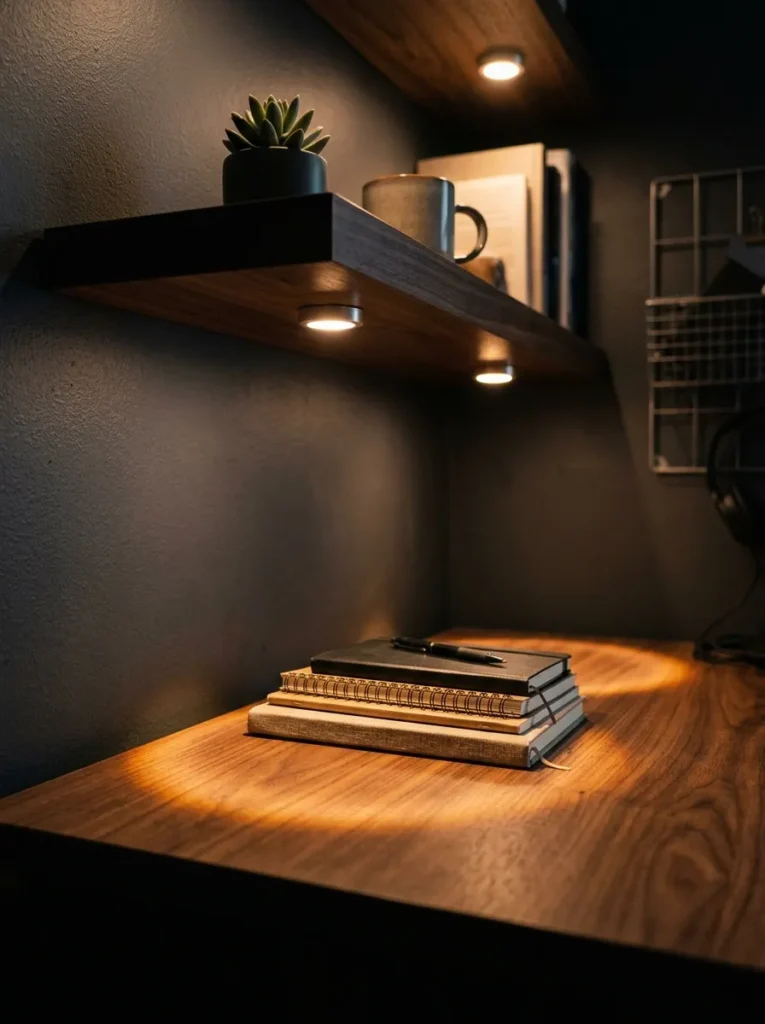
A soft pool of light glowing from underneath a shelf, illuminating the surface below without a visible bulb in sight. Hidden light sources read as architectural rather than added-on, which makes a space feel more finished and considered a subtle cue that reads as “more thought went into this room than it took.”
Stick battery-powered puck lights to the underside of any existing shelf using their adhesive backing, angled slightly forward toward the desk or dresser below. This one suits anyone who wants ambient light without running a single visible cord.
Important: Battery puck lights dim noticeably after about 40 hours of use buy rechargeable ones if you’re using them nightly, or the glow you’re going for turns dull within a month.
12. A Pale Removable Wallpaper Accent
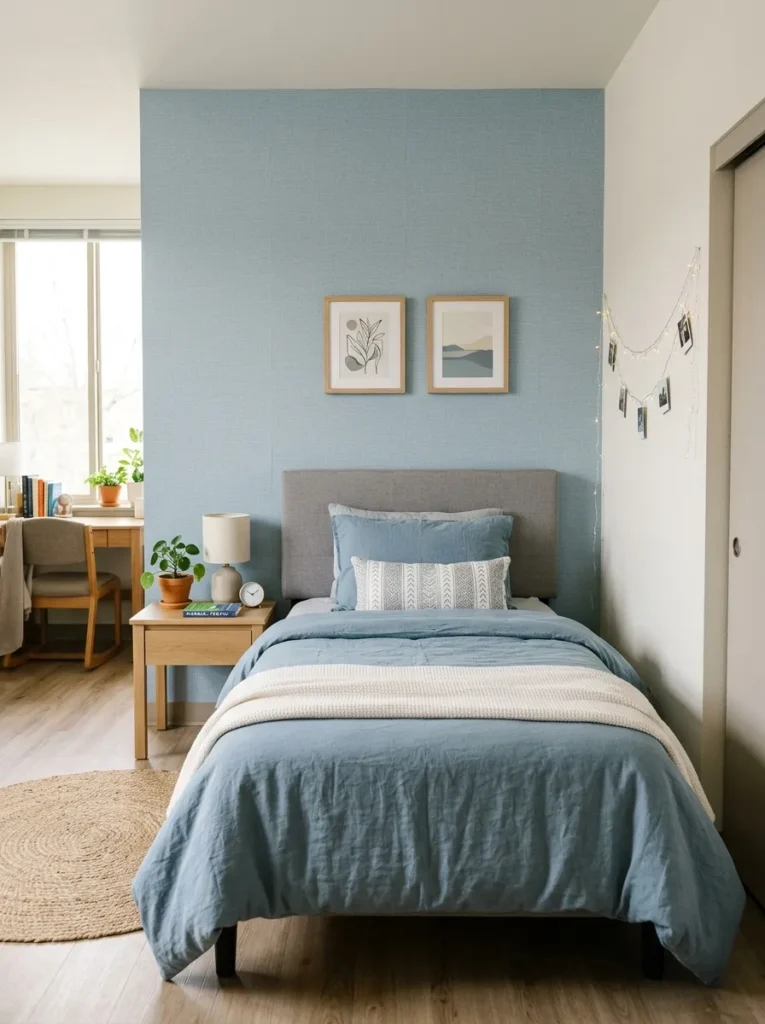
One wall usually behind the headboard carrying a subtle pattern or texture, while the remaining three stay plain and unbroken. Applying pattern to every wall visually shrinks a room by adding busy edges everywhere the eye lands. Confining it to a single wall gives the space one focal point instead of four competing ones the exact restraint that makes small powder room wallpaper work in a space with even less square footage to spare.
Choose a peel-and-stick paper in a tone close to your existing wall color subtle texture over high contrast and apply it only to the wall behind the bed. This one suits anyone in a lease that allows removable wallpaper but not paint.
Important: Confirm your housing contract allows peel-and-stick wallpaper before buying some dorms treat it the same as paint and charge a removal fee at checkout.
Up next: the desk swap that gets your floor back without losing a workspace.
13. A Wall-Mounted or Fold-Down Desk
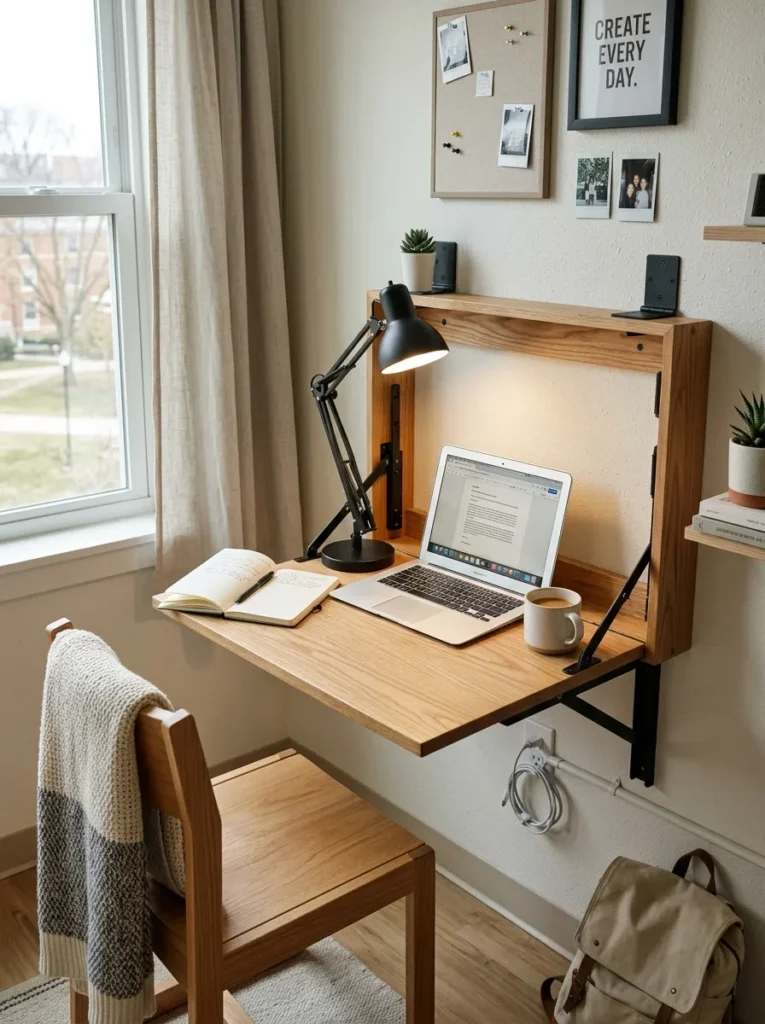
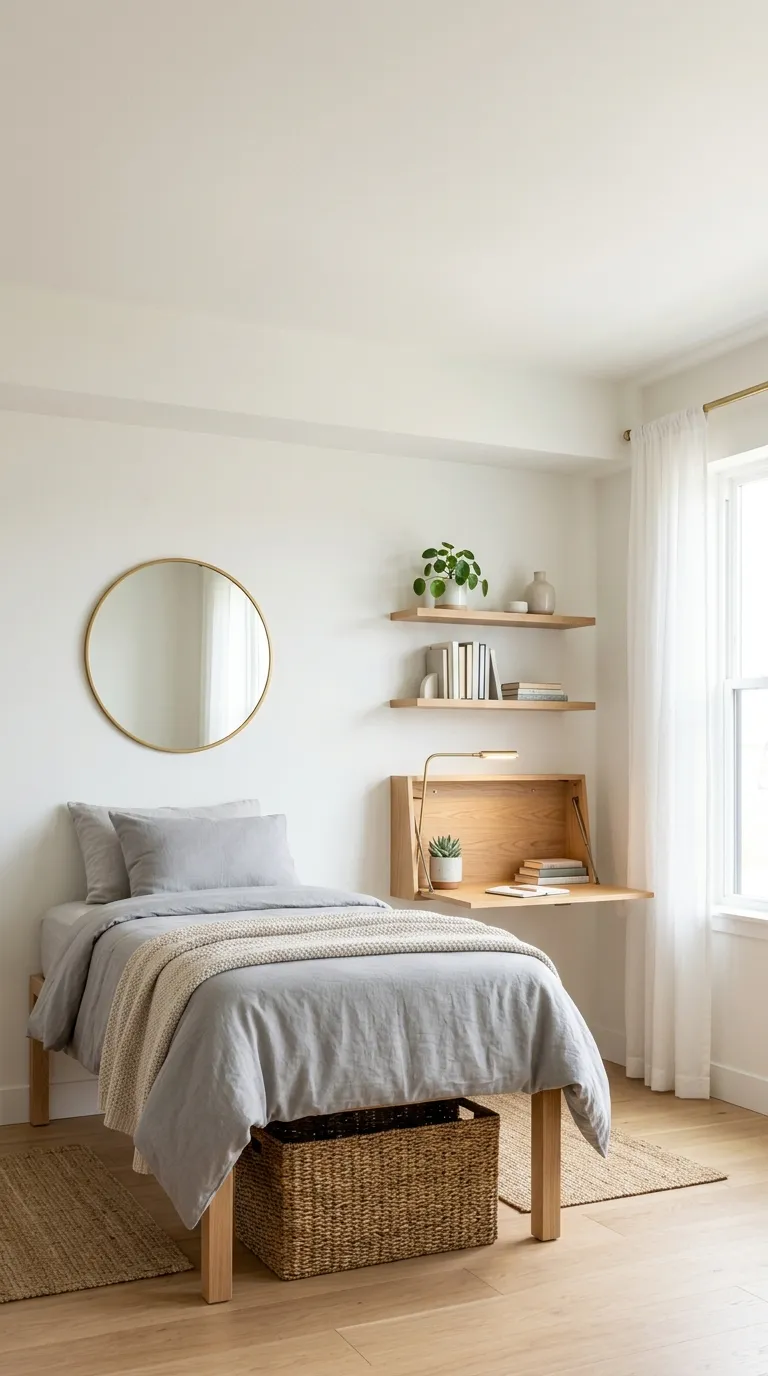
A desk that folds flat against the wall when it’s not in use, disappearing into a shallow panel instead of standing in the room permanently. A standard dorm desk claims floor space around the clock, whether you’re using it or asleep. A fold-down version claims that same space only during the hours you’re actually working the rest of the time, it gives the floor back.
Choose a wall-mounted bracket rated for laptop-plus-books weight, and fold it down only when you’re sitting at it leaving it open defeats the entire point. This one suits rooms so tight that the assigned desk eats the only clear walking path.
Budget Version: A wall-mounted wooden shelf bracket with a hinged support arm costs under $40 and folds flat against the wall cheaper than most branded fold-down desk kits.
14. A Large Statement Mirror Reflecting the Window
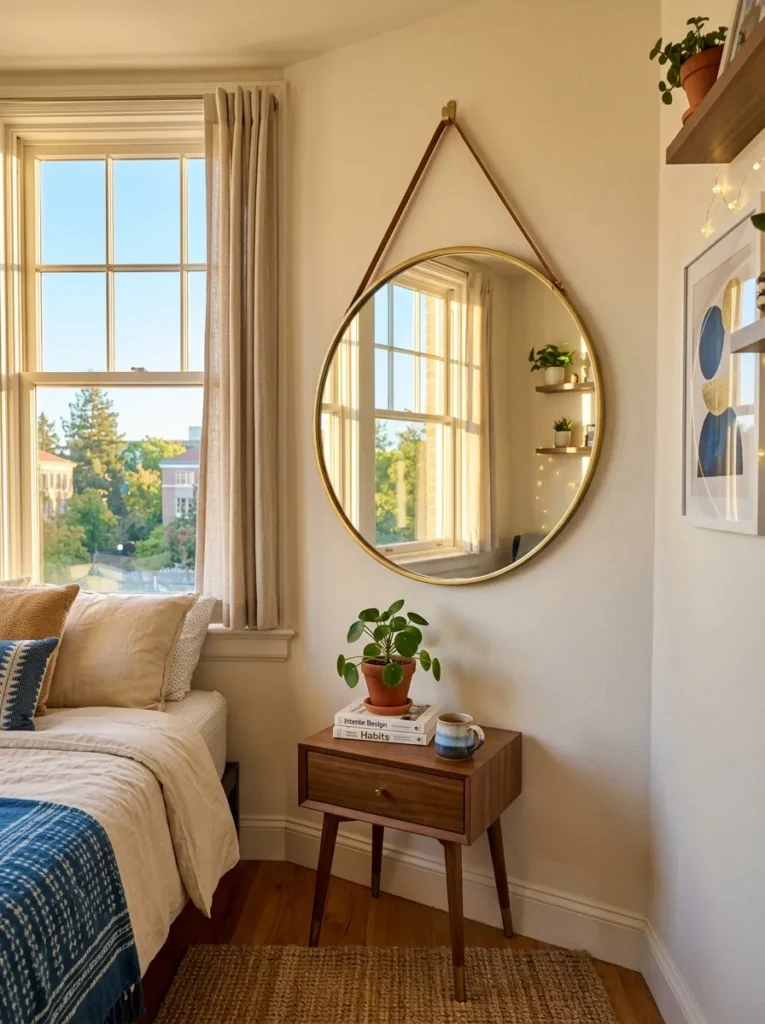
A round or oversized mirror hung on the wall facing the window, doubling the light and sky visible from across the room. Positioning is the entire trick with mirrors the same mirror hung beside the window barely does anything, while one hung opposite it bounces daylight back into the room’s darkest corner the same principle shows up in bathroom mirror placement, where positioning matters more than the mirror itself.
Hang it at eye level, centered on the wall directly across from the window, and skip anything with a heavy or ornate frame that competes with the reflection itself. This one suits rooms with only one window and a dim opposite corner.
Pro Tip: Position the mirror directly across from the window, not beside it that’s what doubles the perceived light, not just the reflection.
Shop This Look
| Product |
|---|
| Full-length leaning floor mirror, slim frame |
| Over-the-door hanging mirror |
| Round wall mirror with thin metal frame |
| Command-strip mirror mounting kit |
| Adhesive mirror tiles for accent wall |
15. Diagonal or Off-Wall Bed Placement
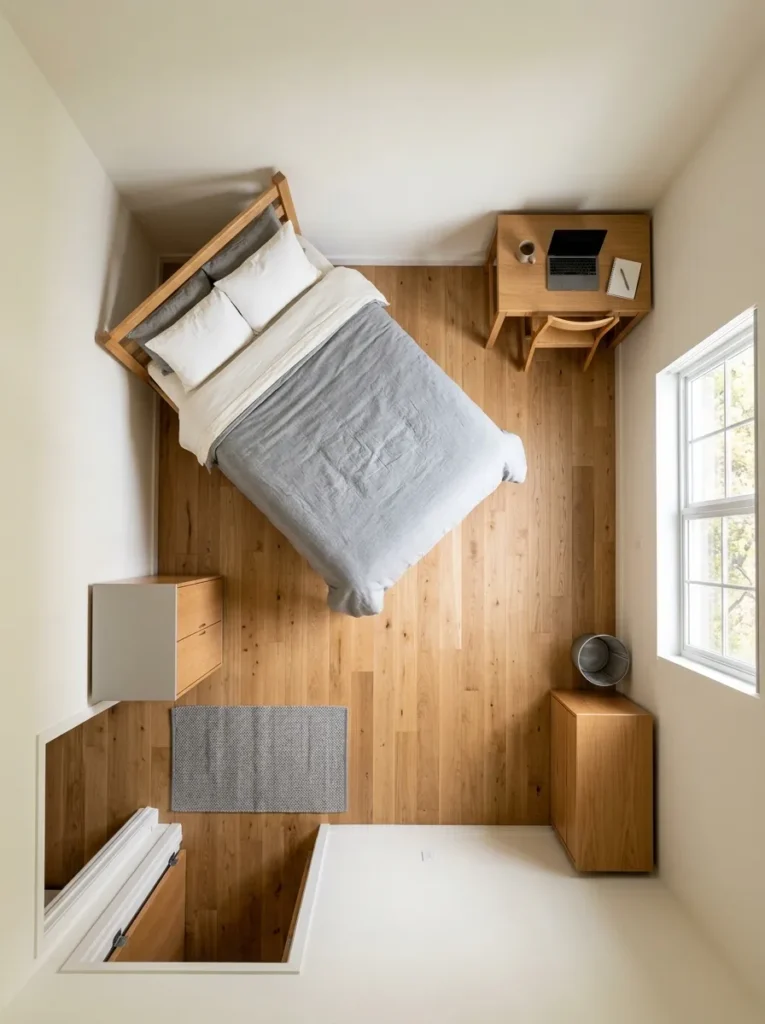
A bed set at a slight angle in the corner rather than flush against a wall, opening up a triangular pocket of extra floor. Most furniture layouts default to flush-against-the-wall placement, which is efficient but not always the most open. Angling one large piece breaks the room’s rigid rectangle and can open a walking path that a straight layout closes off a trick borrowed from tight-footprint spaces like the ones in small she shed and craft room makeovers.
Test the angle with painter’s tape on the floor before moving the actual bed a 20 to 30 degree angle usually opens the most path without wasting the corner space behind it. This one suits larger dorm rooms with an awkward corner that a straight layout leaves dead.
Small-Space Tip: Angling the bed works best in rooms at least 10×12 in anything smaller, the diagonal eats more usable floor than it opens up.
The next idea is the one experienced dorm decorators mention first and beginners skip.
16. Clear Acrylic or Glass Furniture Pieces
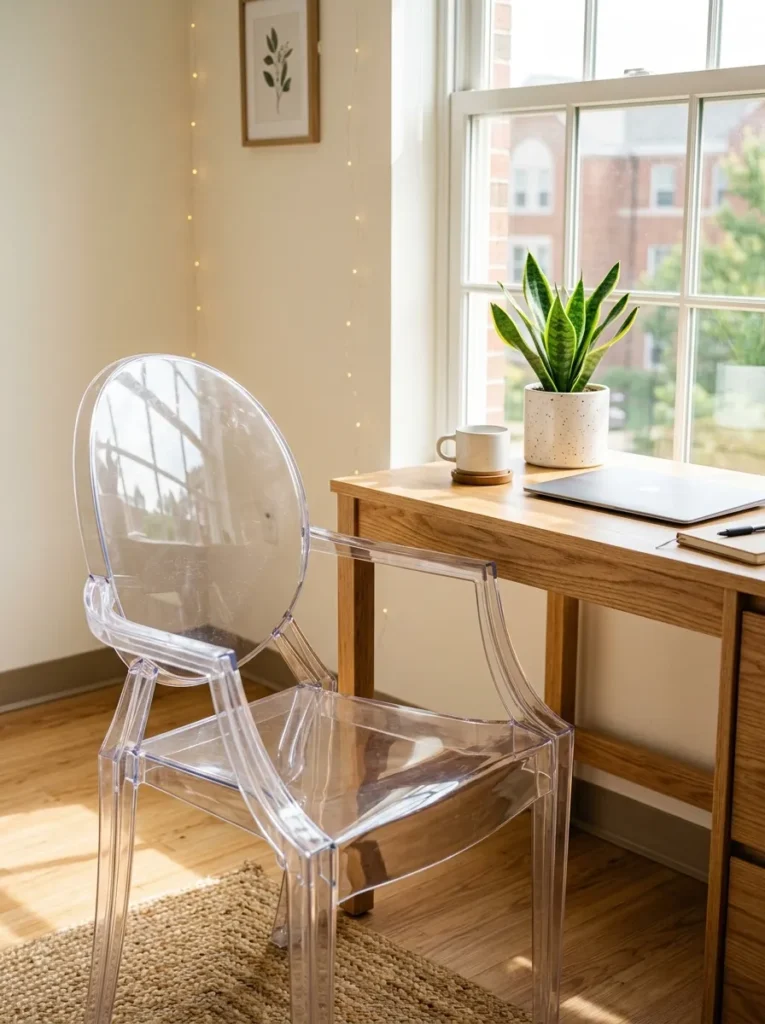
A chair, side table, or small shelf you can see straight through furniture that occupies floor space but not visual space. Every solid piece of furniture in a room adds to its perceived density, even if the actual floor footprint is small. Transparent materials keep the physical footprint while removing the visual one almost entirely.
Swap just one piece a desk chair is the easiest starting point rather than trying to furnish the whole room in acrylic, which starts to look like a showroom instead of a lived-in space. This one suits rooms already tight on furniture where every added piece needs to earn its visual cost.
Important: Clear acrylic scratches more easily than glass wipe it with a microfiber cloth only, since paper towels leave fine scratches that turn cloudy under lamp light.
Here’s something most guides won’t tell you: the ceiling matters more than the floor in a dorm room. In real move-ins, rooms with barely any floor space have read as spacious simply because nothing above eye level was cluttered no cords stapled at random heights, no posters within 12 inches of the ceiling line. Keep the top third of the wall almost empty and the whole room breathes differently.
17. Tonal Bedding and Curtains Matching the Walls
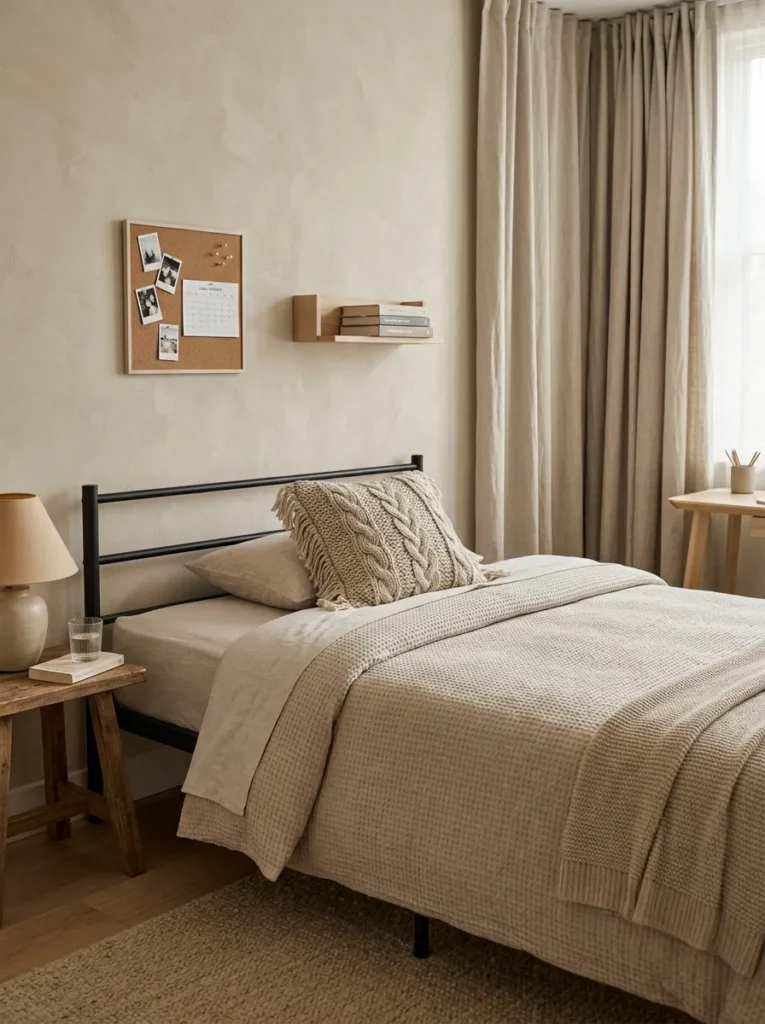
Bedding, curtains, and walls that blend into one continuous tonal field instead of standing apart as separate, competing elements. When large soft-good items match the wall color closely, they stop reading as separate objects and start reading as an extension of the room itself fewer visual “stops” for the eye means the room reads larger.
Buy the duvet cover first, in your wall’s undertone, then match curtains and a throw pillow to within one or two shades of it rather than hunting for an exact match. This one suits anyone who already committed to a light, neutral wall color and wants to finish the effect.
Quick Win: Buy one duvet cover in your wall’s undertone and let everything else pillows, throw, curtains pull from the same two or three shades.
18. A Wall-Mounted Swing-Arm Lamp
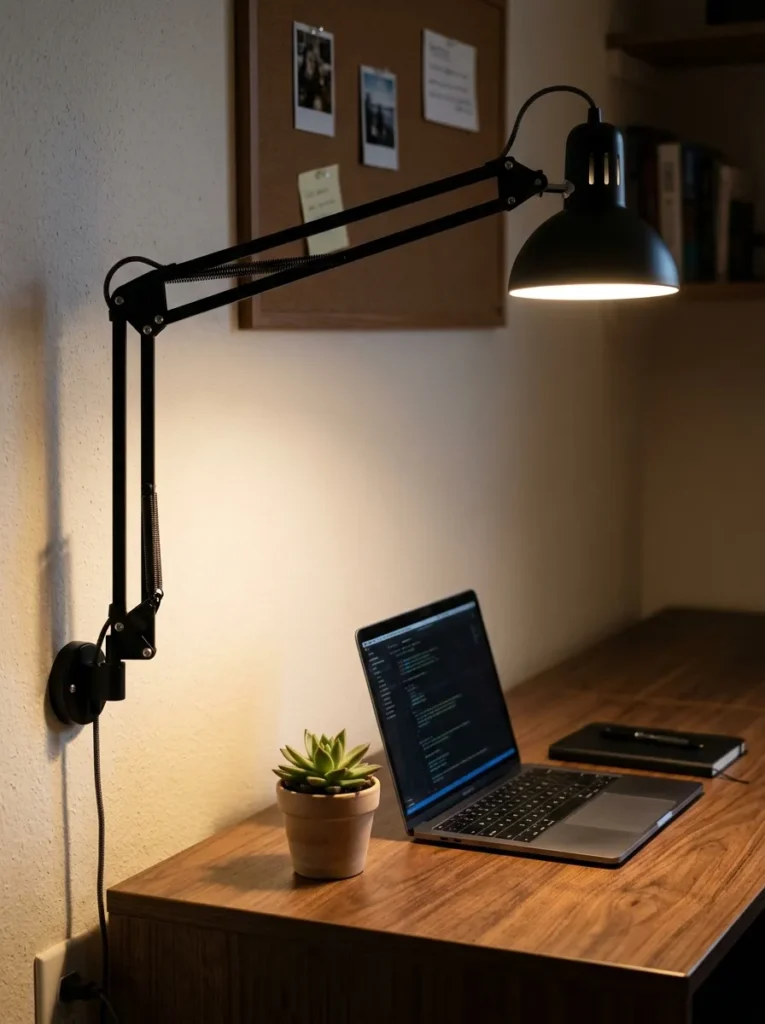
A lamp that extends from the wall on an articulated arm, with no base sitting anywhere on the desk itself. A standard desk lamp claims a fixed chunk of desk real estate permanently. Mounting the same light source on the wall frees that exact spot for actual work, which matters enormously on a desk that’s already small.
Mount it beside the desk at seated eye height, angled down toward the work surface, and route the cord along the wall edge with adhesive clips rather than letting it dangle. This one suits anyone whose desk surface feels cramped the moment a laptop and a lamp both need room.
Pro Tip: Mount the swing-arm lamp on the wall beside the desk, not above it that keeps the light source out of your sightline while you’re actually working.
One more lighting move, then the small details that pull the whole room together.
19. Woven Baskets for Texture Without Bulk
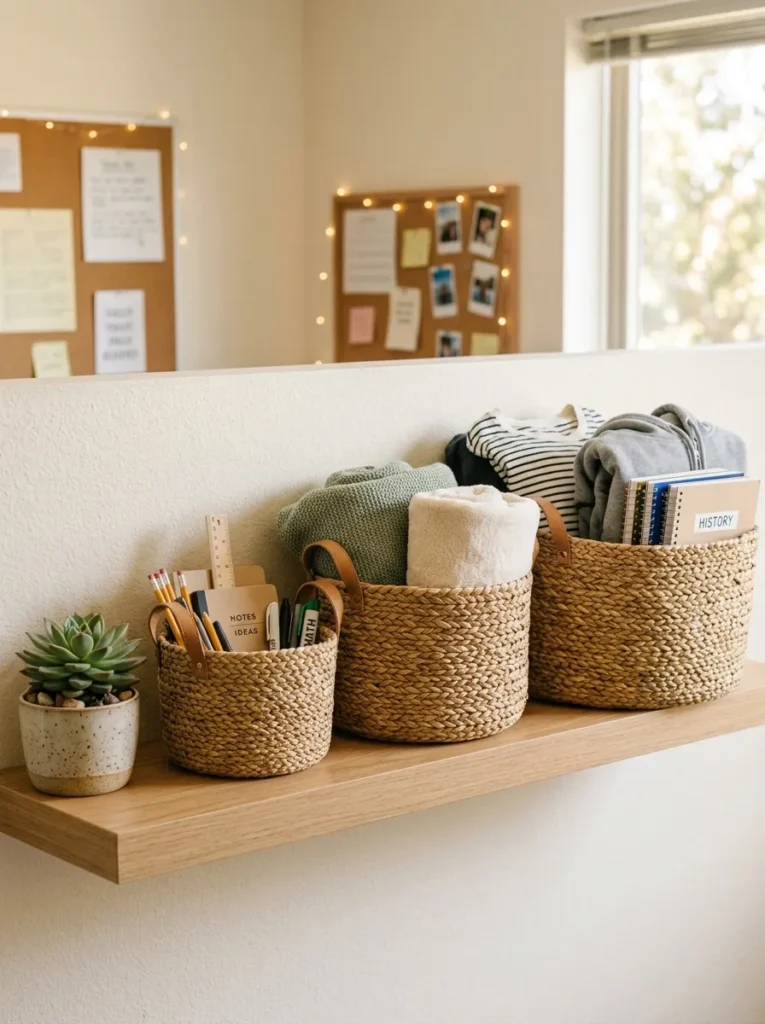
A small cluster of woven baskets on a shelf or floor corner, holding loose items that would otherwise sit exposed. Woven texture adds warmth and visual interest without the bulk of solid furniture it fills a room’s “empty but not quite finished” corners while staying visually light, unlike a solid storage cube.
Choose two or three sizes rather than a matching set of identical baskets, and let the largest hold the bulkiest item a blanket or extra pillow. This one suits anyone with a few loose items that don’t have an assigned home yet.
Styling Note: Group baskets in odd numbers three, not two or four it reads more intentional and less like leftover storage.
Shop This Look
| Product |
|---|
| Woven seagrass storage basket, medium |
| Collapsible fabric storage bin, set of 3 |
| Wall-mounted woven wall basket trio |
| Rattan tray for desk organization |
| Lidded woven basket for closet shelf |
20. Curtains Hung High, Near the Ceiling
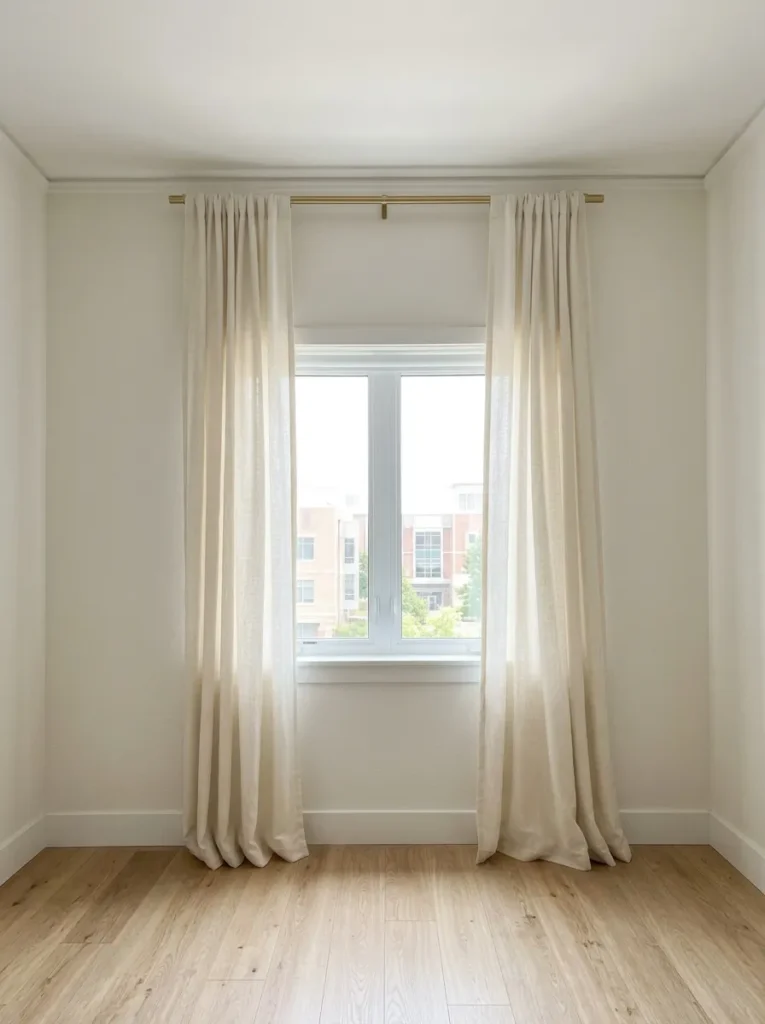
Curtain fabric that starts near the ceiling and drops past the actual window frame, rather than hugging the window’s true dimensions. The eye reads a room’s height from where the curtain starts, not from where the physical window ends. Mounting the rod higher tricks the eye into registering taller walls than the room has.
Mount the rod as close to the ceiling as your wall allows even four to six inches higher than the window frame makes a visible difference and let the curtain fall the full extra length. This one suits rooms with standard eight-foot ceilings that feel lower than they are.
Important: Most people hang curtain rods right above the window frame out of habit moving the rod up to just below the ceiling line adds visual height without changing the window itself.
21. A Vertical-Line Accent to Elongate the Ceiling
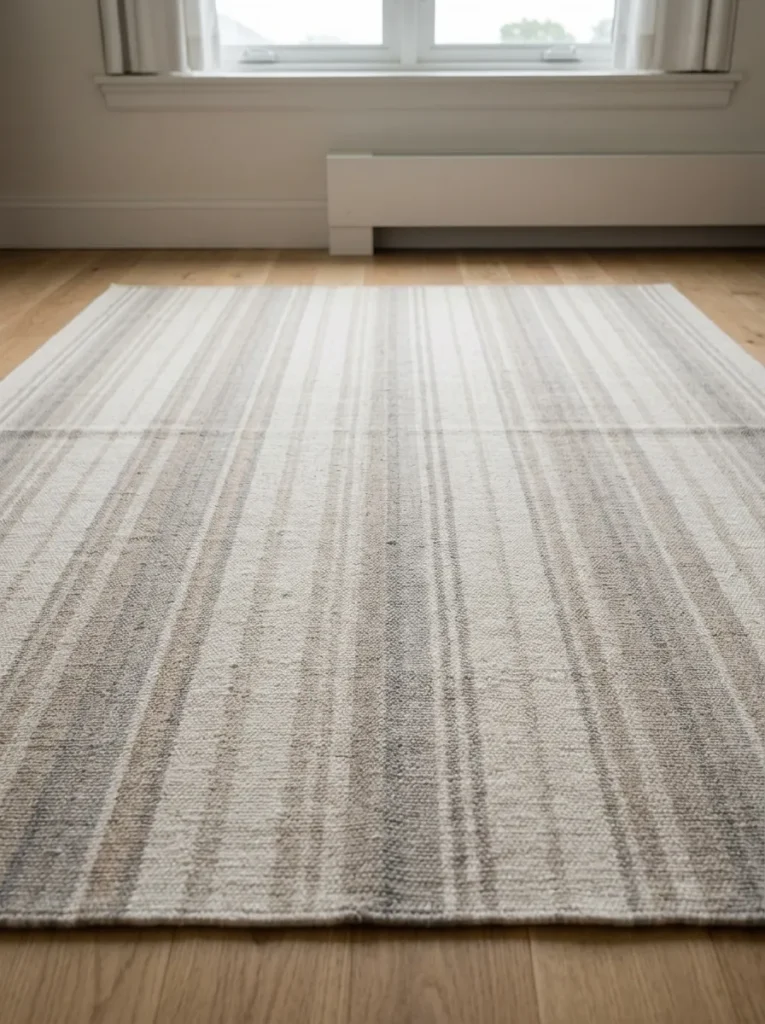
A rug, curtain, or wallpaper panel with a subtle vertical line running through it tonal stripe, not high-contrast pattern. Vertical lines pull the eye up and down rather than side to side, which reads as height. It’s the same principle as a vertical stripe on clothing, applied to a room instead of a body.
Choose a low-contrast, tone-on-tone stripe rather than a bold graphic one subtlety keeps the effect from looking like a pattern statement instead of a room-shaping trick. This one suits rooms that feel wide and squat rather than tall the opposite problem from most small dorm rooms, but common in ground-floor units.
Mistake to Avoid: A busy vertical stripe pattern on a small rug or curtain can visually shrink a room instead of elongating it keep the stripe subtle and tonal, not high-contrast.
Common mistake to avoid: Buying furniture before measuring the room and checking housing rules. Many dorms limit wall damage, candles and some electrical items, so confirm your school policies and the room dimensions first.
Frequently Asked Questions
What can I do about bare dorm walls?
Removable adhesive strips and freestanding pieces are the usual options. Check your housing rules first, since many schools restrict drilling and some adhesives.
How do I add storage to a small dorm room?
Go vertical with shelves, use the space under the bed where it is permitted, and choose pieces that serve two purposes, such as a storage ottoman.
Are string lights allowed in dorms?
Policies vary by school. Many allow LED string lights while restricting other lighting, so check with your housing office before you buy.
How to Start Your Small-Space Transformation
What I’ve found with real dorm move-ins: start by lifting the bed before you buy anything else. A set of sturdy bed risers, rated for at least 300 lbs per leg, instantly frees six to eight inches of usable floor, and nearly every other idea in this list storage bins, a rug, a desk depends on that floor being open.
The most common fixable mistake is buying storage before measuring the space it’s meant to fill. A bin that’s two inches too tall won’t slide under a risered bed, and a shelf unit sized for a full bedroom will eat the one clear wall a dorm room has. Measure first, buy second.
Three cheap swaps make an outsized difference: a three-pack of adhesive floating shelves under $25, a warm white LED string light strand under $15, and a slim over-the-door mirror under $20. None require tools, damage walls, or violate a standard dorm lease.
A full floor-to-ceiling refresh takes a weekend Saturday for furniture and storage, Sunday for lighting and finishing touches. Budget $75–$100 for a light starter pass with risers, one storage bin, and string lights, or $200–$300 to hit most of the ideas on this list, mirror and rug included.
Ready to Create a Bigger-Feeling Dorm Room?
Between the color choices, the lighting swaps, and the layout shifts, these 21 ideas cover almost every lever a small dorm room actually has. None of this has to happen at once even doing three or four of these over a weekend changes how the room reads. Tonight’s easiest move: order a set of bed risers and clear whatever’s currently piled on the floor.
Get the fundamentals right and the room stops fighting you it starts feeling like somewhere you’d want to study, not just sleep. Pin your favorites now, especially the ones that don’t need a single nail.
You Might Also Like