21 Small Powder Room Wallpaper Ideas That Make a Big Impact
A powder room is the one room in the house where wallpaper gets to misbehave a little there’s no shower steam to fight, barely any square footage to cover, and nobody’s judging you for going bolder than you would anywhere else.
This guide walks through 21 small powder room wallpaper ideas, from color and pattern scale to lighting, layout, and the small-space tricks that keep a tiny room from feeling boxed in.
Done right, wallpaper in a half bath does something paint can’t it turns four flat walls into a little moment guests actually remember. It’s low commitment in terms of square footage but high commitment in terms of personality, which is exactly the trade most people are hesitant to make. Worth it, though. Let’s get into it.
Jump To
- Vertical Stripe Wallpaper to Stretch the Ceiling Line
- Deep Emerald Botanical Print for a Jewel-Box Feel
- Warm Oat Grasscloth for Texture Without Pattern
- Mica-Flecked Wallpaper That Catches Sconce Light
- Wallpaper Paired With a Pedestal Sink
- Moody Charcoal Wallpaper With Crisp White Trim
- Wallpaper Matched to Unlacquered Brass Hardware
- Ceiling-Only Wallpaper — the Fifth Wall Trick
- Chinoiserie Mural Panel Behind the Toilet
- Micro-Scale Ditsy Print for Tight Corners
- Warm Terracotta Wallpaper for a Grounded Glow
- Wallpaper Framed by Brass Sconces
- Wallpaper Behind a Single Floating Shelf
- Wallpaper Paired With Woven Hand Towels and Baskets
- Peel-and-Stick Vinyl for Renters and First-Timers
- Soft Blush Pink Wallpaper for a Quiet Powder Room
- Wainscoting Below, Wallpaper Above
- High-Gloss Wallpaper That Bounces Light Around a Windowless Room
- Wallpaper Anchored by an Oversized Arched Mirror
- Wallpaper as the Backdrop for a Small Gallery Wall
- Grasscloth Wrapped From Wall to Ceiling
Why Small Powder Room Wallpaper Makes Such a Difference
Powder rooms don’t get plumbing-heavy humidity the way full bathrooms do, which means the material rules loosen up vinyl-coated paper, grasscloth, even unsealed grasscloth in dry climates can all work here.
The real question isn’t durability so much as commitment: a 30-square-foot room forgives a pattern or color that would feel like too much anywhere else.
Warm terracotta, deep emerald, charcoal, unlacquered brass these read as confident in a small footprint instead of overwhelming. Start with the wall the door swings toward; it’s the one guests see first and the one that does the most work.
| Best starting point | the accent wall facing the door |
| Biggest impact area | wall behind the mirror or toilet |
| Budget to start | $60–$150 for one starter roll |
| Time to complete | an afternoon (peel-and-stick) to a weekend (pasted) |
1. Vertical Stripe Wallpaper to Stretch the Ceiling Line
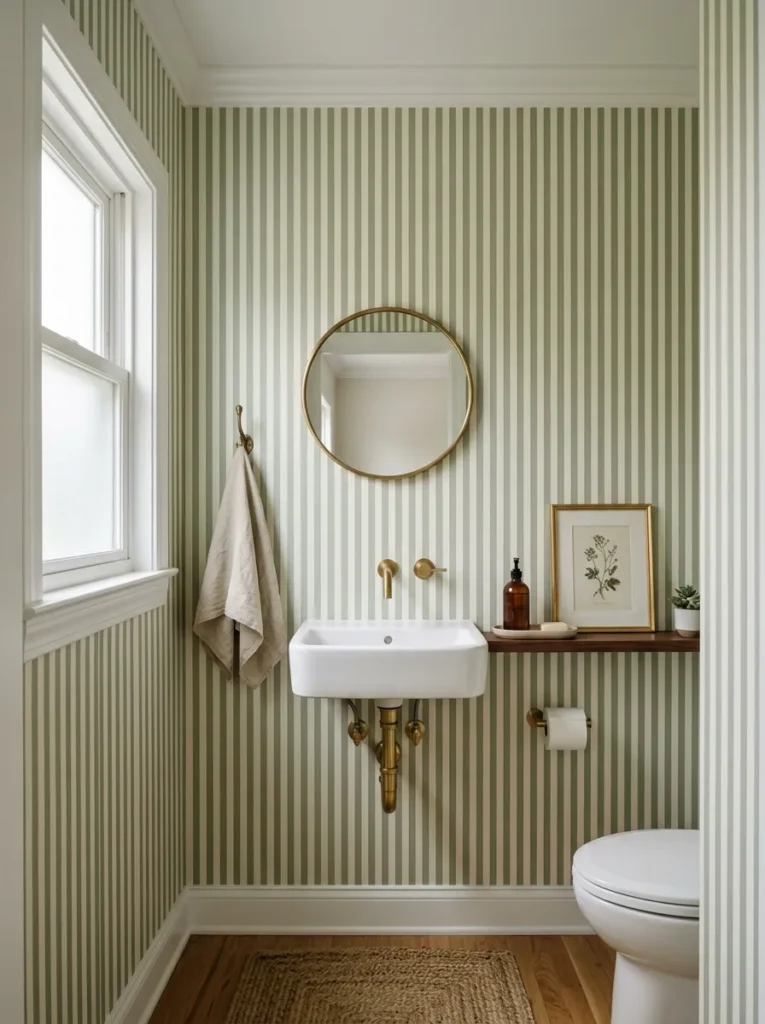
What it looks like: Clean, narrow stripes that pull the eye straight up toward the ceiling the room reads taller than it measures.
Why it works: Vertical lines exploit a real visual-perception trick: the eye follows the stripe before it registers the wall’s actual width, so a 6-foot-wide room feels less cramped. This is the single most common fear people have about powder room wallpaper that any pattern will shrink the room further and stripes do the opposite.
How to copy it: Keep stripe width under 2 inches and stick to two tones with low contrast (ivory and sage, not ivory and navy) so the effect reads as texture, not a barcode.
Best for: Rooms with 8-foot or shorter ceilings, first-time wallpaper buyers.
Small-Space Tip: Run the stripe onto the ceiling for the first 4 inches of trim it removes the visual “stopping point” that makes low ceilings feel lower.
2. Deep Emerald Botanical Print for a Jewel-Box Feel
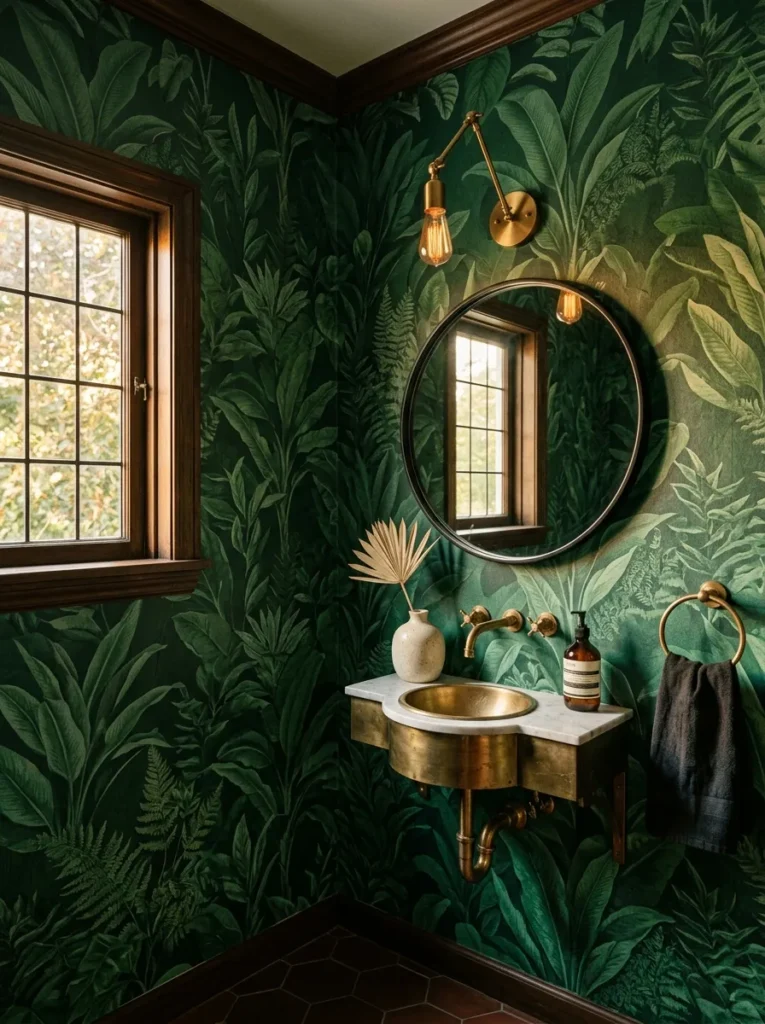
What it looks like: Saturated, layered greens that turn a tiny room into a self-contained jewel box rather than an afterthought.
Why it works: The second biggest fear people have that bold pattern will overwhelm a small room actually inverts once all four walls are covered. A large-scale print on every wall reads as one cohesive scene instead of four competing patterns, because there’s no bare wall left to create contrast against.
How to copy it: Cover all four walls, not just one, and skip patterned towels or bath mats entirely let the wallpaper be the only pattern in the room.
Best for: Maximalists, people hosting frequently, anyone bored of neutral walls.
Pro Tip: Order one extra roll beyond the calculated square footage large-scale botanical prints need pattern matching at every seam, and running short mid-install means a mismatched dye lot.
Up next: the material that gives you all the texture of wallpaper with zero pattern-matching stress.
3. Warm Oat Grasscloth for Texture Without Pattern
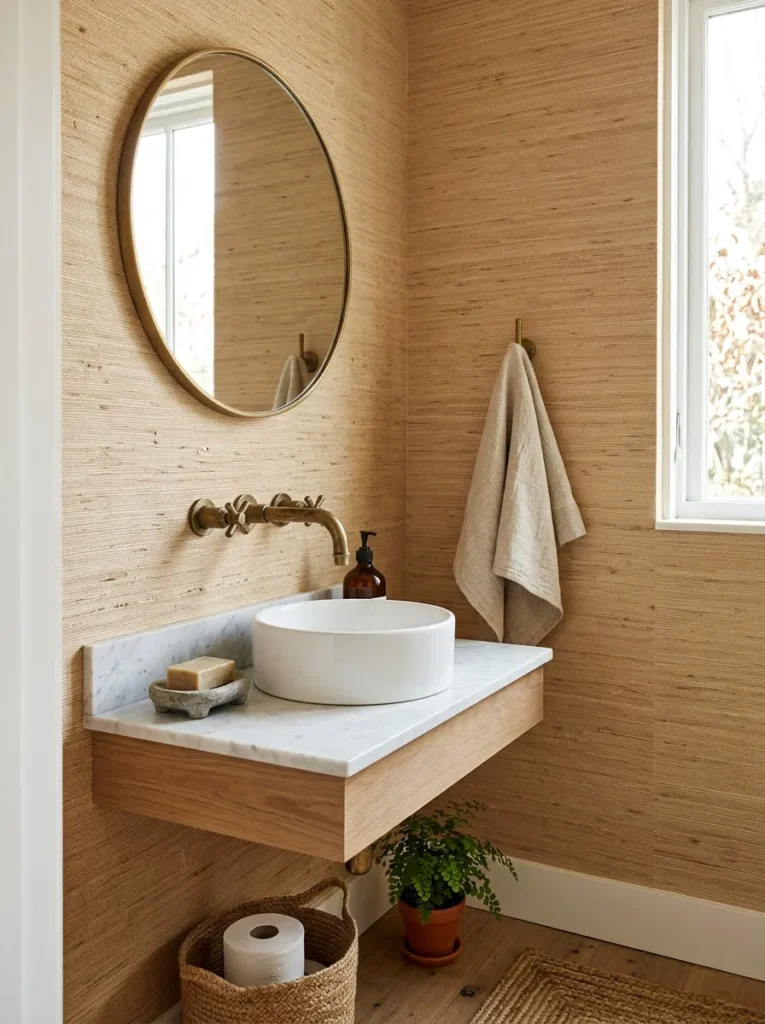
What it looks like: Nubby, hand-woven texture in a warm neutral that reads as considered rather than plain.
Why it works: Grasscloth adds visual weight and tactile interest without introducing a pattern that could clash with existing tile or hardware it solves the “I don’t want to commit to a print” hesitation while still upgrading the room past flat paint.
How to copy it: Choose a fiber-blend grasscloth rated for light moisture exposure rather than raw jute, since powder rooms still see occasional humidity from hand-washing.
Best for: Renters transitioning to homeowners, people who find patterned wallpaper too busy.
4. Mica-Flecked Wallpaper That Catches Sconce Light
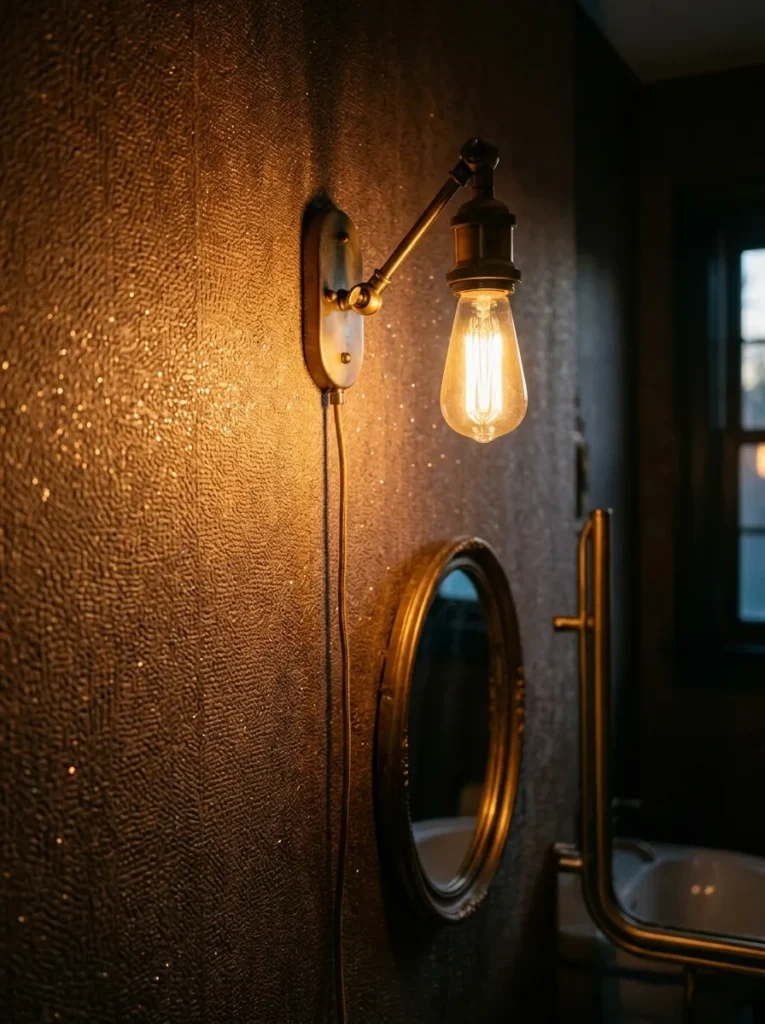
What it looks like: A subtle shimmer that shifts as you move past it flat in daylight, alive under lamp light.
Why it works: Windowless powder rooms rely entirely on artificial light, and mica-flecked paper multiplies whatever light source is in the room by reflecting it back in small, uneven flashes a plain matte wall just absorbs that same light.
How to copy it: Pair it with a single warm-toned sconce rather than an overhead fixture; the raking light angle is what activates the shimmer.
Best for: Interior or windowless powder rooms, evening-heavy households.
5. Wallpaper Paired With a Pedestal Sink
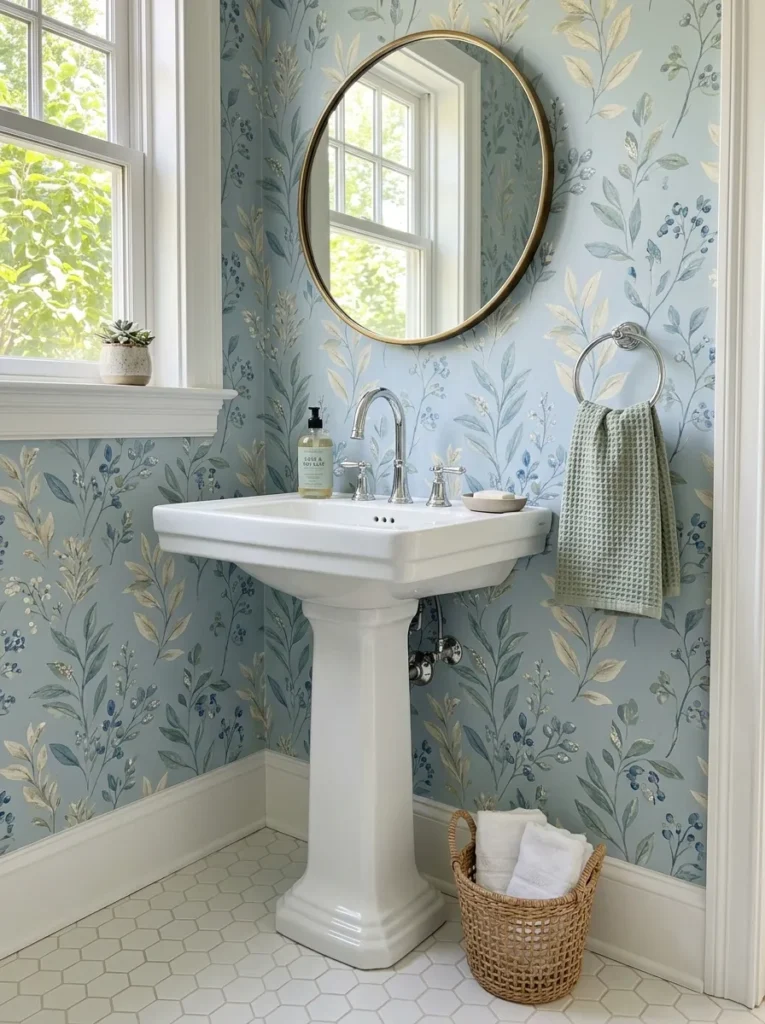
What it looks like: A slim, open-legged sink that lets the wallpaper run uninterrupted from floor to ceiling behind it.
Why it works: A vanity cabinet blocks roughly a third of a wall’s visual field in a small room; a pedestal sink removes that mass entirely, so a busier or bolder wallpaper reads as intentional rather than crowded.
How to copy it: Measure your wallpaper’s pattern repeat before installing a pedestal sink means more of the pattern is visible at once, so a large repeat needs more clearance around the drain.
Best for: Rooms under 20 square feet, anyone choosing a bold or large-scale print.
Warning: Never install unsealed or non-vinyl-coated wallpaper directly behind a sink without a splash guard repeated water contact will lift the seams within a few months, even in a low-humidity powder room.
6. Moody Charcoal Wallpaper With Crisp White Trim
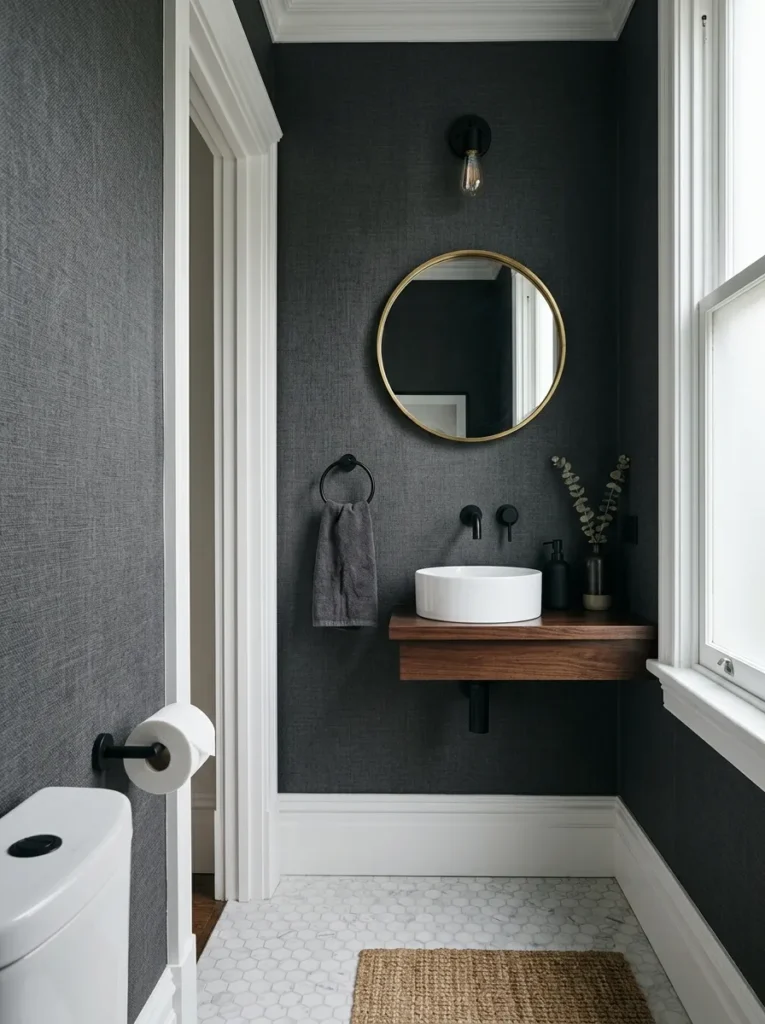
What it looks like: Deep, almost-black walls edged in bright white dramatic without tipping into cave-like.
Why it works: High-contrast trim keeps a dark wallpaper from reading as heavy by giving the eye a clean stopping point at every corner and ceiling line the contrast, not the darkness, is what keeps the room from feeling smaller.
How to copy it: Paint the trim in a bright white with a semi-gloss finish, not matte the sheen difference between wall and trim does more visual work than the color contrast alone.
Best for: North-facing rooms with limited natural light, people wanting a dramatic guest bath.
7. Wallpaper Matched to Unlacquered Brass Hardware
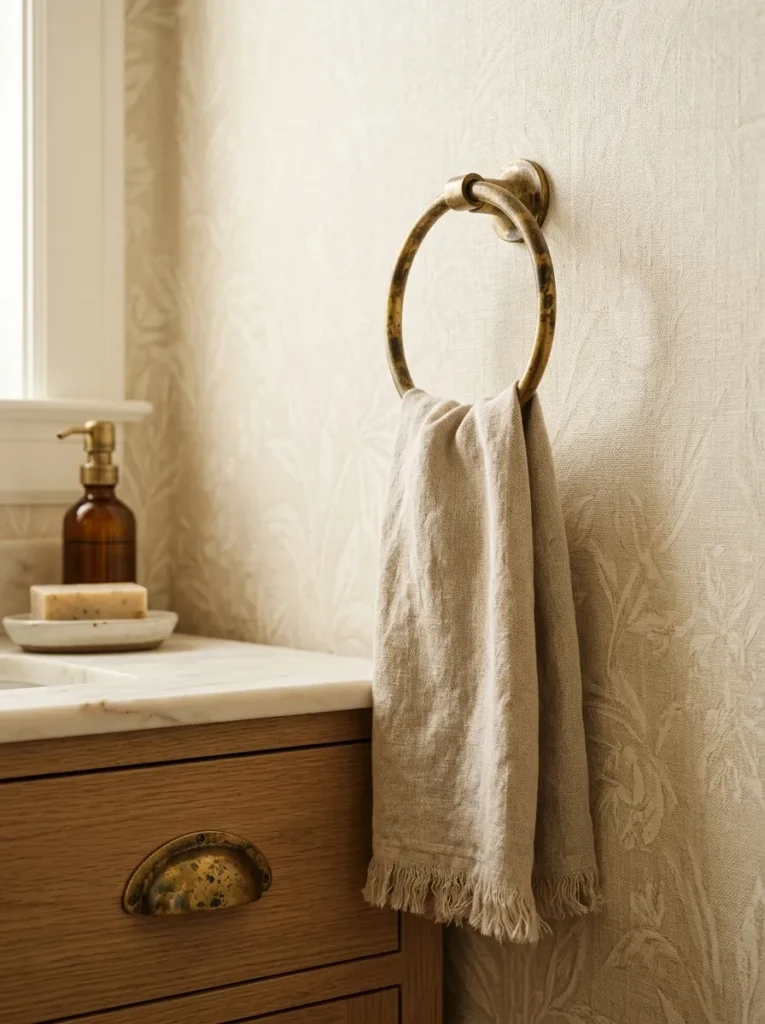
What it looks like: Warm cream paper that lets aging brass hardware do the visual heavy lifting instead of competing with a busy print.
Why it works: Unlacquered brass develops patina over time, and a quiet, warm-toned wallpaper acts as a stable backdrop that lets that patina read as intentional rather than accidental a cool-toned or high-contrast paper would fight it.
How to copy it: Choose a wallpaper undertone within the same warm family as the brass true cream or warm ivory, never a cool grey-white, or the metal will look mismatched instead of coordinated.
Best for: People building a room slowly over time, anyone who likes hardware that ages visibly.
Shop This Look
| Product |
|---|
| Unlacquered brass towel ring |
| Unlacquered brass cabinet knobs |
| Unlacquered brass single-hole faucet |
| Small brass wall hook |
| Linen waffle-weave hand towel |
8. Ceiling-Only Wallpaper — the Fifth Wall Trick
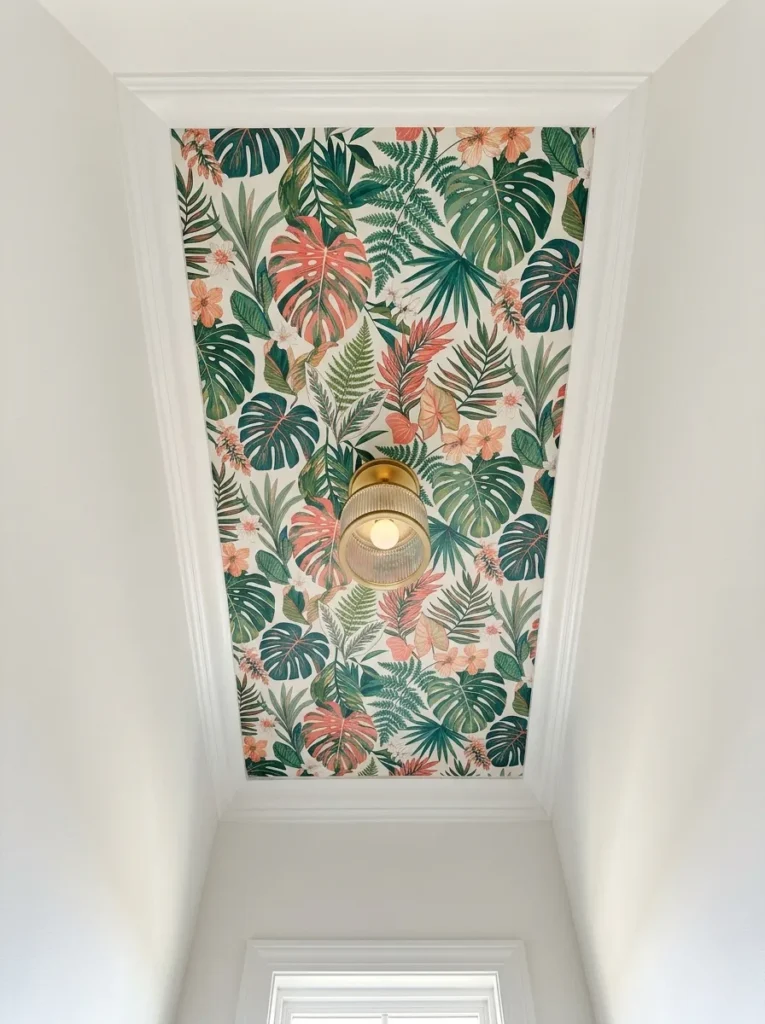
What it looks like: A plain white room until you look up then a full, unexpected pattern takes over the ceiling plane.
Why it works: The “fifth wall” treatment gives the drama of a bold pattern without covering any wall space at eye level, which keeps the room from feeling visually crowded while still delivering a strong design statement.
How to copy it: Order paper with a small or medium repeat large-scale prints get distorted when viewed from directly below rather than straight-on.
Best for: Renters who can’t wallpaper walls, anyone wanting a surprise moment rather than a full statement.
Important: Most people assume ceiling wallpaper needs a professional installer because of the overhead angle a lightweight pre-pasted paper and a smoothing tool with an extension pole make this a manageable solo project for a room this size.
9. Chinoiserie Mural Panel Behind the Toilet
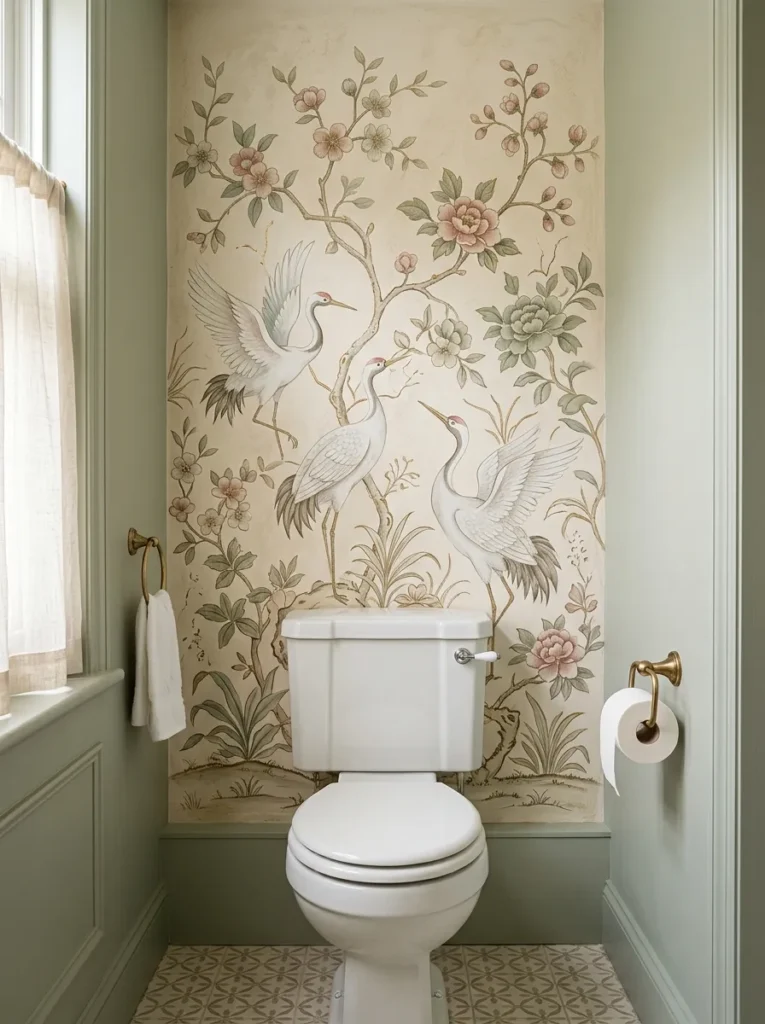
What it looks like: A single, story-like scene cranes, branches, soft washes of color treated as art rather than repeating pattern.
Why it works: Mural-style panels are engineered as one continuous scene rather than a repeat, so there’s no pattern-matching required at the seams, and the visual complexity is concentrated on one wall instead of spread across four.
How to copy it: Measure the exact wall dimensions and order a custom-scaled panel rather than a standard roll most mural companies print to your measurements for a flush fit.
Best for: People who want one dramatic focal wall without full-room commitment.
Quick Win: If a custom mural feels like too much, a large framed print of a botanical scene on plain wallpaper gets you 80% of the visual effect for a fraction of the cost.
This next one is the easiest fix for anyone worried a bold print will feel too busy up close.
10. Micro-Scale Ditsy Print for Tight Corners
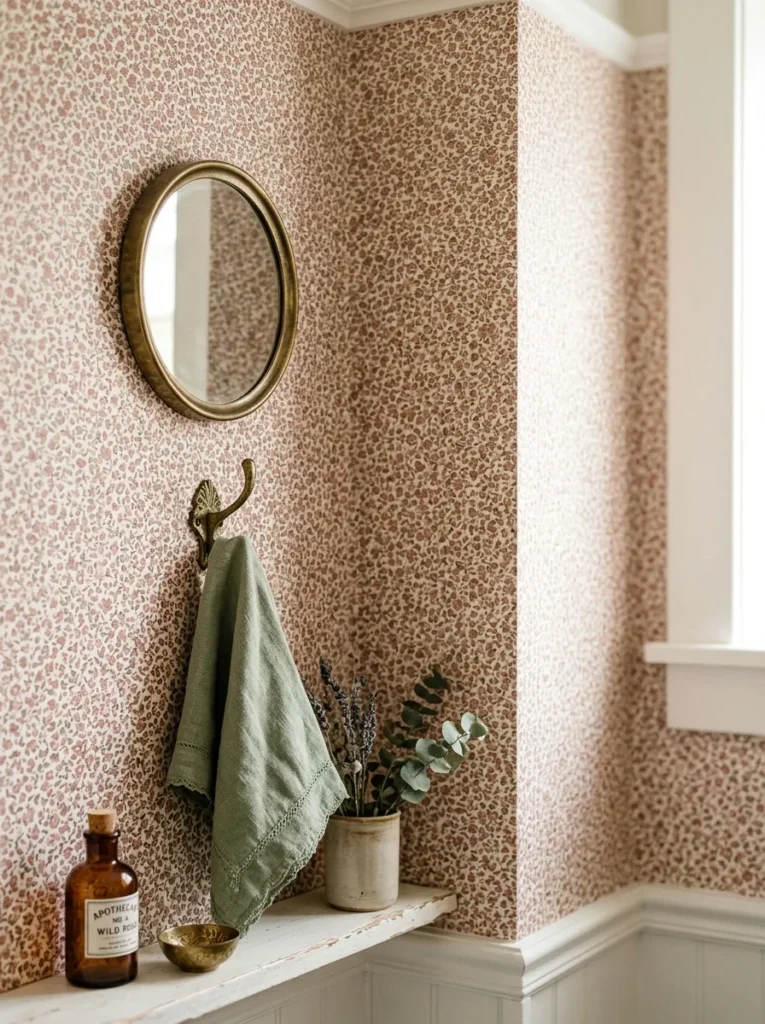
What it looks like: A tiny, dense floral that reads almost as texture from a few feet back rather than a bold pattern.
Why it works: Small-scale prints don’t get visually “cut off” awkwardly at tight corners or above the toilet tank the way large-scale prints do a huge cabbage rose can end up bisected right through the middle in a cramped layout, while a ditsy print just continues seamlessly.
How to copy it: Choose a print with a repeat under 3 inches for rooms narrower than 5 feet, where large-pattern awkward cutoffs are hardest to avoid.
Best for: Irregularly shaped powder rooms, rooms with lots of corners or angled walls.
11. Warm Terracotta Wallpaper for a Grounded Glow
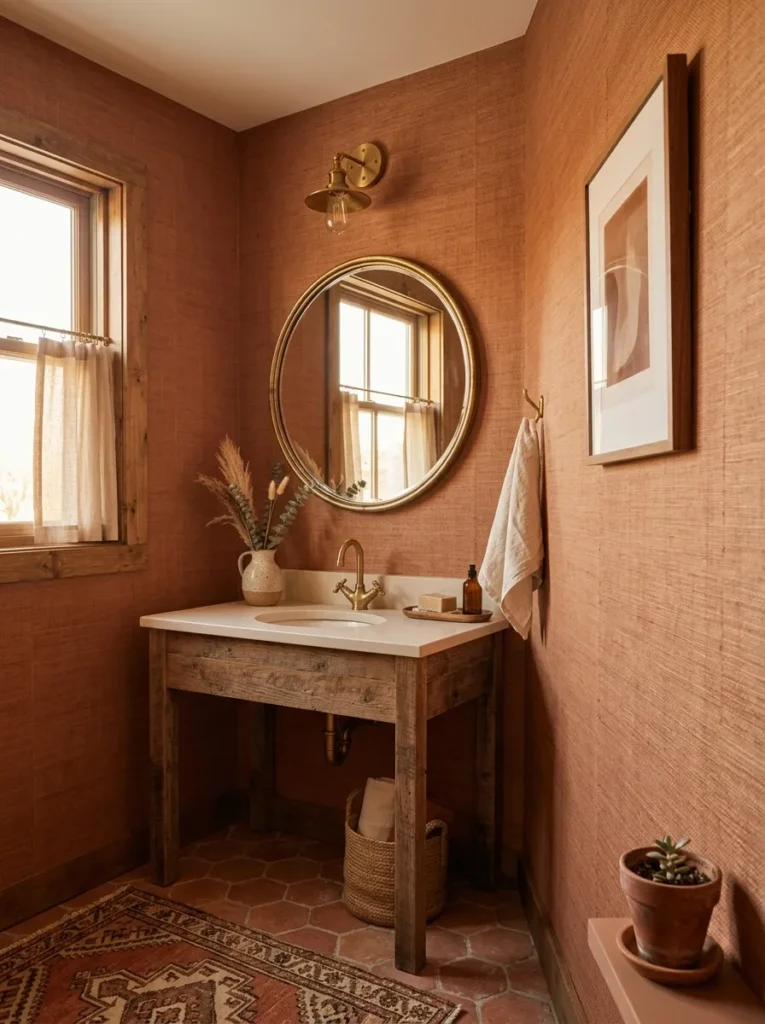
What it looks like: A sun-warmed, earthy tone that makes an artificially lit room feel like it’s holding onto late-afternoon light.
Why it works: Warm-toned walls counteract the flat, slightly cool cast of most LED vanity lighting terracotta’s orange undertone shifts how the whole room’s light temperature reads, making it feel warmer than the bulb actually is.
How to copy it: Confirm the wallpaper’s exact undertone under your own bathroom’s bulb temperature using a sample swatch first terracotta shifts noticeably cooler under daylight-temperature LEDs than under warm-white ones.
Best for: Rooms lit entirely by LED fixtures, anyone wanting warmth without going dark.
Pro Tip: Order a sample swatch and tape it up for 24 hours before committing terracotta reads differently in morning light versus evening lamp light, and a small swatch reveals that shift fast.
12. Wallpaper Framed by Brass Sconces
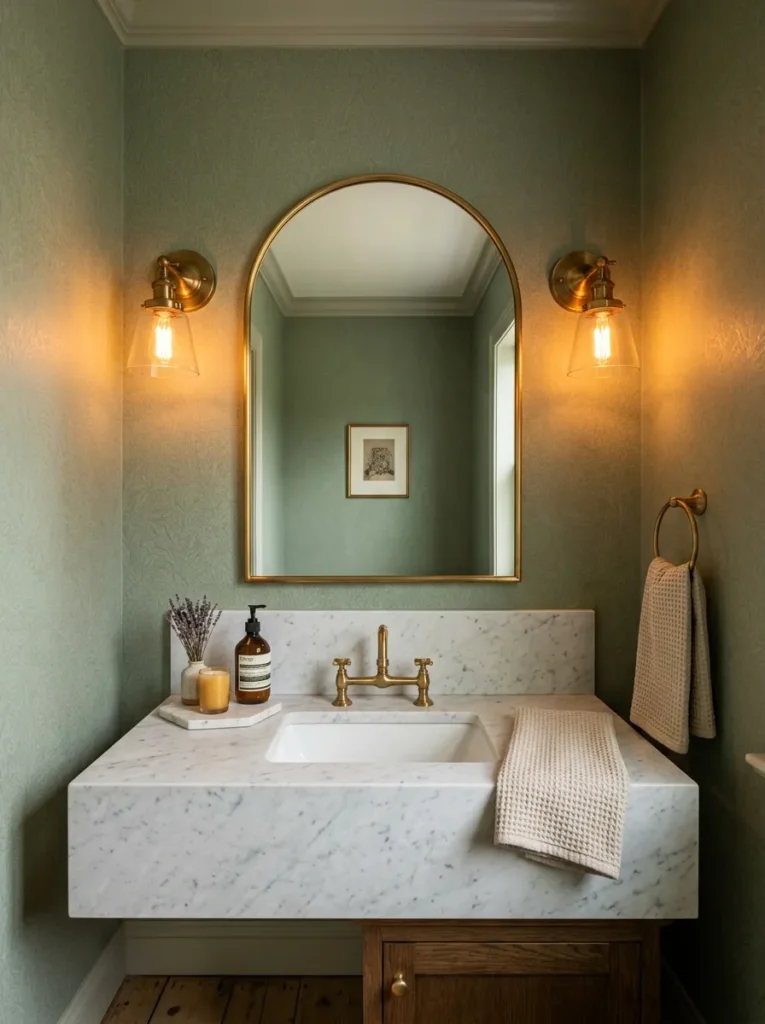
What it looks like: Two warm points of light bracketing the mirror, casting even, flattering light across the wallpaper on either side.
Why it works: Overhead lighting alone creates harsh shadows in a small room and washes out wallpaper texture from directly above; sconces at eye level light the wall from the side, which is what actually reveals texture and depth in grasscloth or embossed papers.
How to copy it: Mount sconces at 60 to 66 inches from the floor, spaced at least 28 inches apart, so light spreads evenly rather than overlapping in one hot spot.
Best for: Powder rooms with only a single overhead fixture currently.
Shop This Look
| Product |
|---|
| Brass double-arm wall sconce (pair) |
| Warm-white dimmable bulbs |
| Arched brass-framed mirror |
| Small marble vanity tray |
13. Wallpaper Behind a Single Floating Shelf
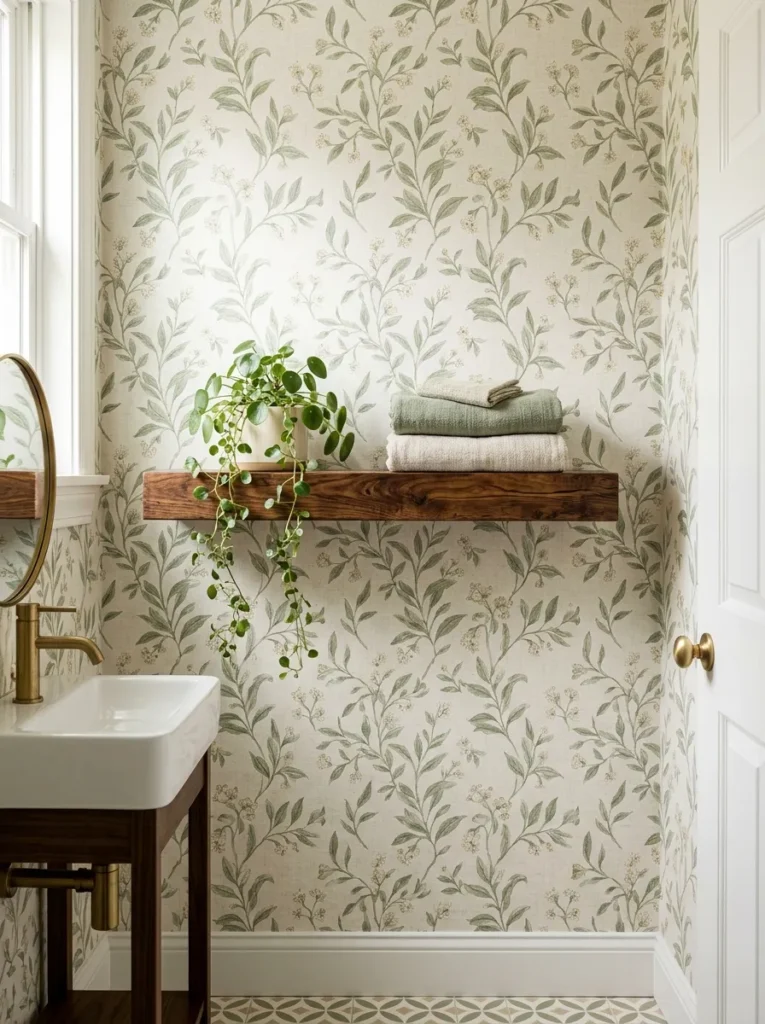
What it looks like: One slim shelf breaking up an otherwise full wall of pattern, giving the eye a place to rest.
Why it works: A single floating shelf adds functional storage without blocking a significant portion of the wallpaper unlike a cabinet, it reads as a design layer sitting on top of the pattern rather than competing with it. If the powder room is part of a bigger organization push, it’s worth browsing more small-space storage tricks before deciding how much shelving to add.
How to copy it: Mount the shelf at a height that clears the pattern’s most visually busy section, usually just below eye level, so the densest part of the print stays visible above it. A small trailing plant on one end keeps the shelf from feeling like pure storage.
Best for: Powder rooms with no existing storage, small rentals needing extra function.
14. Wallpaper Paired With Woven Hand Towels and Baskets
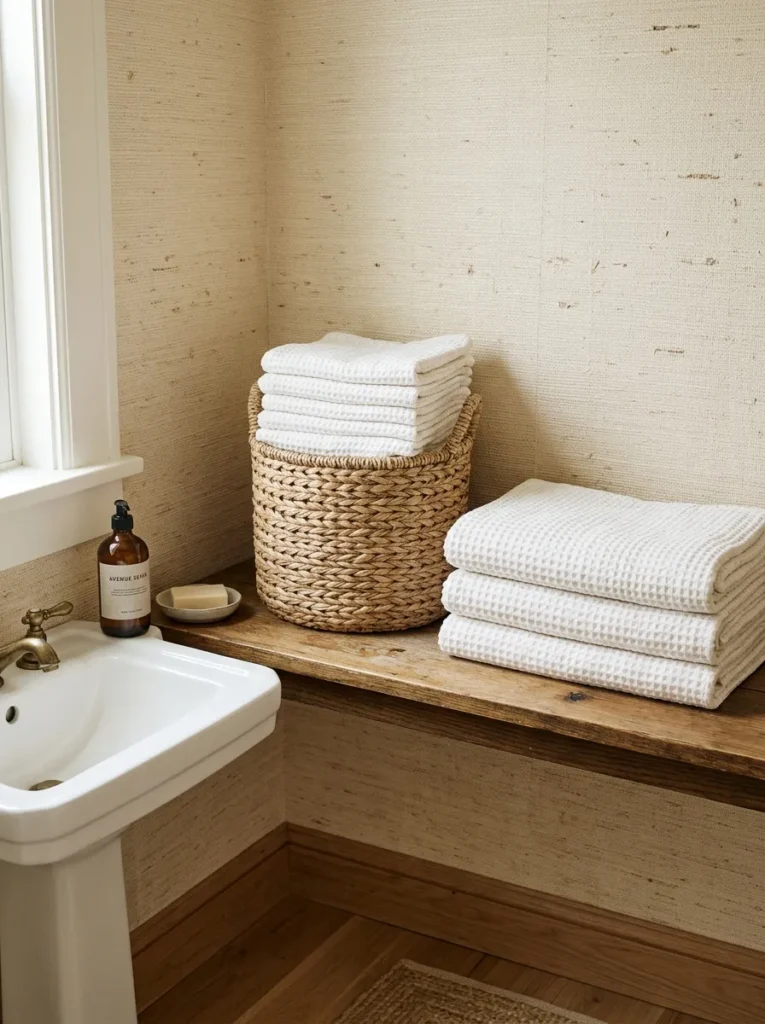
What it looks like: Layered natural textures grasscloth wall, woven basket, waffle towel that feel intentional rather than matched from a set.
Why it works: Repeating a single texture family (woven, nubby, natural fiber) across the wallpaper and accessories creates visual cohesion in a small room without needing matching colors, which is a lower-effort way to look “put together.”
How to copy it: Pick accessories in the same fiber family as the wallpaper seagrass basket with grasscloth wall, not a smooth ceramic basket that breaks the texture thread.
Best for: People decorating on a tight budget, rentals where wallpaper isn’t an option and accessories do the work instead.
Important: Most people assume natural fiber accessories need to be sealed against bathroom humidity in a powder room specifically, there’s no shower steam, so untreated seagrass and jute hold up fine without any spray sealant.
Next up: the one option built specifically for people who can’t commit to paste-and-paper.
15. Peel-and-Stick Vinyl for Renters and First-Timers
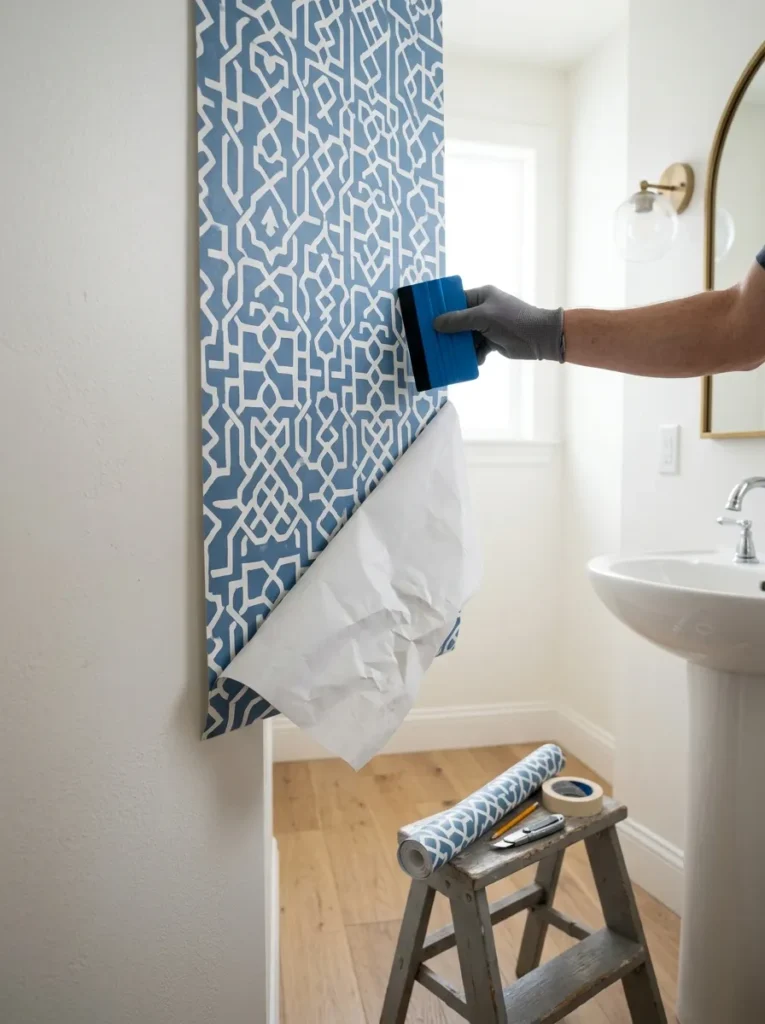
What it looks like: Crisp geometric pattern going up in strips, no paste bucket or wallpaper paste brush in sight.
Why it works: Peel-and-stick vinyl uses a repositionable adhesive backing instead of wet paste, which means mistakes can be lifted and resmoothed within the first few minutes a real advantage in a powder room’s tight corners where a first-timer is more likely to misalign a strip.
How to copy it: Order a fabric-backed vinyl rather than the thinnest paper-backed version it stretches slightly during application, which forgives small measuring errors in a tight room.
Best for: Renters, first-time wallpaper installers, anyone wanting to change the look again in a year or two.
16. Soft Blush Pink Wallpaper for a Quiet Powder Room
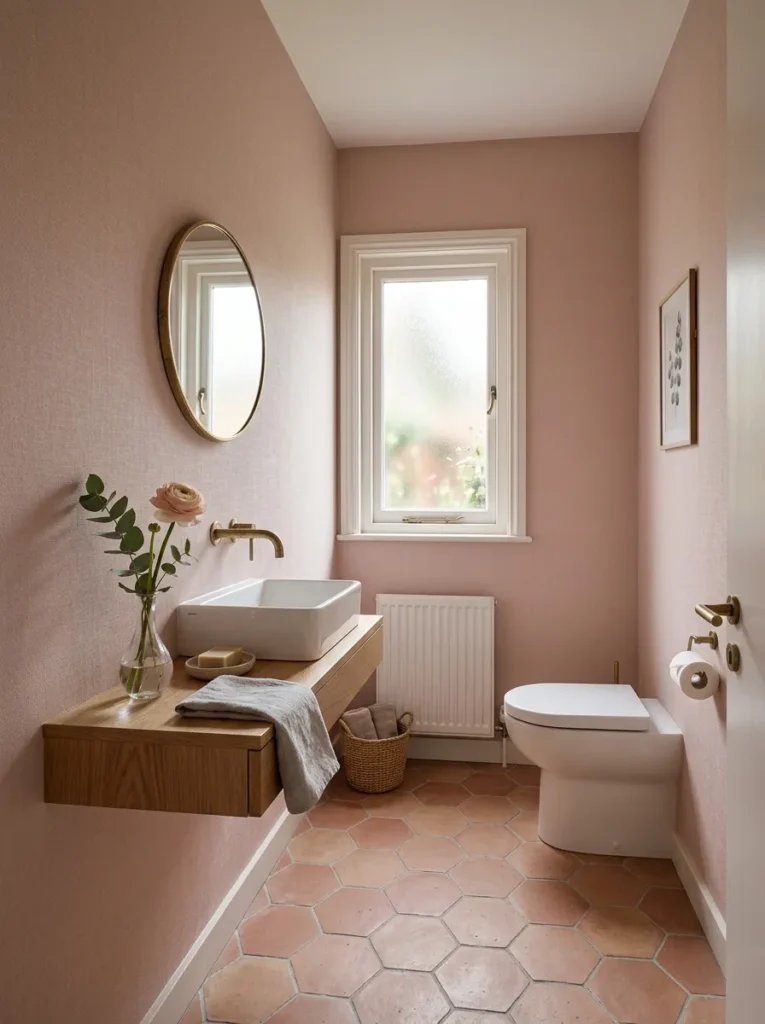
What it looks like: A quiet, dusty pink closer to clay than candy that softens the room without turning precious.
Why it works: A muted, greyed-down pink sits in a color family flexible enough to pair with brass, black, or chrome hardware equally well, which matters in a powder room where the fixtures are usually inherited from the rest of the house rather than chosen fresh.
How to copy it: Choose a pink with visible grey undertone rather than a warm coral-pink the greyed version reads as sophisticated rather than nursery-adjacent.
Best for: People nervous about committing to color, anyone with existing chrome or black fixtures they’re not replacing.
Budget Version: A can of blush-tinted paint in a matte finish gets a similar quiet color effect for under $40, though it won’t add the texture a papered wall provides.
17. Wainscoting Below, Wallpaper Above
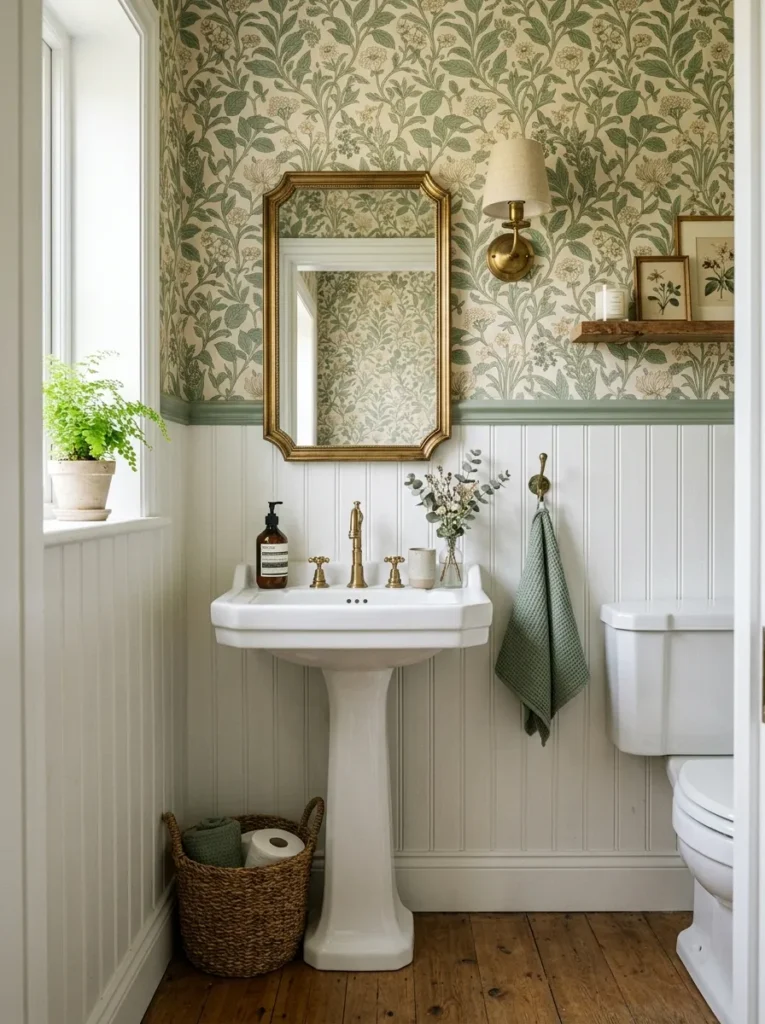
What it looks like: Crisp painted panels below, pattern above a classic split that adds architectural weight to a plain box of a room.
Why it works: Wainscoting protects the lower wall from scuffs and splashes while giving the wallpaper above a defined stopping point, which reads as more custom-built than wallpaper running floor to ceiling on its own.
How to copy it: Install the wainscoting first and let it fully cure before measuring for wallpaper the chair rail height determines exactly how much paper you’ll need above it.
Best for: Older homes with existing wainscoting, people wanting a more traditional or transitional look.
✅ Before You Start This One:
- [ ] Measure and mark chair rail height (typically 32–36 inches from the floor)
- [ ] Install and caulk the wainscoting, then let paint or primer fully cure
- [ ] Measure the remaining wall space above the rail for wallpaper yardage
- [ ] Order 10% extra wallpaper to account for pattern matching above the rail
- [ ] Prime the wall surface above the rail before hanging paper
18. High-Gloss Wallpaper That Bounces Light Around a Windowless Room
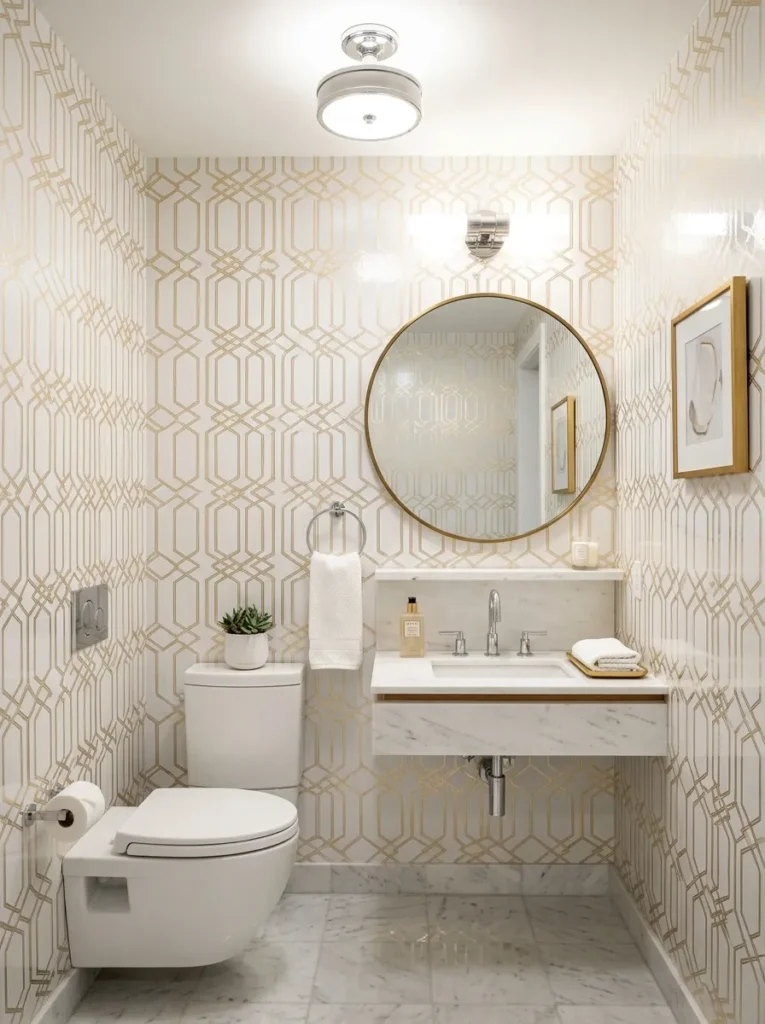
What it looks like: A subtle sheen across the pattern that visibly brightens as the overhead light hits it.
Why it works: Gloss and satin finishes reflect a meaningful percentage more ambient light than matte paper does, which matters most in a powder room with no window the wall itself becomes a secondary light source rather than just absorbing whatever the fixture puts out.
How to copy it: Pair a light-toned, high-gloss paper with the brightest bulb temperature your fixture allows, since the reflective effect is minimal under dim or warm-dimmed light.
Best for: Interior powder rooms with no natural light source at all.
Last stretch the final three ideas are about what surrounds the wallpaper, not the wallpaper itself.
My Views:
In my experience, the single biggest wallpaper mistake in powder rooms under 20 square feet isn’t the color or the pattern it’s stopping the paper 2 inches short of the ceiling because the installer eyeballed the last strip.
That gap reads as unfinished from three feet away, and it’s the first thing guests notice even if they can’t say why the room feels slightly off. Measure ceiling height at both ends of every wall before cutting the final strip older homes are rarely level, and a strip cut to one measurement can come up short on the other side.
19. Wallpaper Anchored by an Oversized Arched Mirror
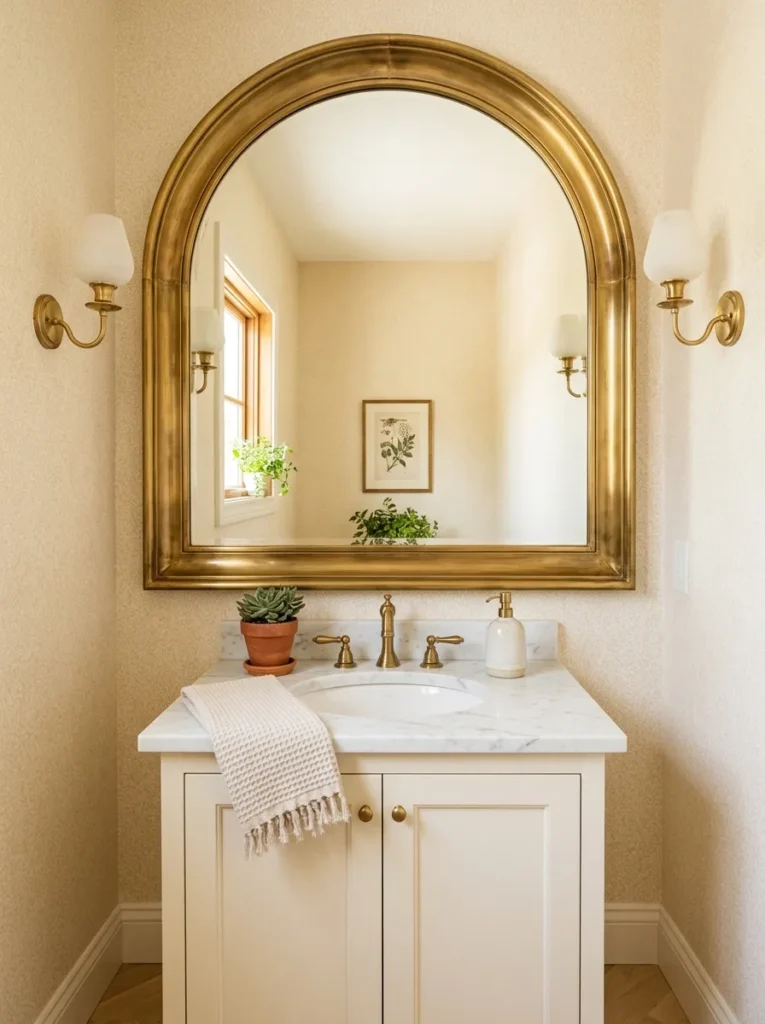
What it looks like: A mirror large enough to reflect the wallpaper on the opposite wall, doubling the visible pattern without adding a single extra roll.
Why it works: A mirror this size acts as a second window in a room with none, and reflecting the wallpaper back into itself makes a 6-by-8-foot room read as significantly larger than its actual footprint. If you’re still narrowing down the shape and frame, it helps to look through more bathroom mirror ideas before settling on one for a wallpapered wall specifically.
How to copy it: Choose a mirror at least 30 inches wide positioned to reflect the most pattern-dense wall in the room, not a blank one.
Best for: Interior powder rooms, anyone wanting to maximize a bold wallpaper’s visual impact.
Shop This Look
| Product |
|---|
| Oversized arched brass mirror |
| Ceramic soap dispenser |
| Small marble soap dish |
20. Wallpaper as the Backdrop for a Small Gallery Wall
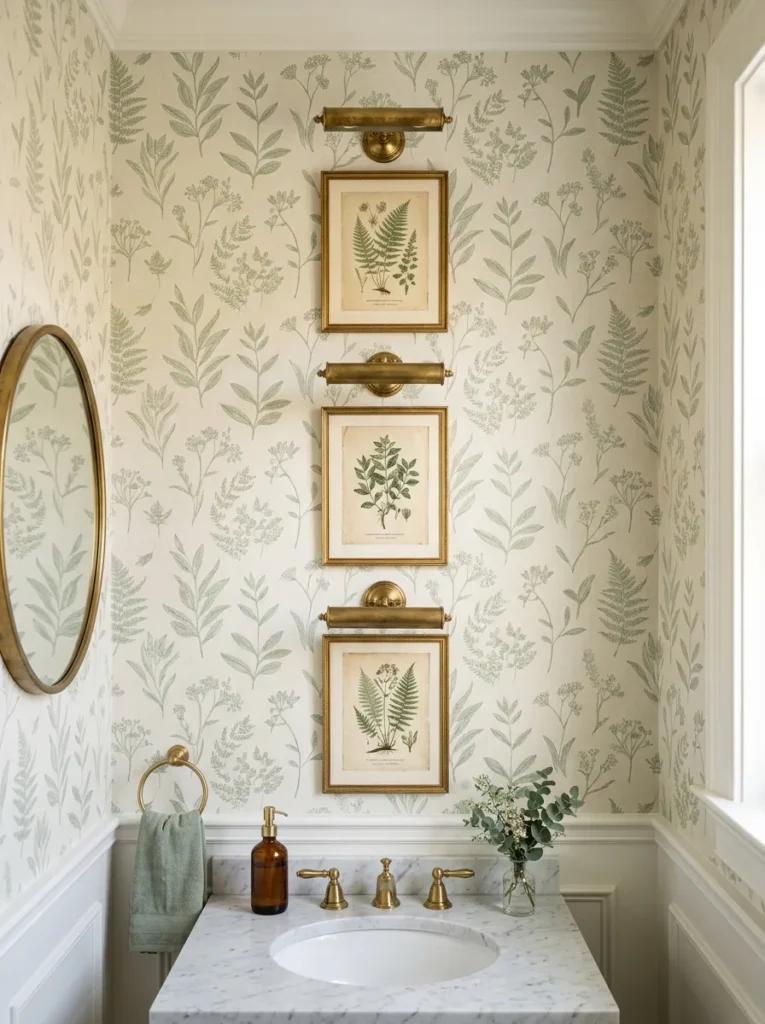
What it looks like: A tight, vertical run of small framed prints laid directly over the pattern, treated as one layered composition.
Why it works: Hanging art over wallpaper only works visually when the frame colors pull from the paper’s palette matching a gold-toned frame to a wallpaper with gold accents ties the two layers together instead of making the art look randomly placed.
How to copy it: Keep frames under 8 by 10 inches and space them 2 inches apart in a single vertical column, which reads as intentional in a narrow wall.
Best for: People who already own small art pieces, anyone wanting to add personality without more wallpaper.
Warning: Never use standard picture-hanging nails directly through pasted wallpaper the small hole tears and spreads under the paper’s weight. Use adhesive picture-hanging strips rated for the frame’s weight instead.
21. Grasscloth Wrapped From Wall to Ceiling
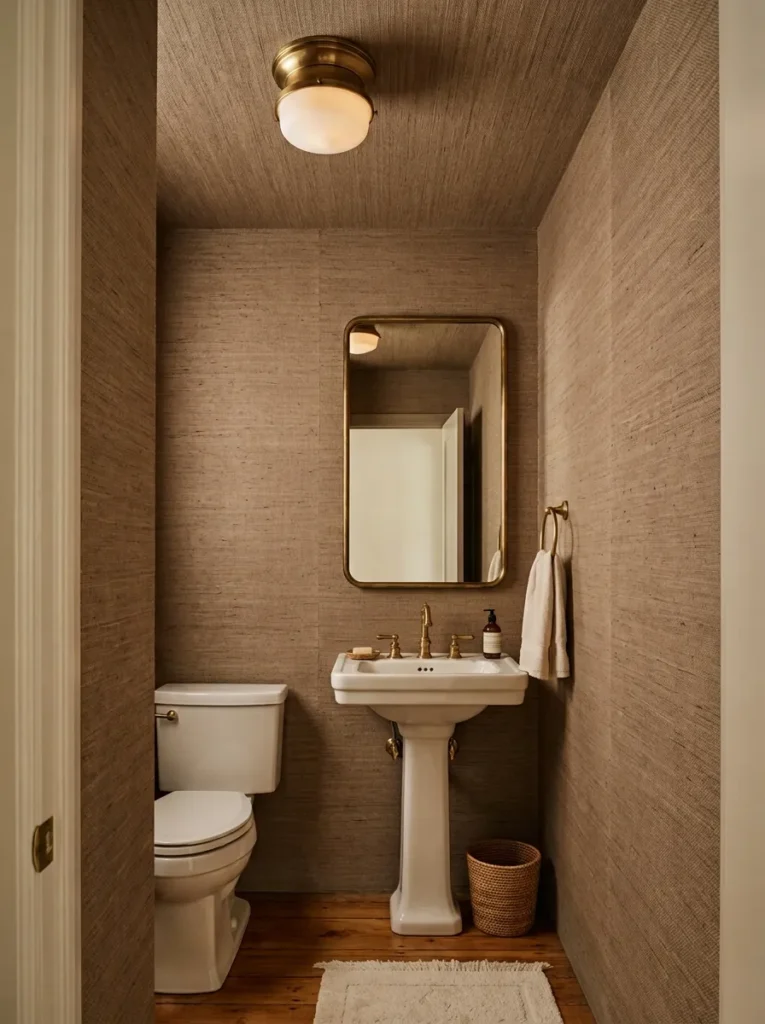
What it looks like: One continuous, textured envelope with no visible break between wall and ceiling the room feels wrapped rather than boxed.
Why it works: Removing the visual stopping point where wall meets ceiling eliminates the strongest cue our eyes use to judge a room’s actual dimensions, so a small powder room reads as a cohesive space rather than a cramped one with a low ceiling.
How to copy it: Order grasscloth from the same dye lot for the entire job, walls and ceiling included mismatched lots are far more visible on grasscloth’s natural fiber variation than on printed paper.
Best for: Powder rooms with ceilings under 8 feet, anyone wanting the most dramatic version of this look.
How to Start Your Small Powder Room Wallpaper Transformation
What I’ve found with real spaces: order a sample swatch of your top two choices and tape them to the wall the door faces that’s the wall people see first, and it’s the one worth getting right before anything else. Live with the swatches for at least two days under both daytime and evening light before committing to a full roll.
The most common fixable mistake is ordering the exact calculated square footage with nothing extra. Pattern matching, cutting errors, and a future touch-up after a scuff all eat into that margin fast order 10-15% more than the calculator says, especially with large-scale prints.
Three items under $50 that make an immediate difference: a smoothing tool with a felt edge (prevents bubbles and creases during install), a set of unlacquered brass cabinet knobs (swaps out builder-grade hardware in minutes), and a single stem of dried pampas grass in a small ceramic vase (fills the counter without adding clutter). If you’re stocking up on small decor pieces like this, a browse through handmade gift ideas can turn up unexpected finds that work just as well on a powder room counter.
A single-wall peel-and-stick project takes an afternoon and runs $60-$150 for materials. A full four-wall pasted install with wainscoting or a mural panel is a full weekend project and typically lands between $300-$700 depending on the paper chosen budget the higher end if a mural or grasscloth is involved.
Ready to Create Your Dream Small Powder Room?
Twenty-one ideas in, and the throughline is really just this: color, texture, and light all do more work in a small room than they would anywhere else in the house. Start small if the whole thing feels like too much at once one accent wall or even just the ceiling is enough to see the difference before committing to all four walls. Today, order a sample swatch of the wallpaper you keep coming back to and tape it up where the door faces.
The right pattern in a room this size should make a two-minute stop feel like somewhere you actually want to be, and the same instinct carries over nicely if you’re refreshing a tan sofa living room next. Pin your favorites now a jewel-box emerald wall hits differently once you’ve scrolled past it three times and come back.
You Might Also Like
- 15 Small Bathroom Paint Colors That Make a Tiny Space Feel Bigger
- 12 Bold Powder Room Ideas for Fearless Decorators
- 10 Budget-Friendly Half Bath Makeovers Under $500