19 IKEA Nursery Storage Ideas That Actually Work in Real Rooms
IKEA nursery storage is basically the art of stretching a budget-friendly, modular furniture line to hold everything a baby somehow accumulates by month six. This guide covers 19 specific ways to combine IKEA pieces Kallax, Trofast, Pax, Skubb, and a handful of smaller organizers into a nursery that stays functional long after the newborn haze wears off.
There’s a particular relief in reaching for a diaper at 2 a.m. and finding it exactly where it should be, not buried under a pile of onesies you’ll outgrow in a month. A room that stores things well doesn’t just look tidy it buys back the twenty seconds of panic-searching you don’t have at that hour. IKEA’s systems weren’t designed specifically for babies, but they adapt well once you know which pieces to combine, and most of them cost less than a single “designer” nursery shelf. Get the storage bones right early and everything else about the room gets easier.
Let’s get into it.
Jump To
- Kallax Shelf Unit as a Changing Table Base
- Trofast System Sorted by Type, Not Just Bins
- Skubb Fabric Boxes Color-Coded by Season
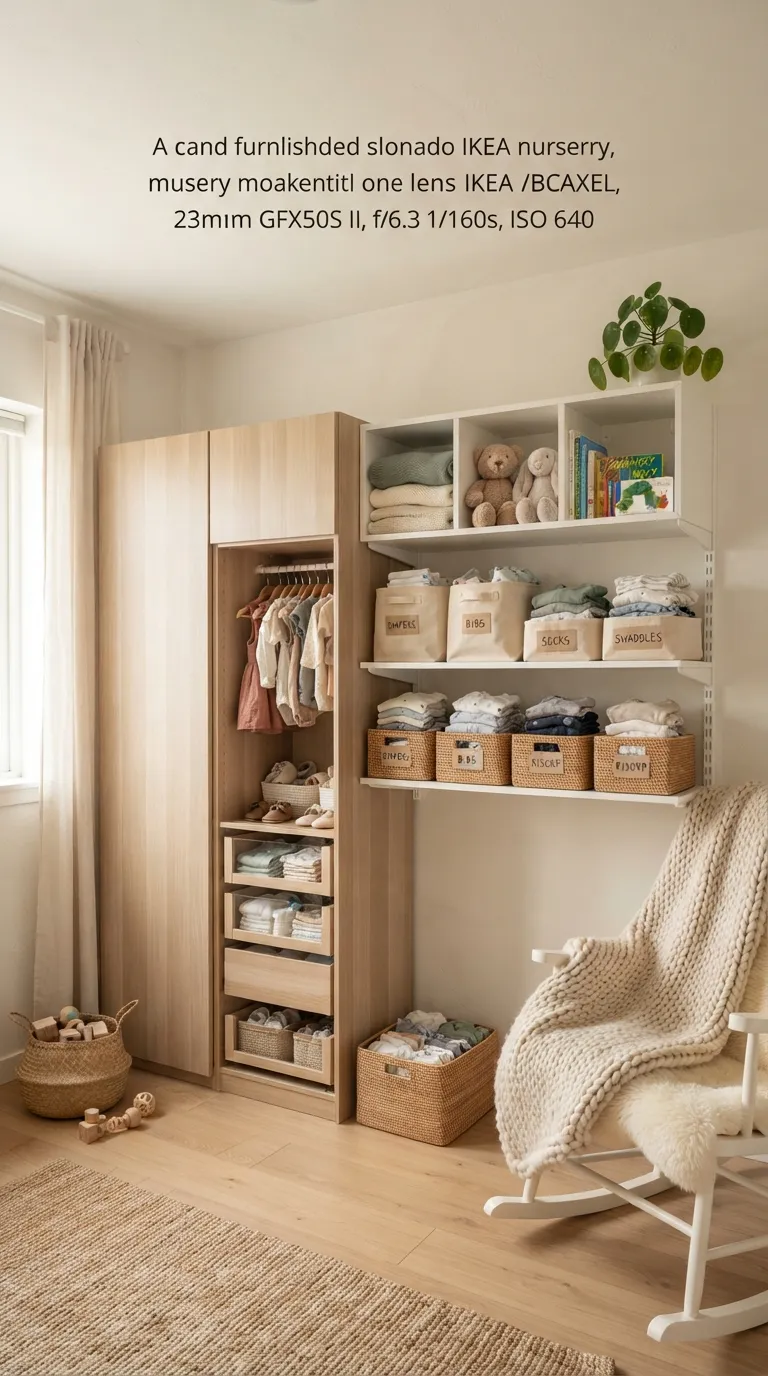
- Pax Wardrobe Customized as a Vertical Nursery Closet
- Mala Fabric Wall Organizer for Diapers and Wipes
- Underbed Storage Baskets Beneath the Crib
- Eket Wall Cabinets Floated Above the Changing Table
- Rationell Drawer Dividers for Tiny Clothing
- Flisat Picture Ledge for Face-Out Book Display
- Woven Vindrutan Baskets for the Closet Floor
- Sundvik Dresser Topped With a Changing Pad
- Battery LED Strip Lighting Inside Open Kallax Cubbies
- Ivar Shelving Painted in Soft Sage for Open Display
- Smastad Storage Bench With a Cushioned Top
- Mulig Clothes Rack for Out-of-Season Overflow
- Godmorgon Woven Baskets for Bath and Laundry Overflow
- Warm Dimmable Sconce Near the Reading Nook Shelf
- Zoning the Room Into Reach, Store, and Display
- Color-Blocked Bins by Garment Type for Fast Mornings
Why IKEA Nursery Storage Makes Such a Difference
IKEA nursery storage means treating a nursery like any other small, high-turnover room sorting by category, using vertical wall space, and choosing bins you can label and rotate as your baby grows out of sizes every few months.
The pieces that work hardest are Kallax, Trofast, Pax, and Skubb, all inexpensive enough to reconfigure without guilt. Warm oak-effect veneers and white laminate keep the room from feeling like a warehouse, while woven baskets soften the edges.
Even a nursery under 80 square feet can hold a full first-year wardrobe if the closet’s vertical space gets used instead of just the rod.
| Best starting point | Kallax shelf unit doubled as a changing table base |
| Biggest impact area | Closet — the vertical space above the hanging rod |
| Budget to start | $80–$150 for a single zone |
| Time to complete | A weekend for one zone, 4–6 weeks for the full room |
1. Kallax Shelf Unit as a Changing Table Base
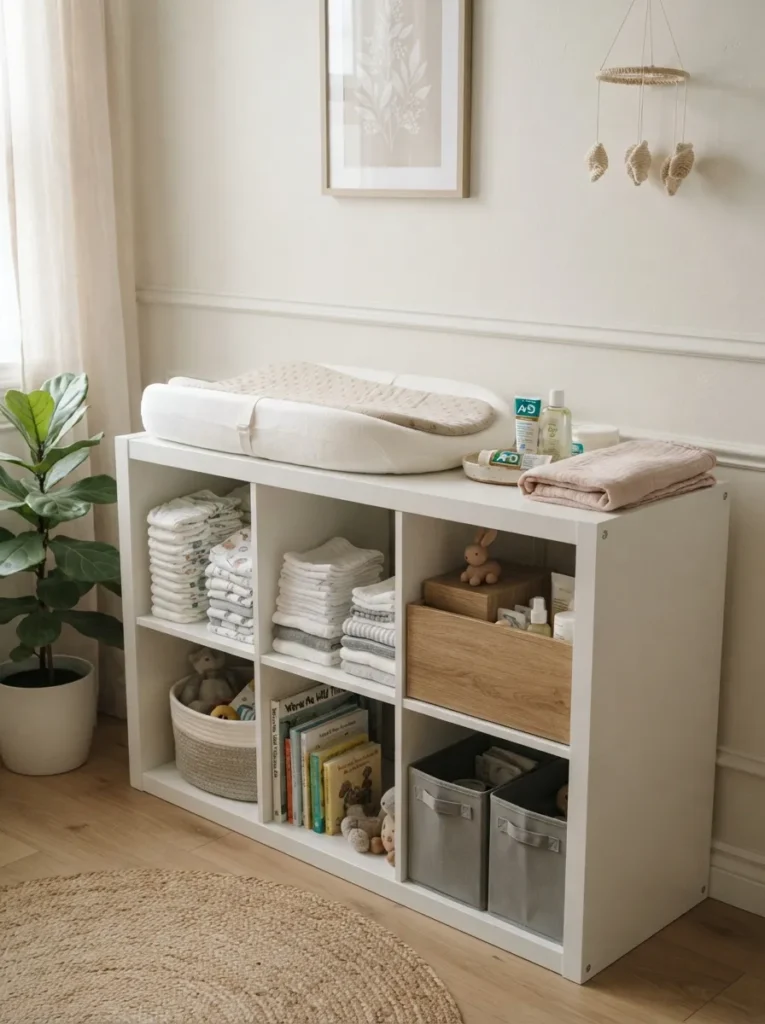
What it looks like: Squat and sturdy, with open cubbies underneath instead of the narrow drawers most changing tables come with.
Why it works: A single piece doing two jobs changing surface and storage keeps floor space open, and the low center of gravity matters more than most parents realize once a wriggling baby is on top.
How to copy it: Buy the 4×2 Kallax, add a strap-on changing pad rated for that exact width, and use two fabric boxes plus two open cubbies rather than filling all four you need at least one open bin for fast, one-handed access.
Best for: Small nurseries where a dedicated changer and a separate dresser won’t physically fit.
Warning: Never skip the anti-tip wall anchor kit that comes in the Kallax box. A baby shifting weight near the edge can pull the whole unit forward, and this is one case where “I’ll do it later” genuinely isn’t worth the risk.
Find It Online:
| Product |
|---|
| Strap-on changing pad sized for a 4×2 cube shelf |
| Anti-tip furniture wall anchor kit |
| Fabric storage boxes with cutout handles, cube-sized |
| Diaper caddy organizer insert |
| Non-slip pad cover in a wipeable fabric |
2. Trofast System Sorted by Type, Not Just Bins
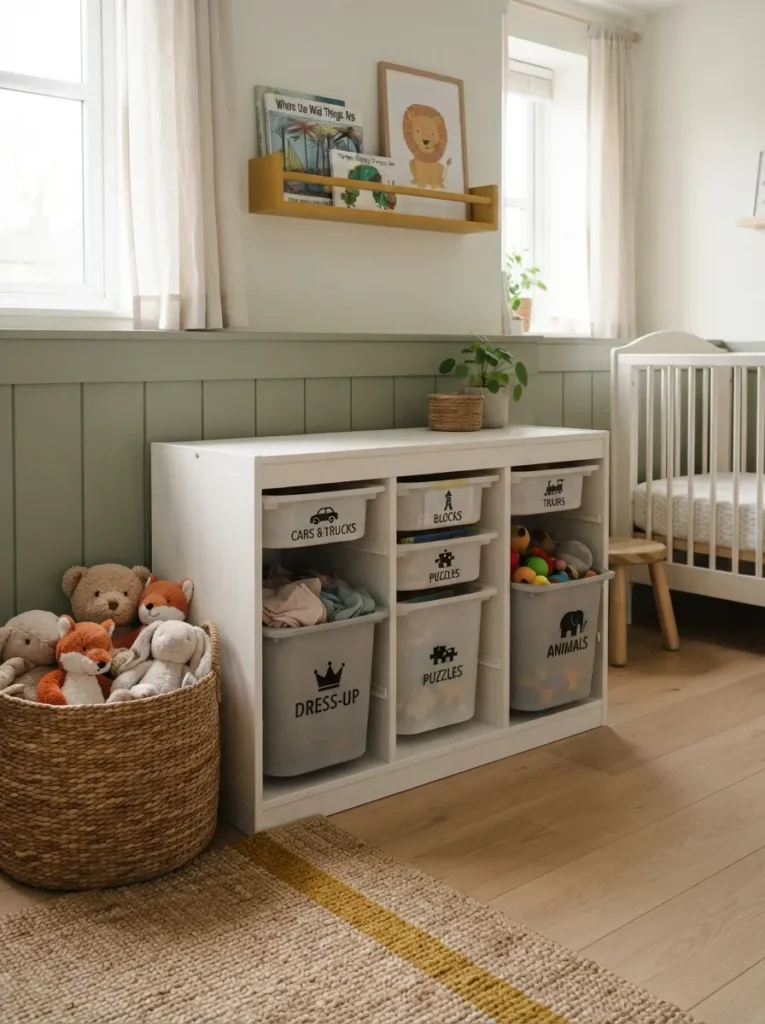
What it looks like: Six bins in two heights, each holding one category instead of one random jumble of everything soft.
Why it works: Sorting by object type not just “toys” cuts search time dramatically, since a toddler, or a tired parent, can find blocks without dumping every bin on the floor first.
How to copy it: Assign one bin per category books, stuffed animals, bath toys, wooden toys, loose parts, out-of-rotation items and use deep bins for anything oversized like stuffed animals, shallow ones for anything flat.
Best for: Parents already fighting a losing battle against one giant toy bin that swallows everything.
✅ Trofast Sorting Setup:
- [ ] Sort every toy into six rough categories before buying a single bin
- [ ] Measure the deepest and flattest items to match bin depth
- [ ] Label each bin with a picture, not just a word, once your child is mobile
- [ ] Rotate one bin’s contents out of sight every few weeks to keep things feeling new
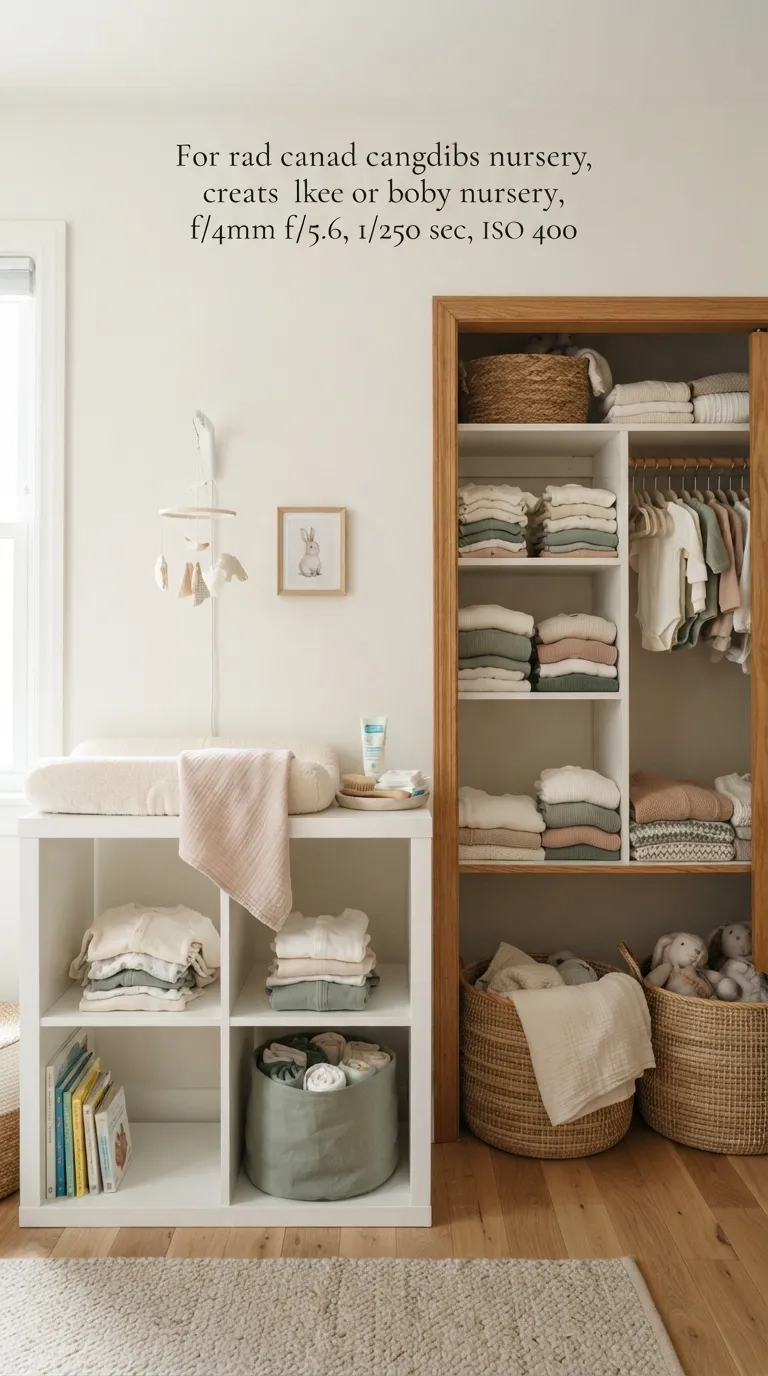
3. Skubb Fabric Boxes Color-Coded by Season
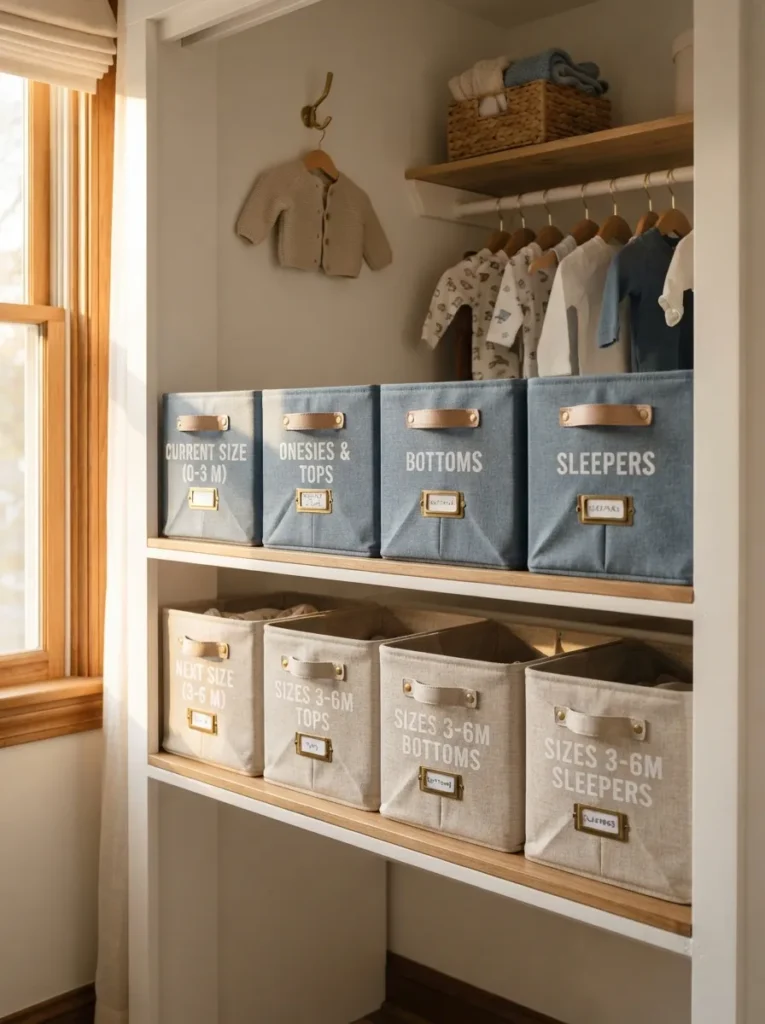
What it looks like: Two rows of soft fabric boxes, one visibly different color from the other, sitting on a closet shelf above the hanging rod.
Why it works: Babies grow out of sizes every six to eight weeks in the first year, and color separates “wear now” from “wear next” faster than reading labels at 6 a.m.
How to copy it: Pick two box colors gray for current size, blush for next size up and swap the entire box out, not individual pieces, the moment a size stops fitting.
Best for: Parents who’ve been caught guessing whether a onesie still fits before getting the baby dressed.
Budget Version: Skip buying extra boxes and use painter’s tape in two colors on the shelf edge instead it costs about $4 and does the same sorting job until you’re ready to upgrade.
The next idea solves a problem most people don’t think about until the closet won’t shut anymore.
4. Pax Wardrobe Customized as a Vertical Nursery Closet
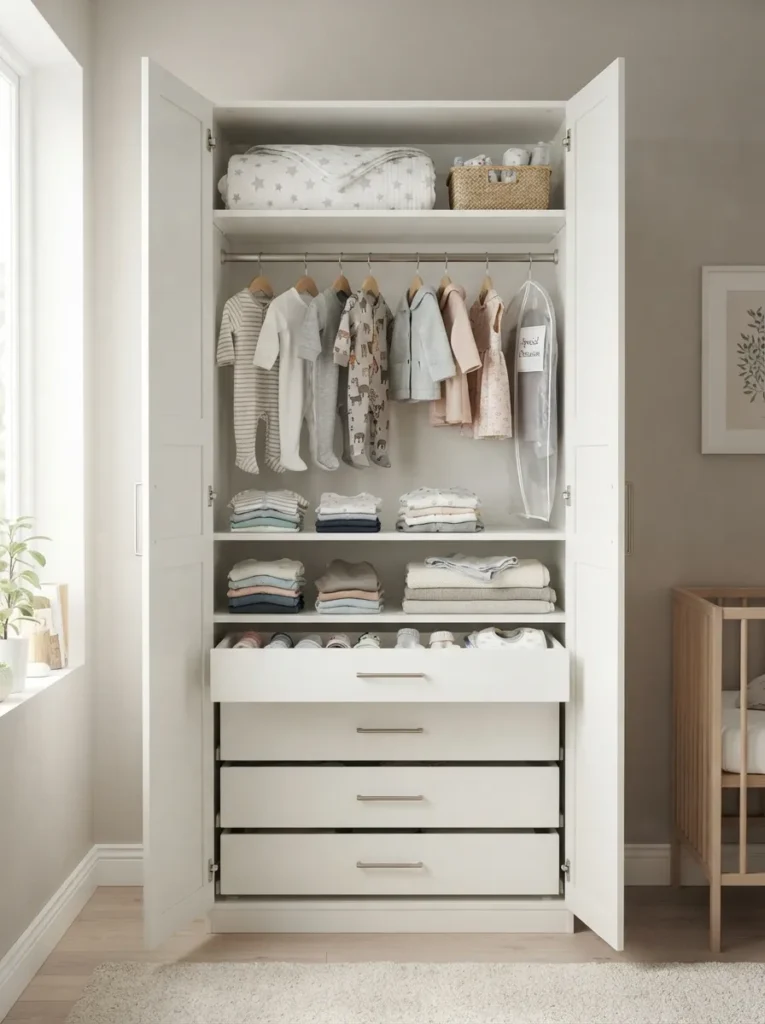
What it looks like: A full-height wardrobe with more shelf space than hanging space, since almost nothing in a baby’s closet needs to hang.
Why it works: Standard closets waste vertical inches above a single hanging rod; a customized frame swaps most of that dead air for shelves and drawers sized to actual baby-clothing dimensions.
How to copy it: Order the narrowest frame that fits your closet opening, then build the interior with roughly 70% shelves and drawers to 30% hanging rod babies mostly need folded storage, not closet rods.
Best for: Anyone converting a standard bedroom closet into a nursery closet from scratch.
Pro Tip: Measure your ceiling height before ordering wardrobe frames come in three heights, and the tallest option often clears code for a stable base cabinet on top, giving you extra sealed storage for keepsakes.
Find It Online:
| Product |
|---|
| Wardrobe frame, narrowest width option |
| Interior shelf inserts |
| Pull-out drawer insert with divider |
| Short hanging rod insert |
| Interior LED lighting strip for wardrobe |
5. Mala Fabric Wall Organizer for Diapers and Wipes
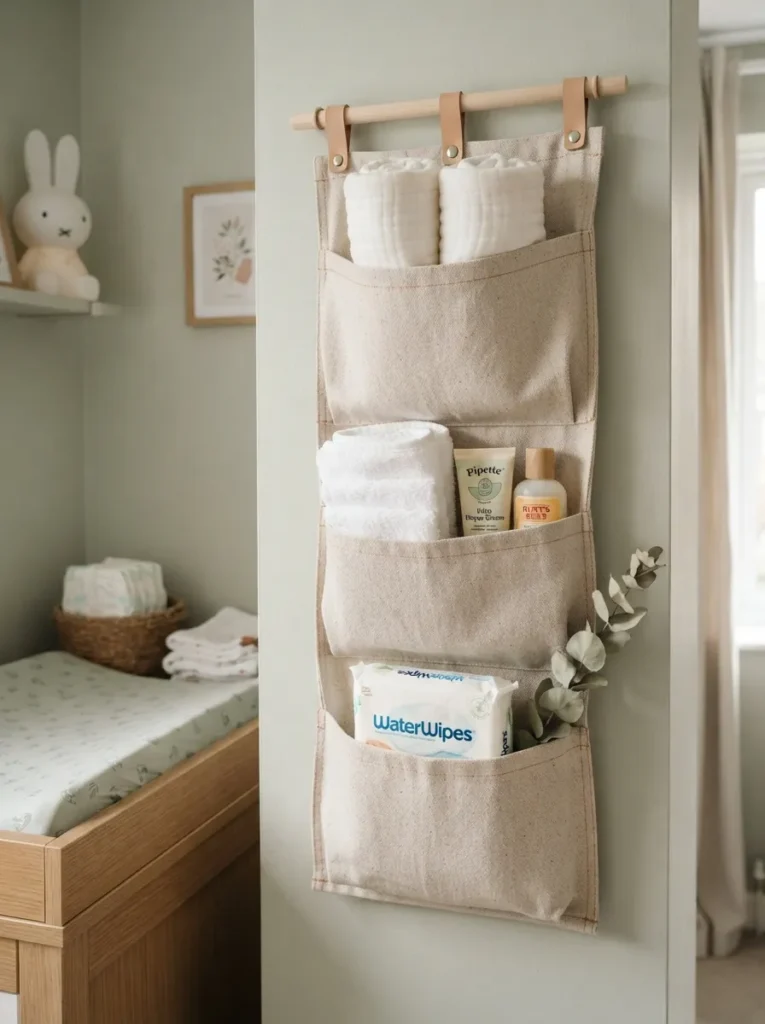
What it looks like: A flat canvas panel with several stitched pockets, hung at arm’s reach beside wherever diaper changes actually happen.
Why it works: Vertical wall pockets free up every inch of horizontal surface near the changing area, which matters because that surface becomes a dumping ground within a week regardless of your intentions.
How to copy it: Mount it slightly lower than seems necessary close enough to grab a wipe one-handed while holding a squirming baby with the other arm and dedicate each pocket to exactly one item.
Best for: Tight changing corners with no nearby shelf or drawer space.
Quick Win: Roll wipes into a spare pocket instead of leaving the plastic pack loose rolled wipes take up roughly half the space and pull out one at a time instead of three.
6. Underbed Storage Baskets Beneath the Crib
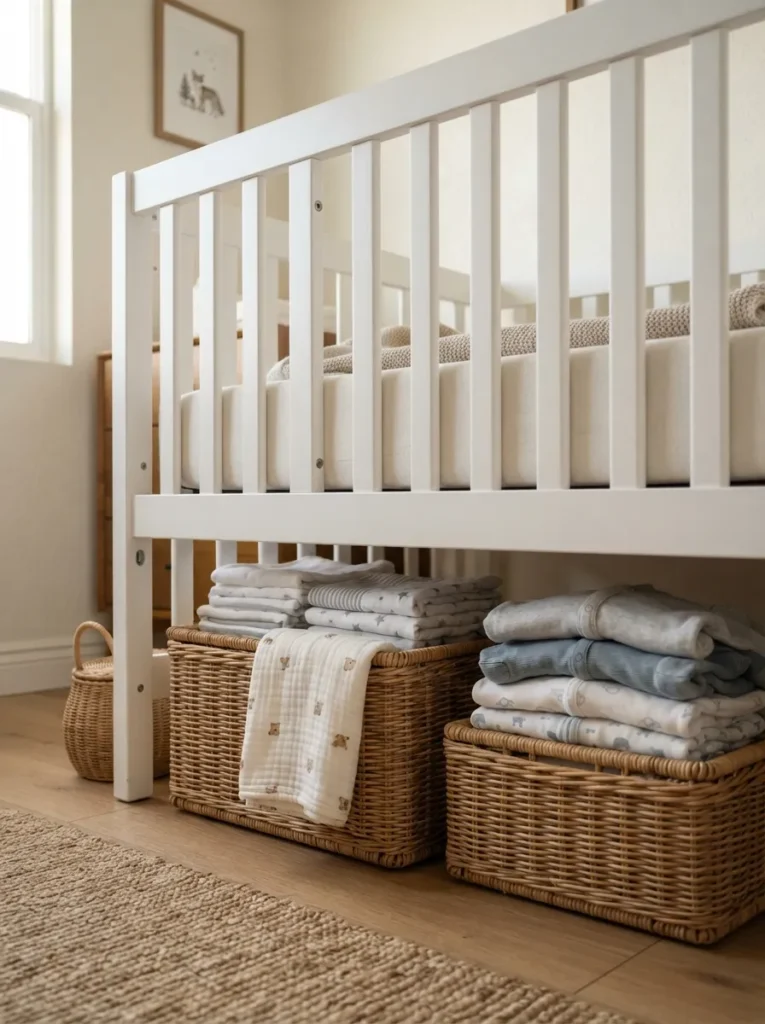
What it looks like: Low, flat baskets sliding into the gap most cribs leave between the floor and the mattress support frame.
Why it works: That gap is usually six to nine inches of completely unused space, and it’s one of the few storage zones that doesn’t compete with wall space or closet real estate.
How to copy it: Measure the exact clearance under your specific crib model before buying anything clearance varies by model and use the space for backup sheets and off-season items, not everyday essentials.
Best for: Nurseries under roughly 80 square feet where every inch of floor plan counts.
Important: Check your crib’s clearance against current safety guidance before adding anything underneath some cribs are designed with that space intentionally open for airflow or cleaning access, and not every model is meant to have baskets wedged beneath it.
Up next: the wall-mounted move that changes everything once your baby starts climbing.
7. Eket Wall Cabinets Floated Above the Changing Table
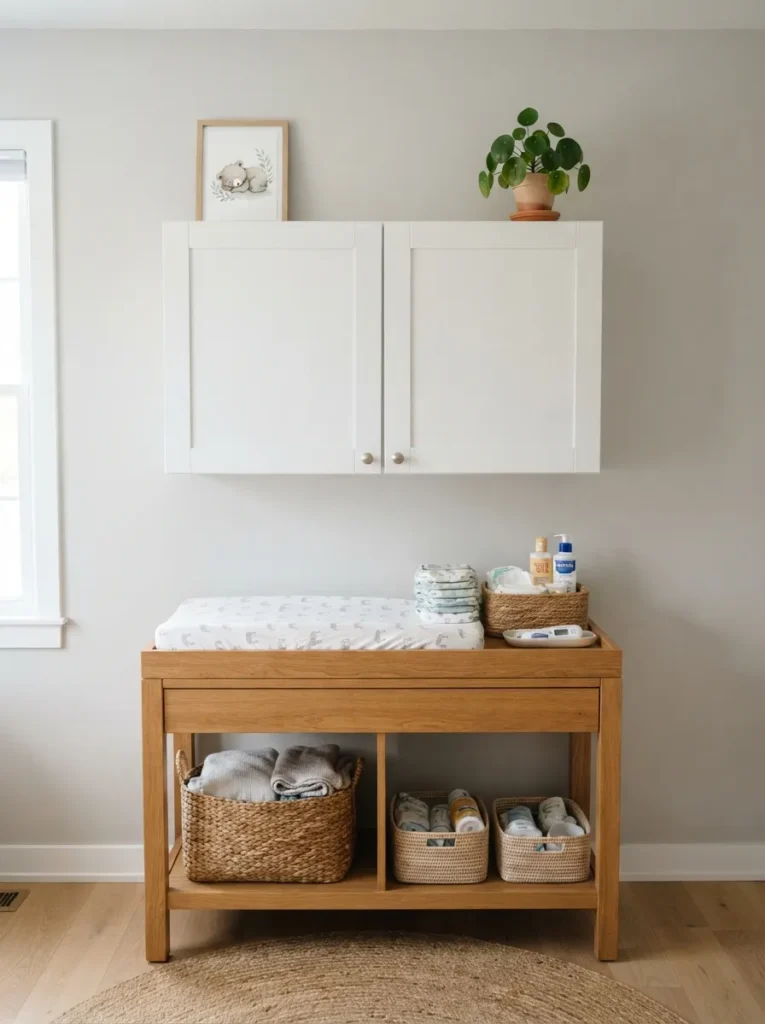
What it looks like: Two boxy cabinets mounted at shoulder height, closed doors hiding anything you don’t want a curious toddler reaching later.
Why it works: Floating cabinets use wall space above the changing table that would otherwise sit empty, and closed doors matter more once your baby becomes a climber who can reach open shelves.
How to copy it: Mount the bottom edge just above where your arm naturally reaches while holding the baby, usually about 50 inches from the floor, and reserve the cabinets for anything sharp, medicinal, or choking-hazard sized.
Best for: Parents planning past the newborn stage, when open shelving stops being safe.
Small-Space Tip: In a nursery under 9 feet wide, mount a single cabinet instead of a pair and pair it with one open shelf below the mix of closed and open storage reads less bulky than two identical boxes stacked.
8. Rationell Drawer Dividers for Tiny Clothing
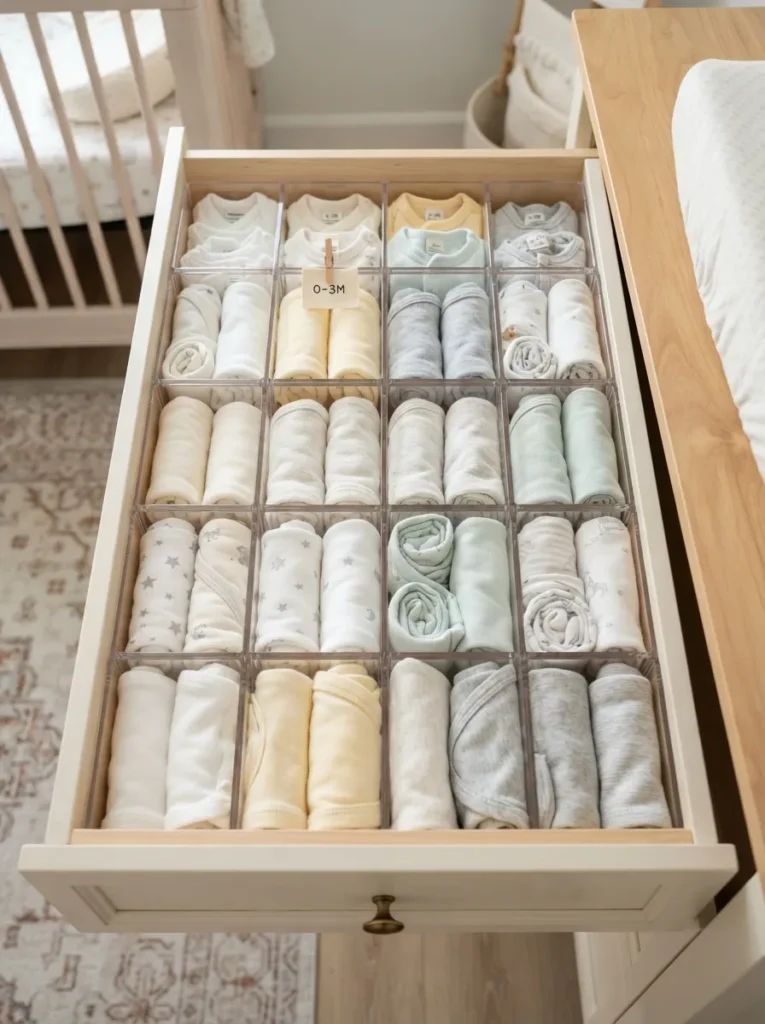
What it looks like: A drawer split into four or five narrow lanes instead of one open pit where everything slides into a pile.
Why it works: Rolling clothing instead of folding it flat lets you see every item at a glance, and dividers keep rolled pieces from toppling into each other the way flat-folded stacks always do.
How to copy it: Roll each onesie from the bottom hem up, stand it on end inside its lane, and sort lanes by size rather than by item type a baby grows out of sizes faster than they cycle through outfit types.
Best for: Anyone who’s opened an “organized” drawer to find it already collapsed into chaos within a week.
Pro Tip: Buy dividers before you buy the dresser wherever possible inserts are sized to specific drawer widths, and a mismatch means they shift and slide instead of locking into place.
Find It Online:
| Product |
|---|
| Drawer divider insert set |
| Clear acrylic drawer organizer bins |
| Fabric drawer liner, wipeable |
| Size-sorting hanging clip tags |
| Rolled-clothing storage baskets for overflow |
9. Flisat Picture Ledge for Face-Out Book Display
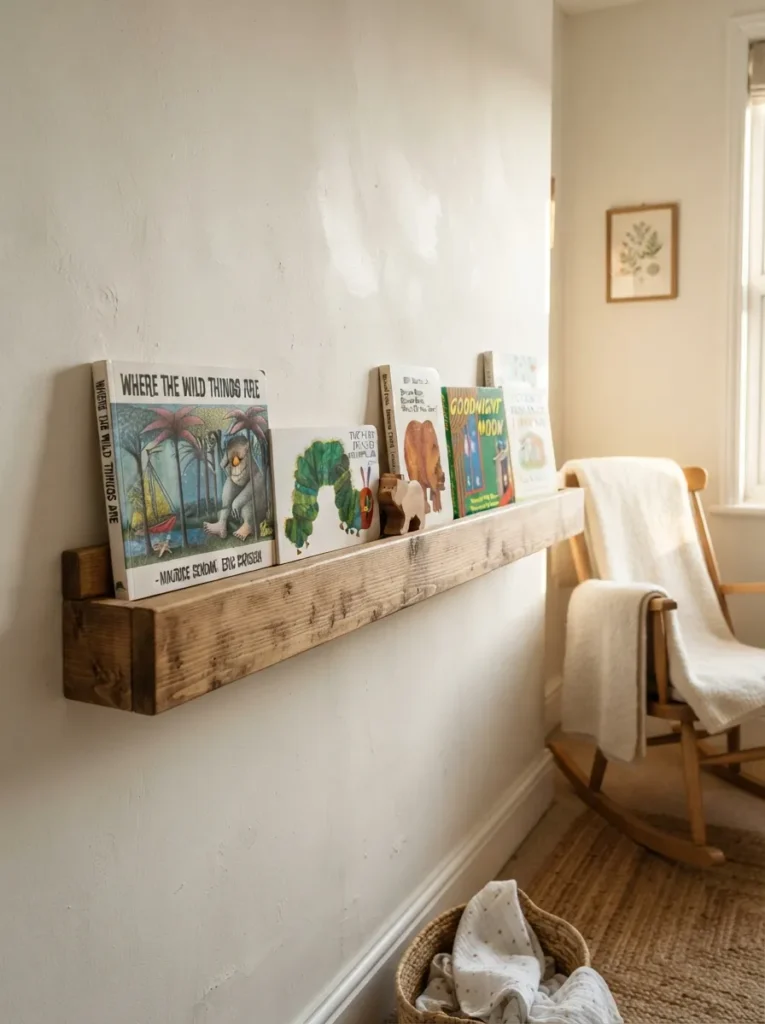
What it looks like: A shallow wooden groove running along the wall at a toddler’s eye level, holding books upright with covers facing out.
Why it works: A young child recognizes a book by its cover, not its spine, so face-out shelving gets books actually picked up and read instead of ignored on a traditional bookshelf.
How to copy it: Mount the ledge low 12 to 16 inches off the floor for a toddler, higher for a newborn’s room meant to grow with them and rotate only five or six books at a time.
Best for: Building an early reading habit without a dedicated bookshelf eating floor space.
Styling Note: Group books loosely by cover color rather than alphabetically it reads calmer on the wall, and nobody browsing a board book collection searches by author anyway.
This next one surprised even experienced organizers the first time they tried it.
10. Woven Vindrutan Baskets for the Closet Floor
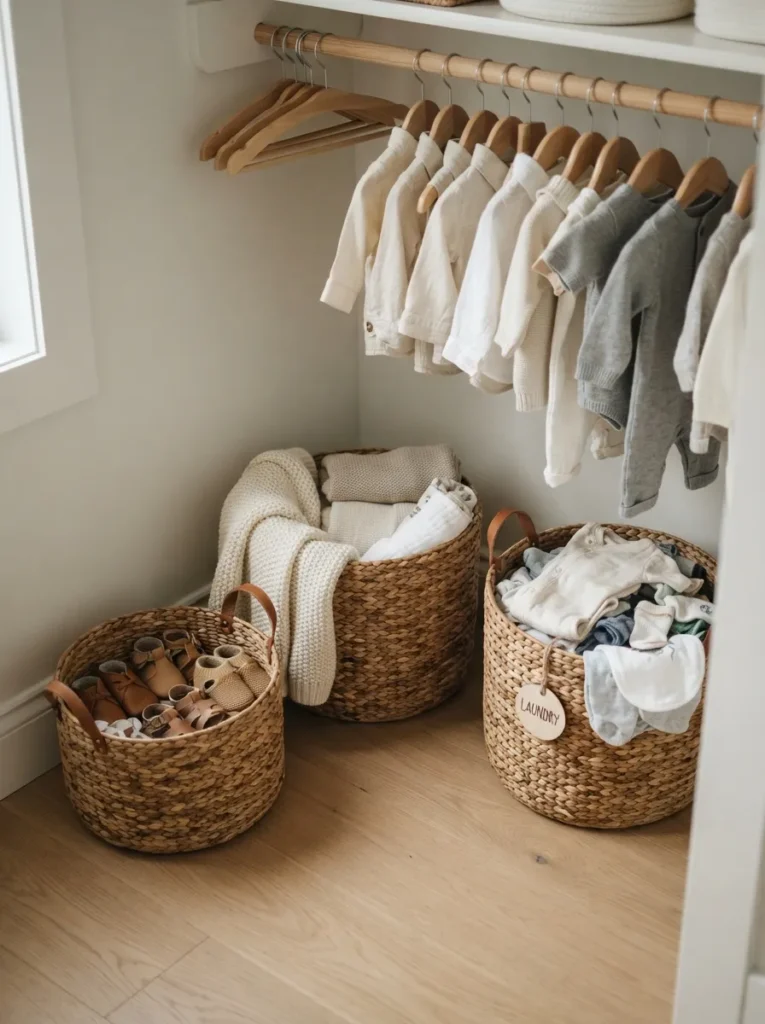
What it looks like: A row of woven baskets sitting directly on the closet floor, using the one zone most closets waste completely.
Why it works: Closet floors are almost always empty dead space below the hanging rod, and open-weave baskets breathe better than sealed bins for anything slightly damp, like a blanket that got a wash-day delay.
How to copy it: Assign each basket one job only shoes, blankets, laundry overflow and keep them shallow enough to see contents at a glance without digging.
Best for: Closets with a single hanging rod and no built-in shelving.
Important: Woven baskets aren’t ideal for anything that needs to stay dust-free long-term, like keepsake items the open weave lets dust settle in faster than a closed fabric box would.
11. Sundvik Dresser Topped With a Changing Pad
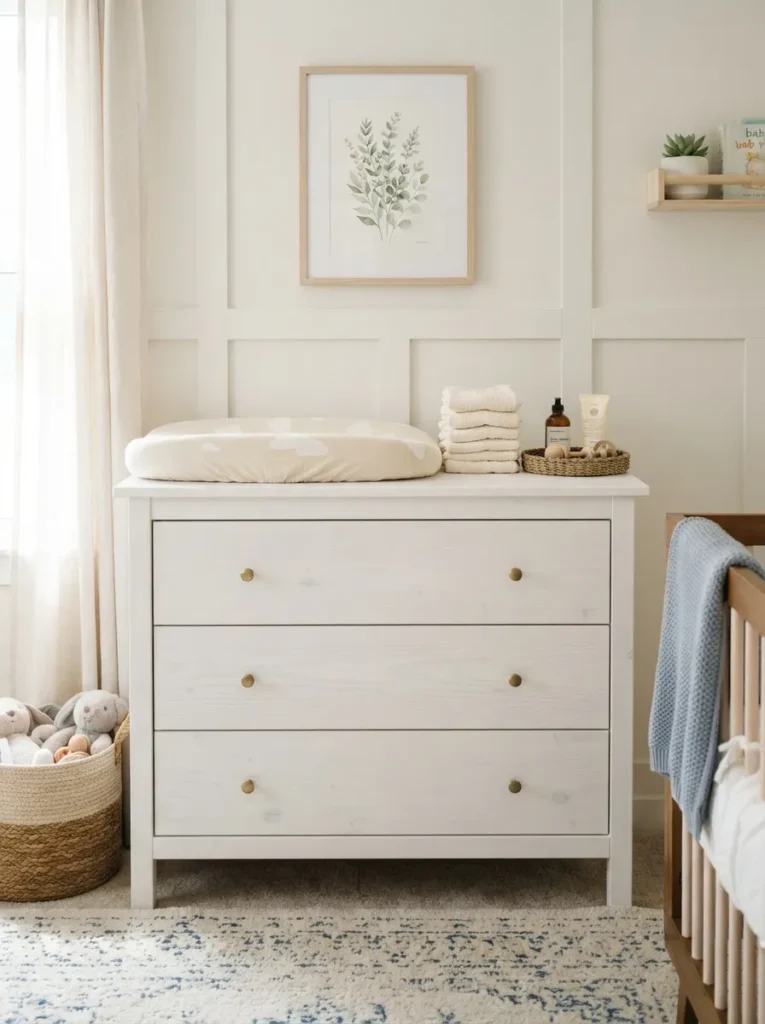
What it looks like: A traditional three-drawer dresser with a strap-on pad on top, functioning as changer and long-term wardrobe in one footprint.
Why it works: Unlike open-cubby storage, drawers keep contents dust-free and out of sight, which matters once the nursery doubles as a guest room and needs to look presentable at a glance.
How to copy it: Reserve the top drawer for daily essentials within one-handed reach, the middle for current-size clothing, and the bottom for the next size up top-to-bottom should roughly track how often you open each one.
Best for: Parents who prefer closed storage over open bins for a calmer-looking room.
Budget Version: Skip the official changing topper and use a firm, washable pad with non-slip backing instead any flat, wipeable surface works as long as it doesn’t shift on top of the dresser.
Find It Online:
| Product |
|---|
| Fitted waterproof changing pad, dresser-width |
| Non-slip pad backing strips |
| Drawer liner paper, washable |
| Wall-mounted safety strap kit |
| Small catch-all tray for loose items |
12. Battery LED Strip Lighting Inside Open Kallax Cubbies
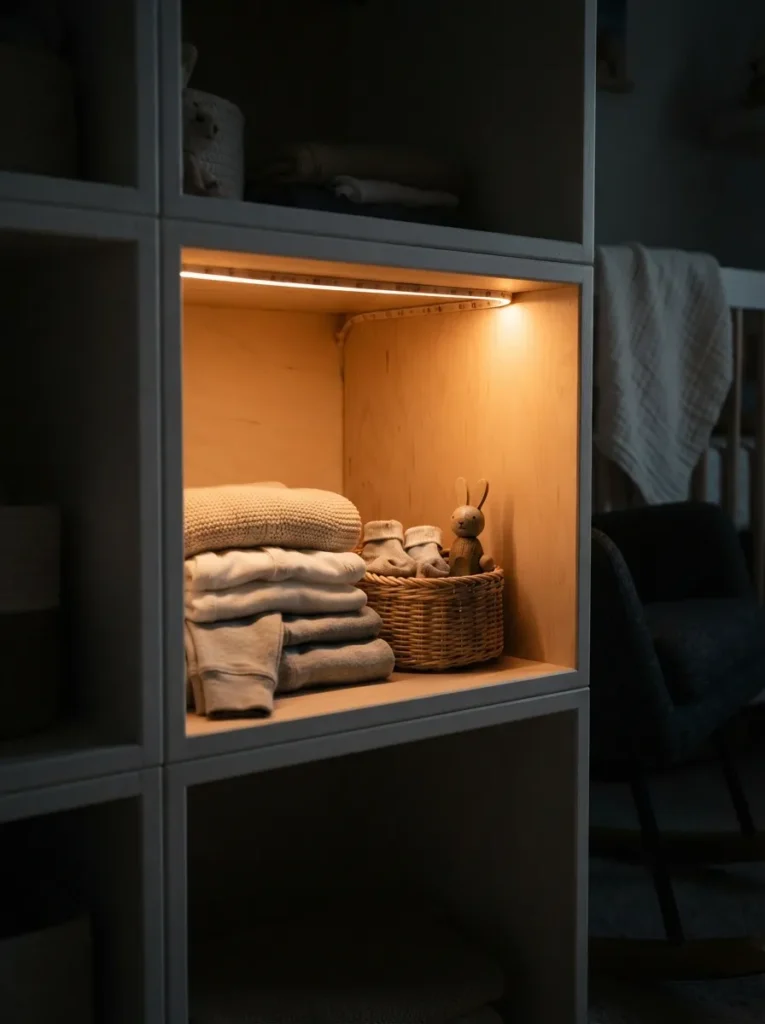
What it looks like: A soft amber glow spilling from inside one or two cubbies, visible even with the main light off.
Why it works: Late-night diaper changes don’t need a full overhead light that jolts an already-half-asleep baby awake a low, warm glow is enough to see by without resetting anyone’s sleep cycle.
How to copy it: Stick battery-powered LED strips along the top inside edge of just the cubbies you’ll reach into at night, set to warm white rather than daylight color temperature, and keep the remote within reach of the changing area.
Best for: Nurseries where the light switch is inconveniently far from the crib or changing table.
Pro Tip: Choose a strip with a dimmer remote over one with only on/off even warm LED light at full brightness can be more disruptive at 3 a.m. than you’d expect.
Keep going the next few ideas cover the parts of the room most guides skip entirely.
13. Ivar Shelving Painted in Soft Sage for Open Display
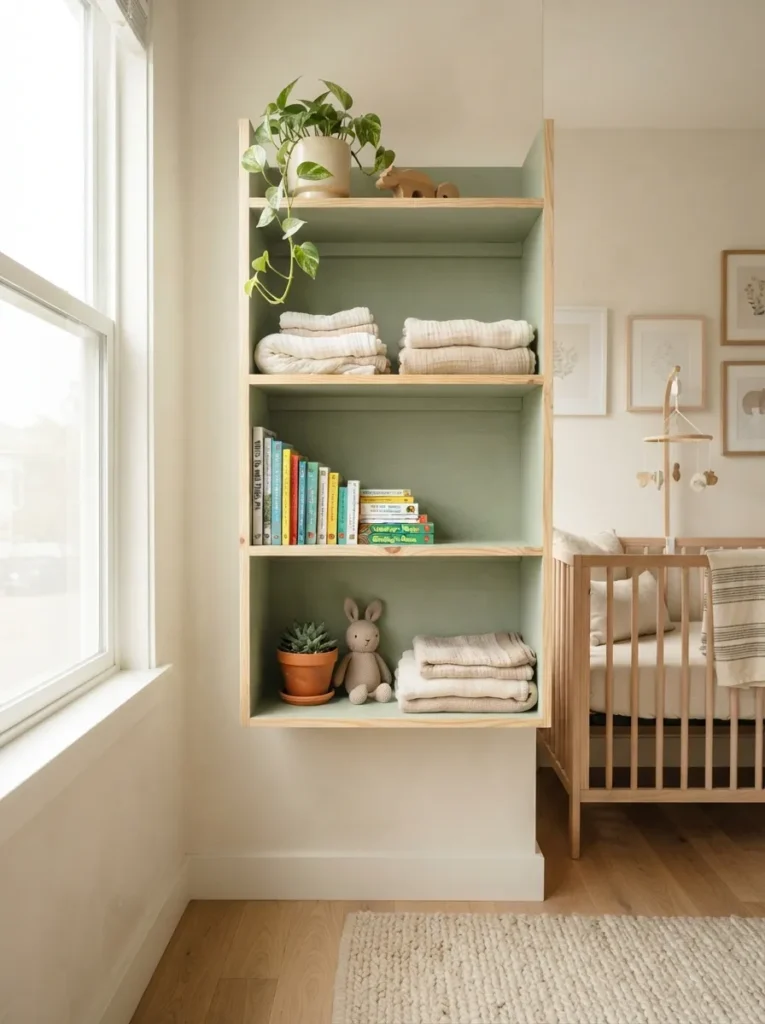
What it looks like: Raw pine shelving transformed with a single coat of muted green paint, holding a mix of folded textiles and a few displayed objects.
Why it works: Unfinished shelving is meant to be painted, and a single consistent color across an otherwise mismatched mix of baby items visually unifies open shelving that would otherwise look cluttered.
How to copy it: Sand lightly, prime, then use a chalk-style or matte paint in a muted green like sage or eucalyptus matte finishes hide fingerprints and scuffs far better than satin or gloss.
Best for: Parents who want visible, decorative storage rather than everything hidden behind closed doors.
Styling Note: Keep no more than a third of the shelving purely decorative the rest needs to function as real storage, or the unit becomes another surface that collects clutter instead of solving it.
14. Smastad Storage Bench With a Cushioned Top
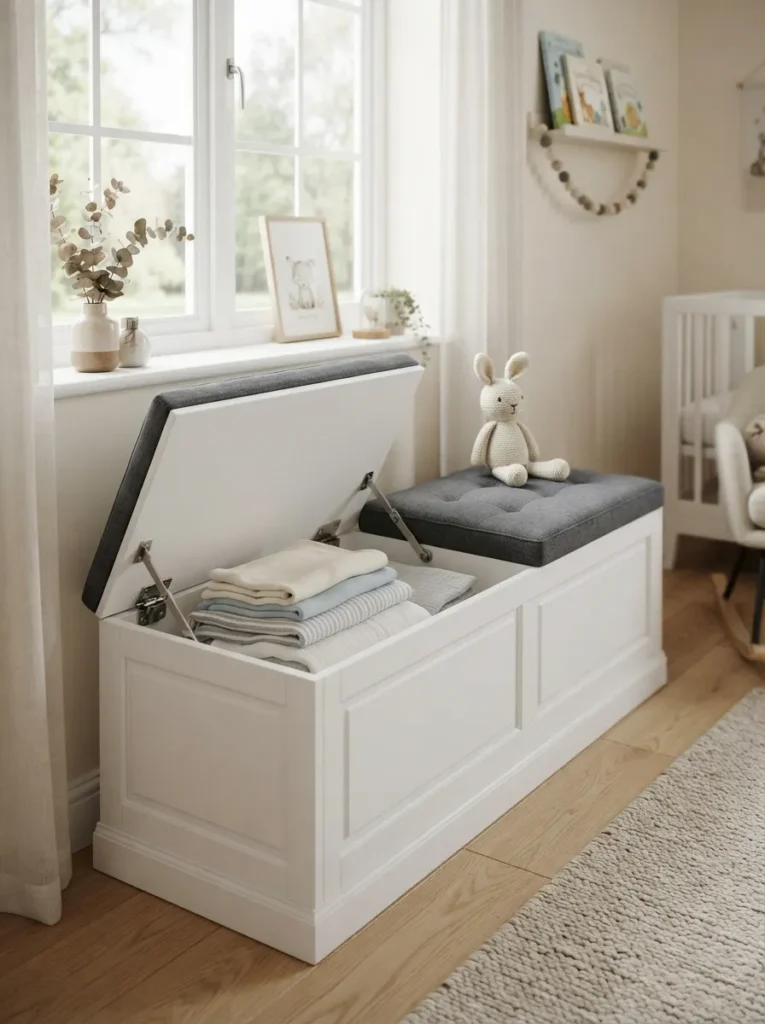
What it looks like: A bench-height box with a padded lid, doubling as seating and a hidden storage cavity underneath.
Why it works: A window seat or reading nook needs seating anyway, so building storage into that exact spot means you’re not sacrificing floor space for a separate storage piece.
How to copy it: Position it under a window if you have one, use the hidden cavity for bulky, infrequently used items like extra bedding, and check for a soft-close hinge before buying a slammed lid near a napping baby is a bad surprise.
Best for: Nurseries with an underused window nook or dead corner.
Important: A hinged lid storage bench isn’t recommended once your child is mobile and curious about climbing into boxes plan to phase this one out or add a hinge lock by the time they’re pulling up to stand.
15. Mulig Clothes Rack for Out-of-Season Overflow
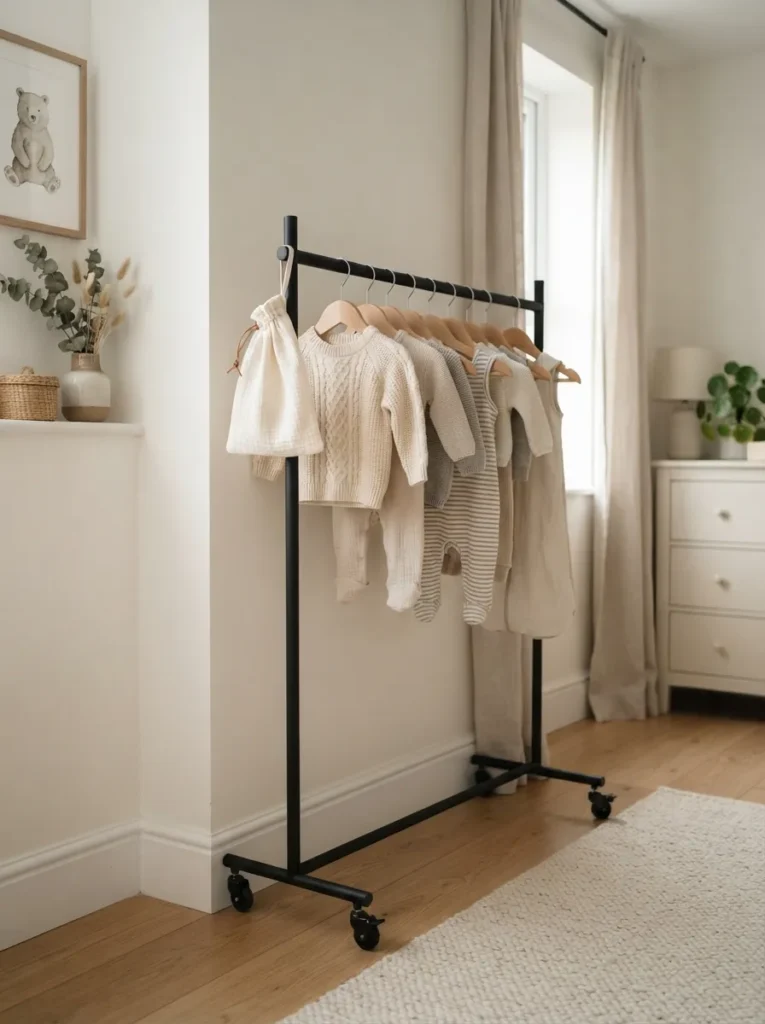
What it looks like: A slim rolling rack tucked into a corner, holding a small, deliberately limited row of clothing.
Why it works: Closets fill up fast with sizes a baby hasn’t grown into yet, and a mobile rack lets that overflow live somewhere separate and roll out of the room entirely once it’s not needed.
How to copy it: Cap it at one rack’s width of hangers, and the moment it overflows, that’s the trigger to box up and store the oldest out-of-season items rather than buying a second rack.
Best for: Nurseries with a single small closet already at capacity.
Quick Win: Use matching slim velvet hangers instead of mismatched wire ones the same rack fits nearly twice as many outfits, and clothes stop sliding onto the floor.
One more stretch the last few ideas tie the whole system together.
16. Godmorgon Woven Baskets for Bath and Laundry Overflow
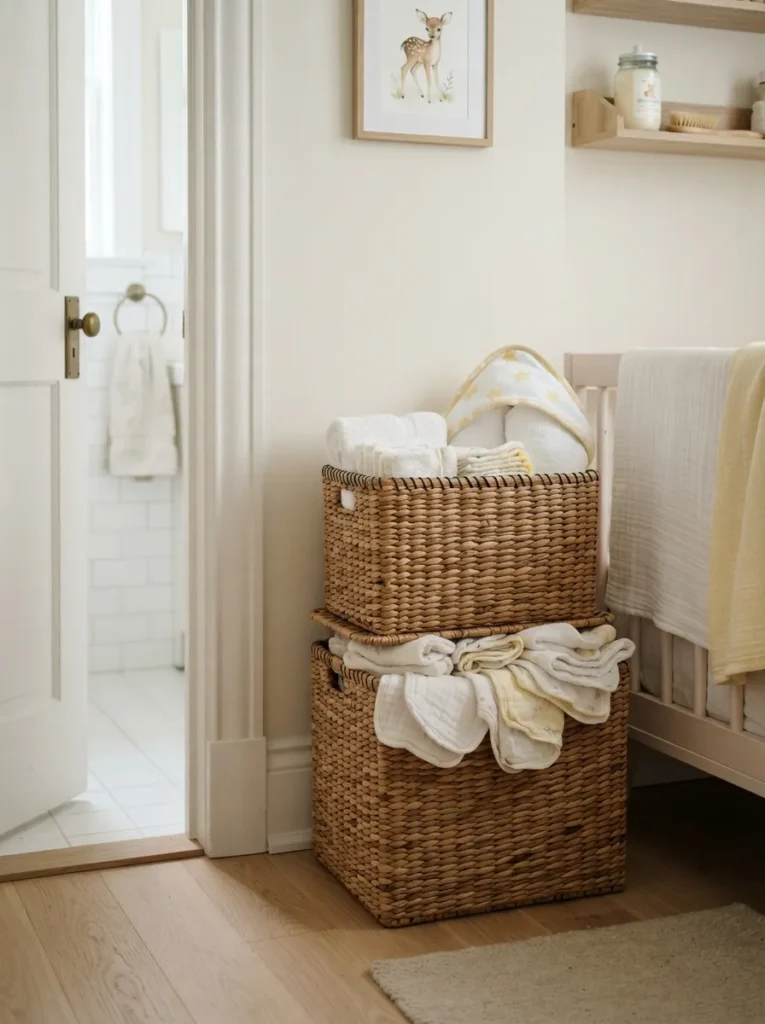
What it looks like: A stacked pair of tightly woven baskets, one clearly larger, holding bath linens and laundry that hasn’t made it to the hamper yet.
Why it works: Bath time generates its own small pile of towels and washcloths that rarely belongs in the main dresser, and keeping that pile physically separate stops bath-damp items from ending up next to folded clean clothing.
How to copy it: Use the larger basket for clean towels stored dry, and a smaller, separate one strictly for items headed to laundry never mix clean and dirty, even temporarily.
Best for: Nurseries where the bathroom is down the hall rather than attached.
Pro Tip: Line the laundry-bound basket with a mesh bag you can lift out whole and drop straight into the washer it skips re-sorting a pile by hand later.
Find It Online:
| Product |
|---|
| Tightly woven rattan basket, large |
| Tightly woven rattan basket, small |
| Machine-washable mesh laundry liner bag |
| Hooded baby bath towel set |
| Basket-mounted label tag clips |
17. Warm Dimmable Sconce Near the Reading Nook Shelf
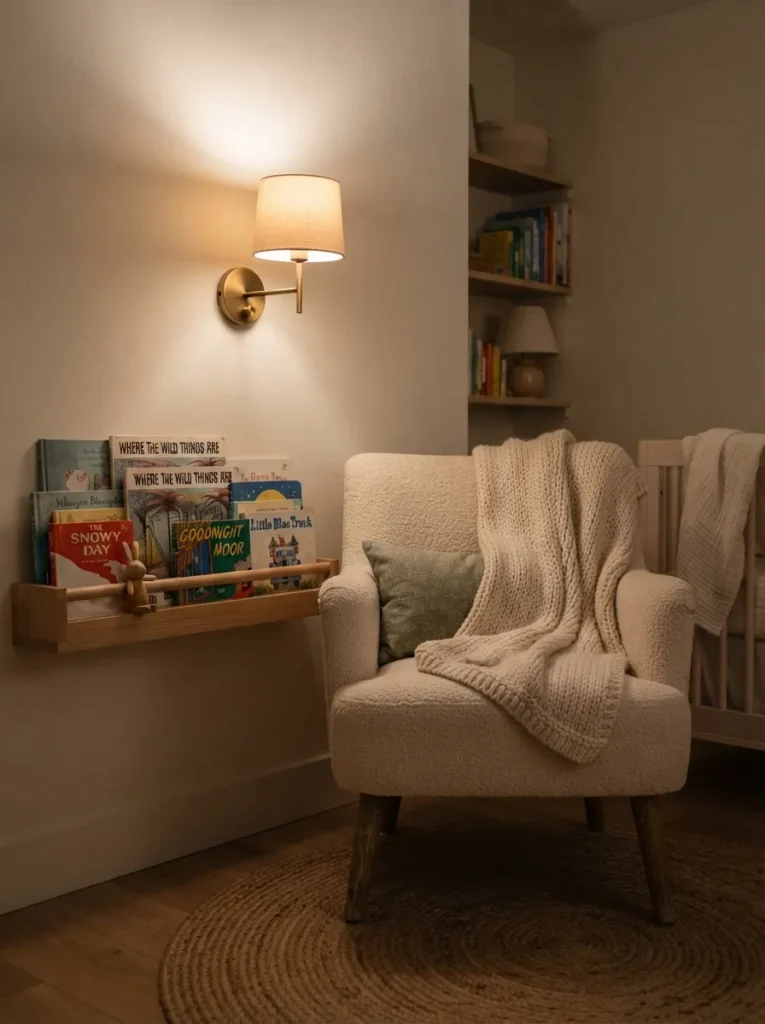
What it looks like: A single small wall light with a soft fabric shade, mounted at seated eye level beside a reading corner.
Why it works: Overhead lighting is too harsh for a bedtime story, and a dimmable sconce lets you dial brightness down gradually as part of the wind-down routine instead of it staying either fully on or fully off.
How to copy it: Mount it slightly behind and above where an adult’s shoulder sits while reading in the chair, so light falls on the page rather than into anyone’s eyes, and choose a warm 2700K bulb over a cooler white one.
Best for: Rooms already set up with a book ledge or reading corner that need better task lighting.
Small-Space Tip: If there’s no wall space free for a sconce, a plug-in dimmable lamp on a nearby shelf does the same job without any wiring just keep the cord routed along the baseboard, not across open floor.
My Views:
Here’s something most guides won’t tell you: the closet almost always matters more than the crib wall. In real nurseries, families spend weeks agonizing over the perfect gallery wall above the crib and then cram an entire year of clothing sizes onto one 12-inch shelf and a single rod. Flip that ratio build out the closet with a customized wardrobe frame or stacked cube shelving first, and the rest of the room tends to organize itself around what’s left over.
18. Zoning the Room Into Reach, Store, and Display
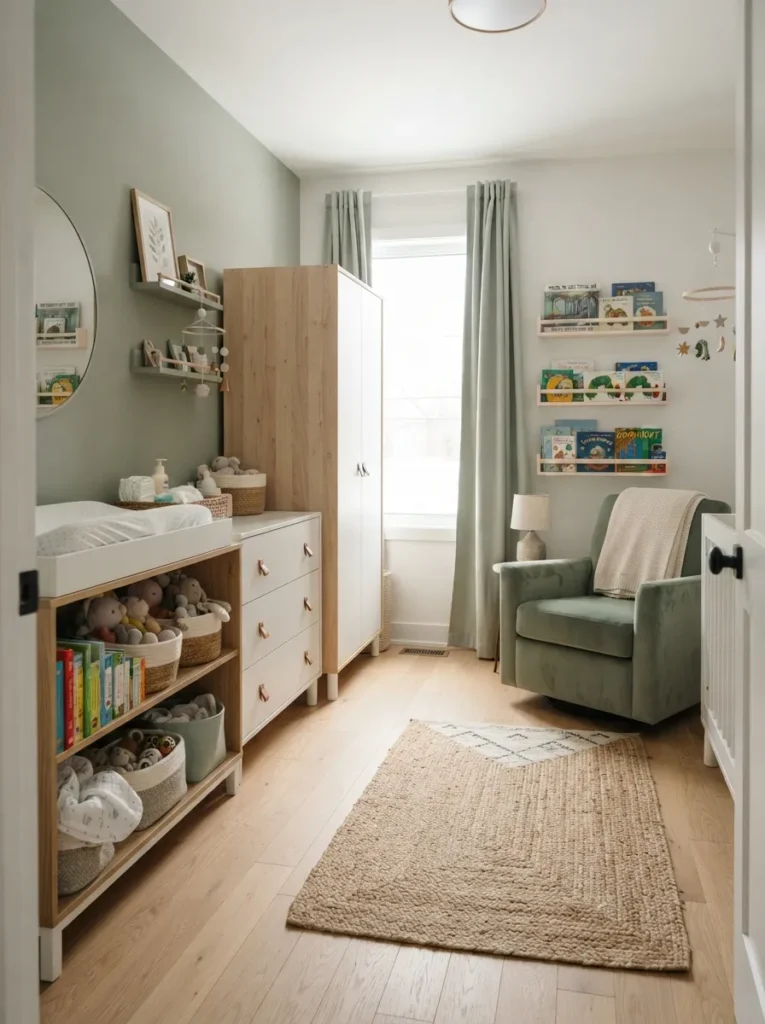
What it looks like: The room split into three invisible zones instead of one continuous wall of matching furniture.
Why it works: A reach zone for daily-use items, a store zone for closed, less-frequent items, and a display zone for books and a few decorative pieces each demand different storage treating them as one category is why most nurseries end up cluttered despite having “enough” furniture.
How to copy it: Walk your actual daily routine where you stand to change a diaper, where you grab pajamas, where you sit to read and place storage at each of those physical points rather than distributing furniture evenly around the room’s perimeter.
Best for: Anyone who’s bought plenty of storage furniture but still feels like the room doesn’t work.
Important: Zoning only holds up if everyone using the room follows it if a partner or caregiver doesn’t know the system, items drift back into one catch-all pile within a couple of weeks.
19. Color-Blocked Bins by Garment Type for Fast Mornings
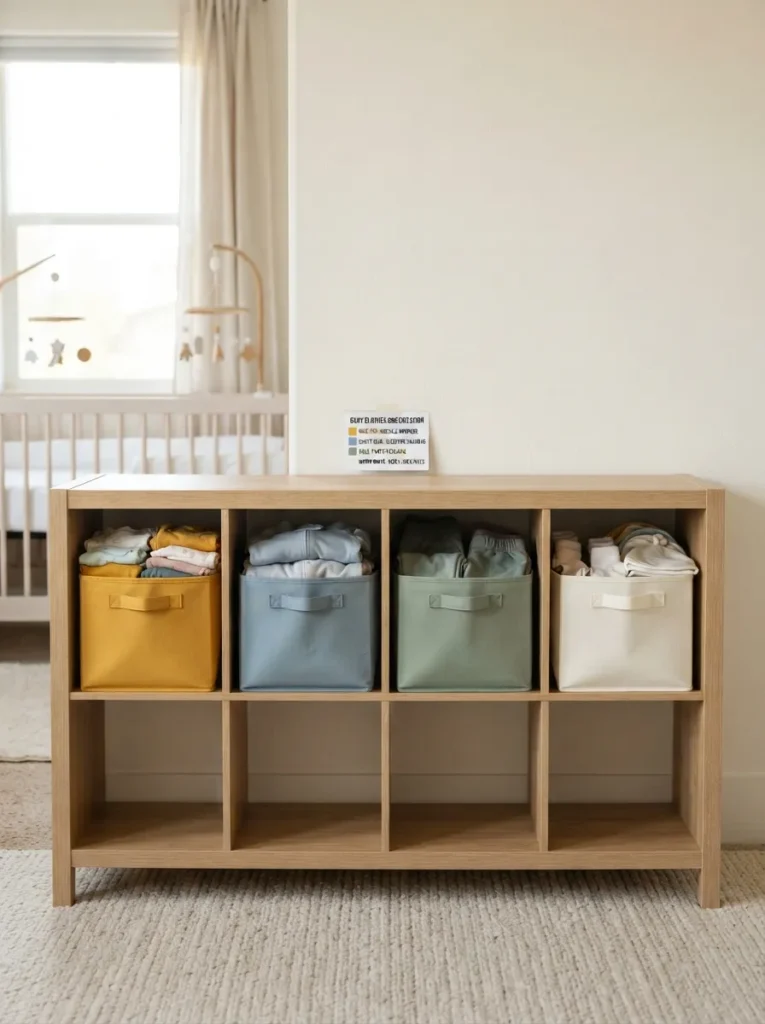
What it looks like: Four boldly different-colored bins side by side inside a Kallax shelf built for toy and clothing sorting, each one visually distinct from across the room.
Why it works: Color coding works faster than reading labels, especially for a half-awake parent or a caregiver who’s never opened this closet before mustard means socks, blue means sleepers, no reading required.
How to copy it: Assign one color per garment category, not per size, since size is already handled by the seasonal box rotation from idea 3, and keep a small written key taped inside a nearby cabinet door for anyone new to the system.
Best for: Households with rotating caregivers, grandparents, or babysitters who need to find things without asking.
Pro Tip: Choose four colors that are genuinely easy to tell apart at a glance two shades of blue defeats the purpose of the system entirely.
How to Start Your IKEA Nursery Storage Setup
What I’ve found with real nurseries: start with a single Kallax 4×2 unit before buying anything else. It’s inexpensive enough to reposition if your layout plan changes, and doubling it as a changing table base means your first purchase solves two problems instead of one.
The most common fixable mistake is buying every storage bin on day one before sorting a single piece of clothing. Bins purchased blind rarely match what you actually own you end up with six deep bins and nothing shallow enough for socks. Sort first, even into loose piles on the floor, then buy exactly what those piles need.
Three cheap items make an outsized difference early: a set of drawer dividers (under $15) for tiny clothing, a single fabric wall organizer (around $10) for the changing area, and one battery LED strip (roughly $15) for nighttime cubby lighting.
A single zone the closet or the changing station is realistic in a weekend for $80 to $150. A full-room system across closet, changing area, and toy storage usually takes four to six weekends spread over a month or two, with most families landing between $250 and $500 total depending on how much they already own.
Ready to Organize Your Nursery for Real Life?
Between color-coded bins, a repurposed changing table, and a closet finally using its vertical space, these 19 ideas cover almost every inch of a real nursery not just the parts that photograph well. None of this needs to happen at once; picking one zone and finishing it properly beats half-finishing all of them.
Tonight, do the smallest possible thing: sort one drawer into rough categories, even without a single new bin yet. A nursery that actually works gives you back time and a little bit of calm on the nights you have the least of both. Pin your favorites now the Kallax changing table combo and the closet zoning idea are the two worth revisiting once you’ve seen the room in person.
You Might Also Like
- 12 Small Nursery Layout Ideas That Don’t Sacrifice Storage
- 15 IKEA Hacks for a Budget-Friendly Kids’ Room
- 10 Closet Organization Systems for Growing Families