15 IKEA Kallax Nursery Ideas for New Parents on a Budget
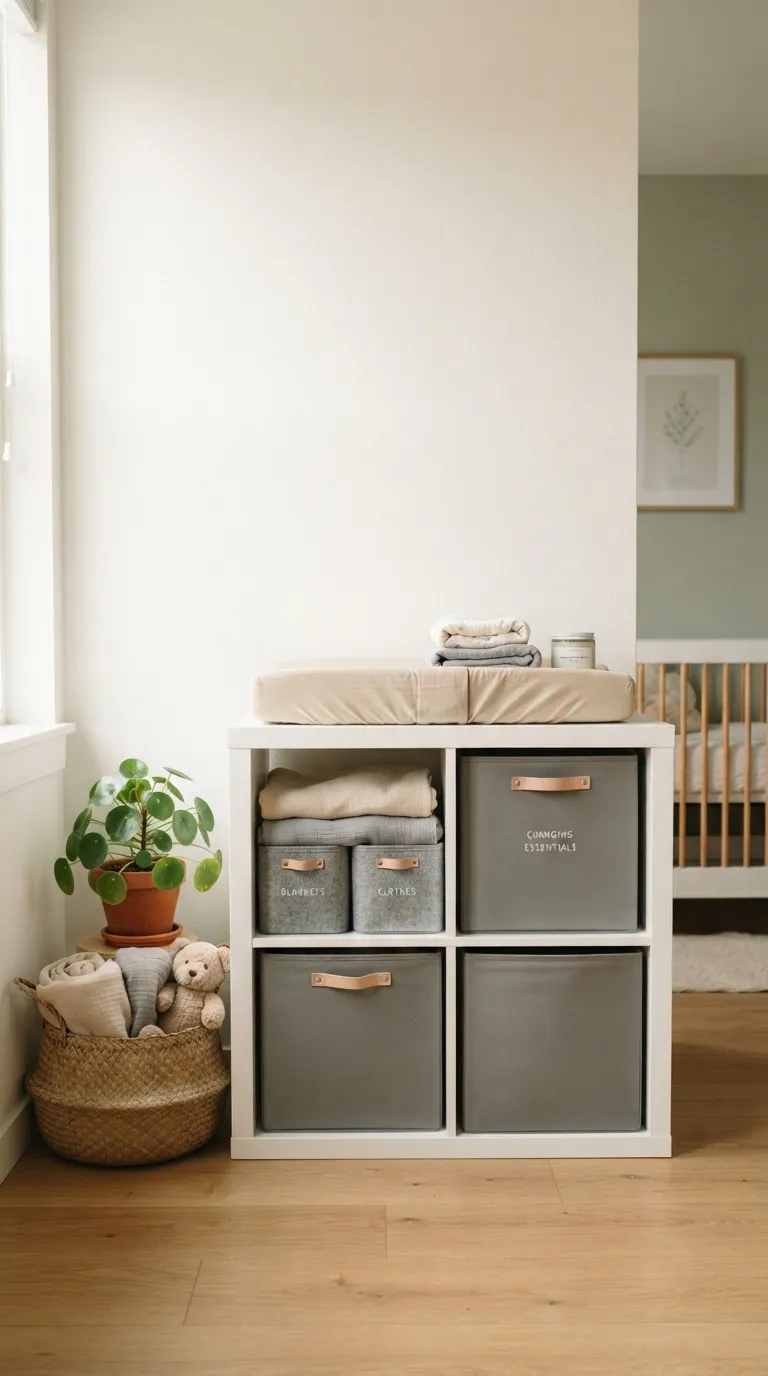
A Kallax unit is IKEA’s modular cube shelving system four cubes, eight cubes, or a full sixteen-cube wall and in a nursery it doubles as a changing station, a diaper caddy, a bookshelf, and a toy bin without eating up floor space you don’t have. Below are 15 ways to turn that one piece of furniture into the backbone of a nursery that actually works on a real budget.
New parents don’t need more inspiration boards they need somewhere for the onesies to go before laundry day three. A Kallax against the wall means less clutter on the floor and less standing in the middle of the room wondering where anything is. Get the setup right once, and every 3am diaper change gets a little less chaotic. Let’s get into it.
Quick Navigation
- Why Kallax Nursery Storage Makes Such a Difference
- 15 IKEA Kallax Nursery Ideas
- How to Start Your Kallax Nursery Setup
- Ready to Organize Your Nursery?
Why Kallax Nursery Storage Makes Such a Difference
The Kallax system has been an IKEA staple since the early 2000s, sold in white, black-brown, and pale birch laminate finishes that hold up to years of use. In a nursery it earns its keep because baby gear changes every few months a 2×2 unit sized right can go from bottle storage to board books to toddler bins without buying new furniture.
It works in small rooms, too, if you start with a single 2×2 against the changing wall before adding anything else.
| Best starting point | One 2×2 or 1×4 Kallax against the changing wall |
| Biggest impact area | Bin and insert organization |
| Budget to start | $60–$150 |
| Time to complete | One afternoon |
15 IKEA Kallax Nursery Ideas
1. Anchor It Before You Style It
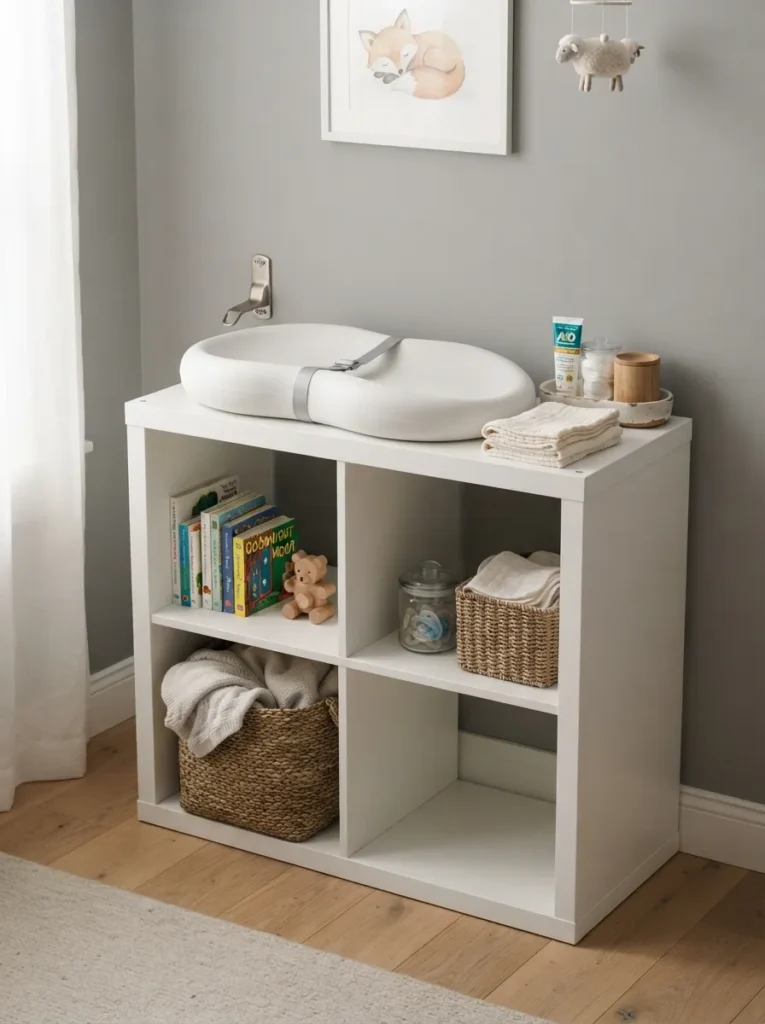
What it looks like: Clean and unremarkable, exactly how it should be. Nothing about a properly secured Kallax stands out that’s the point.
Why it works: A Kallax used as a changing table is top-heavy once a pad and strap are added, and a mobile toddler pulling up on the front edge can tip it. Anchoring it to a wall stud with an anti-tip kit removes that risk without changing how the piece looks.
How to copy it: Buy a metal L-bracket anti-tip kit (not the plastic strap that ships with some units), locate a stud with a stud finder, and screw the bracket into both the unit and the wall before you load a single bin. Once it’s anchored, it becomes the anchor point for a full nursery storage system beyond just the Kallax.
Best for: Every single person setting up a nursery this isn’t optional.
Warning: Skipping the anchor because “it’s against the wall anyway” is the single most common Kallax nursery mistake. A unit resting against drywall with nothing screwed in can still pull forward under enough weight anchor it into a stud, not just the drywall.
Shop This Look
| Product |
|---|
| Metal anti-tip L-bracket furniture anchor kit |
| Contoured changing pad with safety strap, standard Kallax width |
| Stud finder |
| Wall anchor screws, drywall-rated |
| Non-toxic water-based finish touch-up pen for scuffs |
2. A Labeled Bin System for Grab-and-Go Changes
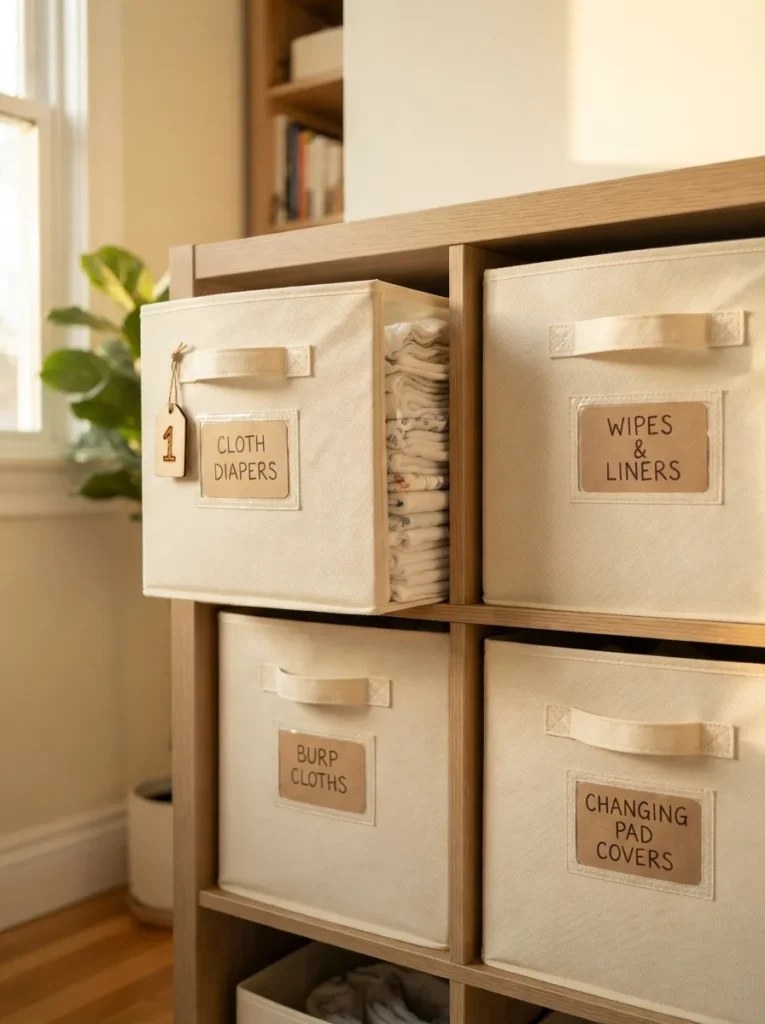
What it looks like: Tidy in a lived-in way bins that get pulled out and pushed back in daily, not display pieces.
Why it works: Decision fatigue at 3am is real, and a system that requires reading labels defeats the purpose. Color or icon-based labeling lets a sleep-deprived parent grab the right bin without thinking.
How to copy it: Use one bin per category diapers, wipes and cream, swaddles, burp cloths and label each with a simple icon rather than a full word, since icons register faster in low light. The same logic scales well into a broader closet organization system once you’re tackling more than the nursery.
Best for: Parents who’ll have night-shift help partners, grandparents, or a sitter who don’t know your system yet.
Budget Version: Skip branded label makers. A paint pen and painter’s tape on the bin front costs under $5 and peels off clean if the system changes.
3. Color-Coded Bins by Clothing Size
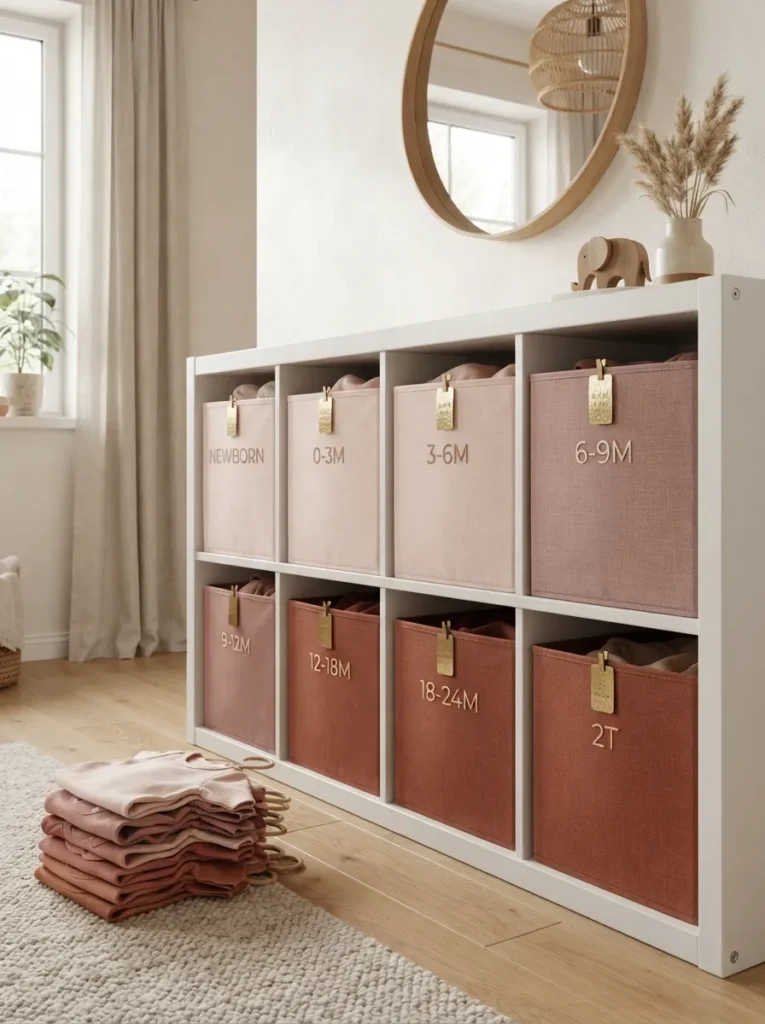
What it looks like: A gentle gradient, left to right, that reads as intentional rather than mismatched.
Why it works: Newborns outgrow sizes every few weeks, and a color sequence lets you scan for “what’s next” without pulling every bin. It’s a sorting system disguised as decor.
How to copy it: Assign one color family per size range newborn, 0-3 months, 3-6 months and keep the current size in the most reachable middle cube, not the top or bottom.
Best for: Parents stocking up on hand-me-downs or gifted clothing in bulk.
Quick Win: Don’t buy new bins for this dye or swap fabric bin covers on bins you already own for under $10 a set.
The next idea leans on texture instead of color, and it’s the one most people skip entirely.
4. Woven Seagrass Baskets for Soft Texture
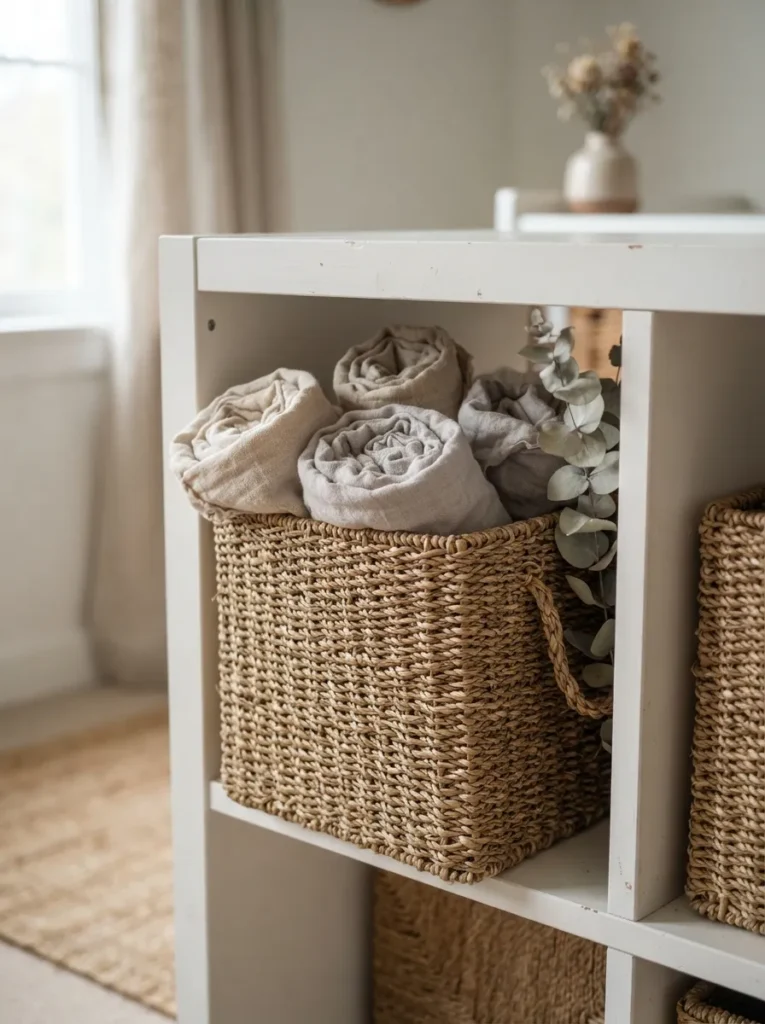
What it looks like: Soft-edged and textural against the Kallax’s flat laminate the one material break in an otherwise rectilinear grid.
Why it works: All-fabric or all-plastic bins can feel sterile in a room meant to feel warm. Seagrass adds visual weight and texture contrast without adding pattern, which keeps a small room from feeling busy.
How to copy it: Reserve seagrass baskets for soft goods only blankets, burp cloths, stuffed animals since seagrass doesn’t hide odor the way a washable fabric bin does with diapers.
Best for: Parents who want the room to feel less clinical without committing to a full design style.
Pro Tip: Seagrass baskets vary in width by a half-inch or more between batches measure your cube opening (13×13 inches on a standard Kallax) before ordering, not after.
5. LED Puck Lights Inside the Cubbies
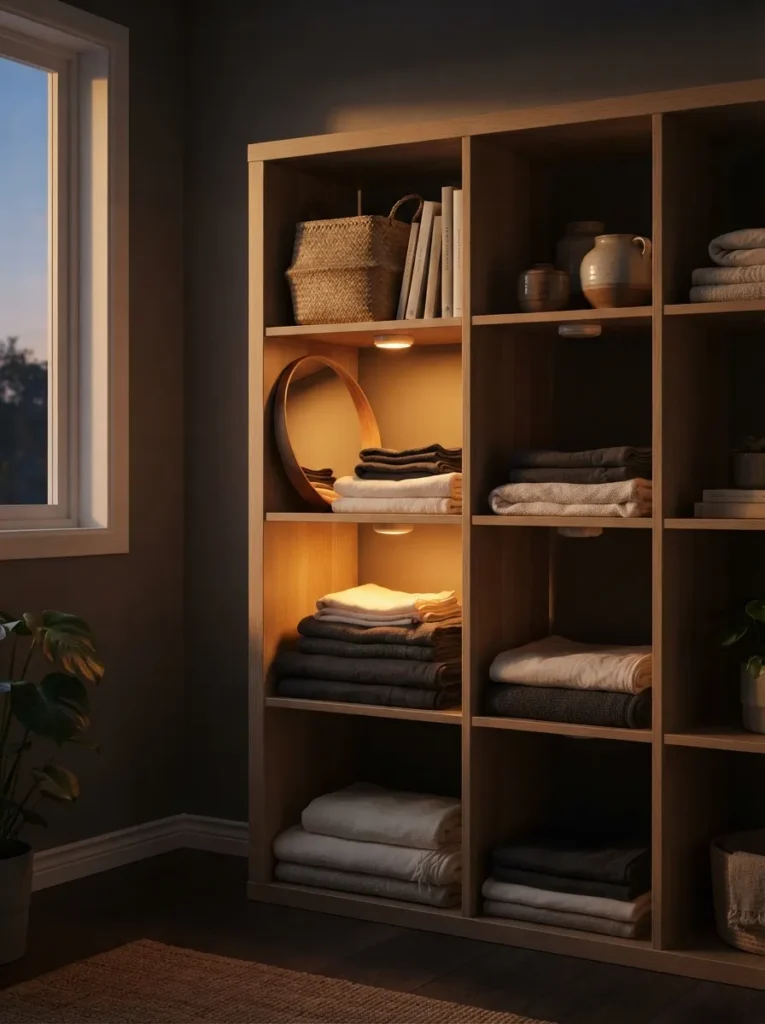
What it looks like: A soft amber wash low to the ground, nothing like an overhead fixture snapping on.
Why it works: Overhead lights disrupt a baby’s melatonin production during night feeds. A dim, warm-toned light source at cube height gives just enough visibility for a diaper change without fully waking anyone.
How to copy it: Use battery-powered, stick-on puck lights rated under 2700K color temperature, mounted to the underside of the cube above so the light source itself stays hidden from view.
Best for: Parents handling most night feeds without a partner’s help.
Styling Note: Angle the puck light toward the back of the cube rather than straight down it diffuses softer and avoids a harsh spotlight effect on whatever’s stored there.
Up next: the layout trick that solves shared-room nurseries without a single wall going up.
6. A Soft Room Divider for a Shared Nursery
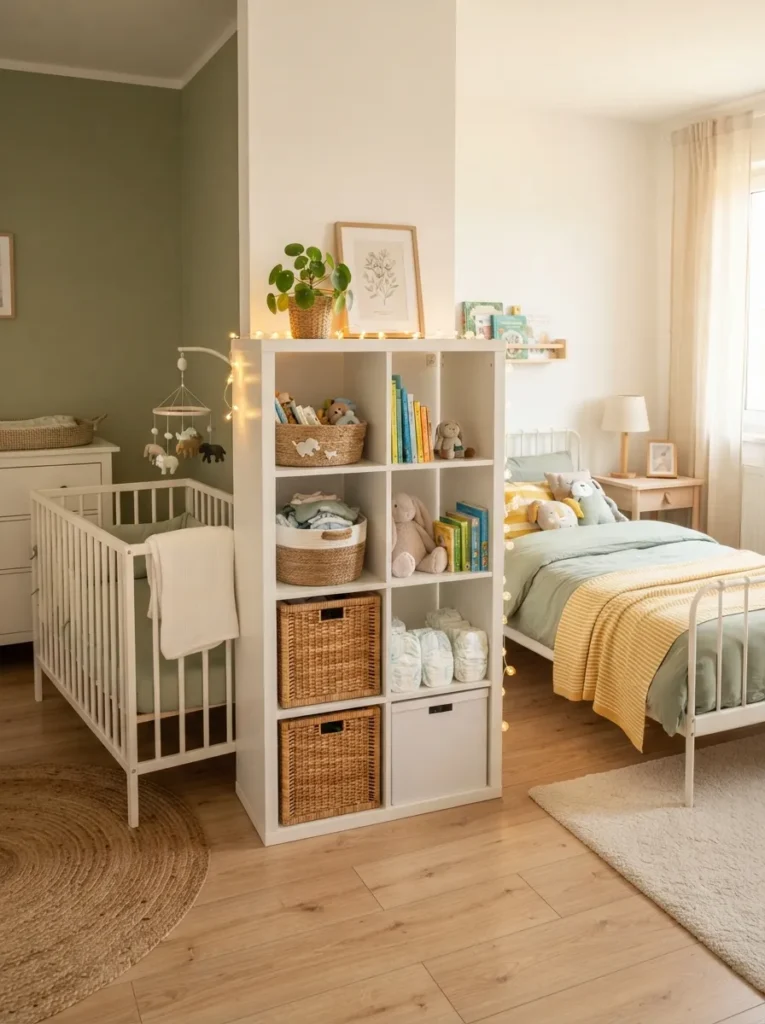
What it looks like: A freestanding wall of cubes splitting the room without closing it off light and sightlines still pass through the open cube backs.
Why it works: A true wall divider blocks airflow and requires a contractor. A Kallax positioned perpendicular to the existing wall creates a visual boundary and usable storage on both sides while keeping the room open and code-compliant for a shared space.
How to copy it: Anchor the unit to the floor and an adjacent wall stud using an L-bracket kit rated for freestanding placement, since a mid-room unit has no wall behind it to lean on. If you’re new to styling the unit itself, these Kallax styling ideas are worth a look before committing to a divider layout.
Best for: Families putting a nursery and an older sibling’s bed in one room.
Mistake to Avoid: Placing a mid-room Kallax without anchoring both the floor and a side wall connection freestanding placement needs two anchor points, not one.
7. A Half-Height, Single-Row Kallax for Tiny Nurseries
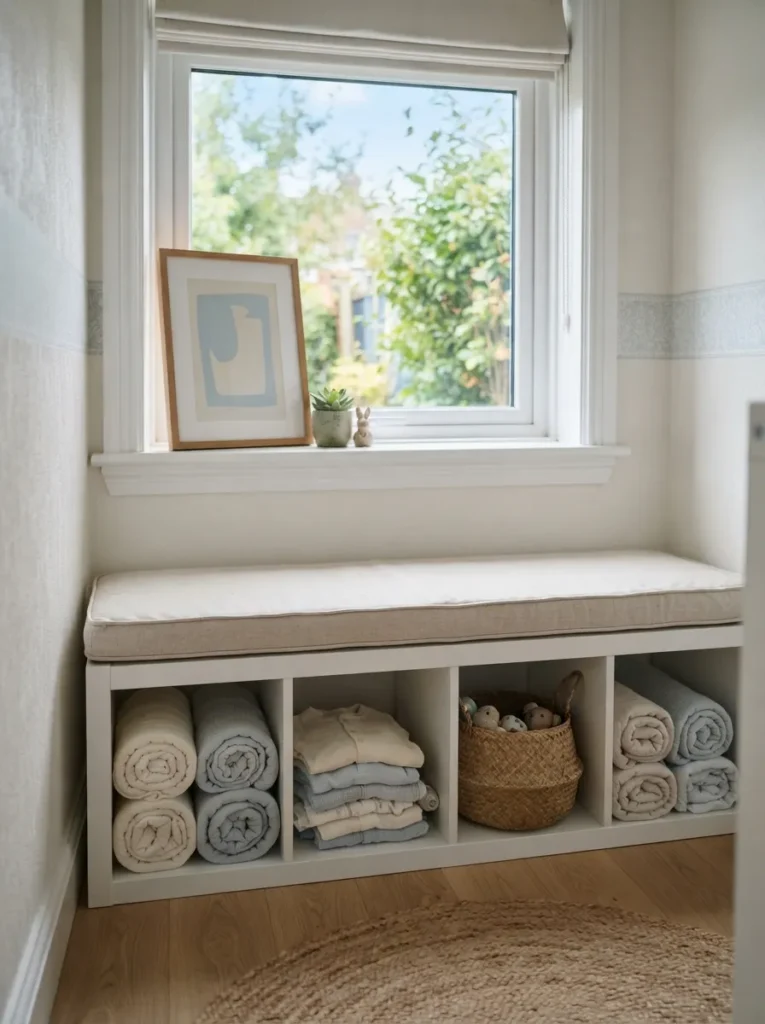
What it looks like: Low and unobtrusive, sitting at seat height rather than climbing the wall.
Why it works: A full 4×4 or 8-cube tower reads as heavy in a small room and eats vertical sightlines. A single row of four cubes gives the same storage volume spread horizontally, which keeps ceilings feeling higher.
How to copy it: Use the 1×4 configuration instead of 2×2, and top it with a thin foam cushion cut to size it becomes usable seating, not just storage.
Best for: Nurseries under 80 square feet or rooms with a low, wide window. The same principles behind these small-room layout ideas apply just as well here, even outside a dorm setting.
Important: A single-row 1×4 Kallax is not rated as a step stool or standing surface even with a cushion on top the cube walls aren’t reinforced for standing weight the way the frame edges are.
The next idea skips color for a softer, more neutral palette worth considering if you don’t know the baby’s gender yet.
8. A Pastel, Gender-Neutral Insert Palette

What it looks like: Soft and varied without leaning pink or blue a palette that reads as intentional rather than undecided.
Why it works: Alternating three neutral tones across the grid, rather than one flat color everywhere, keeps the wall of cubes from reading as a plain office shelving unit.
How to copy it: Pick three tones from the same saturation level so none competes for attention, and never place two bins of the same color directly beside each other.
Best for: Parents decorating before finding out the baby’s gender, or planning to reuse the setup for a second child.
Small-Space Tip: In a tight room, keep the palette to two tones instead of three a third color in under 80 square feet starts to read as clutter rather than variety.
9. Fabric Drawer Inserts for Diaper Organization
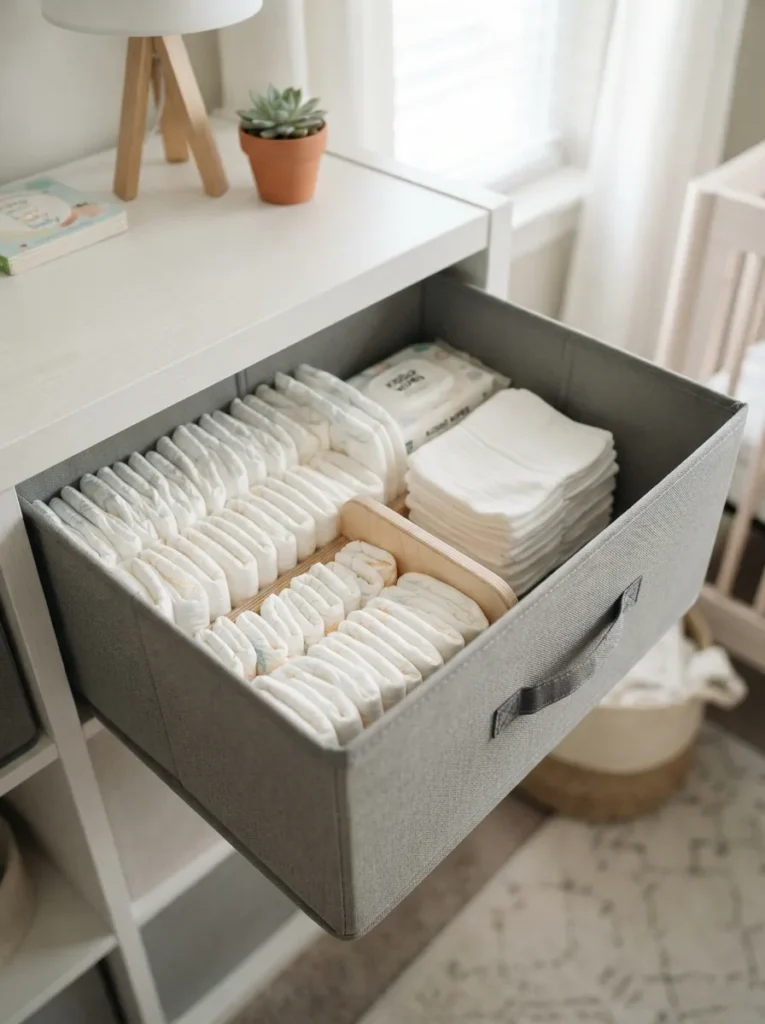
What it looks like: A pull-out drawer rather than an open bin closed on three sides, open on top.
Why it works: Open bins collect dust and let smaller items slide to the bottom. A fabric drawer insert with a semi-rigid frame keeps its shape and slides in and out on the cube’s smooth interior without catching.
How to copy it: Roll diapers instead of stacking them flat rolling makes more fit per drawer and makes the current size visible from above at a glance.
Best for: Parents storing multiple diaper sizes at once during a fast growth phase. For more diaper-specific setups beyond the Kallax itself, these nursery storage hacks cover a few additional angles.
✅ Diaper Station Setup Checklist:
- [ ] Measure the cube opening and confirm the drawer insert fits with a half-inch of clearance
- [ ] Assign the most reachable cube (waist height, not floor level) to the current diaper size
- [ ] Add a wipes dispenser or open pack directly beside the drawer, not inside it
- [ ] Roll and load diapers by size, largest at the back
- [ ] Test the drawer glide fully loaded before calling the station done
Shop This Look
| Product |
|---|
| Semi-rigid fabric drawer insert, sized for standard Kallax cube |
| Wipes dispenser with flip lid |
| Small wooden drawer divider |
| Diaper caddy for on-the-go restocking |
| Odor-control liner bags |
Next up: what to do with the wall directly above your changing station.
10. A Window Seat with a Cushion Topper
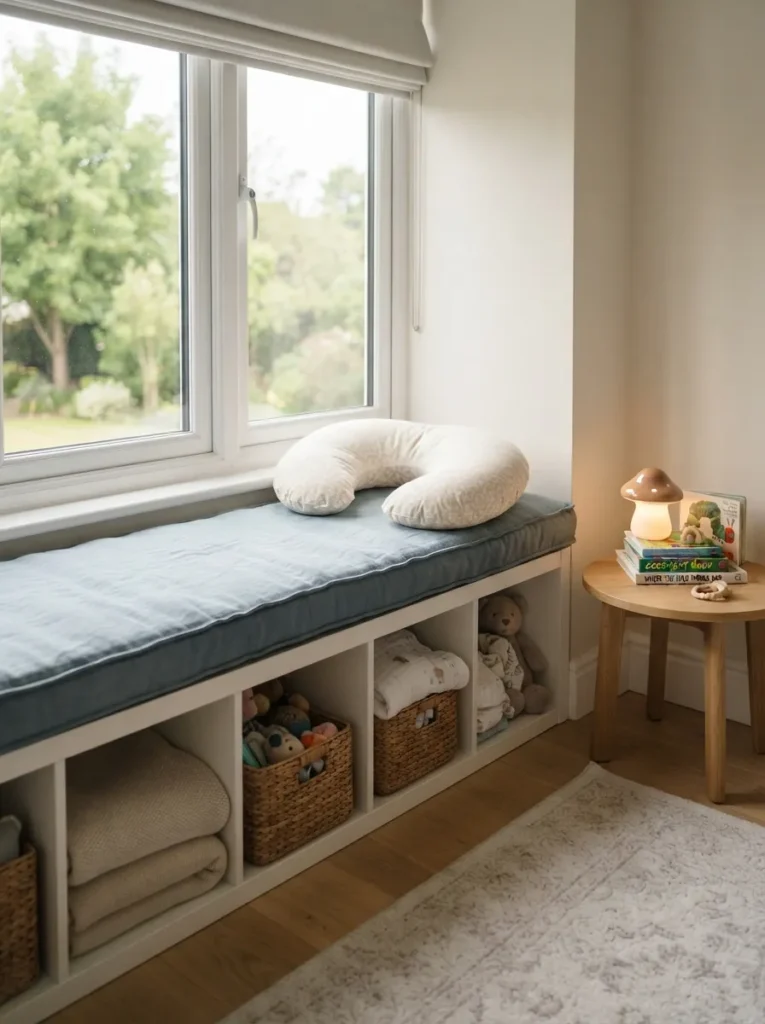
What it looks like: A low bench under a window, cushioned enough to sit on for a middle-of-the-night feed.
Why it works: A rocking chair takes up floor space a small nursery often doesn’t have. A Kallax topped with a cushion gives seating and storage in the same footprint, and the cube storage underneath keeps nursing supplies within arm’s reach.
How to copy it: Order a cushion cut to the exact width of your unit configuration a standard 30-inch cushion won’t fit a 4×1 Kallax, which runs closer to 58 inches and choose a removable, washable cover.
Best for: Small nurseries that can’t fit a separate glider or rocking chair.
Quick Win: No budget for a custom cushion yet? A folded crib mattress topper under a fitted sheet works as a temporary bench cushion for under $20.
11. Open Cubby Book Display, Covers Facing Out
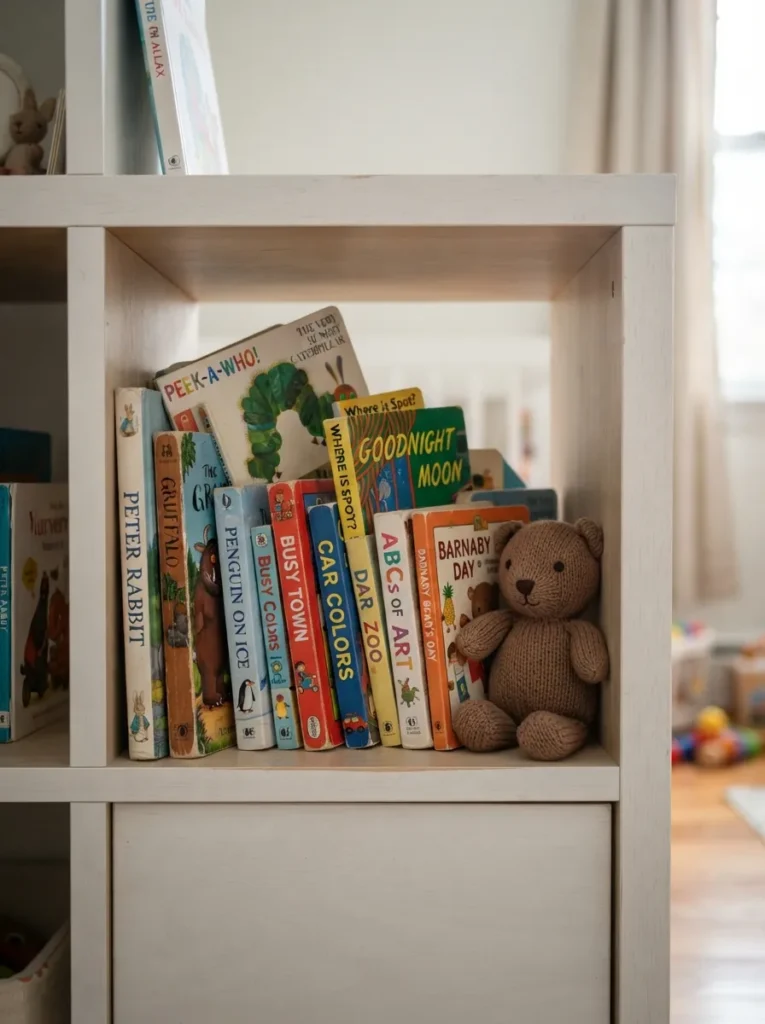
What it looks like: More gallery wall than bookshelf the covers do the decorating.
Why it works: Board books stored spine-out are invisible to a toddler still learning to read titles. Cover-out display lets a child recognize and choose their own book, which research on early literacy consistently points to as a factor in independent reading habits.
How to copy it: Reserve one full cube per 8–10 books, propped at a slight lean rather than stacked flat, and rotate the selection every few weeks to keep it from feeling static.
Best for: Toddler transitions, or nurseries being set up with an older sibling in mind. The same display logic carries into these Kallax toy storage hacks once board books give way to toys.
Pro Tip: Add a thin strip of adhesive cork or felt along the cube’s bottom edge before propping books it stops board books from sliding forward every time the cube gets bumped.
Shop This Look
| Product |
|---|
| Adhesive felt or cork lining strips |
| Board book starter set, mixed titles |
| Small bookend or corner brace |
My Views:
Here’s something most guides won’t tell you: the top of a Kallax unit is almost never where people think to babyproof, and it’s usually the most-touched surface in the whole nursery. I’ve walked into three separate nursery setups where the top edge at exactly toddler grabbing height once they’re pulling up had a sharp laminate corner with no corner guard, while the parents had padded every outlet in the room. Round the front two corners with adhesive corner guards before the crib even ships; it’s a five-minute fix that gets skipped almost every time.
12. Positioned Under Natural Light with a Blackout Pairing
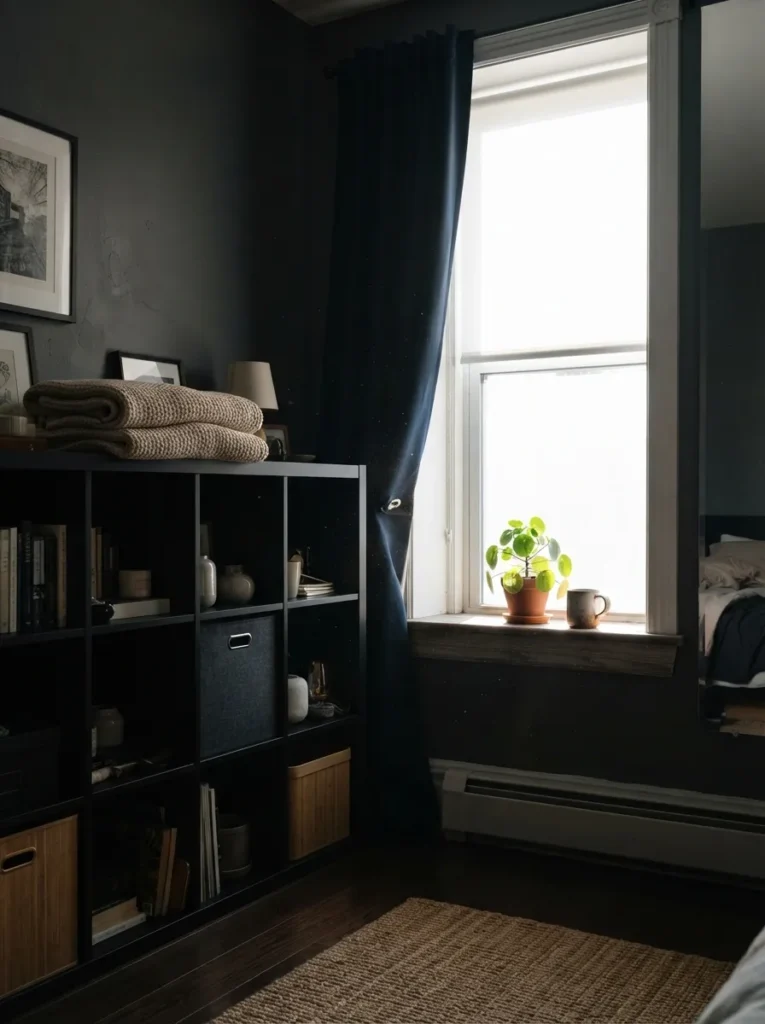
What it looks like: Bright daytime light in one half of the frame, a dim, nap-ready room in the other.
Why it works: Placing the Kallax near but not directly under the window keeps stored fabric bins from sun-fading while still letting the room fill with daylight during wake windows, and pairing it with true blackout curtains supports the darkness naps depend on.
How to copy it: Position the unit on the wall perpendicular to the window rather than facing it directly, so bins and books sit out of direct sun exposure while the room itself still gets full light.
Best for: Parents fighting inconsistent nap schedules tied to light exposure.
Styling Note: Choose a blackout curtain with a separate sheer layer underneath it lets you flip between full darkness for naps and filtered light for playtime without swapping panels.
One more layout idea after this, plus two ways to work with color and material you haven’t seen yet.
13. Two-Tone Contrast Cubes for Visual Zoning
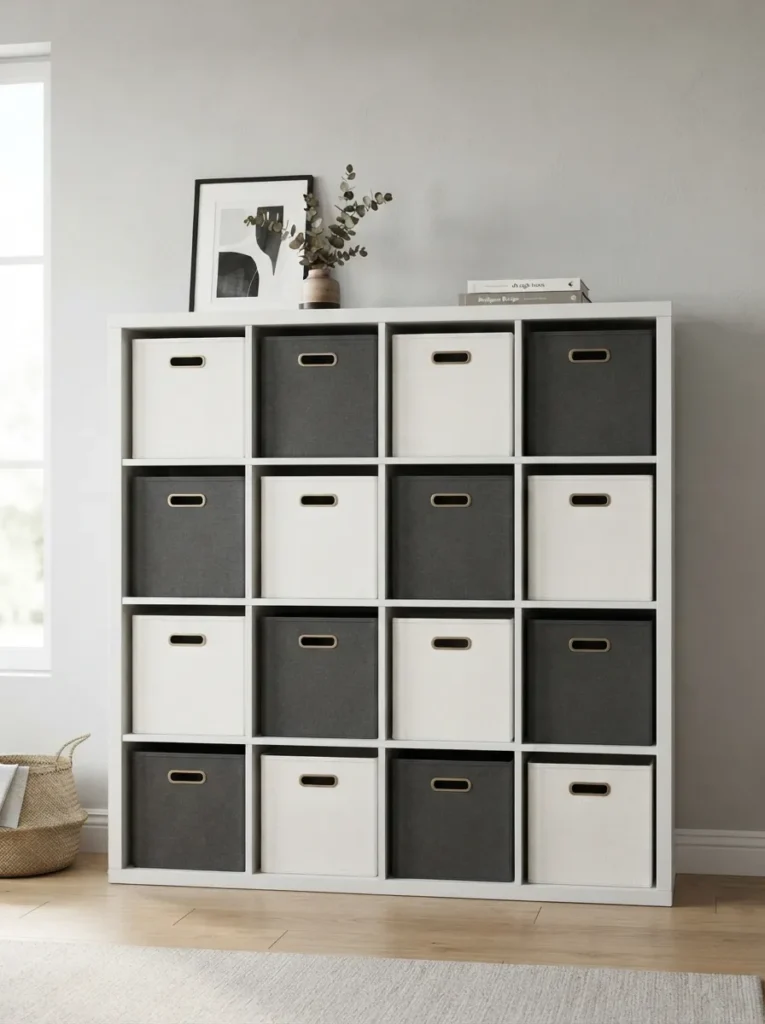
What it looks like: A checkerboard rhythm across the grid instead of one flat color sharper and more graphic than the pastel version.
Why it works: Alternating dark and light cube backers creates depth on what’s otherwise a flat, two-dimensional grid, and it doubles as a visual zoning tool dark cubes for out-of-season storage, light cubes for daily-use items.
How to copy it: Buy or paint removable cube backer panels rather than the whole unit, so the base frame stays neutral and resellable if your plans change.
Best for: Parents who want the nursery to transition into a toddler room without a full redo later.
Important: Painted cube backers need a fully cured coat at least 72 hours before bins go back in, or fabric bins can pick up a faint paint smell that lingers for weeks.
14. Mixed Wood Tones: White Cube Base, Oak Leg Frame
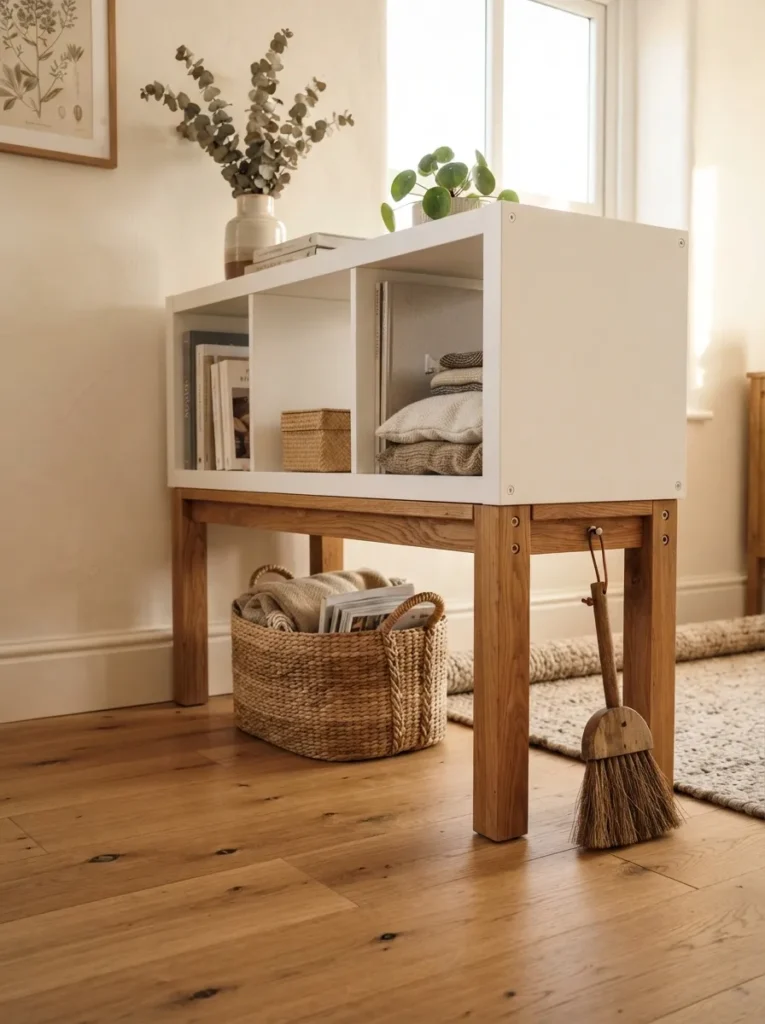
What it looks like: The same white cube grid, lifted a few inches off the ground on warm wood legs.
Why it works: A leg frame breaks up the visual heaviness of a flat-bottomed unit sitting directly on the floor, and the gap underneath makes the room easier to sweep or vacuum a real advantage in a room that collects crumbs and lint fast.
How to copy it: Add IKEA’s own leg accessory kit or a third-party wood leg set rated for the unit’s full loaded weight, not just the empty frame weight listed on the box.
Best for: Parents who want the storage system to read as furniture, not shelving. It’s the same elevated, furniture-forward approach used in this Kallax TV unit build, just scaled down for a nursery.
Budget Version: Skip the branded leg kit and use four adjustable furniture risers instead they run under $15 for a set of four and work with most standard Kallax footprints.
15. Wall-Mounted to Free Up Floor Space
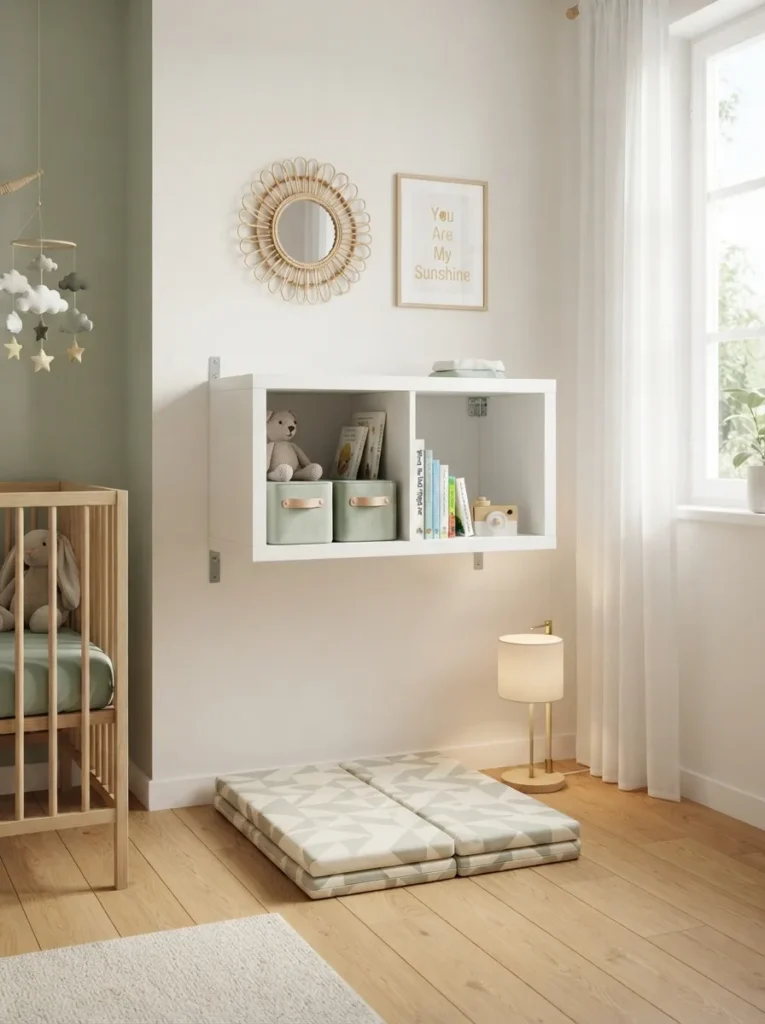
What it looks like: Storage floating above an open floor no legs, no base, no visual clutter at ground level.
Why it works: Every square foot of floor a mobile baby can use for tummy time or a play mat matters more than most storage decisions. Mounting a smaller two-cube unit to the wall at a fixed height above crawling reach keeps the storage without sacrificing that floor space.
How to copy it: Use heavy-duty wall mounting brackets rated well above the unit’s fully loaded weight, and mount into at least two studs never drywall anchors alone for a wall-hung Kallax.
Best for: Small nurseries where every square foot of floor matters more than extra cube count.
Pro Tip: Mount the unit at a height where the bottom cube sits above a standing toddler’s reach, not just above a crawling infant’s the reach changes fast in the first year.
Shop This Look
| Product |
|---|
| Heavy-duty wall mounting bracket kit, rated for full unit weight |
| Stud finder |
| Two-cube Kallax unit |
| Play mat sized to fit the freed floor space |
How to Start Your Kallax Nursery Setup
What I’ve found with real spaces is that the first move should be picking one wall the changing wall before buying anything else. Anchor a single 2×2 there first. That one decision anchors the whole room’s layout, and every other idea on this list builds outward from it.
The most common fixable mistake is buying fabric bins before measuring the cube openings. Kallax cubes run 13×13 inches, and bins bought a half-inch too wide or narrow either won’t slide in cleanly or will sag and collapse within weeks. Measure first, buy second.
Three items under $50 that make an immediate difference: a set of two fabric drawer inserts sized for a standard cube (around $16 for the pair), a metal anti-tip anchor kit (around $12), and a single woven seagrass basket for swaddle storage (around $18).
A basic single-unit setup takes one afternoon and runs $60–$150 depending on how many bins you add. A full nursery wall multiple units, wall mounting, all inserts is realistically a weekend project and lands closer to $250–$400 once hardware and cushions are factored in.
Ready to Organize Your Nursery?
Between the anchored changing station, the color-coded bins, and the wall-mounted layout for tight rooms, these 15 ideas cover almost every version of a Kallax nursery, small apartments included. You don’t need to buy three units and every insert type this weekend one anchored 2×2 with two good bins already solves more than most people expect.
Tonight, measure your changing wall and order the anti-tip kit before anything else it’s the cheapest, least glamorous item on this list and the one that matters most. A nursery that actually holds everything without three baskets getting dug through at 2am feels less like decor and more like relief. Pin the ideas that fit your space now you’ll be back for the bin-labeling system around month four, guaranteed.
You Might Also Like
- 12 Budget Nursery Storage Ideas That Aren’t Kallax
- 9 IKEA Kallax Hacks for Small Bedrooms
- 10 Diaper Station Organization Ideas for New Parents