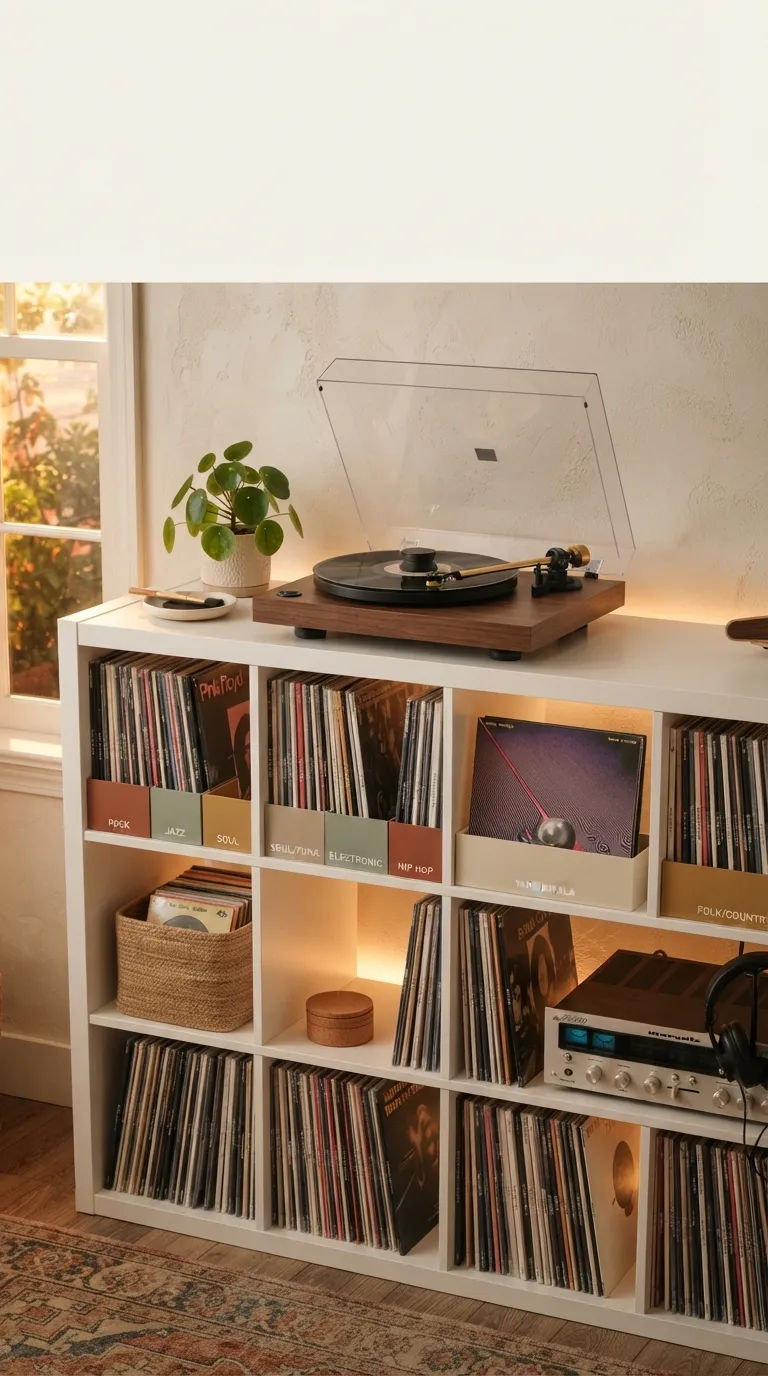
16 IKEA Kallax Record Storage Ideas for Vinyl Collectors
Record collections rarely stay small once you start buying, and IKEA’s Kallax is the shelf most collectors reach for because the cube openings match a standard 12-inch sleeve almost exactly. This list walks through 16 record storage ideas for vinyl collectors, covering everything from divider setups that stop warping to a full listening-corner build.
There’s a specific kind of satisfaction in flipping through a row of records that actually stand upright, spines facing out, nothing slumping sideways. Get the setup right and thirty minutes of digging turns into three. Get it wrong, and you’re stacking crates on the floor within a year again. Let’s build something that actually holds up.
Quick Navigation
- Why IKEA Kallax Record Storage Makes Such a Difference
- 16 Kallax Record Storage Ideas for Vinyl Collectors
- How to Start Your Kallax Record Storage Setup
- Ready to Build Your Vinyl Storage Setup?
Why IKEA Kallax Record Storage Makes Such a Difference
The Kallax works for vinyl because the math lines up: each 13×13-inch cube holds roughly 35-45 records standing upright, and a 12-inch sleeve slides in with barely a half-inch of play. Untreated pine and the laminate finishes both hold weight fine, but the plywood back panel flexes over time under a fully loaded column, so bracing matters more than the finish.
It’s having a moment because reissue and secondhand vinyl sales keep climbing, and most collectors outgrow their first shelf within a year of buying a turntable. In a small room, start with one 2×2 cube near an outlet expand once you know your real collection size, not before.
| Best starting point | One 2×2 Kallax cube near a wall outlet, loaded to test real capacity |
| Biggest impact area | Vertical dividers — they stop warping and let you browse by flipping |
| Budget to start | $60–$150 for one unit plus dividers and casters |
| Time to complete | A weekend for one unit; a full wall build takes 2–3 weekends |
16 Kallax Record Storage Ideas for Vinyl Collectors
1. Stand Vinyl Records Vertically With Dividers That Actually Stop Warping
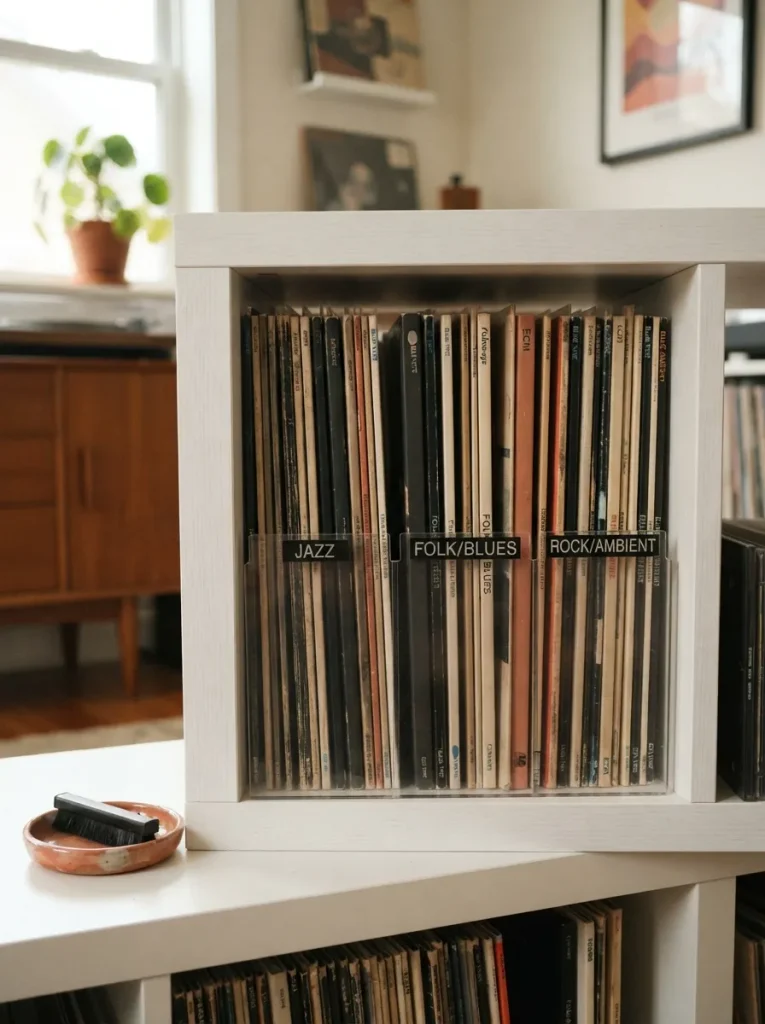
What it looks like: Records stand spine-out in tight, even rows, held vertical by slim acrylic or wood dividers spaced every 15-20 records.
Why it works: Vinyl warps under its own weight when stacked flat even a few weeks of horizontal stacking can bow a record enough to affect playback, since the pressure lands unevenly across the surface. Dividers keep every sleeve vertical, which is the only orientation vinyl was designed to rest in long-term.
How to copy it: Cut 1/8-inch acrylic or 1/4-inch plywood into 12.5-inch squares, sand the bottom edge smooth, and space one every 15-20 records tight enough that the row doesn’t lean, loose enough to flip through freely.
Best for: Anyone who’s already noticed a slight warp in a favorite record, or collectors storing more than 40 LPs.
Budget Version: Skip the acrylic sturdy cardboard filing dividers work almost as well under $10, though they wear out faster than plywood.
Shop This Look
| Product |
|---|
| Clear acrylic record divider set |
| 1/4-inch birch plywood sheet, pre-cut |
| Blank kraft genre label stickers |
| Fine-grit sanding block |
| Ceramic stylus brush holder |
2. Reinforce Each Kallax Cube Before Loading It With Records
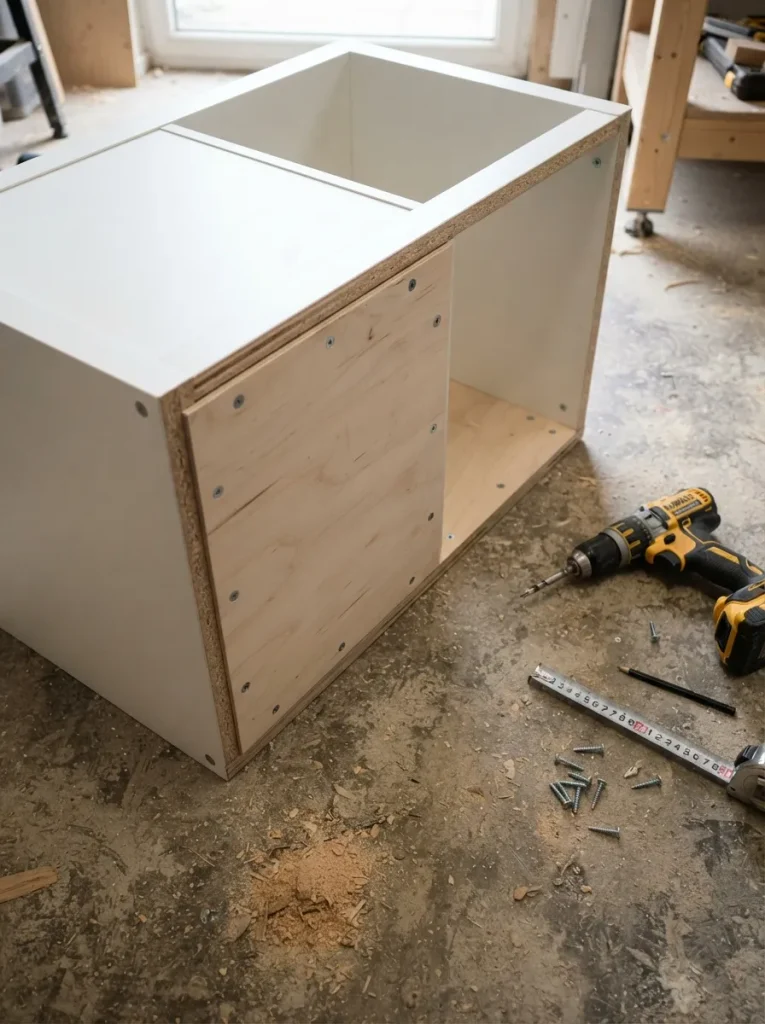
What it looks like: A slim plywood or MDF panel sits flush against the particleboard shelf base, invisible once records are loaded on top.
Why it works: A full cube of vinyl weighs 25-35 pounds, and Kallax shelves are particleboard wrapped in laminate strong for books, but they sag over a year or two under constant record weight, especially on the bottom rows. A support panel spreads that load across the full shelf instead of the center point. The same weight-and-anchoring logic shows up in nursery Kallax setups, where a loaded unit needs the same reinforcement regardless of what’s filling it.
How to copy it: Cut 1/4-inch plywood to the exact interior dimensions of one cube, drop it in before loading records, and check for sag every six months on bottom-row units especially.
Best for: Collectors with more than 300 records, or anyone stacking a Kallax two units high.
Warning: Loading a top-heavy Kallax without anchoring it to the wall is the single most common mistake with vinyl storage a fully loaded 4×4 unit can weigh over 400 pounds and tip forward if a bottom row is pulled hard. Use the anti-tip brackets IKEA includes, every time, no exceptions.
3. Sort Your Vinyl by Genre With Labeled Crate Inserts
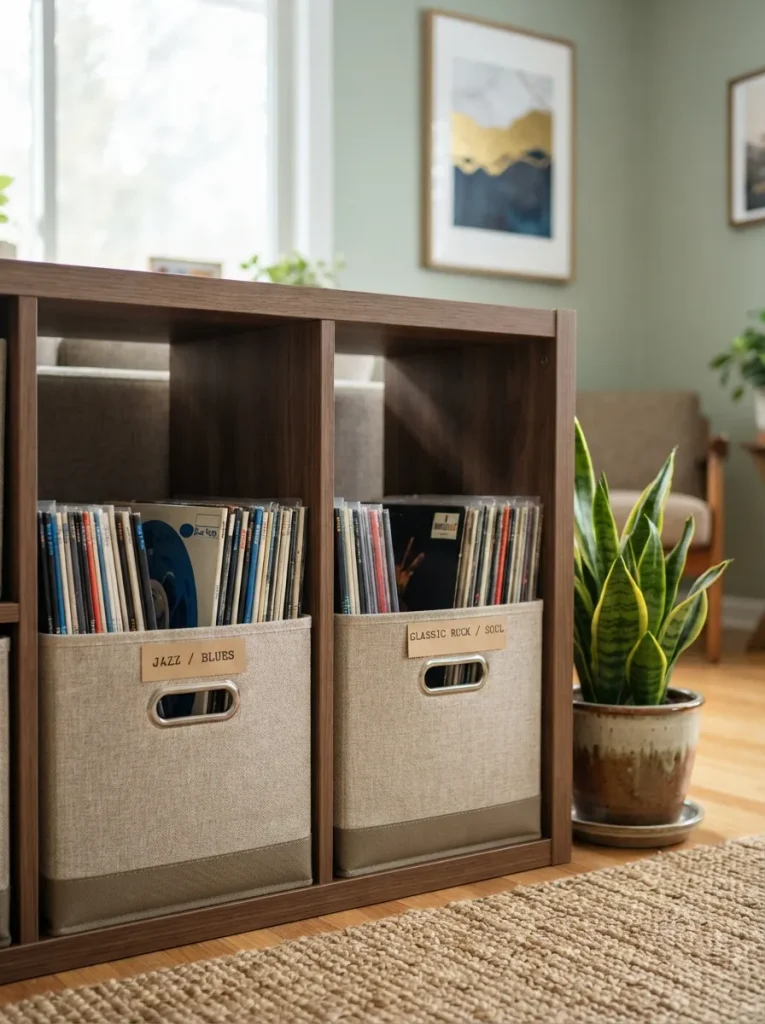
What it looks like: A canvas or wire crate insert drops into one cube, with a typed or handwritten label naming the genre or decade inside.
Why it works: Grouping by genre jazz, soundtrack, 90s hip-hop cuts browsing time dramatically once a collection passes 200 records, since alphabetizing by artist only helps when you already know exactly who you’re looking for.
How to copy it: Buy crate inserts sized specifically for 12-inch records, not generic storage bins, and label the front lip rather than the spine so it reads from across the room.
Best for: Collectors who browse by mood more than by artist name.
Styling Note: A typewriter or letterpress-style label reads as intentional rather than like a moving box worth the extra few dollars per label.
The next idea solves a problem most people don’t think about until their record player is already sitting on top of the shelf.
4. Add Locking Casters for a Rolling Kallax Record Cart
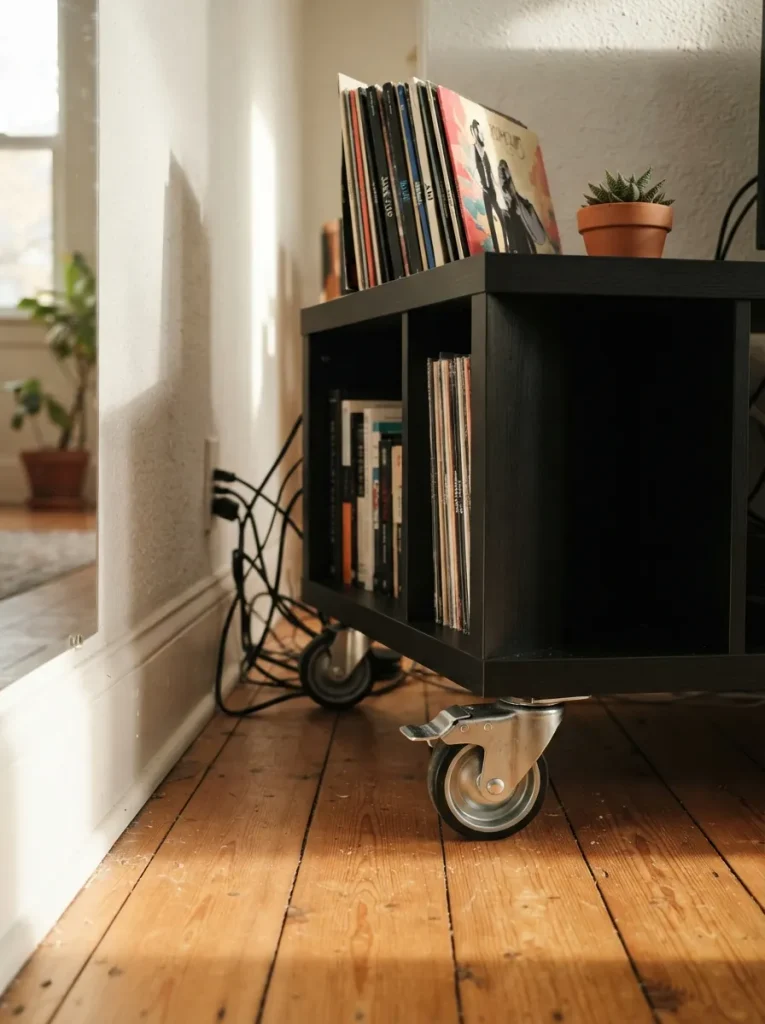
What it looks like: A low, single-row Kallax rolls freely on locking casters, letting the whole unit pull away from the wall for cleaning or cable access.
Why it works: DJs and anyone who moves gear between rooms benefit from a unit that isn’t fixed in place locking casters solve the access problem without giving up the storage capacity of a full row.
How to copy it: Use casters rated for at least 300 pounds combined, lock two of the four when the cart sits in its resting spot, and leave 3 inches of clearance behind for cables.
Best for: DJs, anyone who rearranges furniture often, or renters who move apartments frequently.
Shop This Look
| Product |
|---|
| Locking caster set, 300lb rated |
| Low-profile 1×4 shelving unit |
| Cable management sleeve |
| Furniture floor protector pads |
5. Turn a Kallax Sideways as a Room Divider
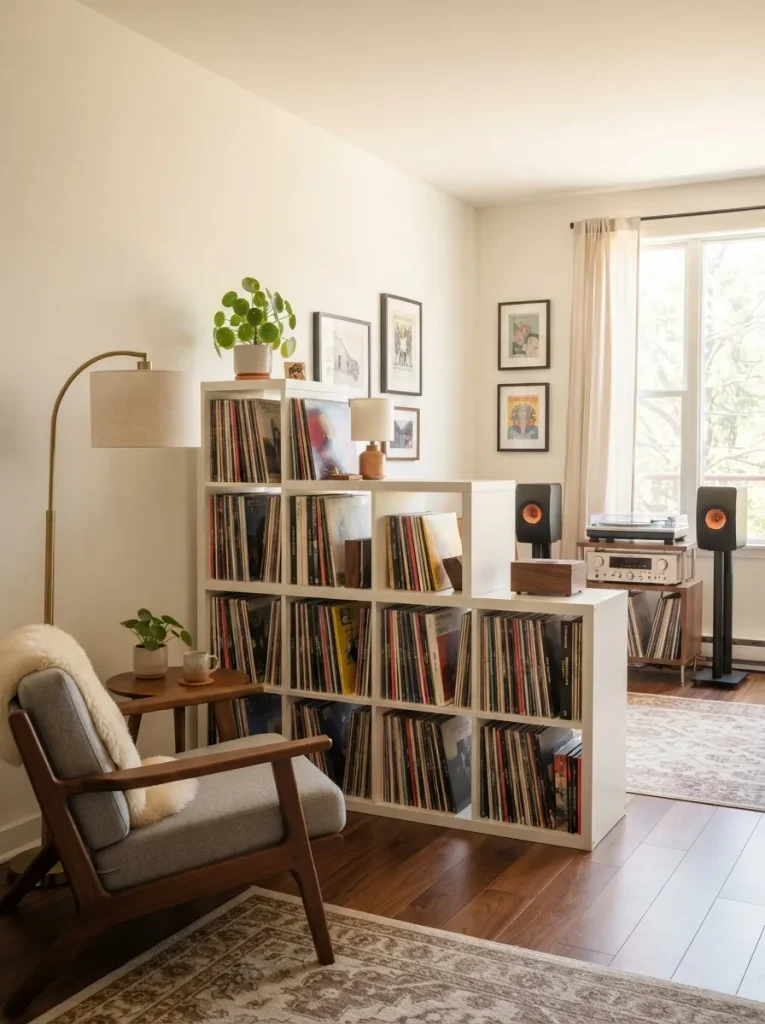
What it looks like: A full-height Kallax stands away from the wall, splitting an open room into two zones while staying visually open on both faces.
Why it works: Because Kallax cubes are open on both sides, the unit divides a room without blocking light the way a solid bookcase would a wall’s worth of separation with none of the visual weight.
How to copy it: Anchor the unit to the ceiling or floor with an anti-tip kit since it’s freestanding on both sides, and keep the heaviest rows on the bottom two shelves for stability.
Best for: Studio apartments and open-plan living rooms that need a defined listening zone.
Small-Space Tip: In a studio under 500 square feet, a 2×4 divider does the same job with a much smaller footprint than a full 4×4.
6. Fit an L-Shaped Kallax Corner Configuration in Tight Rooms
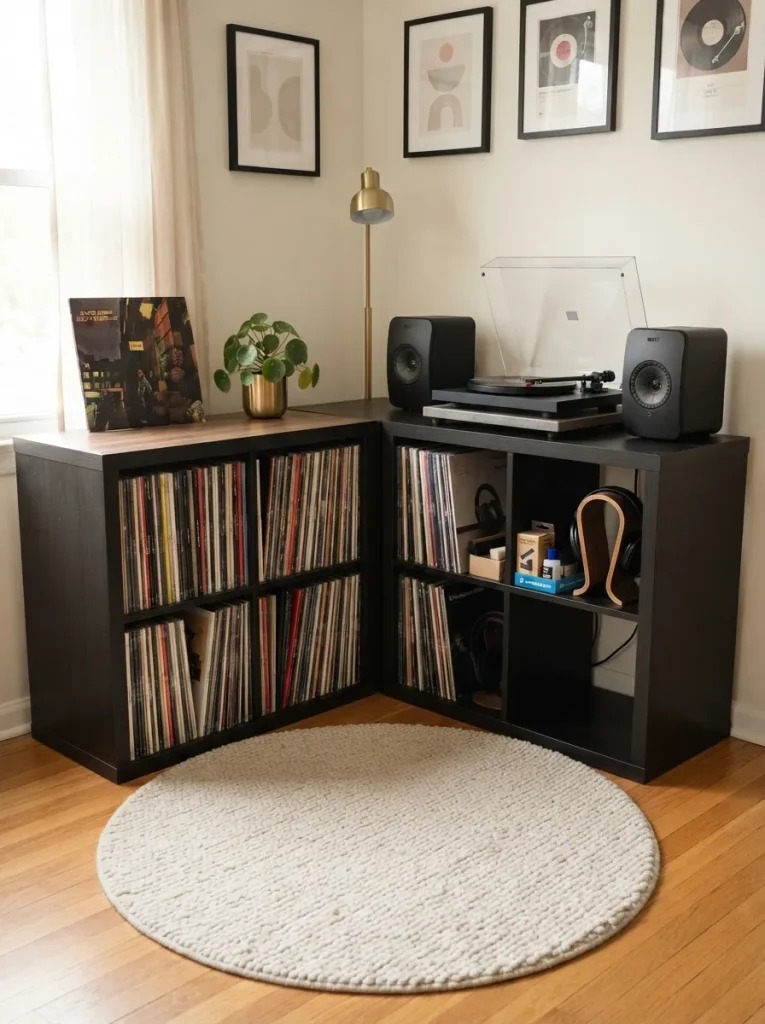
What it looks like: Two shorter Kallax units meet at a room corner at a right angle, using dead corner space that usually sits empty.
Why it works: Corners are the most underused square footage in small rooms, and an L-shaped pair spreads record weight across two walls instead of loading one wall to its limit.
How to copy it: Use two 2×4 units rather than one large 4×4 easier to carry into a small room, and they let you push one unit flush into the corner seam.
Best for: Bedrooms and small living rooms under 150 square feet.
Mistake to Avoid: Pushing a corner configuration flush against a swinging door measure the door’s full arc before placing the second unit, not just its closed width.
Up next: the one addition that makes a record wall feel finished instead of just functional.
7. Top a Kallax With a Dedicated Turntable Stand and Hidden Cables
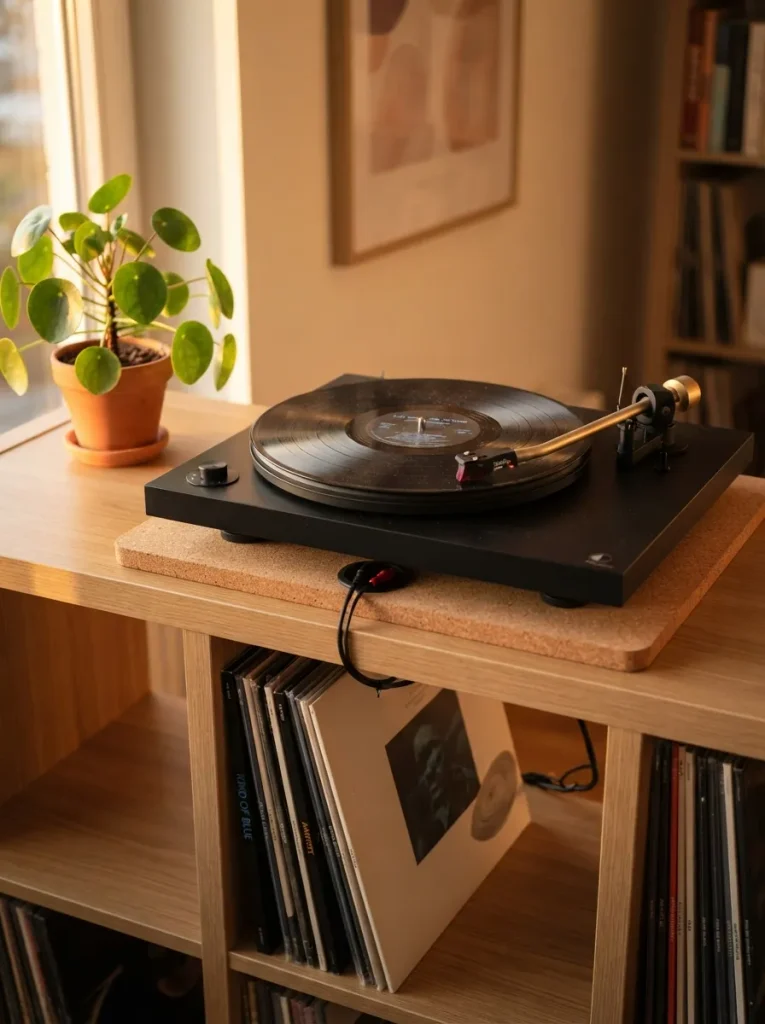
What it looks like: The turntable sits on a separate isolation platform on top of the Kallax, cables disappearing through a drilled grommet into the cube below instead of trailing across the floor.
Why it works: Kallax tops flex slightly when someone walks past, and that vibration transfers straight into the needle as audible rumble. An isolation pad or a separate platform breaks that path before it reaches the cartridge. It’s the same top-surface flex we account for in Kallax TV unit builds, where a wobbly top shows up as screen shake instead of needle rumble.
How to copy it: Drill a 1-inch grommet hole in the back corner of the top panel, route power and RCA cables into an empty cube, and set the turntable on a cork or sorbothane isolation pad rather than directly on the laminate.
Best for: Anyone who’s noticed skipping or rumble that isn’t coming from the records themselves.
✅ Turntable Setup Checklist:
- [ ] Confirm the Kallax top can hold the turntable plus isolation platform (most handle it, but check heavier direct-drive models)
- [ ] Drill the cable grommet hole before placing the turntable, not after
- [ ] Set the isolation pad down first, then the turntable on top
- [ ] Route and secure cables into the cube below with a cable clip
- [ ] Level the turntable with a small bubble level before first use
8. Add LED Strip Lighting Behind the Record Cubes
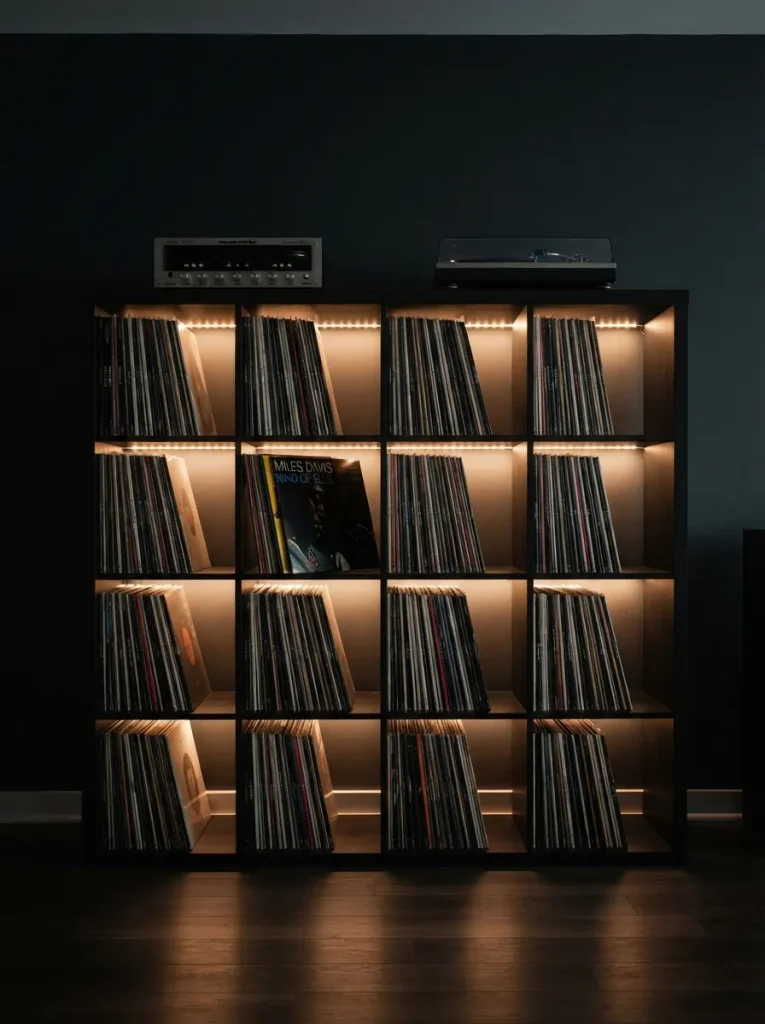
What it looks like: A thin LED strip runs along the rear edge of each cube, casting soft light across the record spines instead of leaving the unit dark once the sun goes down.
Why it works: Vinyl storage is naturally recessed and shadowed, and most people only ever see their collection under overhead room light a strip at the back edge lights the spines specifically, which is exactly where the browsing information lives.
How to copy it: Use a battery or USB-powered adhesive LED strip in warm white, 2700K, not daylight blue, mounted along the top-back edge of each cube facing forward, with a small in-line dimmer.
Best for: Evening listening sessions and anyone who wants the shelf to double as ambient lighting.
Quick Win: Battery-powered LED strips with a motion sensor need zero wiring and install in about five minutes per cube.
Shop This Look
| Product |
|---|
| Warm white 2700K adhesive LED strip |
| USB power adapter with in-line dimmer |
| Battery-powered motion sensor puck lights |
| Cable clips for strip routing |
9. Use Fabric Bins for 45s and Singles
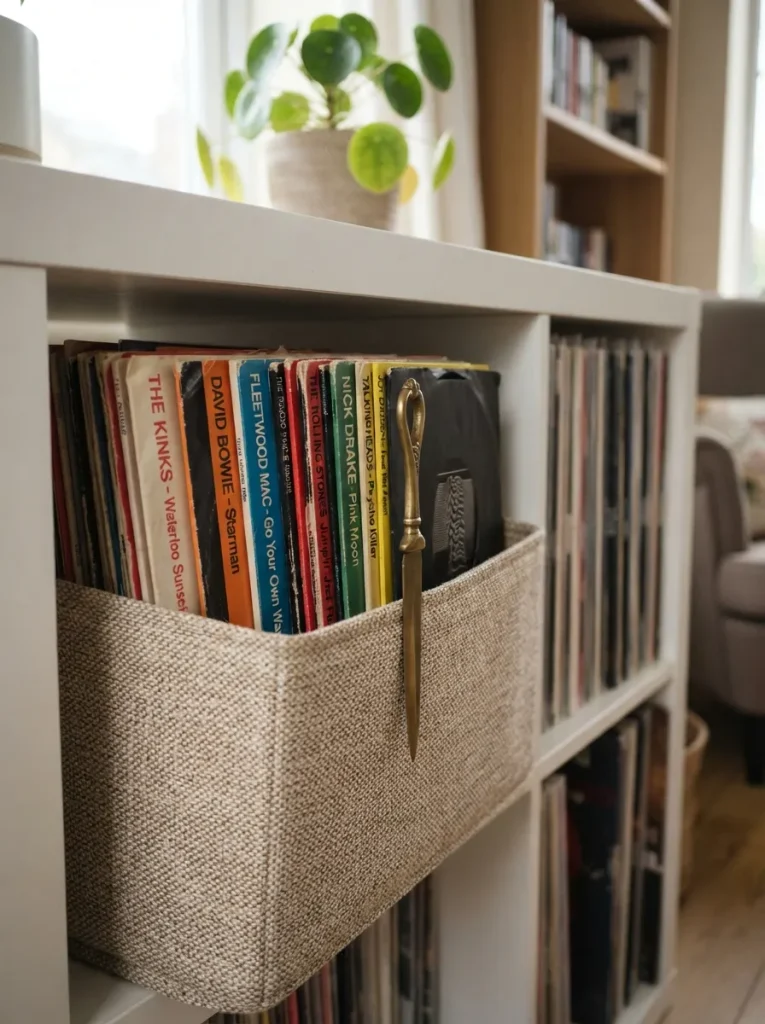
What it looks like: A woven or canvas bin sized for 7-inch records sits in its own cube, keeping singles from getting lost or bent between full-size LPs.
Why it works: Seven-inch records are thinner and prone to bending, and mixing them into a row of 12-inch LPs means they slide sideways and get crushed. A dedicated bin at the right depth keeps them upright without wasted space. It’s the same bin-depth problem covered in general closet organization setups the container has to match what’s going inside it, not just look tidy.
How to copy it: Choose a bin with a firm base, not floppy canvas, sized close to 7.5 inches deep, and stand the singles on edge the same way as full LPs rather than stacking them flat inside the bin.
Best for: Collectors who buy reissue 7-inch singles or older 45 collections.
Important: Most fabric storage bins are sized for books or toys, not records measure the interior depth before buying, since anything under 7 inches lets singles lean and warp against the bin walls.
This next one is the fix most collectors only discover after their first record gets crushed at the bottom of a pile.
10. Stack Two Kallax Units Floor-to-Ceiling for Big Vinyl Collections
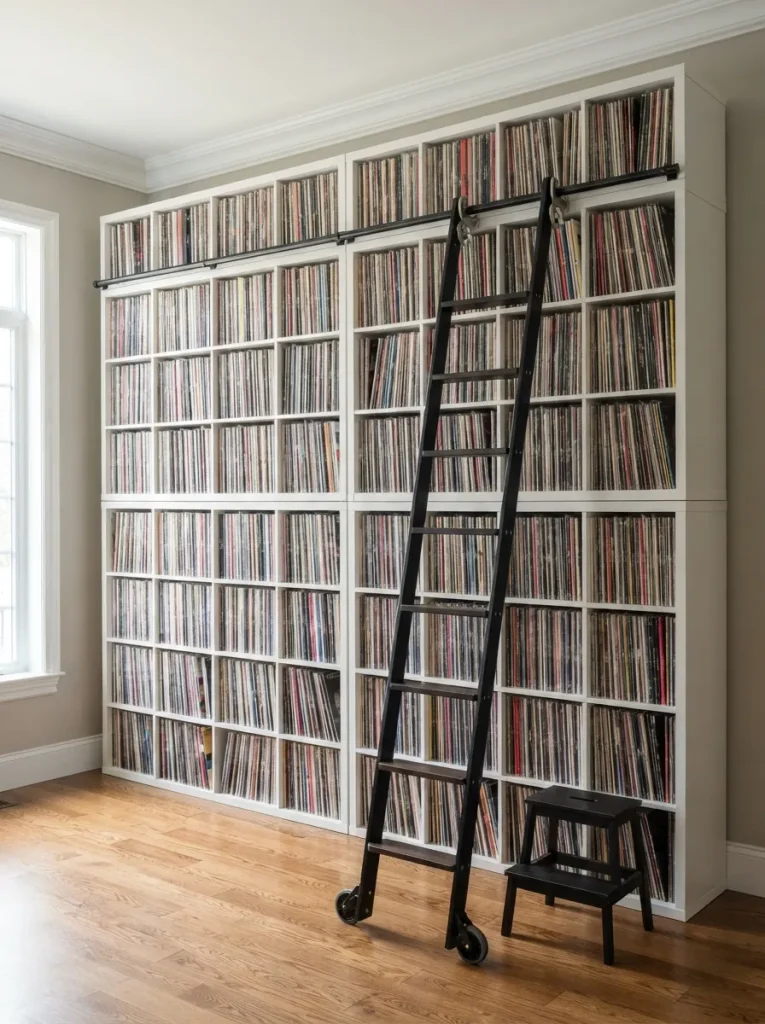
What it looks like: Two Kallax units connect vertically along a full wall, reaching close to ceiling height, with the top rows reachable by a small ladder or step stool.
Why it works: A collection past 1,000 records genuinely needs square footage a single unit can’t provide, and stacking vertically uses wall space that would otherwise sit empty above a standard 4-foot shelf.
How to copy it: Bolt the two units together with the connector hardware IKEA sells separately, anchor the stack to wall studs at two points, and keep frequently played records on the bottom four rows.
Best for: Serious collectors with 800+ records and at least 8 feet of ceiling height.
Next up: what to do with the records you’re not ready to shelve permanently or don’t want little hands getting into.
11. Add Door Inserts to Hide Overflow or Childproof Low Cubes
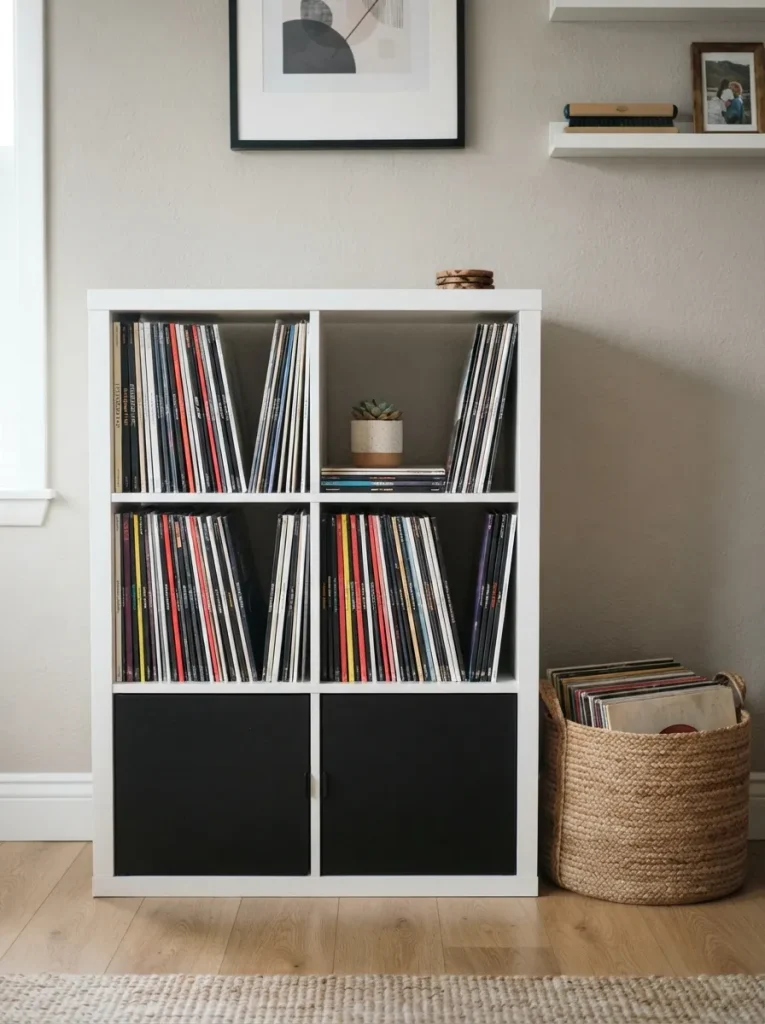
What it looks like: The bottom one or two cubes get push-latch door inserts, hiding overflow, sleeves, or fragile first pressings behind a clean panel instead of an open shelf.
Why it works: Open shelving looks great until the collection outpaces the dividers, and a closed cube gives you somewhere to stash duplicates or records waiting to be filed without it showing. The same push-latch approach shows up in kid-safe Kallax toy storage, where hiding contents matters as much as containing them.
How to copy it: Install doors on the bottom row specifically if there are kids or pets in the house it’s the row small hands reach first and keep frequently played records on the open shelves above.
Best for: Households with young kids, pets, or anyone tired of an overflowing “to file” pile.
Styling Note: Matching the door color to the laminate finish makes the closed cubes disappear into the unit rather than reading as an obvious storage hack.
12. Line the Kallax Back Panel With Cork to Cut Echo
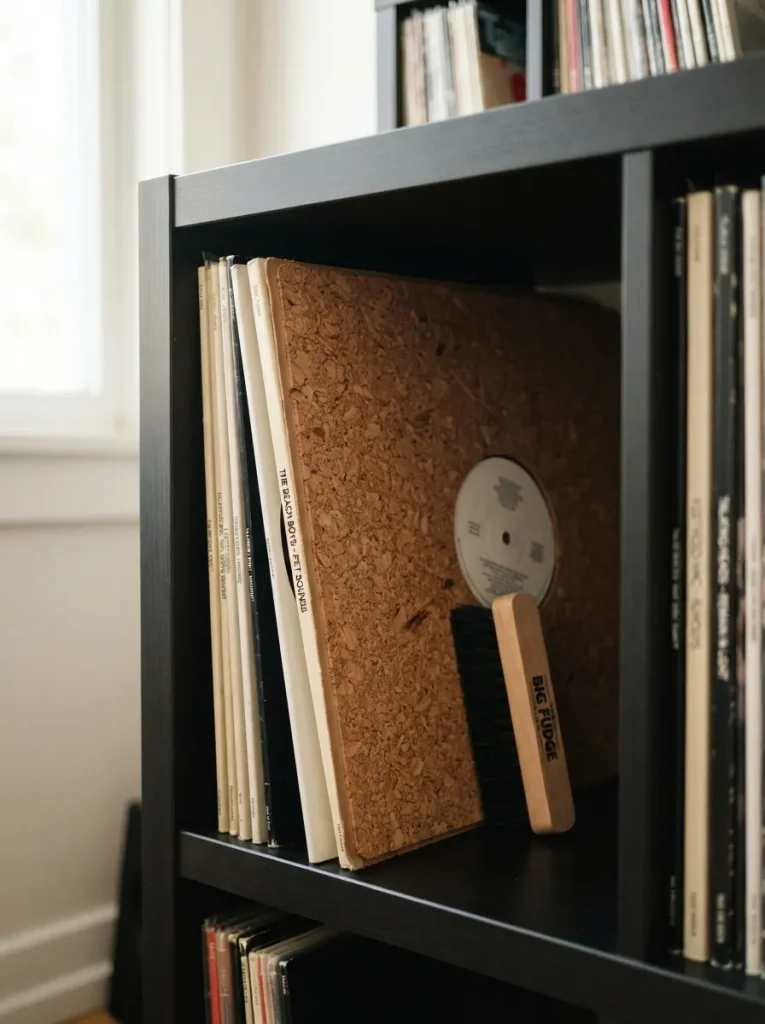
What it looks like: A thin sheet of cork lines the plywood back panel of each cube, barely noticeable unless you pull the records forward.
Why it works: The particleboard back panel on a Kallax is a hard, flat surface that bounces sound, and in a room already used for listening, that reflection adds a slight boxiness to nearby speakers. Cork absorbs some of that reflection with almost no installation work.
How to copy it: Use adhesive-backed cork sheeting, sold for bulletin boards, cut to the interior back panel dimensions, and press it on before loading records back in.
Best for: Listening rooms where the Kallax sits near or behind the speakers.
Pro Tip: Cork sheeting under 1/8 inch thick won’t do much acoustically go with at least 1/4-inch cork underlayment, sold in most flooring sections, for a noticeable difference.
Shop This Look
| Product |
|---|
| Adhesive-backed cork underlayment sheet |
| Utility knife for trimming |
| Spray adhesive for cork mounting |
| Microfiber record cleaning brush |
My Views:
Here’s something most guides won’t tell you: a fully loaded 4×4 Kallax against an interior wall transfers noticeably less bass thump to neighbors than the same wall left bare, because the mass of 800-plus records acts as a crude sound barrier. I’ve had renters use this on purpose against a shared apartment wall. It’s not a substitute for real soundproofing, but it’s not nothing either — worth knowing before deciding which wall gets the shelf.
13. Top the Unit With Framed Album Art
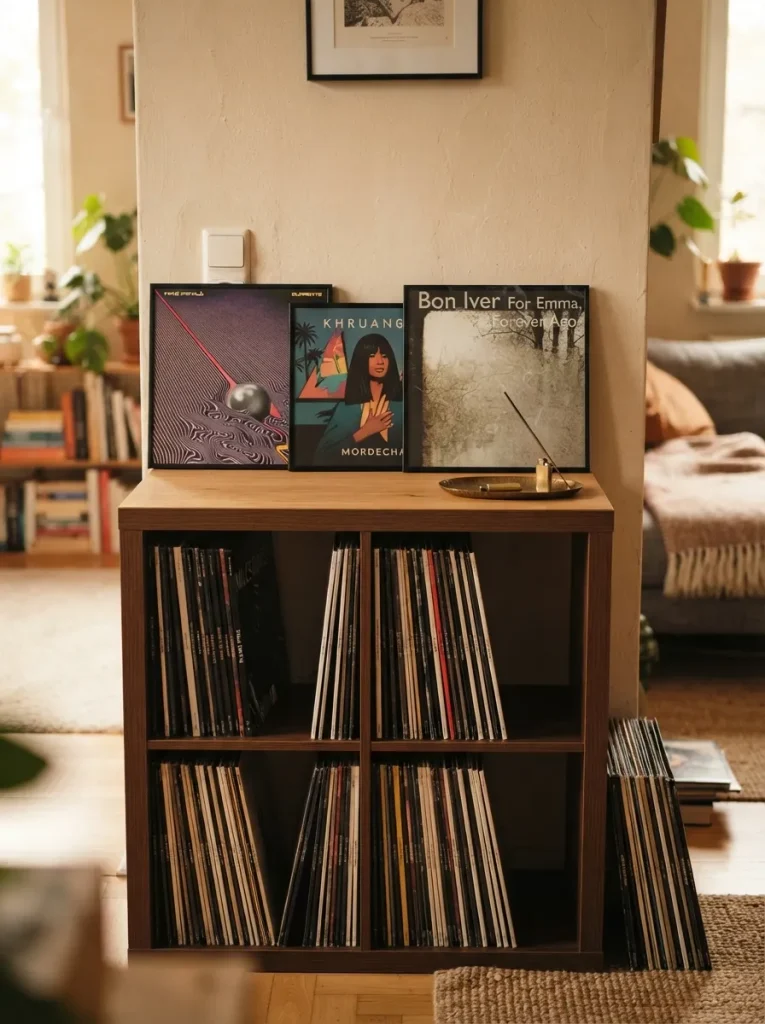
What it looks like: Two or three framed album covers lean against the wall on top of the unit, rotated out seasonally rather than mounted permanently.
Why it works: A record collection is already a personal archive, and displaying a few covers as art ties the storage function to the collecting itself it also gives an often-empty top surface an actual purpose. It’s one of the easier moves covered in our broader Kallax styling ideas roundup.
How to copy it: Use frames sized exactly for 12×12-inch sleeves, since standard picture frames run slightly small, and rotate which covers are displayed every few months so the top stays current.
Best for: Anyone who wants the shelf to read as intentional decor, not just storage.
14. Color-Code Record Dividers by Genre
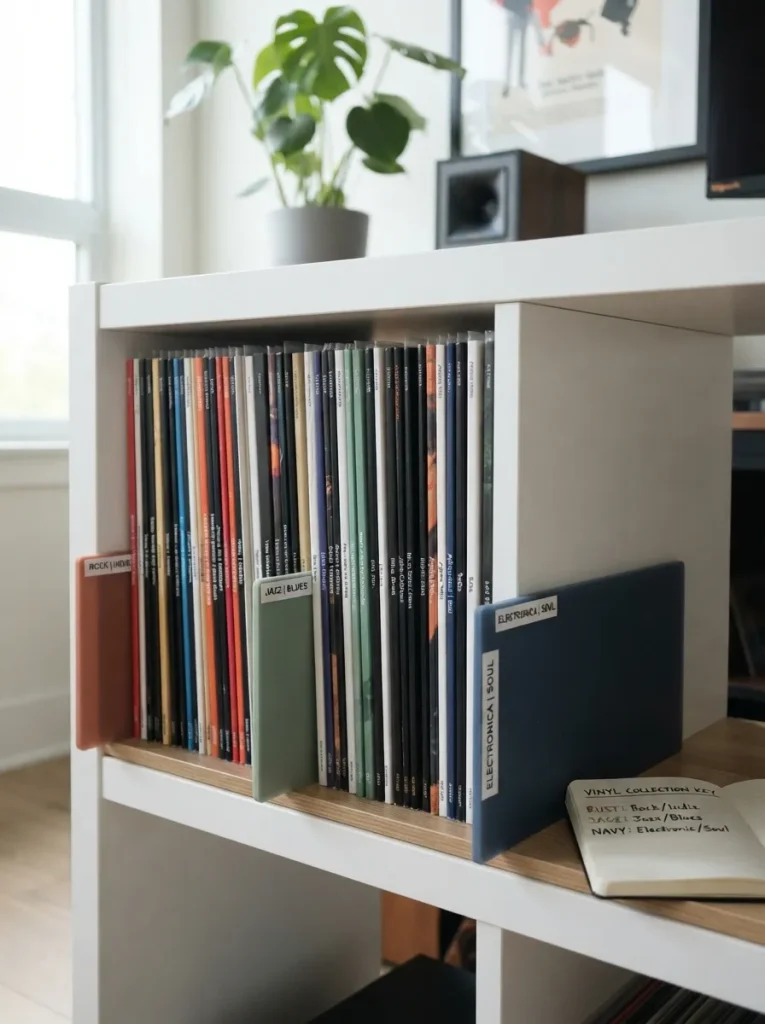
What it looks like: Instead of plain white dividers, each genre gets its own muted color rust for soul, sage for folk, navy for jazz visible at a glance from across the room.
Why it works: Color coding shortcuts the need to read every label individually, which matters most in low light or when scanning quickly for one section mid-listening-session.
How to copy it: Pick 4-6 muted tones, avoiding bright primary colors that read as a kids’ playroom, and keep a small written key taped inside a nearby cube until the pairing becomes automatic.
Best for: Large, multi-genre collections where quick visual scanning matters more than exact alphabetizing.
Quick Win: Painted wine corks glued to divider tops work as a nearly free color-coding system if buying new dividers isn’t in the budget.
Two more ideas left including the one that turns unused vertical space into actual seating.
15. Use a Half-Size Kallax for a First Vinyl Collection
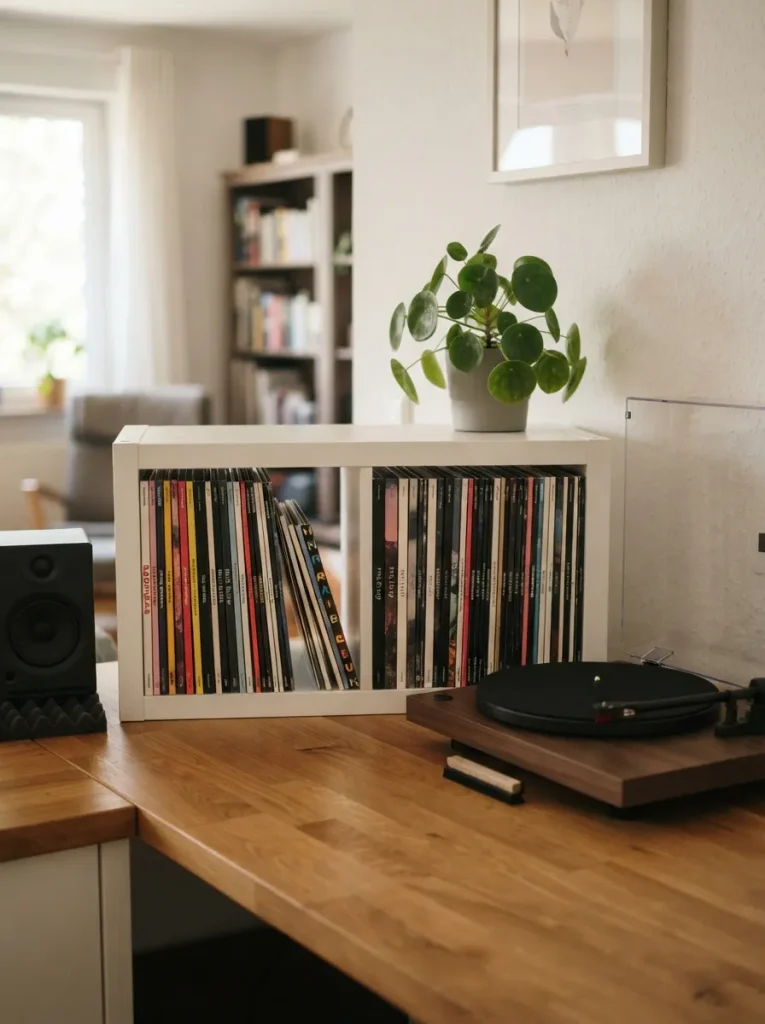
What it looks like: A small 1×2 or 1×4 Kallax sits on a desk, dresser top, or low table, sized for a collection that’s still growing rather than an imagined future one.
Why it works: Buying a full 4×4 unit for 30 records leaves most of it empty for years, and an oversized shelf actually makes a small collection look sparser than it is. Starting smaller matches the shelf to the collection instead of the other way around.
How to copy it: Buy the smallest Kallax size that fits the current collection with about 20% room to grow, and treat outgrowing it as the signal to add a second small unit rather than upgrading to one giant one.
Best for: New collectors under 100 records, dorm rooms, and small apartments.
Small-Space Tip: A 1×2 Kallax mounted on the wall above a desk uses zero floor space at all just confirm the wall anchors can hold the loaded weight.
16. Cap a Low Kallax With a Cushion for a Listening Nook
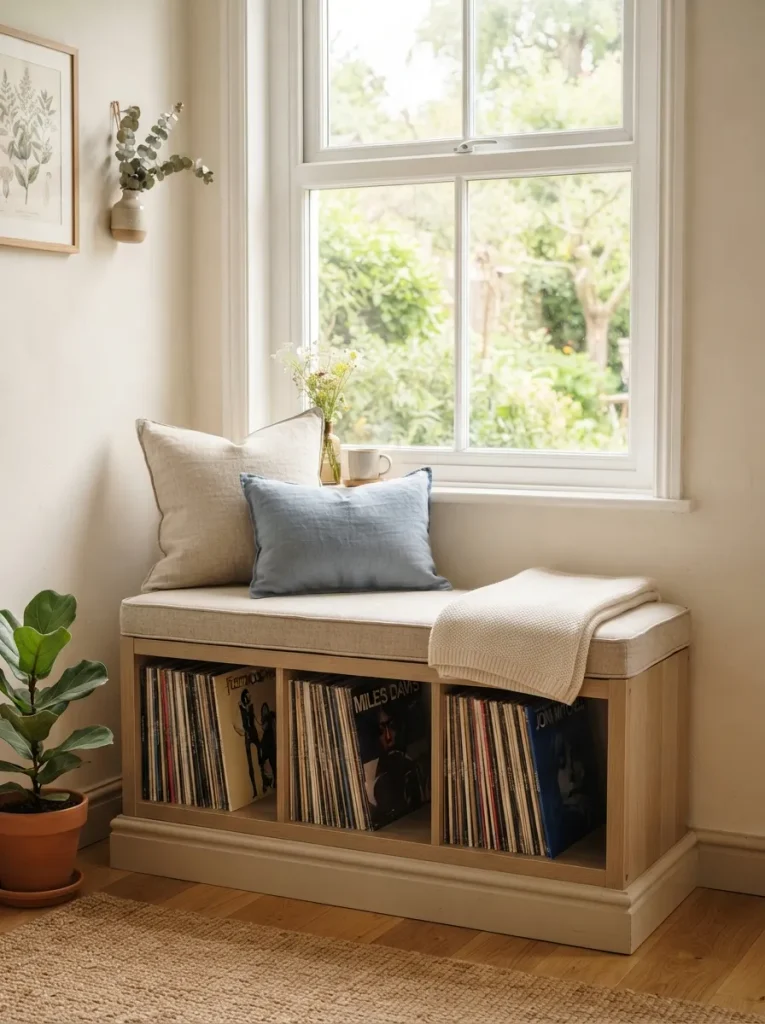
What it looks like: A low, wide Kallax row sits beneath a window with a fitted cushion on top, turning record storage into a bench for actual listening sessions.
Why it works: A record collection begs to be sat with, and a low unit with seating on top puts the records within arm’s reach of where you’ll actually spend time flipping through them, instead of across the room.
How to copy it: Use a 2×4 or 1×4 unit no taller than standard seat height, about 17-19 inches, with a cushion custom-cut to the exact top dimensions so it doesn’t slide.
Best for: Window nooks, reading corners, or anyone who wants their collection to double as a seat.
Small-Space Tip: In a room too small for a separate chair, this single piece replaces both seating and storage worth measuring before adding a chair elsewhere.
Shop This Look
| Product |
|---|
| Custom-cut bench cushion, linen cover |
| Low-profile 1×4 shelving unit |
| Throw pillow set, neutral tones |
| Folded wool blanket |
How to Start Your Kallax Record Storage Setup
In practice, the first move isn’t buying the shelf it’s counting the collection. Measure roughly how many records you actually own, divide by 40 for a realistic per-cube capacity, and buy exactly that Kallax size plus one empty cube for growth. Buying a 4×4 for a 60-record collection is the single move that makes a setup feel unfinished for years.
The most common fixable error is loading records before adding dividers or a support panel. Once 40 records are stacked, most people never go back and retrofit the shelf properly. Do the reinforcement and dividers first, even if it means the shelf sits half-empty for a week.
A set of acrylic dividers under $20, a roll of adhesive-backed cork underlayment under $15 for acoustic lining, and a single warm-white LED strip under $15 cover the three upgrades that make the biggest visible difference for the least money.
A single reinforced, divided cube can be finished in an afternoon for under $100. A full wall build two stacked units, dividers, lighting, and a turntable stand realistically takes two to three weekends and runs $300-600 depending on unit count and hardware.
Ready to Build Your Vinyl Storage Setup?
Between vertical dividers, rolling casters, corner configurations, and a full listening nook, there’s a Kallax record storage setup that fits almost any room and any collection size. None of it needs to happen at once one reinforced cube with proper dividers is a complete, finished project on its own. Start today by measuring your current collection and picking the smallest Kallax size that actually fits it, with room to grow.
A shelf that’s sized and organized right turns digging through records from a chore into the best part of putting one on. Save this one before your next IKEA trip dividers and casters are easy to forget once you’re already home.
You Might Also Like
- 12 IKEA Kallax Media Wall Hacks for Your Home Theater
- 8 Garage Storage Ideas for Record Crates and Vintage Gear
- 6 Turntable Setup Tips for Better Sound in a Small Room