13 Winter Blue Bathroom Decor Ideas for Cozy Cold Months
Blue turns cozy in winter the moment something warm sits beside it: amber light, honey-toned wood, brushed brass, thick cotton. These 13 winter blue bathroom decor ideas cover the paint undertone that makes or breaks the room, the lighting that rescues it, and a vanity finish that survives steam.
Picture slate walls holding the evening quiet while a low glow pools on warm wood. Towels feel heavy. Amber, not glare, fills the mirror. Blue sets the calm. Warmth does the rest.
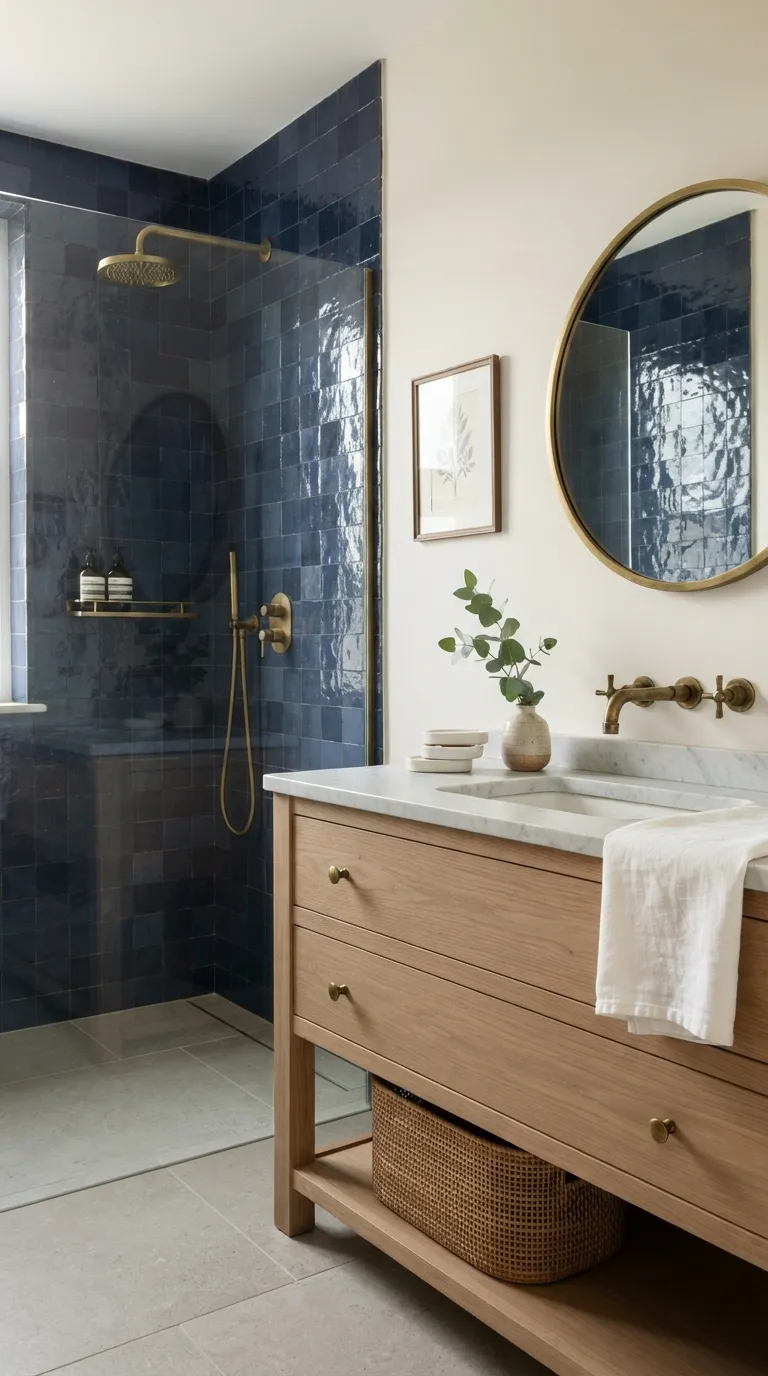
Quick Navigation
- Why Winter Blue Bathroom Decor Works So Well
- The Ideas, Easiest Fixes First
- How to Start Your Winter Blue Bathroom Transformation
- Ready to Create Your Dream Winter Blue Bathroom?
Why Winter Blue Bathroom Decor Works So Well
Blue brings the calm; winter asks for warmth layered over it. The working formula is a muted base (slate, dusty blue, or deep ink navy) balanced by warm counterweights: honey-toned oak or teak, brushed brass, oatmeal and cream cotton, amber-leaning light. Dark evenings turn the bathroom into a refuge, so the pairing suits the season. Small bathrooms handle it well, since one mid-depth blue makes walls recede instead of close in. Start with lighting and paint undertone; everything else is easier to adjust.
Style at a Glance
| Element | Cool Anchor | Warm Counterweight |
|---|---|---|
| Philosophy | Calm and depth | Comfort and glow |
| Materials | Glazed tile, painted wood | Oak, teak, brass, cotton |
| Color palette | Slate, dusty blue, ink navy | Oatmeal, cream, rust, amber |
The Ideas, Easiest Fixes First
1. Slate-Blue Walls with Warm White Trim and Ceiling

Pale icy blue against stark white trim is the default, and it’s the pairing that makes a bathroom feel like cold storage in January. Swap in a slate or dusty blue with visible gray in it, then set it against a creamy, warm white on trim and ceiling. Blue with a green lean tends to read fresh and spa-like, violet-leaning blues read heavier and sleepier, and gray-leaning slate takes warm accessories best. Use a moisture-resistant bathroom or kitchen formula in satin or semi-gloss; flat paint holds steam marks and is hard to wipe clean. Best for bathrooms with a small window or none, where a mid-depth blue adds shelter instead of shrinking the room.
Pro Tip: Paint a two-foot sample square on the dimmest wall and check it at night under your actual bulbs. Blue shifts more than most colors between daylight and lamplight, and evenings are when this room gets used.
2. Warm-White Bulbs in Frosted Sconces Beside the Mirror
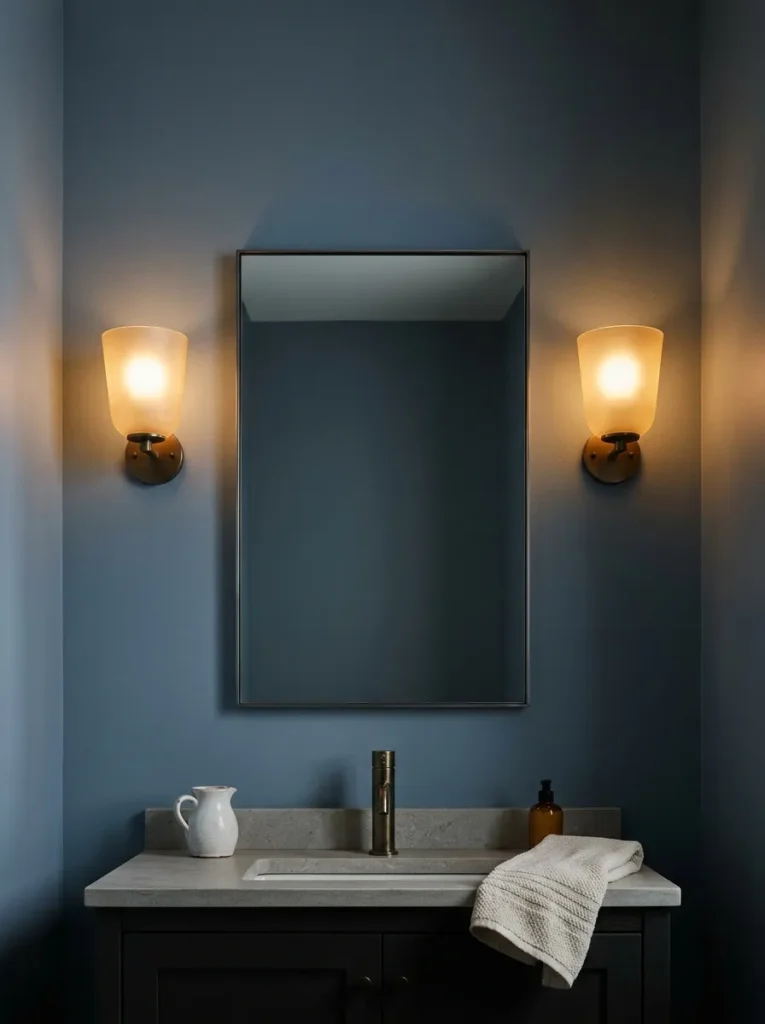
Light temperature changes blue more than a paint swap does. Cool-white bulbs push slate toward steel, while 2700K warm white pulls the same wall toward soft denim. Mount a pair of sconces on either side of the mirror with the bulbs near eye level, so light falls across the face instead of casting shadows from above. Frosted or opal glass shades matter as much as the bulb: bare LEDs throw hard glare off glossy tile and chrome, and a shade scatters it into a glow. Ideal if a single overhead light is the only source and the room feels flat after dark.
Warning: Any fixture near the tub or shower spray needs a damp or wet rating on the packaging. A dry-location sconce can corrode early, and that’s a safety issue, not only a lifespan one. Check the rating before buying, and hire an electrician if replacing hardwired fixtures is outside your comfort zone.
Shop This Look
| Product |
|---|
| Frosted glass bathroom wall sconces (pair) |
| 2700K warm-white LED bulbs in the sconce’s base size |
3. Brushed Brass Hardware Instead of Chrome
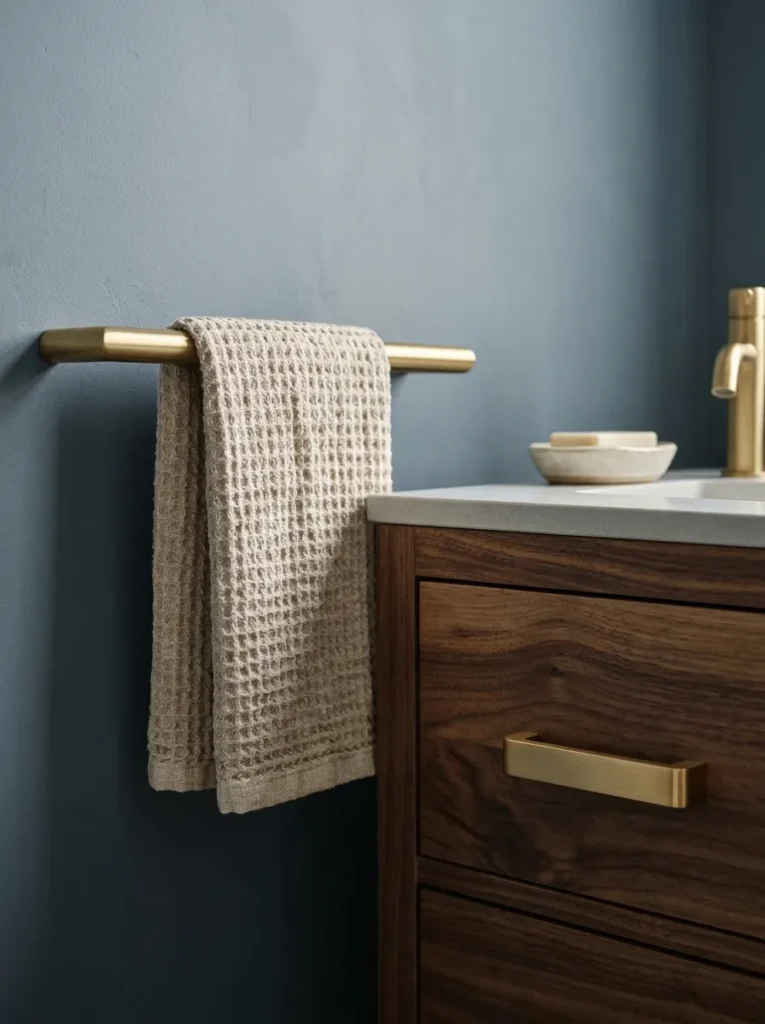
Brass pulls, a towel bar, and a faucet in warm metal give blue a golden thread to hold onto. Against slate, brushed or satin brass reads as amber without the mirror shine of polished finishes, and brushed surfaces hide water spots better than polished chrome. Mixing metals works if you commit: two finishes at most, each repeated at least twice. Brass faucet, black towel bar, chrome shower valve is three metals arguing. Unlacquered brass darkens into patina over the years, while lacquered brass stays uniform, so choose based on whether you like change. Best where pulls and a towel bar can be swapped without touching plumbing.
Budget Version: Keep this under $100 (approximate) by replacing only the cabinet pulls, one towel bar, and a pair of robe hooks in matching satin brass, and leaving the faucet alone.
Cold tile underfoot is a winter bathroom’s biggest complaint, and the fix in idea 4 gets worse the fluffier you go.
4. An Oversized Oatmeal Bath Rug
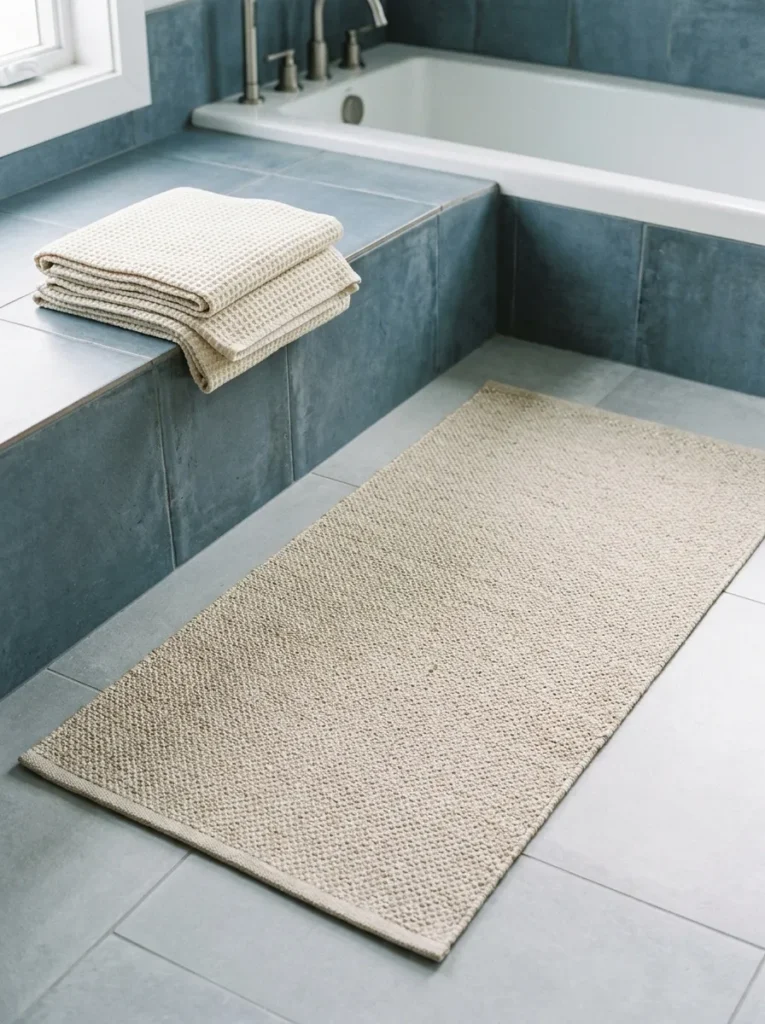
Cold tile underfoot is winter’s real bathroom complaint, and an oatmeal or cream rug answers it physically and visually. Size it so both feet land on it when stepping out of the tub or shower, which usually means bigger than the small mat packaged with a bath set. Flat-woven cotton or a low tufted pile with a non-slip backing works best; deep shag holds water and can smell musty. Oatmeal beats pure white against blue, since stark white next to slate can read icy again. Best for cold tile or stone floors where warmth matters more than looks.
Important: A thicker rug is not automatically warmer in practice. Deep pile traps water and dries slowly, so keep two machine-washable rugs and rotate them, hanging the damp one over the tub edge or a rail between uses.
Shop This Look
| Product |
|---|
| Oatmeal cotton bath rug, large, machine-washable with a non-slip backing |
| Cream waffle-weave bath towel set |
5. Rust or Amber Accents in Small Doses

Blue’s opposite on the color wheel is orange, which is why a touch of rust, terracotta, or amber looks natural beside it. Start with one hand towel in a rust tone, then add a ceramic soap dish and a candle in related shades; three repeats scattered between sink and tub read as intentional rather than as a second theme. Muted terracotta sits calmer against slate than bright orange, which fights it. Matte ceramic and amber glass hold up well around water. Keep everything else quiet so the accent has room to stand out. Best for bathrooms that already have blue walls and still feel flat.
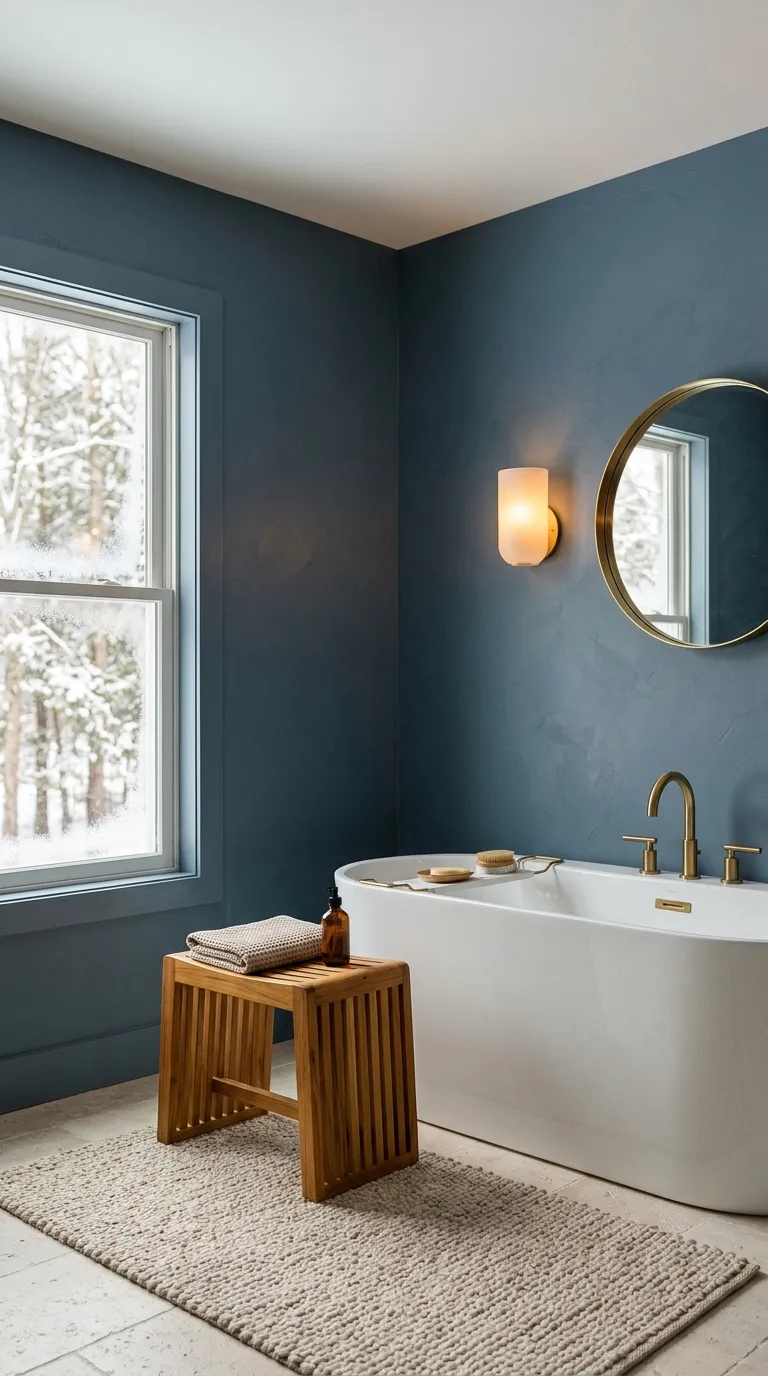
6. A Slatted Teak Stool Beside the Tub
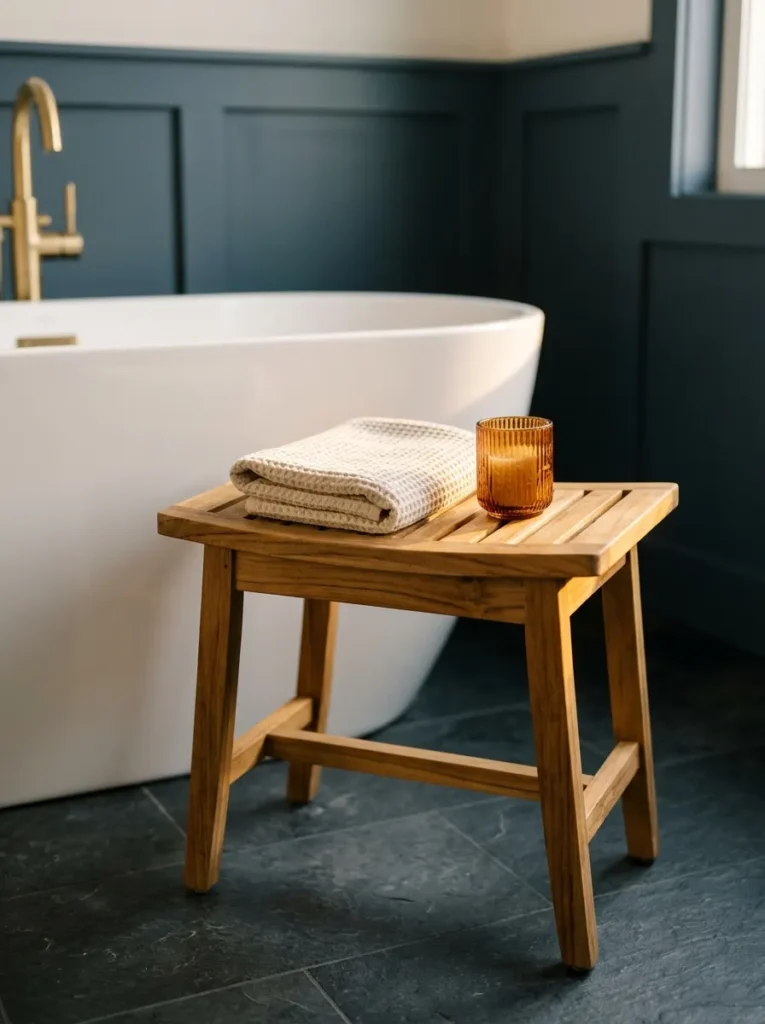
A slatted teak stool beside the tub puts honey-colored wood where blue needs it most: at eye level, within arm’s reach of the bath. It holds a folded towel, a candle, or a mug of tea. Teak’s natural oils make it a standard choice for wet areas, while oak and pine need a water-resistant finish and a wipe-down after steamy baths. Pick legs over a solid base so water can’t pool underneath, and match the seat height roughly to the tub rim so the surface feels like part of the bath. Best for bathrooms with a little floor space beside the tub.
Pro Tip: Slatted seats dry faster than solid ones, so choose slats if the stool will sit near the shower spray, and check under the feet from time to time for trapped water.
Shop This Look
| Product |
|---|
| Slatted teak bath stool |
| Amber ribbed-glass candle holder |
Idea 7 costs nothing and takes one minute in the doorway: deciding which wall the room says its first sentence on.
7. Style the Wall You See First from the Doorway

Eyes settle on the first wall they meet, so the doorway wall is where warmth should be concentrated. In most bathrooms that’s the vanity, tub, or shower wall; style whichever one you face on entering. Group a wood shelf, one brass accent, and a framed print there, and keep the side walls plain. Hang the print with its center near eye level (57 to 60 inches is the common gallery guideline) and keep it clear of shower spray. Put glass over the print, since steam warps paper in poorly ventilated bathrooms. Best for bathrooms that feel scattered, with small items on every wall and nothing in charge.
Styling Note: Stand in the open doorway before anything goes on the wall. Place the pieces on the counter or floor, shift them until the shelf, print, and brass piece form a loose triangle, then mark the positions.
8. A Linen-Look Blue Shower Curtain Hung Near the Ceiling
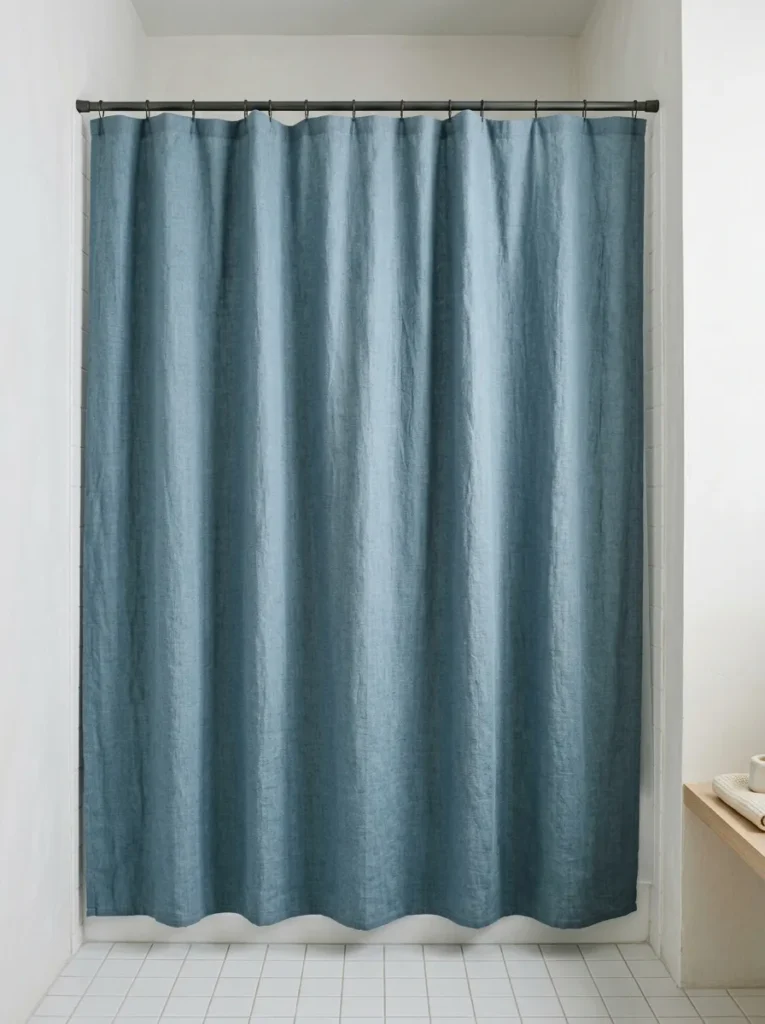
Small bathrooms get the most from this trick: a curtain hung near the ceiling makes one unbroken vertical line, so the eye travels up and the room reads taller. Choose a linen-look woven curtain in muted blue, or pale blue with a faint stripe, rather than glossy vinyl, which flattens the cozy mood. Let the hem clear the floor by about an inch so it dries between showers and doesn’t wick water onto the rug. Keep a separate frosted liner behind it; the decorative layer shouldn’t have to be the waterproof one. Renters can use a tension rod near the top of the alcove, though check its load rating against the curtain and liner together.
Pro Tip: Choose a curtain a little wider than the rod span so it folds softly. Flat, taut fabric looks like a screen, while gentle folds add texture.
Shop This Look
| Product |
|---|
| Linen-look blue shower curtain |
| Shower curtain rod in a matte finish |
| Frosted shower liner |
9. Glazed Dusty-Blue Tile with Warm Grout
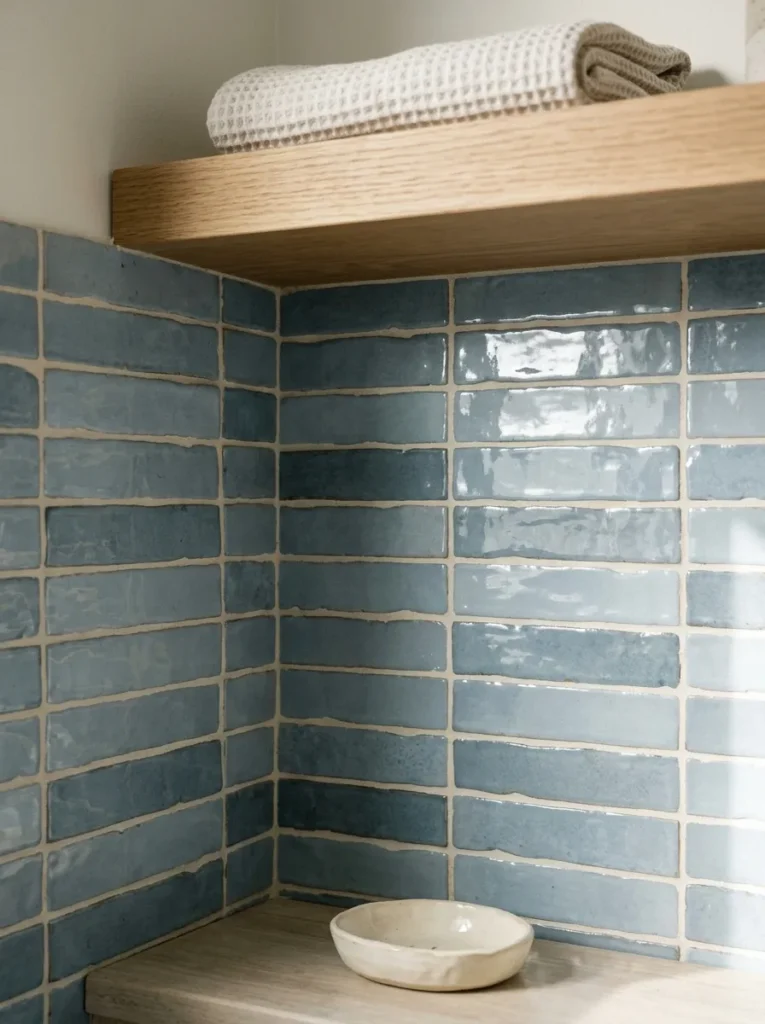
White grout around blue tile turns a soft surface into graph paper. Choose a warm off-white or light greige grout instead, and the tile reads as one continuous glazed field. Small, slightly irregular tiles in dusty blue catch light unevenly, which adds depth to even a modest vanity backsplash or tub surround. Sealing cement-based grout helps it resist stains, and a slightly darker warm grout hides steam and soap marks longer. For renters or tight budgets, peel-and-stick tile on a vanity wall gives a similar effect. Best for anyone already planning a splash zone, since tile is the one blue surface that never needs repainting.
Important: Peel-and-stick tile covers a surface; it doesn’t waterproof one. Keep it to a vanity backsplash away from direct spray, and check the manufacturer’s guidance for bathroom use.
Idea 10 swaps a single wall plate and gives you a bright room at 7 a.m. and a candle-low one at 10 p.m.
10. A Dimmer Switch for Bath-Time Light

Fit a dimmer into the existing switch, and the room shifts from bright task light in the morning to low amber at night. Pair it with LED bulbs marked dimmable, and confirm the dimmer is rated for LED loads; mismatches cause flicker or humming. Set the evening level just bright enough to find a towel, not to read a label. If working inside a switch box isn’t familiar, this is a short job for an electrician, and the circuit should be off at the breaker either way. Best for anyone who uses the bathroom at both 7 a.m. and 10 p.m. and wants the room to suit both.
Pro Tip: Look for dim-to-warm bulbs, which shift toward amber as they dim, much like a candle. The packaging says so; not every dimmable bulb does it.
11. A Round Mirror in a Brass or Sealed-Wood Frame

A round mirror with a thin brass ring or a honey-wood frame softens the right angles of tile and vanity and adds a warm outline against blue walls. In winter its job grows: across from a window, it doubles the little daylight there is; in a windowless room, it multiplies sconce glow. Center it at the eye level of whoever uses the sink most, and keep it slightly narrower than the vanity so it doesn’t crowd the wall. Raw wood frames swell in steam, so look for a sealed or lacquered finish. Best for bathrooms where straight lines dominate and the mirror is the first thing facing the door.
Shop This Look
| Product |
|---|
| Round mirror with a brass-tone or sealed-wood frame |
| Cream ceramic vanity tray |
The counterintuitive part: in a small bathroom, a deeper blue usually feels warmer after dark than a pale one. Light colors reflect whatever reaches them, and in winter that’s often cool gray daylight or cool-white bulbs. A mid-depth slate absorbs more of it, leaving 2700K sconce light to read as a glow instead of a wash. Pale blue still works when the room gets real morning sun; test it at night before committing.
12. Color-Drench the Room in One Deep Blue, Ceiling Included

Most bathrooms get colored walls and a white ceiling, and the line where they meet slices the room in two. Color-drenching puts one deep blue on walls, trim, and ceiling, so the edges blur and the room reads as a single warm-lit shell after dark. Vary the sheen for depth: a low-sheen mildew-resistant paint on the ceiling, satin on the walls, semi-gloss on the trim, all in moisture-resistant formulas, since the ceiling gets the most steam. Best for windowless or low-light bathrooms. In a bright room, a drenched deep blue can feel heavy.
Mistake to Avoid: Using the wall sheen on the ceiling. Glossier ceilings show every roller mark and patch under side lighting from sconces, so keep the ceiling low-sheen.
Idea 13 is the biggest swing in this list, and the paint matters less than the prep.
13. A Deep Ink-Blue Painted Vanity
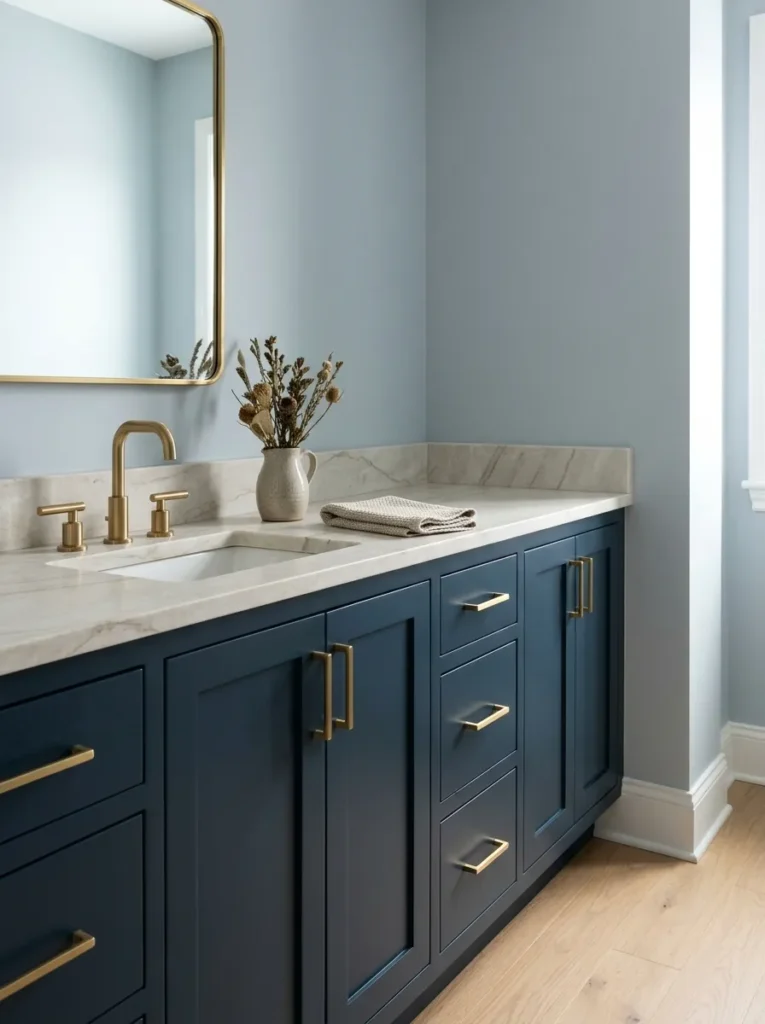
Start with the cabinet’s surface, not the color. Steam leaves a film on bathroom cabinets that stops paint from bonding, so clean and degloss before opening any can. Then paint the vanity a deep ink blue, close to navy with a trace of gray, and it becomes the room’s anchor: a dark mass at floor level that makes lighter walls and a cream top look deliberate. Cabinet-grade enamel in satin is the right finish. Cure time is typically measured in days, not hours, so keep doors open until the label says otherwise. Best for a sound but dated vanity that only needs a new face.
✅ Vanity Paint Sequence:
- [ ] Remove doors, drawers, and hardware, and label each so everything returns to the same spot
- [ ] Clean with a degreasing cleaner, then lightly scuff the old finish
- [ ] Apply a moisture-rated bonding primer
- [ ] Brush or roll two thin coats of cabinet enamel, sanding lightly between coats if the label says to
- [ ] Leave doors open until the label’s cure time has passed
How to Start Your Winter Blue Bathroom Transformation
Before anything else, change the bulbs to 2700K warm white. Blue responds to light temperature more than to nearly any other decision, and a paint sample judged under cool-white bulbs gives a misleading answer. Everything that follows is easier once the light is right.
The most common beginner error is pairing blue with chrome, stark white towels, and cool-white bulbs, so every element runs cold. Fix it by adding warmth in three separate places: light, metal or wood, and textiles. One of each is enough to tip the room.
Three finds that typically sit well under $50 each: a rust-glaze ceramic soap dish, a matte ceramic bud vase with dried stems, and a small framed print under glass. None repeats a piece above, and each adds a warm note without a project.
A weekend covers the lighting swap, rug, towels, curtain, and accessories. Painting walls takes a weekend plus drying time, and a vanity repaint runs a week or more because of cure time. A starter refresh often lands around $150 to $300, and a fuller update with paint, lighting, a mirror, and hardware could reach roughly $600 to $1,200. Treat both as ballpark guides, not quotes.
Ready to Create Your Dream Winter Blue Bathroom?
Thirteen winter blue bathroom decor ideas cover a lot of ground: paint undertones and drenching, wood and brass, tile, layered light, and a layout that tells the eye where to land. None of them demands a full renovation. One warm bulb in the vanity fixture can change how the walls read tonight, and every idea after that builds on it a little at a time.
Aim for the feeling of stepping into a warm room on a dark evening: steam, amber glow, heavy cotton, quiet blue all around. Save the ideas that match your bathroom to a Pinterest board, then start with the one you can finish this weekend.
Keep Exploring
- 11 Navy and Brass Bathroom Ideas That Feel Warm in Winter
- 15 Winter Blue Bedroom Ideas for Long, Quiet Nights
- 9 Bathroom Towel Storage Ideas That Keep Winter Linens Within Reach