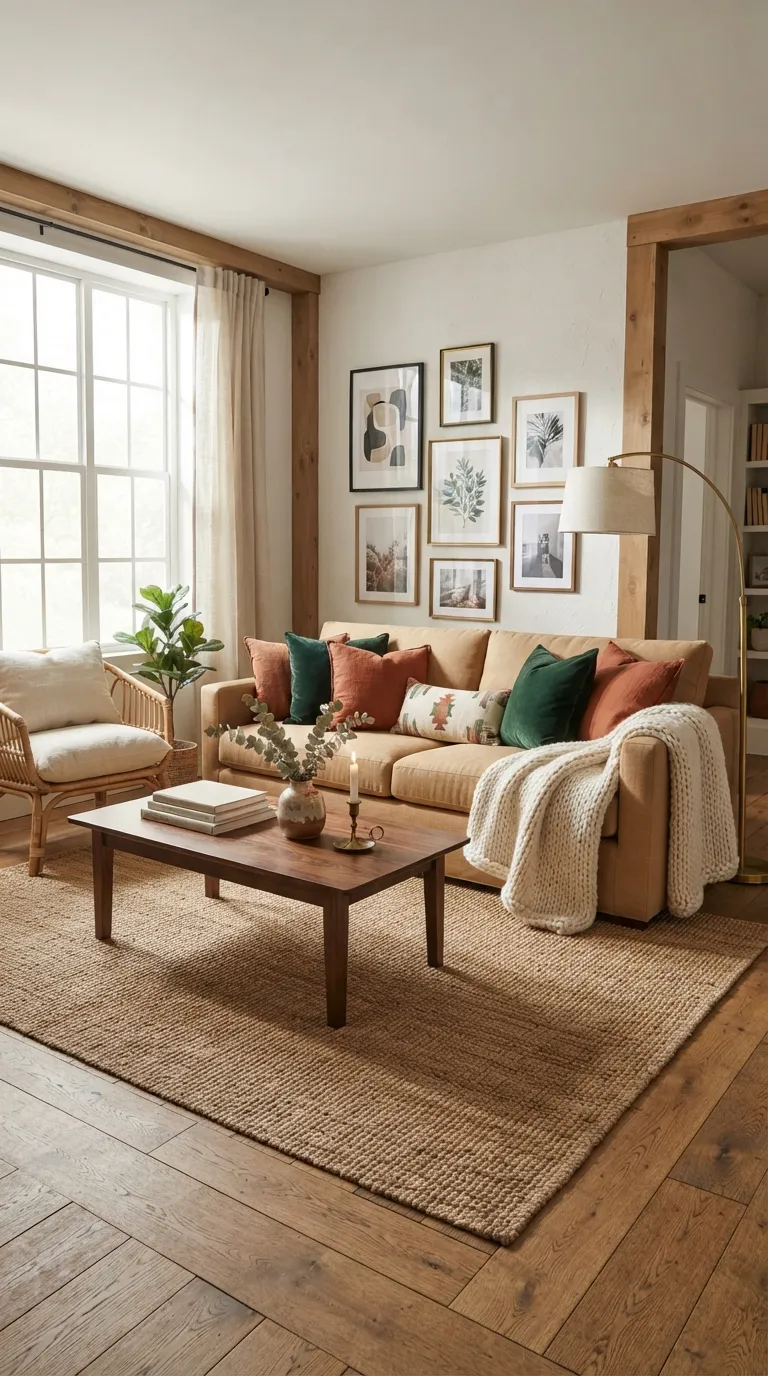
22 Tan Sofa Living Room Ideas That Actually Work (Not Just Beige-on-Beige)
A tan sofa is basically the little black dress of living room furniture it goes with more than people give it credit for, and it hides everyday wear far better than white or gray ever will. This guide walks through 22 tan sofa living room ideas, covering color pairings, texture, lighting, and layout fixes that keep the space from reading flat.
There’s a reason tan keeps showing up in living rooms years after “greige everything” should’ve gotten old it’s warm without trying too hard, and it plays nicely with terracotta, navy, emerald, or black iron, depending on the mood a room’s actually going for that season.
Layer it right and the space feels lived-in instead of showroom-staged. Get lazy with it, though, and it slides into forgettable fast. Twenty-two ways to make sure that doesn’t happen.
Quick Navigation
- Why a Tan Sofa Living Room Makes Such a Difference
- 22 Tan Sofa Living Room Ideas to Try
- How to Start Your Tan Sofa Living Room Transformation
- Ready to Create Your Dream Tan Sofa Living Room?
Why a Tan Sofa Living Room Makes Such a Difference
A tan sofa reads as a soft, warm neutral somewhere between camel and oatmeal and it’s become the go-to for people who want a living room that outlasts a few redecorating cycles without looking dated. It pairs cleanly with warm terracotta, deep emerald, ink navy, and black iron hardware, plus natural materials like jute, rattan, and unfinished oak.
Right now it’s having a moment because it flexes between warm-maximalist and pared-back palettes without a full furniture swap. In smaller living rooms, prioritize the rug and one bold textile first that’s what keeps a small tan-sofa room from reading beige-on-beige.
| Best starting point | Identify your sofa’s undertone — warm yellow-tan vs. cooler greige-tan — before buying anything else |
| Biggest impact area | The rug and one bold textile (pillows, throw, or curtains) |
| Budget to start | $150–$400 for accent pieces |
| Time to complete | A weekend for accents; 4–6 weeks for a full furniture refresh |
22 Tan Sofa Living Room Ideas to Try
1. Fix the “Boring Beige” Look With a Bold Accent Wall Behind Your Tan Sofa
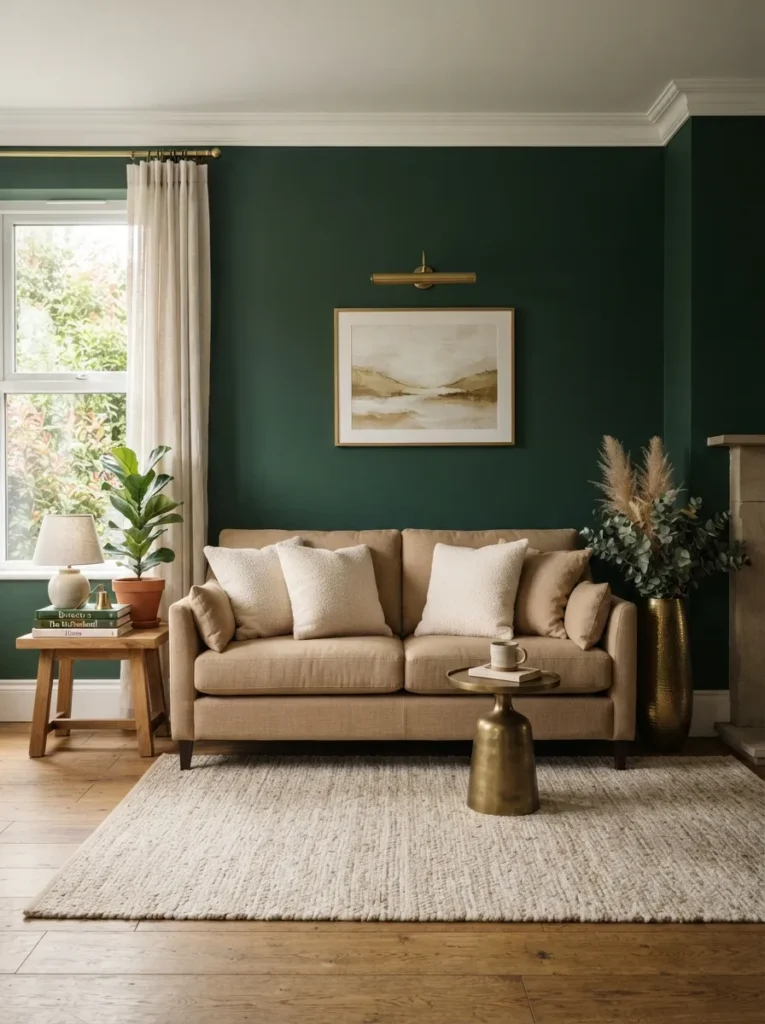
What it looks like: Grounded the wall goes rich and dark while the sofa stays the visual resting point in the room.
Why it works: This is straight color theory tan sits at a warm mid-value, so it advances against a saturated backdrop instead of disappearing into it. Deep colors recede less than most people expect at this depth, which is why the pairing reads bold instead of muddy.
How to copy it: Paint just the wall behind the sofa not all four in a deep bottle-green or forest tone, keep the trim white, and let the tan sofa’s warmth bridge the two tones.
Best for: Renters who want to test bold color with a single accent wall instead of committing to a full repaint.
Important: Most people assume tan sofas only work with pastel or neutral walls. The opposite is usually true saturated wall colors make tan read richer, not clashing.
2. Stop Matching Everything — Layer Textures Instead of Colors
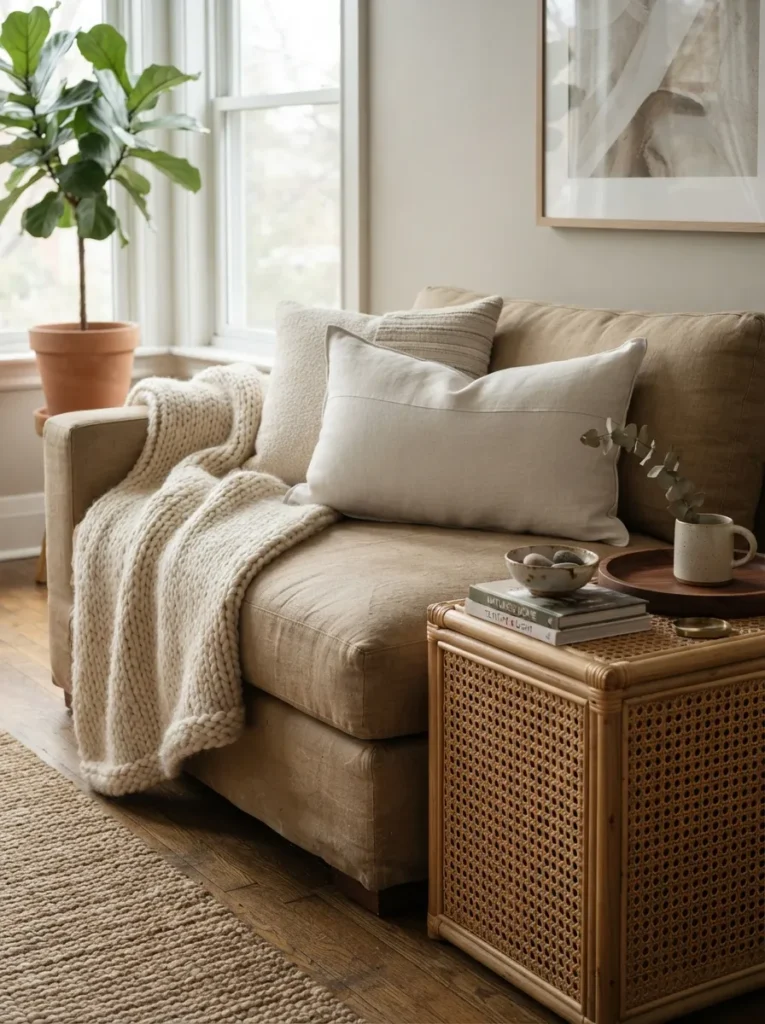
What it looks like: Layered no two surfaces near the sofa feel the same to the touch.
Why it works: Texture layering is the design principle that saves an all-neutral room from looking flat on camera and in person. When color contrast is low, texture contrast has to do the work smooth linen against nubby boucle against woven jute reads as intentional, not accidental.
How to copy it: Pick three textures max per seating area one smooth (linen), one nubby (boucle or chunky knit), one woven (rattan or jute) and repeat them elsewhere in the room so it doesn’t feel like a one-off vignette.
Best for: Anyone who inherited an all-neutral living room and wants depth without buying a single new color.
Mistake to Avoid: Buying pillow covers in the exact same tan as the sofa. It reads as one flat shape from across the room instead of a styled seating area.
3. Swap In a Warm Brass Floor Lamp
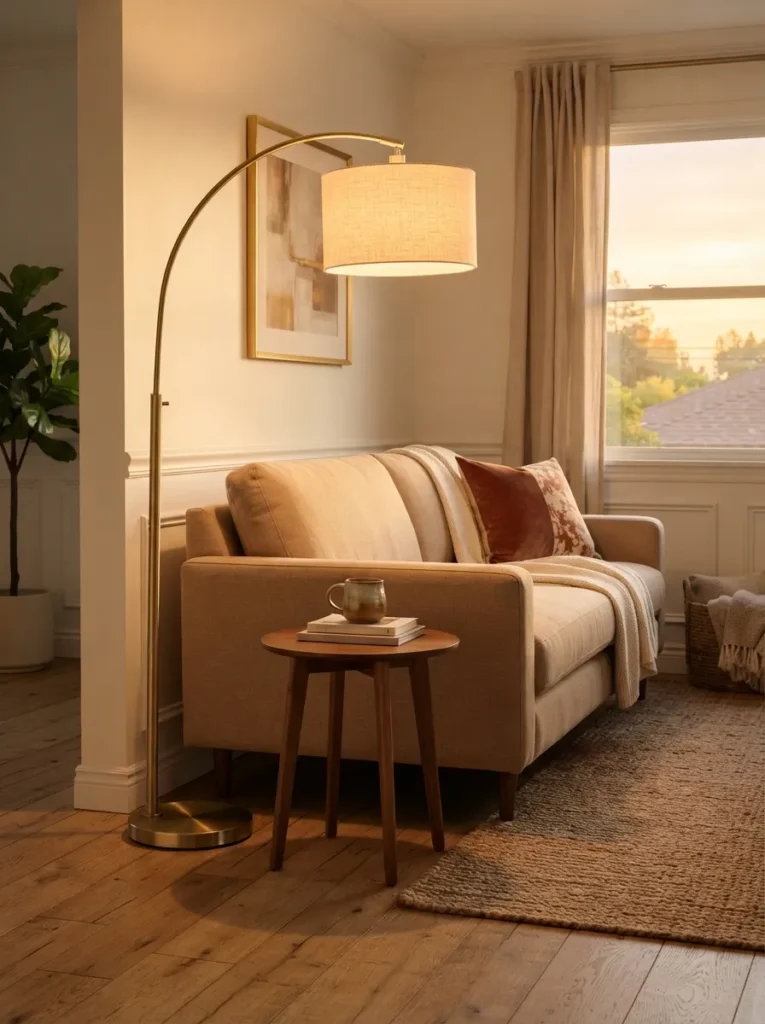
What it looks like: Warm the light pools low and golden instead of flooding the ceiling.
Why it works: Light behavior matters as much as furniture choice. Overhead lighting flattens a tan sofa’s texture and can wash the color out to look gray under certain bulbs; a floor lamp casts directional, warm light that keeps the sofa’s undertone looking intentional in evening hours.
How to copy it: Position a brass or black-iron arc lamp so its shade sits roughly at seated eye-level, and use a warm 2700K bulb anything cooler will fight the tan’s natural warmth.
Best for: People who use their living room mostly in the evening and want it to feel cozy, not office-lit.
Shop This Look
| Product |
|---|
| Brass arc floor lamp with linen drum shade |
| Warm 2700K dimmable LED bulb |
| Marble-base brass reading lamp for a side table |
| Woven rattan pendant shade |
| Adjustable-arm brass floor lamp |
The next idea is one people skip entirely because it feels almost too simple and it costs almost nothing.
4. Add Rust and Terracotta Throw Pillows
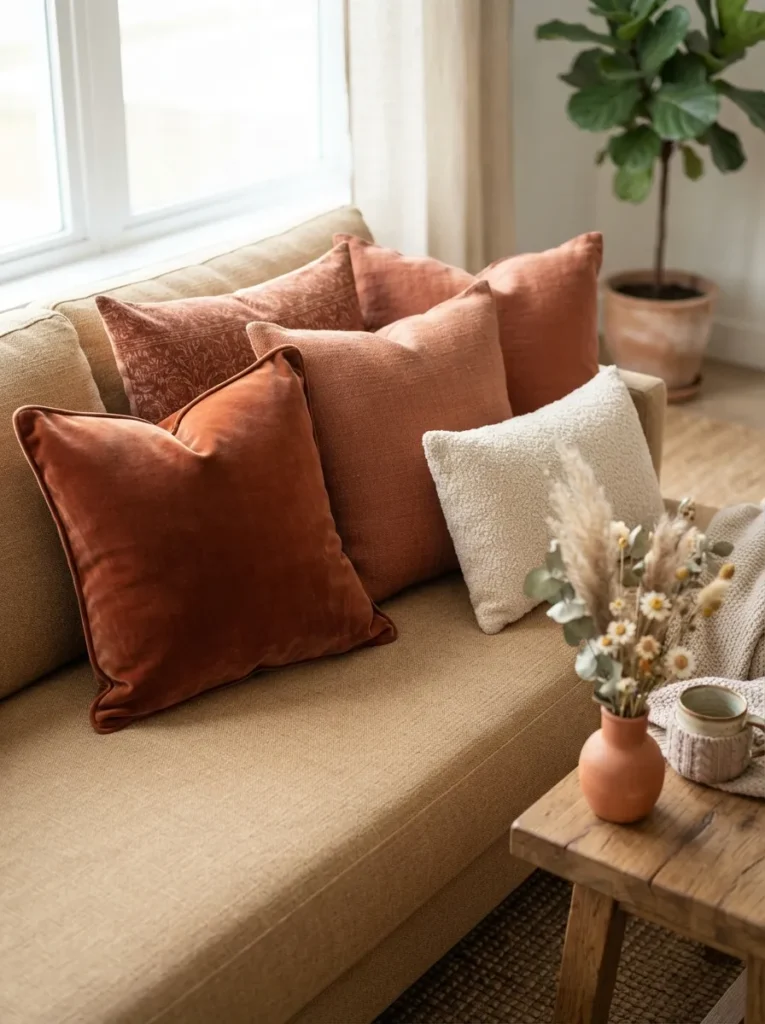
What it looks like: Sun-warmed the pillows sit a shade darker and richer than the sofa itself, not a match.
Why it works: Rust and terracotta share tan’s yellow-orange undertone, so the pairing reads as harmonious rather than clashing this is analogous color theory, not a coincidence. The slight value contrast keeps the eye moving instead of blending into one shape.
How to copy it: Choose pillow covers a full shade or two darker than the sofa think dried-clay orange, not peach and mix one velvet with one cotton or linen cover for texture variation.
Best for: Renters and beginners who want a fast seasonal refresh without touching furniture.
Pro Tip: Wash rust and terracotta swatches against your sofa fabric in daylight before buying some rust tones read muddy brown under warm bulbs, and you won’t catch that under store lighting.
If you already lean toward this warm, rust-and-cream palette outdoors, it’s worth browsing our fall porch ideas for a few pairings that translate just as well indoors.
5. Choose a Dark Wood Coffee Table for Contrast
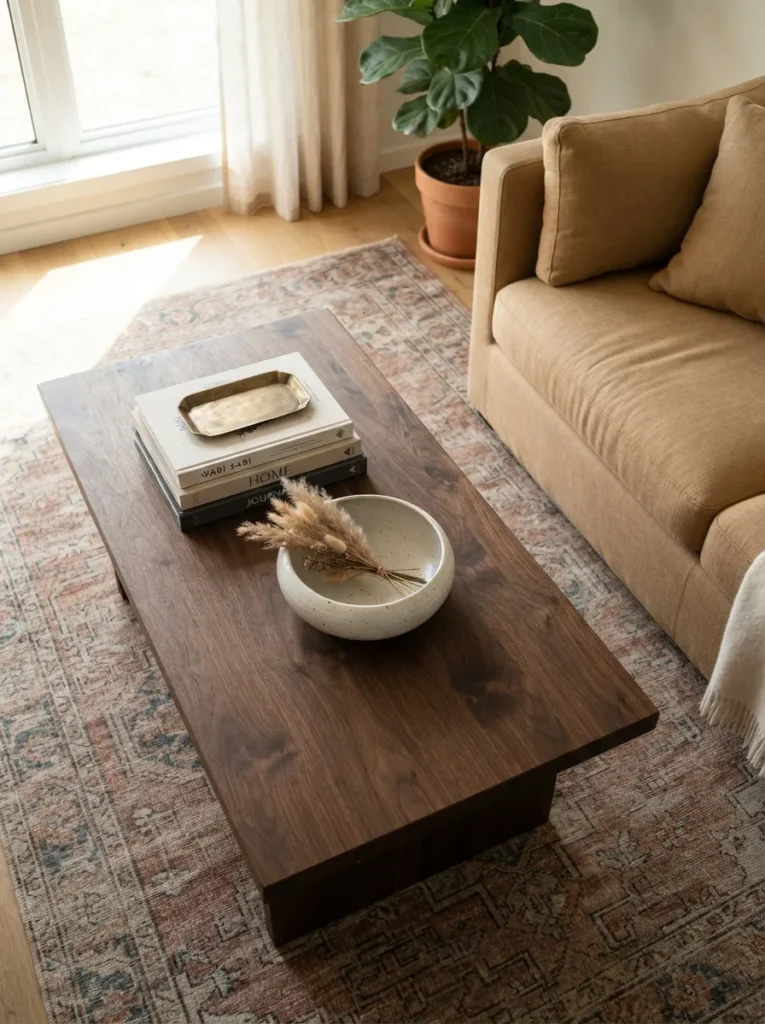
What it looks like: Anchored the low, dark table gives the eye somewhere to land against all that lighter fabric.
Why it works: Visual weight matters at floor level. A tan sofa paired with another light-toned coffee table can feel like the room is floating; a dark walnut or espresso-toned table adds ballast and creates the value contrast a neutral room usually lacks.
How to copy it: Go with a solid or veneer walnut table in a matte, not glossy, finish glossy dark wood reads formal, matte reads livable.
Best for: Living rooms that already have several light-wood or light-toned pieces and need one grounding element.
Budget Version: A dark-stained secondhand table refinished with two coats of walnut gel stain costs under $60 in materials and gets the same visual weight as a $400 retail piece.
6. Layer a Chunky Jute Rug Underfoot
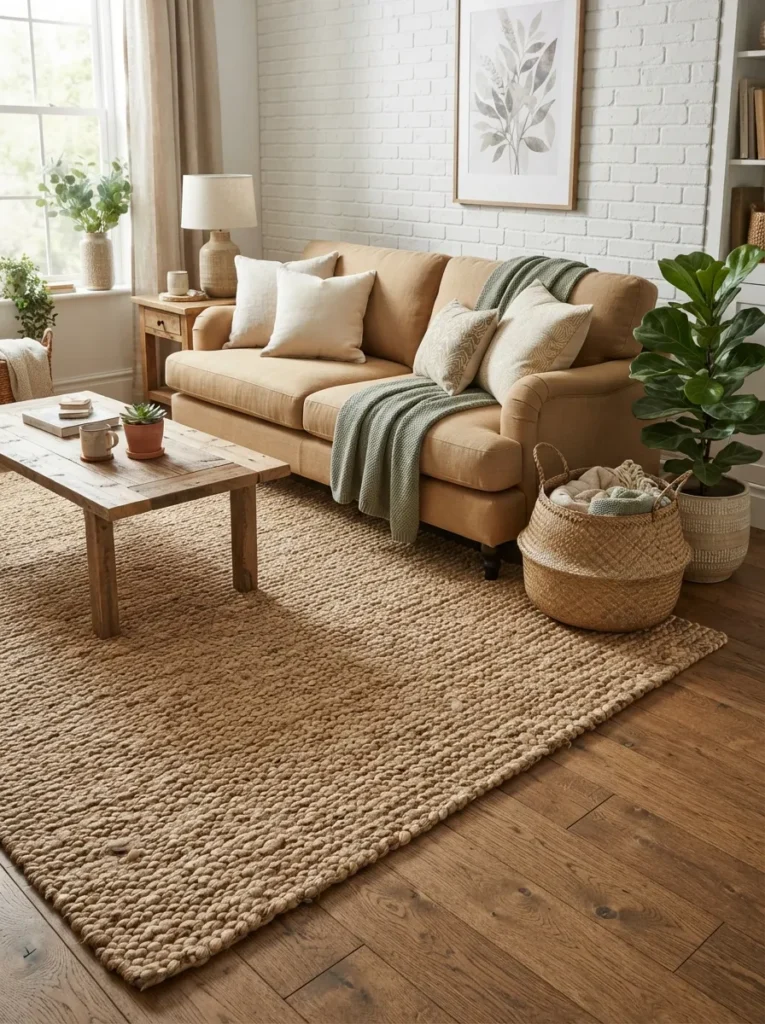
What it looks like: Raw the coarse weave contrasts against the sofa’s smoother upholstery instead of blending in.
Why it works: Two tan-toned pieces (sofa and rug) can flatten a room if their textures match too closely. A chunky jute weave keeps them in the same color family while adding enough textural contrast that the floor doesn’t disappear visually into the seating.
How to copy it: Size the rug so at least the front legs of every seating piece sit on it, and choose a thick, natural (undyed) jute weave rather than a flat-woven sisal for maximum texture payoff.
Best for: Living rooms that feel visually flat despite having plenty of furniture.
Up next: the layout move that costs nothing and instantly makes the room feel bigger.
7. Build a Gallery Wall With Mixed Frame Finishes
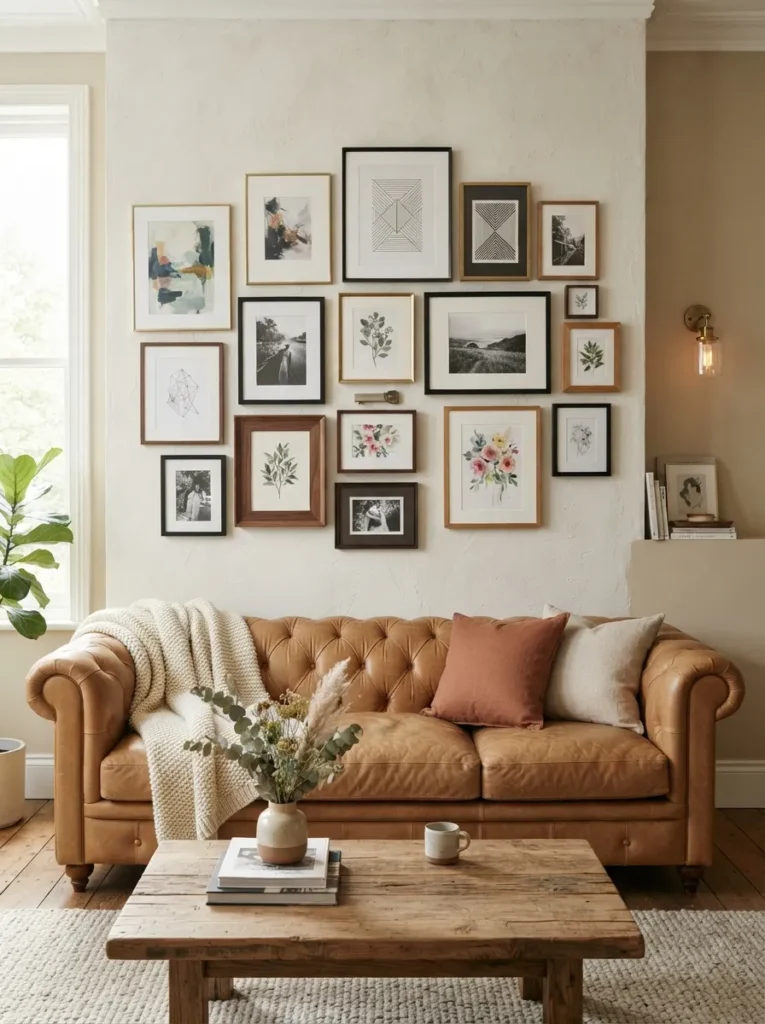
What it looks like: Curated like it was collected over years, not bought as a matched set.
Why it works: Repetition without variation reads as a kit; mixing black, brass, and natural wood frames creates the kind of visual interest that makes a gallery wall feel personal rather than store-bought, while the tan sofa below keeps the whole arrangement grounded.
How to copy it: Anchor the layout with one large frame slightly off-center above the sofa, then build outward with 4–6 smaller frames in at least two different finishes never more than three frame finishes total, or it starts to look chaotic.
Best for: People with an existing art or photo collection who haven’t found a way to display it cohesively.
8. Pair Deep Emerald Green With Your Tan Sofa for Instant Richness
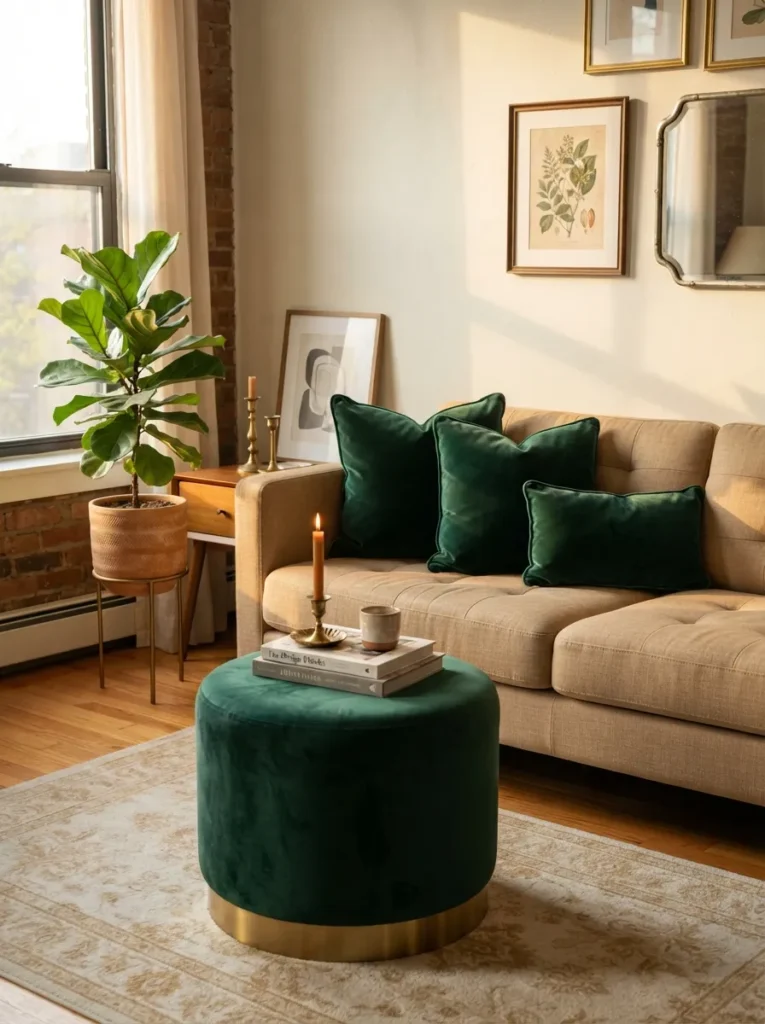
What it looks like: Luminous the velvet catches light differently than the sofa’s matte weave, giving the whole seating area more dimension.
Why it works: Emerald is a near-complementary shade to tan’s warm undertone, which creates enough contrast to feel intentional without competing for attention a common pairing in higher-end interiors precisely because it reads expensive without being loud.
How to copy it: Introduce emerald through one velvet piece (pillow, ottoman, or throw) rather than paint, so it can be swapped out easily if the mood changes.
Best for: People who want a “designer” moment without repainting anything.
9. Float the Sofa Away From the Wall
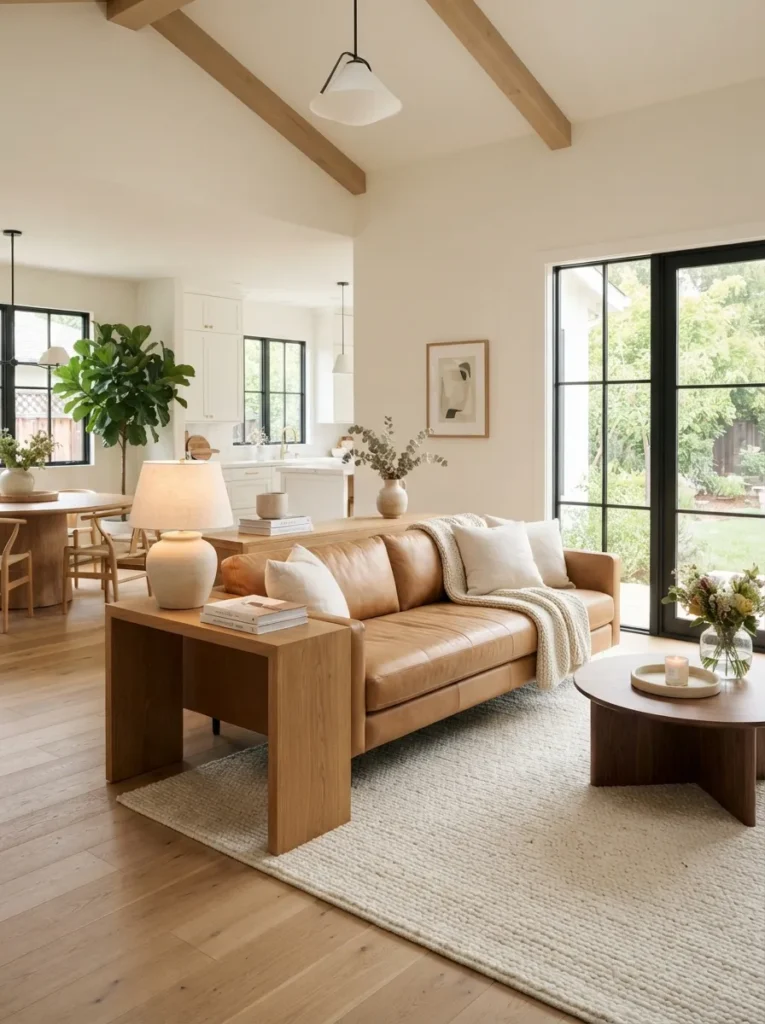
What it looks like: Intentional the sofa reads as the center of a defined zone instead of furniture pushed against a wall.
Why it works: This is a proportion and flow principle pushing every piece against the perimeter of a room actually makes it feel smaller by leaving one giant unused void in the middle. Floating the sofa creates a walkway behind it and a clearer conversation area in front.
How to copy it: Leave at least 30 inches behind the sofa for walking clearance, and use that space for a slim console table instead of leaving it empty.
Best for: Open-concept living rooms or any room where the sofa currently backs up to nothing but wall.
The next idea is one most people overlook entirely and it costs almost nothing.
10. Add a Rattan or Wicker Accent Chair
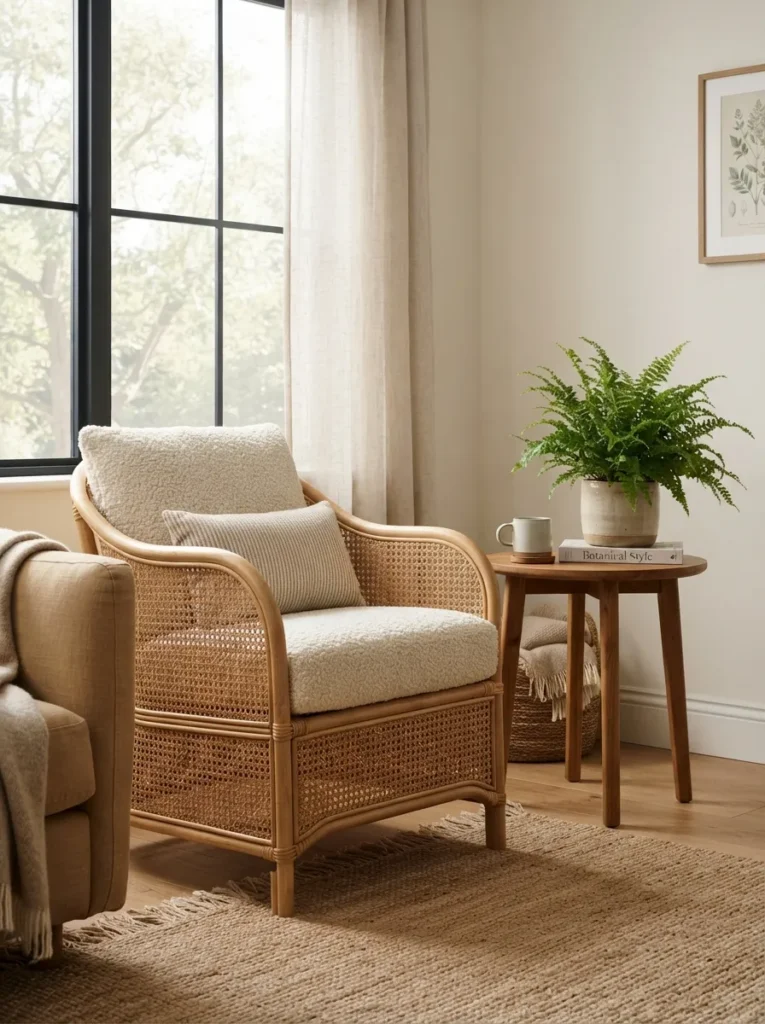
What it looks like: Airy the open weave keeps the seating area from feeling heavy despite adding another piece.
Why it works: Material layering matters here more than color rattan’s open weave contrasts against the sofa’s dense upholstery, and because it’s still in the tan-brown family, it doesn’t fight for attention the way a bold-colored chair would.
How to copy it: Choose a rattan chair with a solid-colored cushion, not a busy pattern, so the weave itself stays the visual interest rather than competing with the fabric.
Best for: People who want to add seating without adding visual bulk to a smaller living room.
Pro Tip: Measure the chair’s widest point, not just the seat, before buying rattan frames flare out more than upholstered chairs and eat more floor space than they appear to in photos.
Shop This Look
| Product |
|---|
| Rattan accent chair with cream boucle cushion |
| Natural wicker papasan chair |
| Rattan swivel accent chair |
| Woven rattan chair with black iron frame |
| Round rattan side table to pair with the chair |
11. Layer Three Light Sources for Evening Warmth
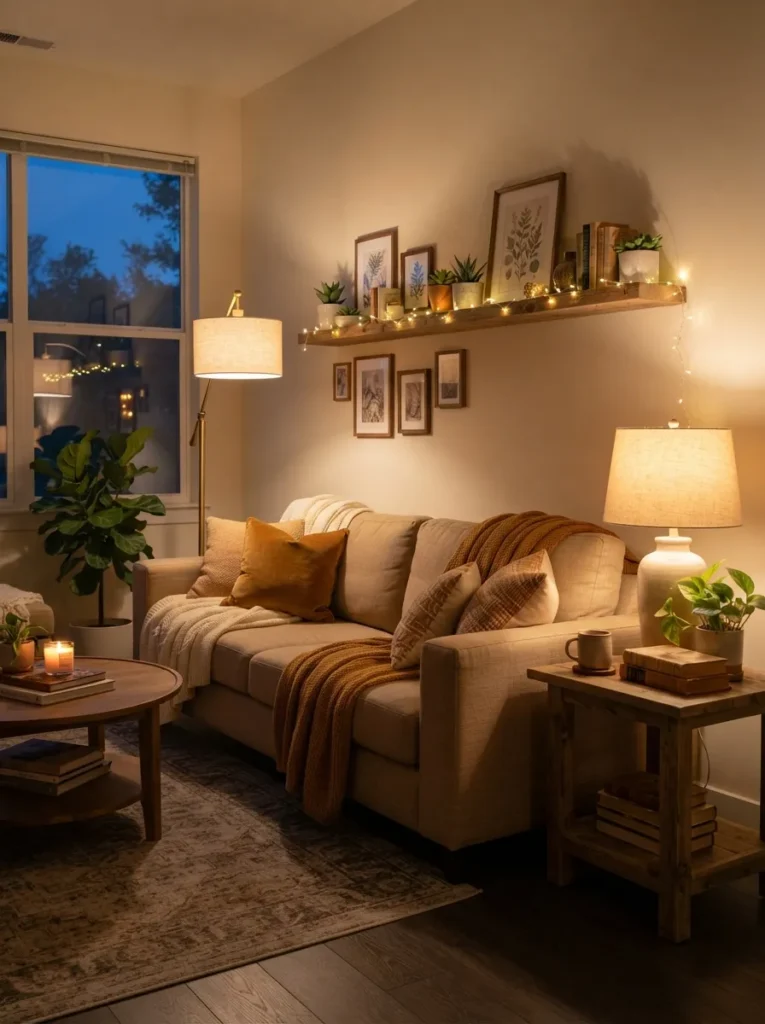
What it looks like: Hushed no single bright source, just overlapping pools of warm light.
Why it works: A single overhead fixture creates flat, even light that drains warmth from a tan color palette. Three sources at different heights floor, table, and shelf-level create depth and shadow, which is what actually reads as “cozy” in photos and in person.
How to copy it: Turn off the overhead light entirely in the evening and rely on a floor lamp, a table lamp, and one accent source (candles or string lights) instead all on the same warm color temperature.
Best for: Anyone whose living room feels sterile at night despite looking fine during the day.
This next one surprised even experienced decorators the first time they tried it.
12. Style the Coffee Table With a Tray Vignette
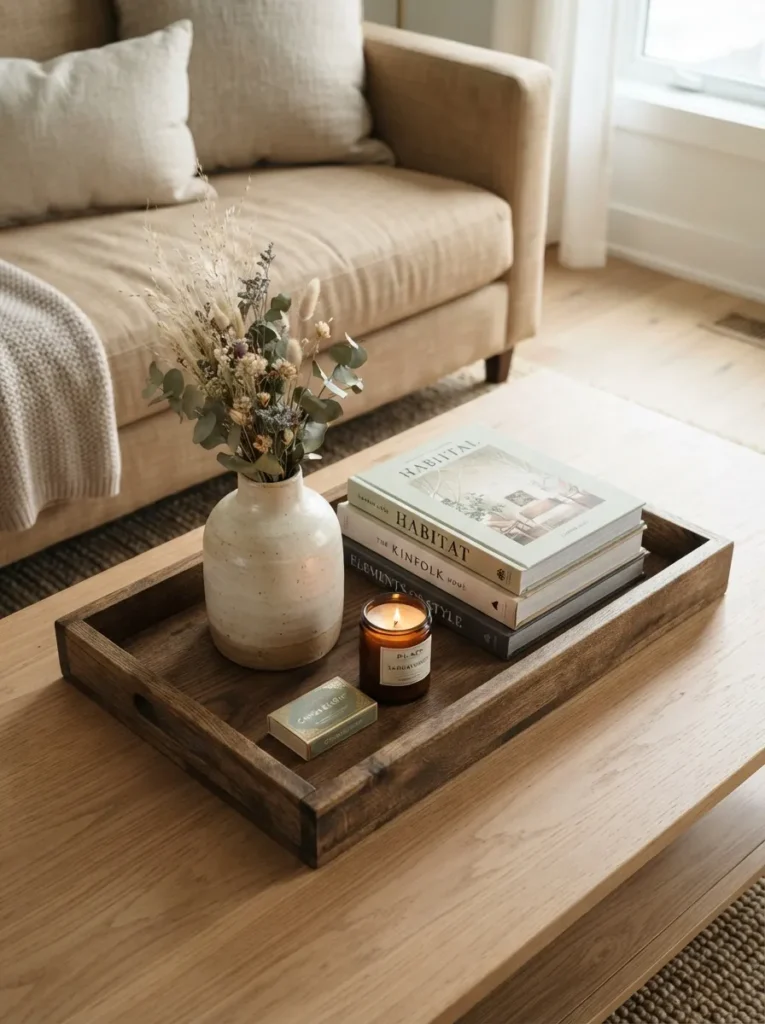
What it looks like: Composed every object has a clear height and role instead of scattered clutter.
Why it works: A tray corrals objects into one visual unit, which is a grouping principle that keeps small decor from reading as mess on an otherwise open coffee table especially important next to a large, plain-fabric sofa that needs a visual counterpoint.
How to copy it: Use the classic three-height rule one tall object (vase), one medium (stack of books), one low (candle or dish) all within a single tray. A small potted plant works just as well as the tall piece; these modern succulent planter ideas are close to foolproof if you tend to forget to water.
Best for: People who already own decor pieces but can’t figure out how to arrange them so they look intentional.
13. Add a Navy Blue Statement Piece Next to Your Tan Sofa
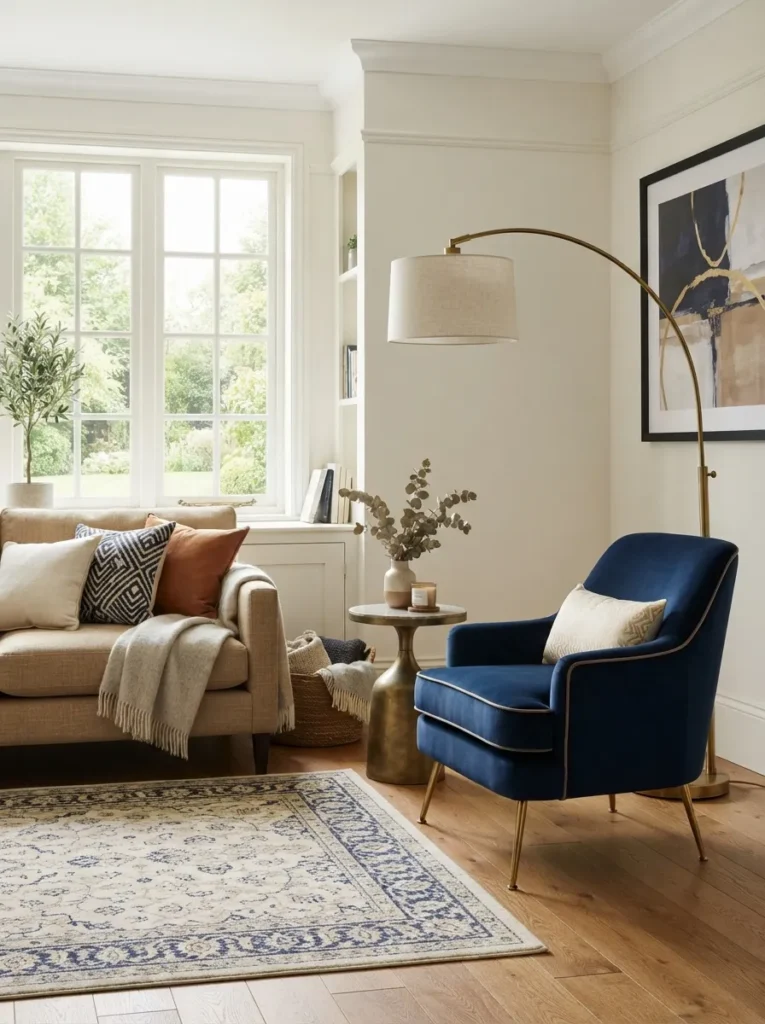
What it looks like: Confident the deep navy holds its own against the sofa instead of disappearing next to it.
Why it works: Navy and tan sit at opposite temperature and value points, which creates strong visual contrast without clashing cool-dark against warm-light is one of the most reliable pairings in interior color theory for exactly this reason.
How to copy it: Introduce navy through one substantial piece an accent chair or a large ottoman rather than small accessories, since navy needs enough surface area to register as a statement instead of an afterthought.
Best for: People who want a bolder, more “finished” living room without going fully maximalist.
Important: Navy paired with tan can read cold if the undertones don’t match stick to navy with a slight warmth to it (not a stark, icy blue-navy) so it doesn’t fight the sofa’s warm base.
14. Ground the Room With a Console Table
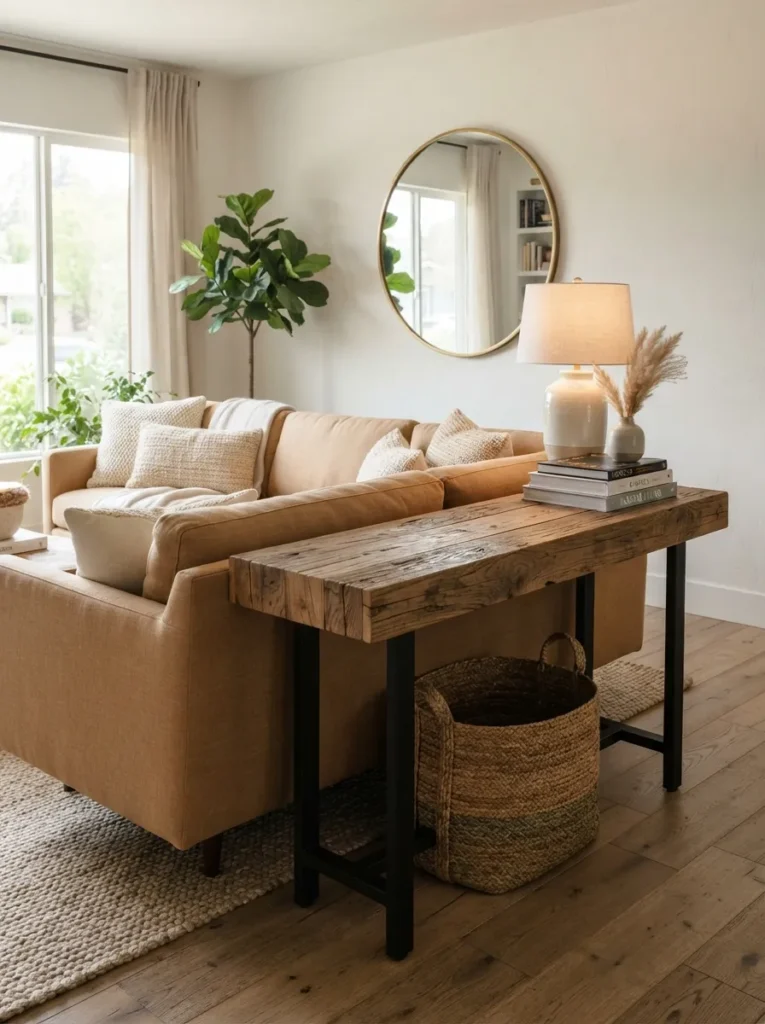
What it looks like: Purposeful the space behind the sofa stops feeling like leftover square footage.
Why it works: This solves the same problem as floating the sofa (Idea 9) from a different angle furniture-scale objects behind a floating sofa give the eye a stopping point and prevent the “backless” feeling that makes open-plan rooms feel unfinished.
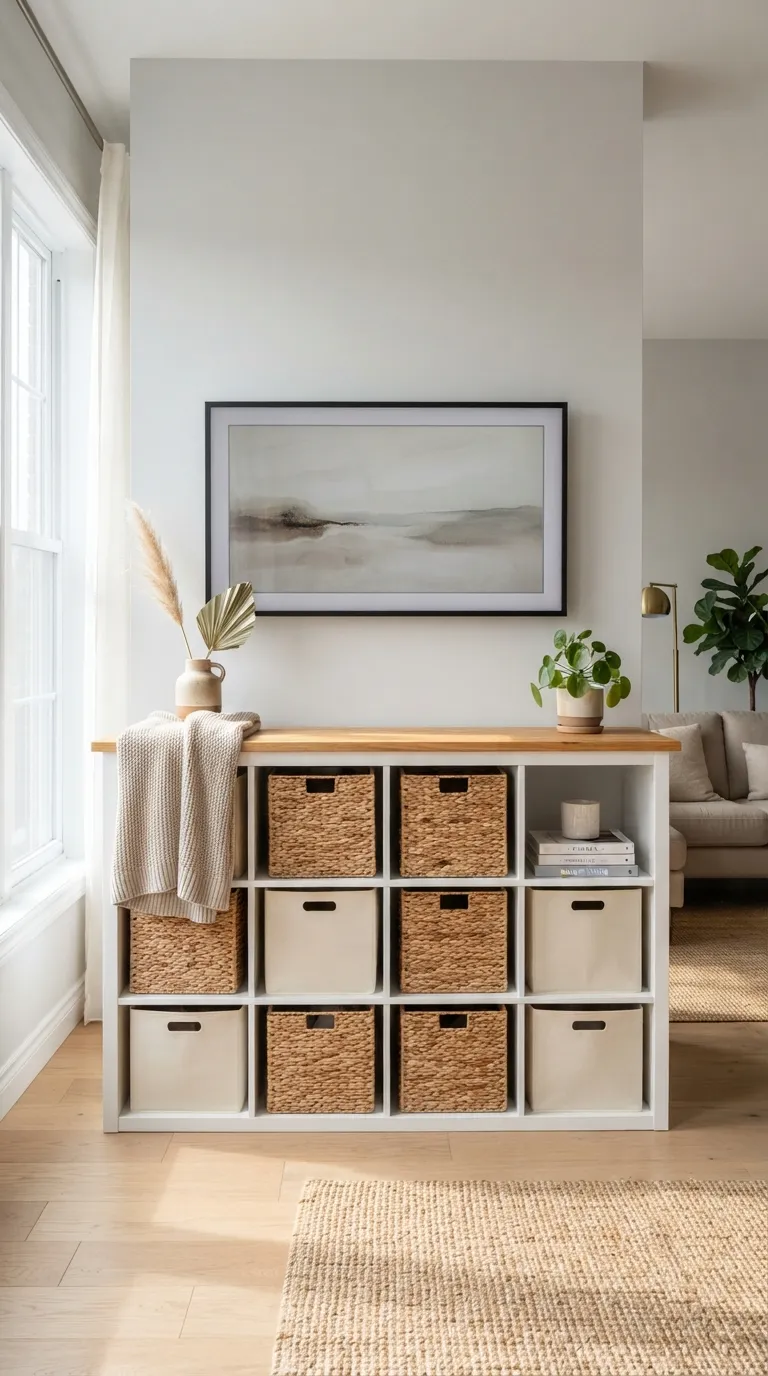
How to copy it: Choose a console no more than two-thirds the length of the sofa, and keep the top styled with no more than three objects so it doesn’t compete with the seating area. If you need storage more than styling surface, an IKEA Kallax TV unit does the same grounding job with a lot more function built in.
Best for: Open-concept living rooms where the sofa’s back faces a hallway or dining area.
Shop This Look
| Product |
|---|
| Reclaimed wood console table with iron legs |
| Rattan-front console table |
| Round brass-rimmed mirror for above the console |
| Ceramic table lamp with a linen shade |
| Woven storage basket for console styling |
15. Mix In a Leather Accent Chair
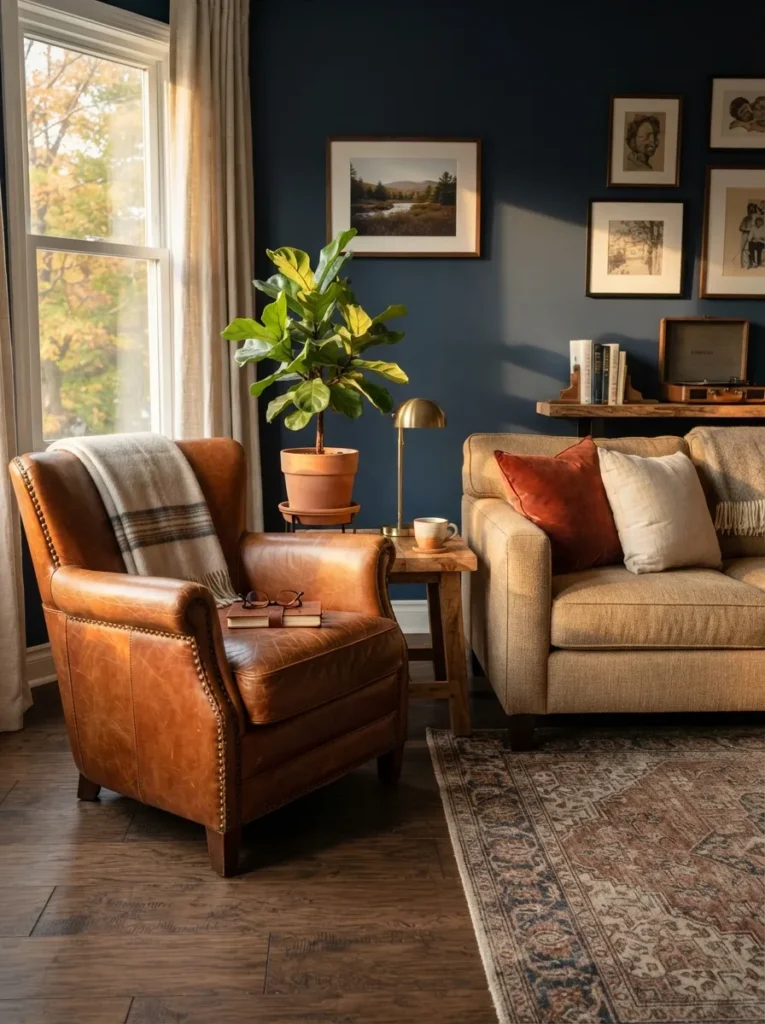
What it looks like: Layered two warm materials sitting near each other without reading as matched.
Why it works: Leather and fabric reflect light completely differently leather has sheen and shadow variation that flat upholstery doesn’t, so pairing a cognac leather chair with a tan fabric sofa adds material contrast even though the colors are in the same family.
How to copy it: Go a shade or two darker than the sofa in cognac or saddle-brown leather, and place the chair at an angle rather than facing the sofa head-on for a more collected, less “matching set” feel.
Best for: People who want warmth and richness without introducing a new color into the room.
The next idea only takes about ten minutes but it’s the one people skip most.
16. Use a Slim Console Behind the Sofa in Tight Layouts
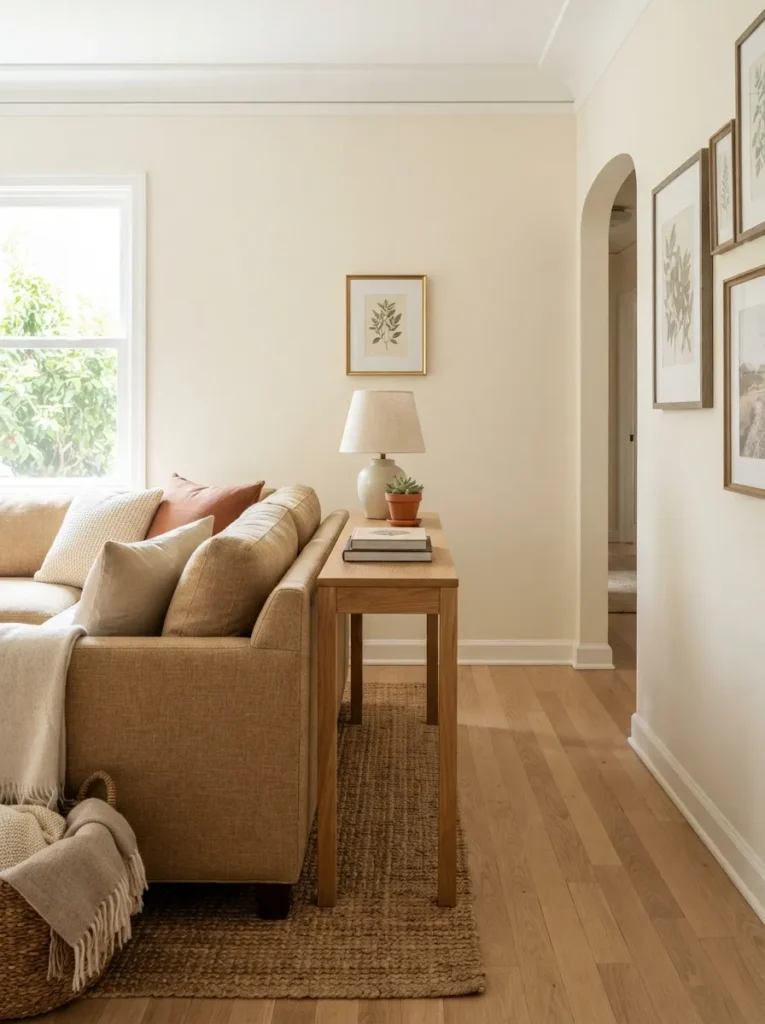
What it looks like: Efficient the table barely reads as furniture from across the room, just a thin shelf of function.
Why it works: In tight layouts, standard 16-inch-deep consoles eat clearance fast. A slim, sofa-table-style console (10–12 inches deep) gives the same styling surface and lamp placement without blocking a walkway proportion is doing the heavy lifting here, not styling.
How to copy it: Measure your walking clearance first; if it’s under 30 inches with a standard console, size down to a slim sofa table instead of skipping the surface entirely. It’s the same inch-by-inch thinking we used in our craft closet organization tips small footprints just need smarter proportions, not less furniture.
Best for: Small or narrow living rooms where every inch of floor space is doing double duty.
17. Layer Pillows Using the Rule of Three
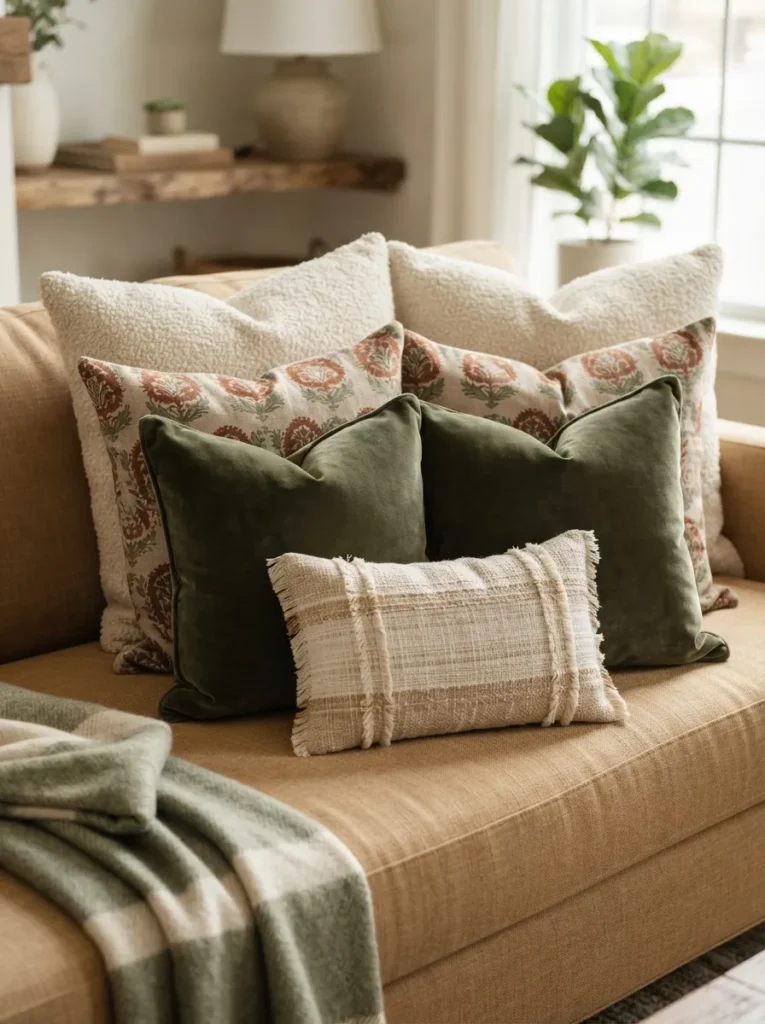
What it looks like: Fluffed but deliberate like it took two minutes, even though the plan behind it took longer.
Why it works: Pillow arranging is one of the few design moves with an actual formula behind it odd numbers photograph better than even, and layering pairs with one contrasting accent keeps the arrangement from looking either too matched or too random.
How to copy it: Follow the sequence below to build the arrangement from the back corners in.
✅ Pillow Layering Checklist:
- [ ] Start with one pair of large (20×20″) solid-color pillows in the back corners
- [ ] Add a second pair of smaller (18×18″) patterned or textured pillows in front
- [ ] Add one lumbar pillow in a contrasting color at the center
- [ ] Fluff and angle each pillow slightly inward toward the center of the sofa
Best for: Anyone who’s bought pillows before but can’t figure out why the arrangement never looks as good as it does in photos.
Shop This Look
| Product |
|---|
| Boucle lumbar pillow cover |
| Block-print cotton throw pillow cover |
| Chunky knit cream pillow cover |
| Velvet terracotta pillow cover |
| Down-alternative pillow inserts (18×18″ and 20×20″) |
18. Add Blush or Dusty Pink for Softness
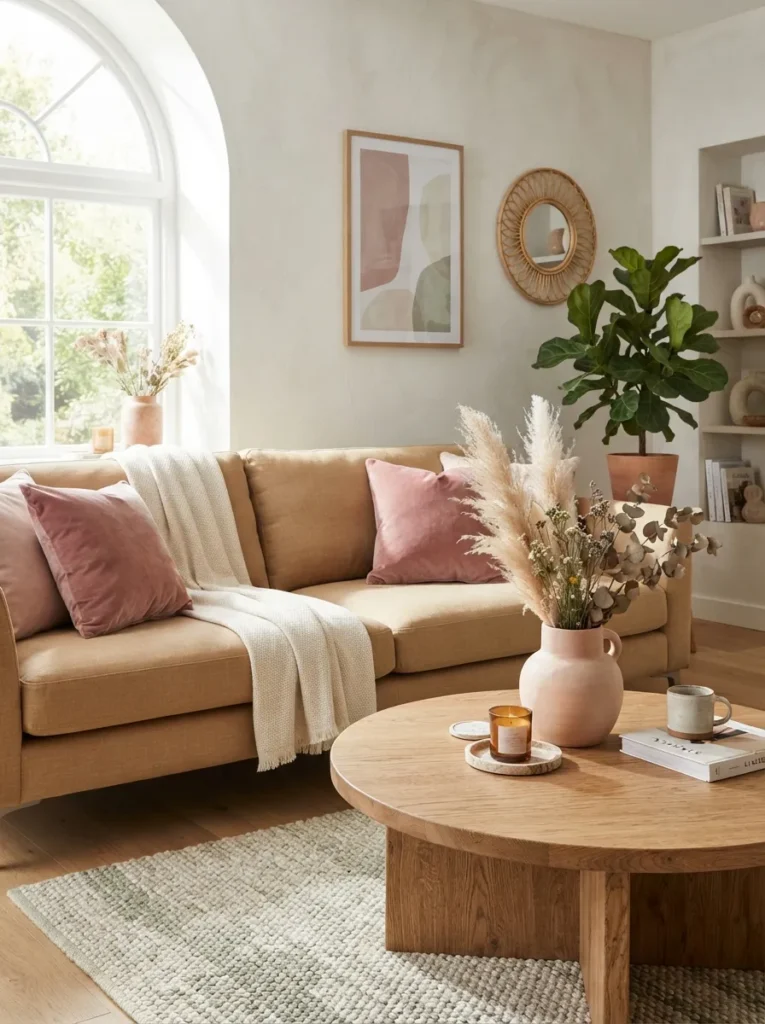
What it looks like: Soft the pink takes the edge off a room that might otherwise feel too masculine-neutral.
Why it works: Dusty, muted pink shares tan’s warmth but adds a completely different hue, which keeps the palette from feeling one-note without introducing the kind of contrast that reads busy. It’s a quieter move than terracotta or navy, and it works where those feel like too much.
How to copy it: Stick to muted, dusty pink tones not bubblegum or baby pink through one or two small pieces, like a vase or a single pillow, rather than covering the whole sofa in it.
Best for: People decorating a shared space who want warmth without the room skewing too traditionally “masculine” or “feminine.”
Mistake to Avoid: Going more than 15% pink in the room. Past that point it stops reading as an accent and starts competing with the sofa for attention.
In my experience, the biggest thing people get wrong with a tan sofa isn’t color it’s scale. A single 18×18″ pillow on a deep, oversized sofa just gets swallowed, and the whole seating area ends up looking under-furnished even when it isn’t. On sofas deeper than about 38 inches, size up to at least one 22×22″ or 24×24″ pillow per side it sounds like a small adjustment, but it’s the difference between a sofa that looks styled and one that looks like it’s still waiting for its decor.
19. Maximize Natural Light With Sheer Linen Curtains
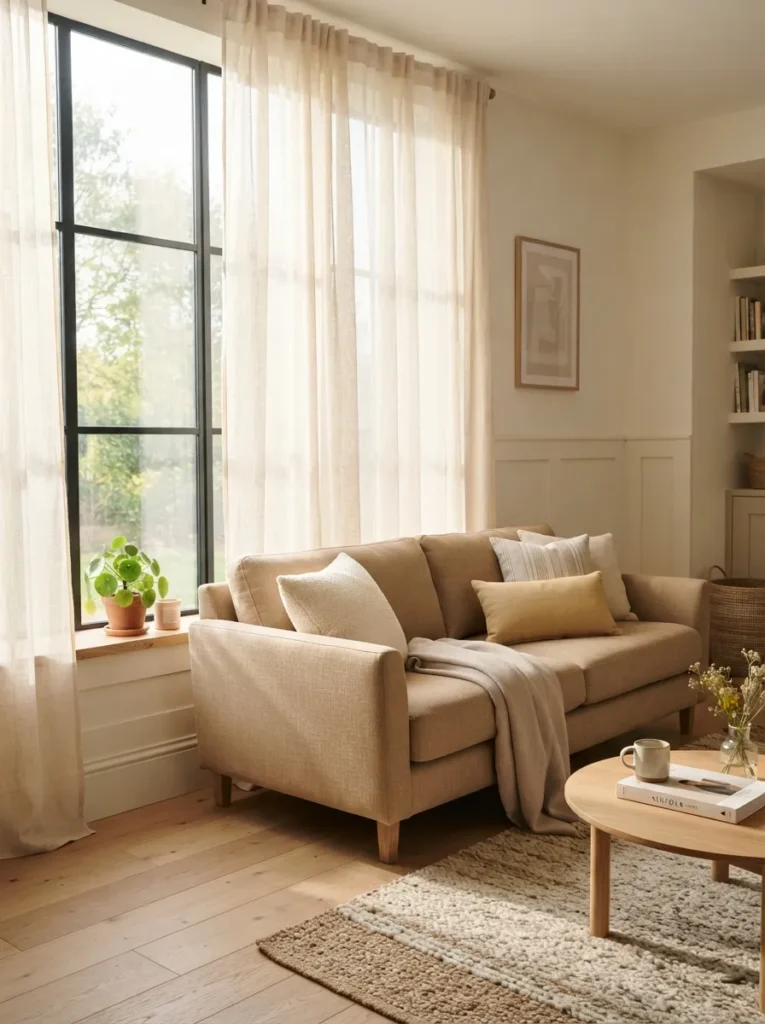
What it looks like: Luminous the whole room looks a shade brighter without adding a single lamp.
Why it works: Light behavior again heavy blackout curtains cut off natural light and make a tan sofa look duller than it is, while sheer linen diffuses daylight and actually amplifies it across the room’s warm tones.
How to copy it: Hang curtain rods a few inches above the window frame and wider than the window itself, so the sheers frame the light instead of blocking any of it when open.
Best for: North- or east-facing living rooms that already struggle to feel bright.
20. Match or Contrast Wood Tones on Purpose
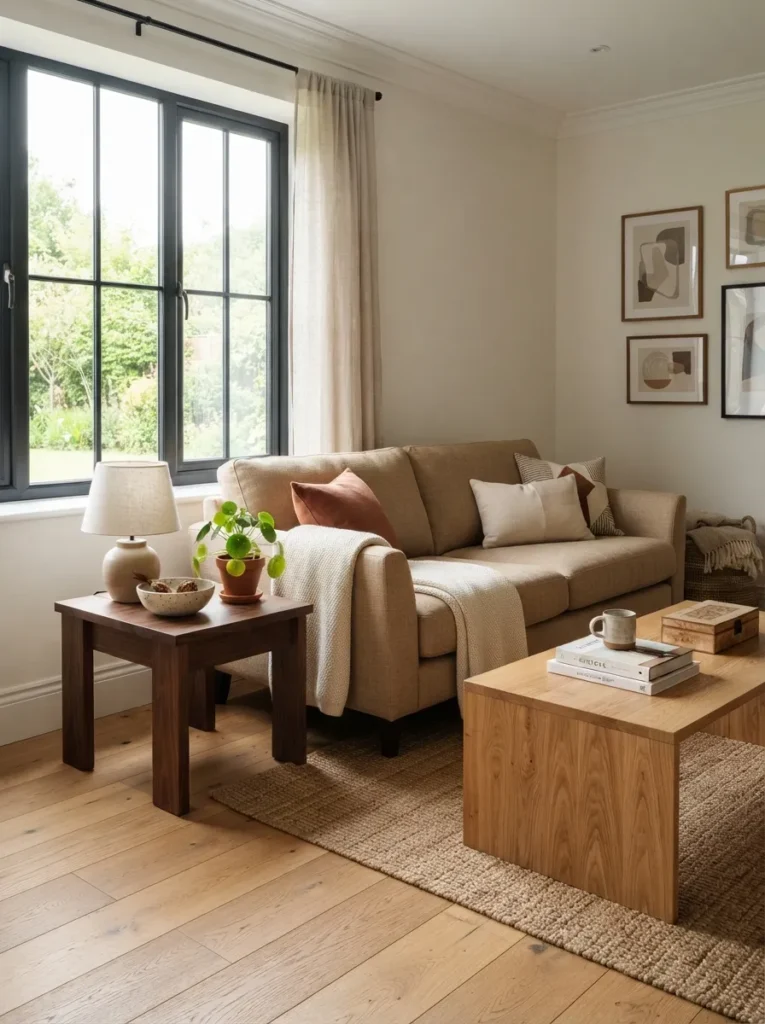
What it looks like: Intentional the wood tones feel chosen, not accidentally mismatched.
Why it works: Wood tone clashing is one of the most common living room complaints, and it usually comes down to undertone, not shade orange-toned oak next to gray-toned walnut fights even when the colors seem compatible on paper.
How to copy it: Pick one dominant wood tone for large pieces and use a second, contrasting tone only for small accents (a tray, a frame, a stool) never split evenly 50/50 between two tones.
Best for: People combining furniture from different sources hand-me-downs, thrifted pieces, and new purchases who want it to look cohesive.
Warning: Buying a new wood piece without checking its undertone against your existing furniture in natural daylight is the single most common and most expensive mismatch mistake. Orange-toned oak and cool gray-washed wood almost never sit well side by side, and returns on furniture aren’t always free.
21. Add Swivel Chairs for Flexible Seating
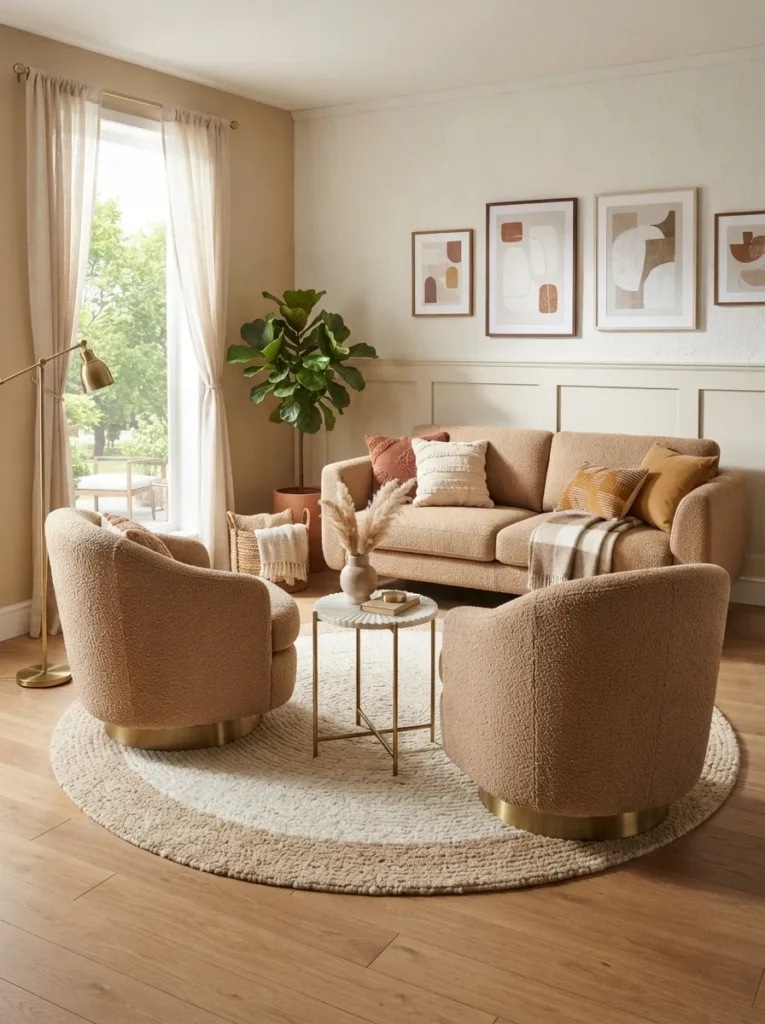
What it looks like: Relaxed the chairs angle slightly inward, suggesting movement even standing still.
Why it works: Swivel chairs solve a real functional problem fixed chairs force a room into one conversation configuration, while swivel bases let the same seating face the sofa, the TV, or each other depending on the moment, without rearranging furniture.
How to copy it: Place a pair of swivel chairs at a slight inward angle across from the sofa, leaving at least 4 feet of walkway space in the center for the room to still function as a pass-through.
Best for: Households that use the living room for more than one purpose TV watching, hosting, working throughout the day.
Quick Win: If new swivel chairs aren’t in the budget, a swivel base kit can be added to most existing accent chairs for a fraction of the cost.
22. Size the Rug to Anchor Your Tan Sofa Living Room
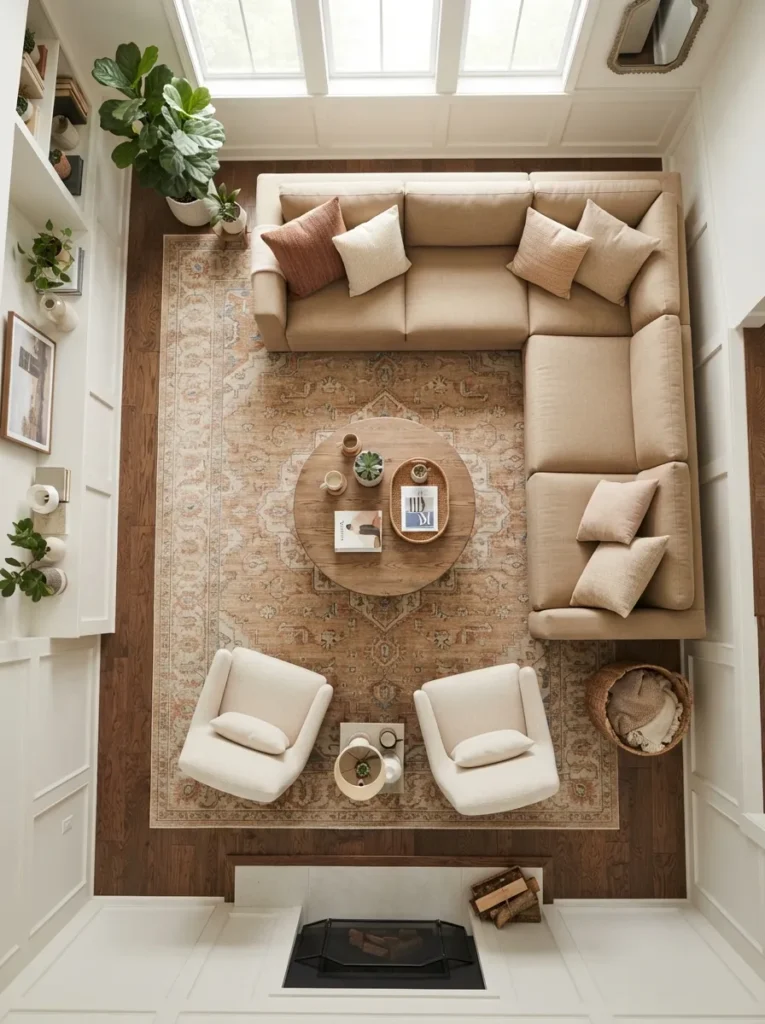
What it looks like: Grounded the whole seating group reads as one connected zone instead of furniture scattered on bare floor.
Why it works: Rug sizing is the single most common living room mistake, and it’s a proportion issue an undersized rug makes even an expensive, well-styled tan sofa look like it’s floating on an island, disconnected from everything around it.
How to copy it: Size the rug so at least the front two legs of every seating piece sofa, chairs, and any ottomans sit on it; in larger rooms, all four legs on every piece looks best.
Best for: Anyone whose living room has good furniture but still feels “off” in a way they can’t quite name.
Pro Tip: When in doubt, size up. An oversized rug reads as an intentional design choice; an undersized one almost always reads as a mistake, even to people who can’t say why.
How to Start Your Tan Sofa Living Room Transformation
What I’ve found with real spaces: start with the rug, not the paint color. A chunky jute rug in a warm oatmeal tone, sized to catch at least the front legs of every seating piece, does more to pull a tan sofa living room together than any single accent piece it’s the one element that touches everything else in the room.
The most common fixable mistake is matching pillow covers exactly to the sofa’s tan tone. It washes the whole seating area into one flat shape from across the room. Swap at least half the pillows for a contrasting color or texture rust, navy, or a chunky knit and the sofa suddenly reads as styled instead of just occupied.
Three items under $50 that make an immediate difference: a chunky-knit cream throw folded over one arm of the sofa, a pair of unscented taper candles in a brass holder for the coffee table, and a single dried pampas grass stem in a stoneware vase.
A full weekend covers the accent layer rug, pillows, lighting for roughly $150 to $400. A full furniture refresh, including a new coffee table, accent chair, and console, usually takes four to six weeks between ordering and delivery and runs anywhere from $1,500 to $4,000 depending on how much gets replaced versus restyled a similar staged approach to how we tackled our own pool house makeover, accents first, big furniture later.
Ready to Create Your Dream Tan Sofa Living Room?
Between the color pairings, the texture layering, and the layout fixes covered across these 22 ideas, there’s no single “right” way to style a tan sofa just a lot of small, compatible choices. Transformation doesn’t have to happen all at once; picking one or two ideas this week is enough to notice a difference. Start today by swapping in one contrasting pillow or moving the coffee table onto a properly sized rug both take under fifteen minutes.
Done right, the room stops feeling like a neutral holding pattern and starts feeling like somewhere worth spending an evening. Pin your favorites now so the terracotta pillow idea doesn’t get lost in your feed by the time you’re ready to shop.
You Might Also Like
- 15 Living Room Color Palettes That Aren’t Afraid of Bold Accents
- 12 Small Living Room Layout Ideas That Don’t Sacrifice Comfort
- 18 Neutral Sofa Styling Tricks for a Living Room That Feels Finished