Double Vanity Mirror Ideas That End the Morning Queue
The cure for a cramped shared vanity is giving each person a mirror, a light, and a stretch of counter that belongs to them alone. These 13 double vanity mirror ideas couples sharing a bathroom will love all follow one rule: build each side around the person standing at it, meaning their eye height, their light, their reach.
Two clear reflections replace one shared squint. Glass sits where eyes actually land, warm light reaches faces instead of foreheads, and nobody leans around a partner to find their own reflection. A shared vanity, it turns out, only has to be shared everywhere except the mirror.
Jump To
- Two People, One Vanity: What Each Side Actually Needs
- The Ideas, Biggest Fixes First
- Center Each Mirror on Its Own Basin
- Tall Vertical Mirrors for Two Eye Levels
- Sconces at Eye Level on Both Sides
- Frame Finishes That Echo the Faucet
- One Wall-to-Wall Mirror
- Mirrored Medicine Cabinets, One Per Person
- A Painted Panel Behind the Pair
- Backlit LED Mirrors on Separate Switches
- A Swing-Arm Magnifier on One Side Only
- Sealed Wood and Rattan Frames
- Mock Up Both Mirrors Before Drilling
- Two Shapes, One Center Line
- Pivot Mirrors That Tilt to Each Person’s Eye Level
- Measure the Vanity Before You Pick a Mirror
- Frequently Asked Questions
- Pick the Pair That Fits Your Light
Two People, One Vanity: What Each Side Actually Needs
A double vanity puts two basins side by side, and the mirrors above them decide whether that setup feels generous or cramped. Flat or beveled silvered glass, slim frames in matte black, brushed brass, or sealed oak, and warm-white light at face height do most of the work. In a small bathroom, fix mirror position and lighting before spending on frames.
Quick Reference
| Factor | Answer |
|---|---|
| Best starting point | Center a mirror on each basin |
| Biggest impact area | Light at face height beside each mirror |
| Budget to start | About $150–$400 (approximate) |
| Time to complete | A weekend; longer if wiring is involved |
The Ideas, Biggest Fixes First
1. Center Each Mirror on Its Own Basin, Not on the Whole Vanity

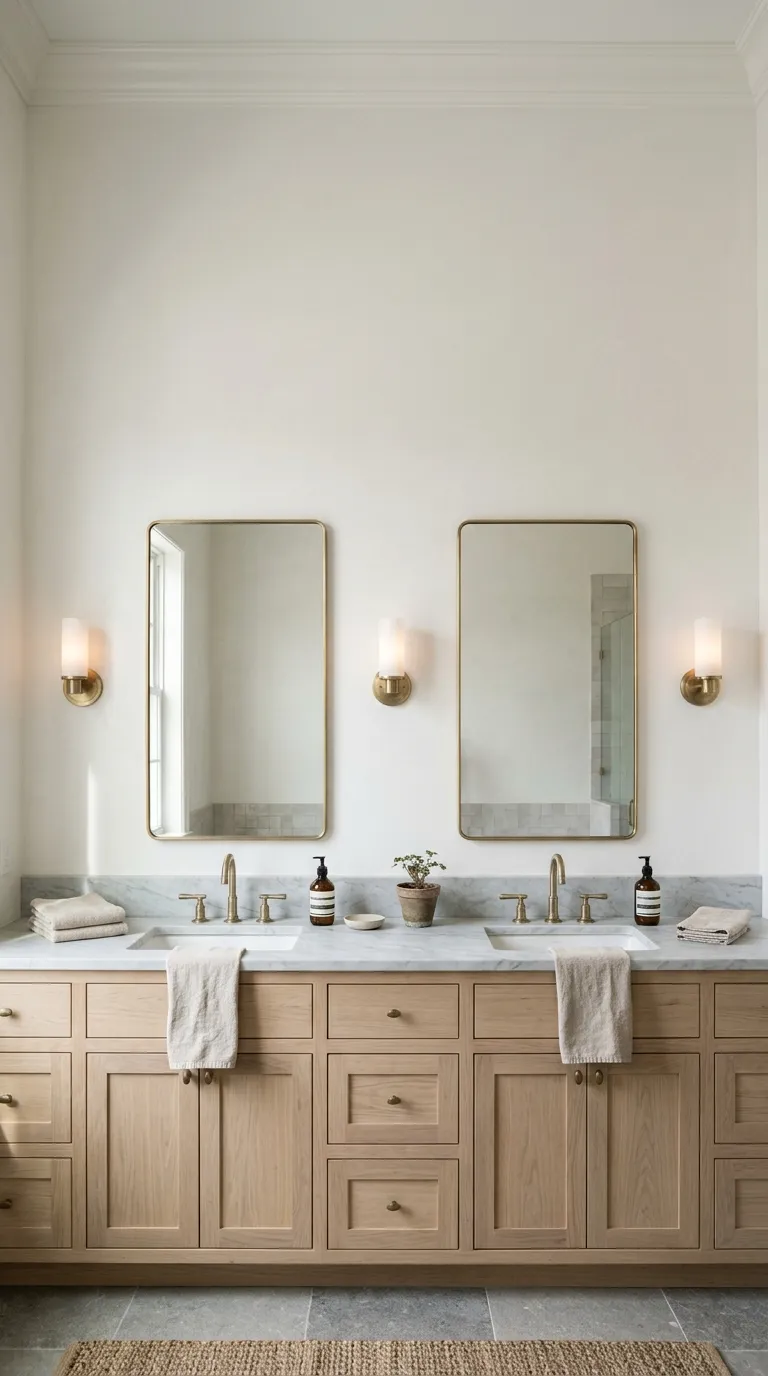
One wide mirror hung at the vanity’s midpoint, or two mirrors pushed together in the center, ignores where each person actually stands. Center each mirror on its own basin instead, and leave a gap of about 4 inches between the pair so the two read as deliberate pieces rather than one mirror with a seam. Measure from the basin center, not from cabinet door lines, because doors, drawer banks, and basins don’t always line up. Couples who bump shoulders at the sink gain the most.
A vanity with a center drawer bank or an off-center basin has a different midpoint than its sinks. Mark each basin’s center on the wall, then check the mirror against that mark rather than the cabinet.
2. Tall Vertical Mirrors for Two Different Eye Levels

Couples with a visible height difference often end up with one person stooping and the other staring at their own forehead. Tall vertical mirrors let two eye levels share the same pane. Stand each partner at their basin, mark eye level on the wall, and pick a mirror whose bottom edge sits a few inches above the faucet and whose top clears the taller mark by a hand’s width. Glass this large is heavy, so hang it on studs or wall anchors rated for its weight; drywall alone won’t hold it.
Shop This Look
| Product | What to look for |
|---|---|
| Tall vertical mirror, one per sink | Taller than it is wide; slim frame; top edge clears the taller person’s eye mark; both mirrors from one order so finishes match |
| Vanity tray | Sized to stay inside one sink’s half; water-resistant surface that wipes clean |
| Ceramic toothbrush holder | Glazed so it won’t stain; one per side, same finish family as the tray |
3. Sconces at Eye Level on Both Sides of Each Mirror

Sconces on both sides of each mirror, mounted at eye level, fill in the shadows an overhead fixture leaves under the eyes and nose. A single sconce centered between the two mirrors can serve both inner sides if you widen the gap so its backplate has clear room all around, and one more at each outer edge completes the set. Choose sconces with a damp-location rating, and leave hardwiring to a licensed electrician following local code.
Set sconce height to the shorter partner’s eye level. Light from the side forgives a few inches of difference, so the taller person still gets even illumination. Space them by the numbers. Leave about 4 to 6 inches between each mirror edge and its sconce, and keep a flanking pair about 36 to 40 inches apart, centre to centre, so light reaches both sides of each face. A single sconce centred between the two mirrors needs the same clear space on each side, so widen the centre gap until its backplate sits with room to spare. A light bar hung above a mirror instead should be about 75 percent of the mirror width, so a 30 inch mirror takes a fixture around 22 to 24 inches wide.
Shop This Look
| Product | What to look for |
|---|---|
| Wall sconce, damp-rated | Damp-location marking on the listing; frosted or opaque shade to cut glare in the glass; finish matching the faucet |
| Dimmer switch | Rated for LED loads; a single control for the whole sconce set |
| LED bulbs, warm white | Same color temperature in every fixture; dimmable |
Frame color is the easy decision. The next idea turns on something subtler, a difference in sheen, that can make matching metals look mismatched.
4. Frame Finishes That Echo the Faucet

Brushed brass frames beside a brushed brass faucet read as one decision; a polished brass frame beside that same faucet reads as a near miss, and it’s the mismatch most people only spot after installation. Match both the metal and the sheen, then cap the room at two metals, counting sconces, drawer pulls, and the towel bar. If the vanity already mixes finishes, let the frame echo whichever appears most often instead of adding a third.
Budget Version: Lightweight framed mirrors with thin metal frames often come in under $100 each (approximate). Skip heavy glass and custom shapes, which push the price up.
5. One Wall-to-Wall Mirror for a Narrow Bathroom
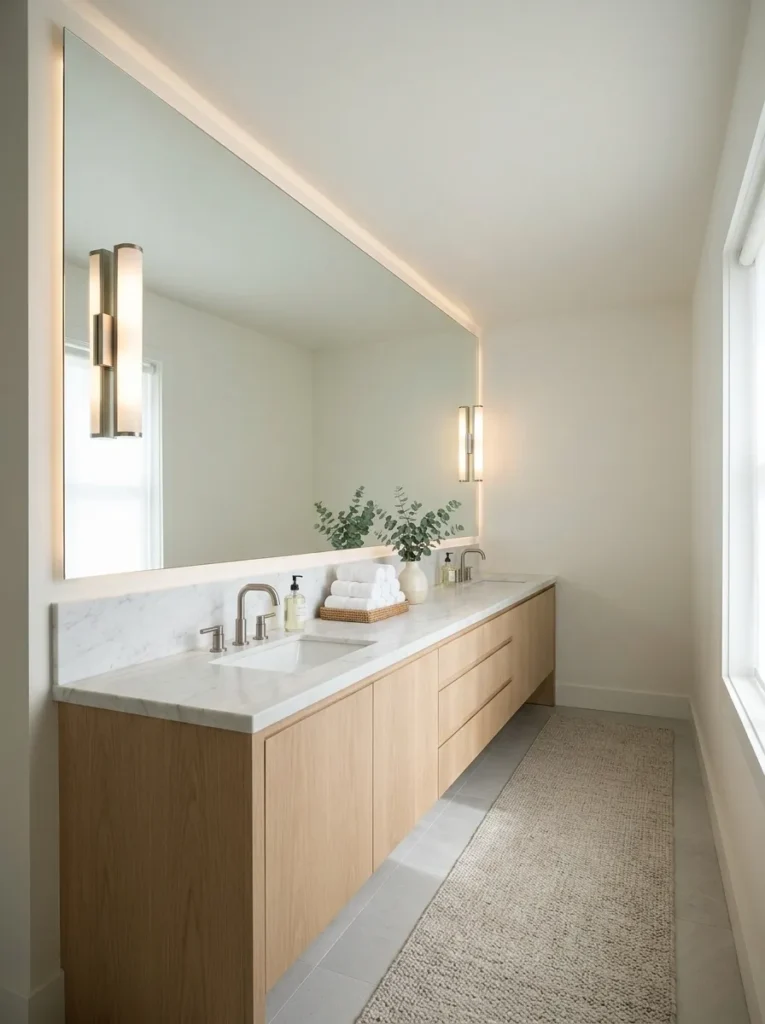
Ask a glass shop for one wall-to-wall mirror and have them measure at the top, middle, and bottom of the wall, since walls and tile lines aren’t always square. A single sheet running the vanity’s full width makes a narrow bathroom read wider and gives both people one continuous reflection, which suits rooms with no space for gaps or sconces. The trade-off: the glass can’t shift, so each face must land where it already hangs. Weight makes this a job for the shop’s installers, using clips or adhesive rated for the glass.
6. Mirrored Medicine Cabinets, One Per Person
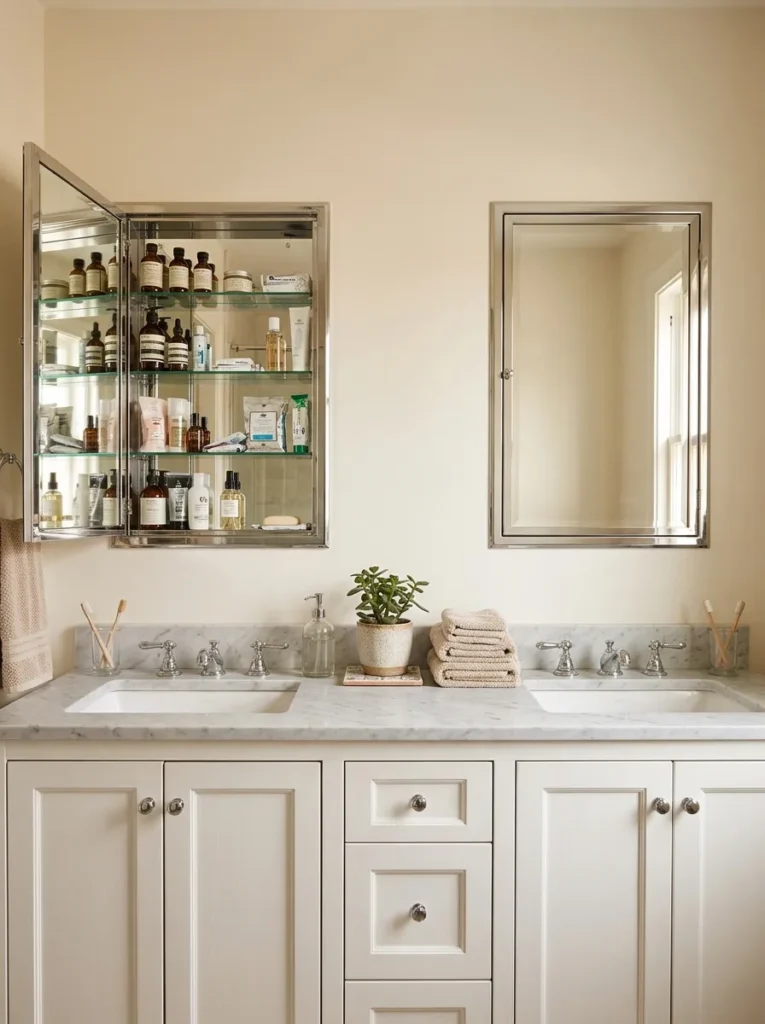
Mirrored medicine cabinets turn the same wall footprint into two sets of shelves and end the one-drawer negotiation. Choose cabinets hinged on their outer edges, so the doors swing away from each other instead of colliding in the middle. Recessed models sit flush between studs and look cleaner, while surface-mount models suit walls with pipes or wiring behind them. Loaded shelves get heavy, so anchor into studs either way.
Warning: Cutting a recess without checking the wall cavity for pipes, wiring, and studs can turn a cabinet install into a repair bill. Confirm what’s behind the wall first, or choose surface-mount.
Shop This Look
| Product | What to look for |
|---|---|
| Mirrored medicine cabinet, one per person | Door hinged on the outer edge; recessed or surface-mount to suit the wall; adjustable interior shelves |
| Clear acrylic organizer bins | Sized to fit the shelf depth; keeps each person’s daily items separate |
| Robe hook | Mounted beside each cabinet; finish matching the faucet |
A thin black frame on a white wall looks sketched on. The next idea fixes that with a pot of paint.
7. A Painted Panel Behind the Pair

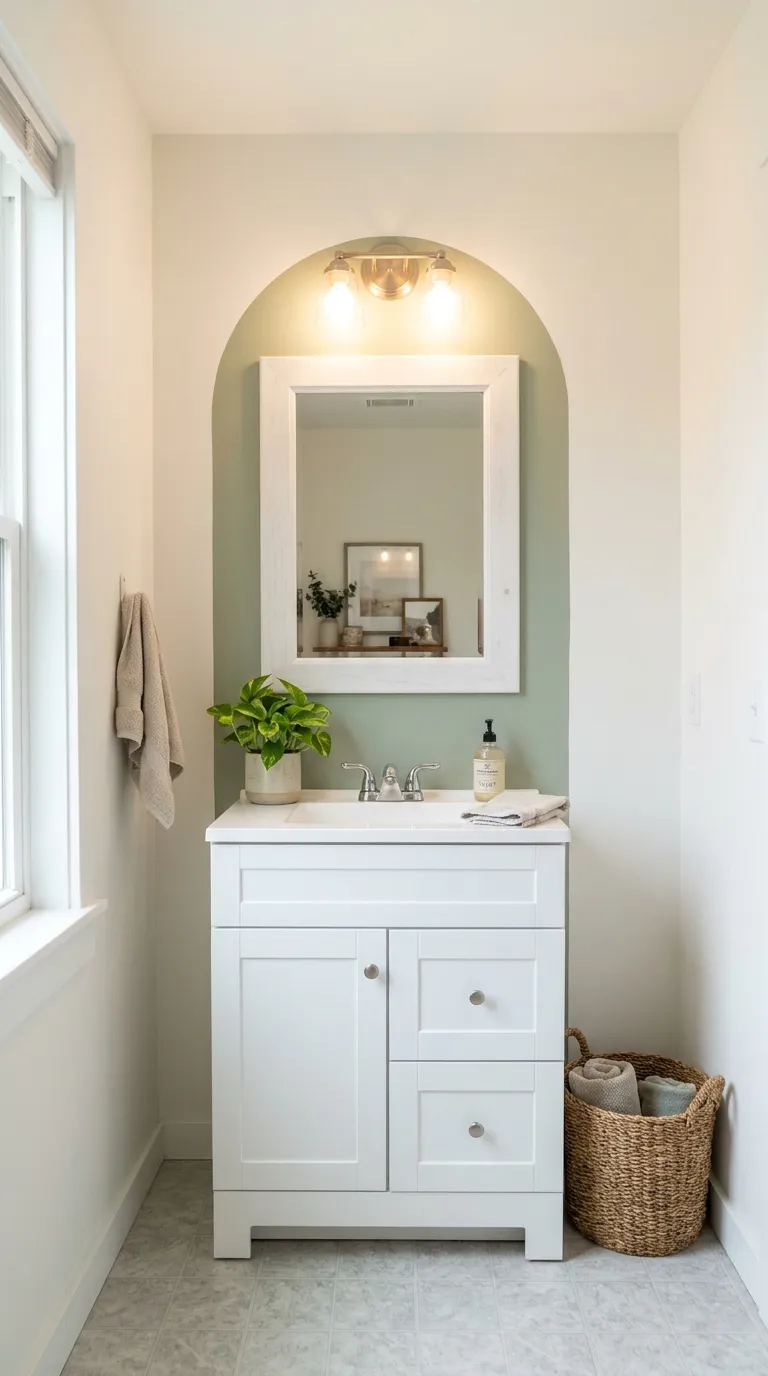
A frame only shows up when it contrasts with the wall behind it. Paint one continuous panel behind the pair, running about 2 inches past the outer edges and above the tops, in a deeper tone than the surrounding wall. Match the undertone to the tile or countertop: a warm greige beside cream tile, a gray-green beside white marble. Use a paint formulated for humid rooms.
Styling Note: Run the paint down to the countertop or backsplash line instead of stopping short, so the panel looks built in.
8. Backlit LED Mirrors on Separate Switches

Backlit LED mirrors glow from behind the glass and spread even light across a face, useful on walls too narrow for sconces. Give each mirror its own switch or touch control so an early riser doesn’t light up a partner’s side, and look for models with a defogger so the glass is usable straight out of the shower. Hardwired models are a job for a licensed electrician, following local code.
Important: A lit mirror isn’t automatically a waterproof one. Check the listing for a damp-location marking or an IP rating, and confirm whether the mirror plugs in or is hardwired before buying.
Shop This Look
| Product | What to look for |
|---|---|
| LED backlit mirror, one per sink | Damp-location or IP marking; dimmable with warm-to-cool settings; defogger; independent control for each mirror |
| Bath towels in two tones | One tone per person; same fabric weight so they hang evenly |
| Soap pump | Glass or ceramic body; matte or clear finish that stays tidy beside bright glass |
9. A Swing-Arm Magnifier on One Side Only
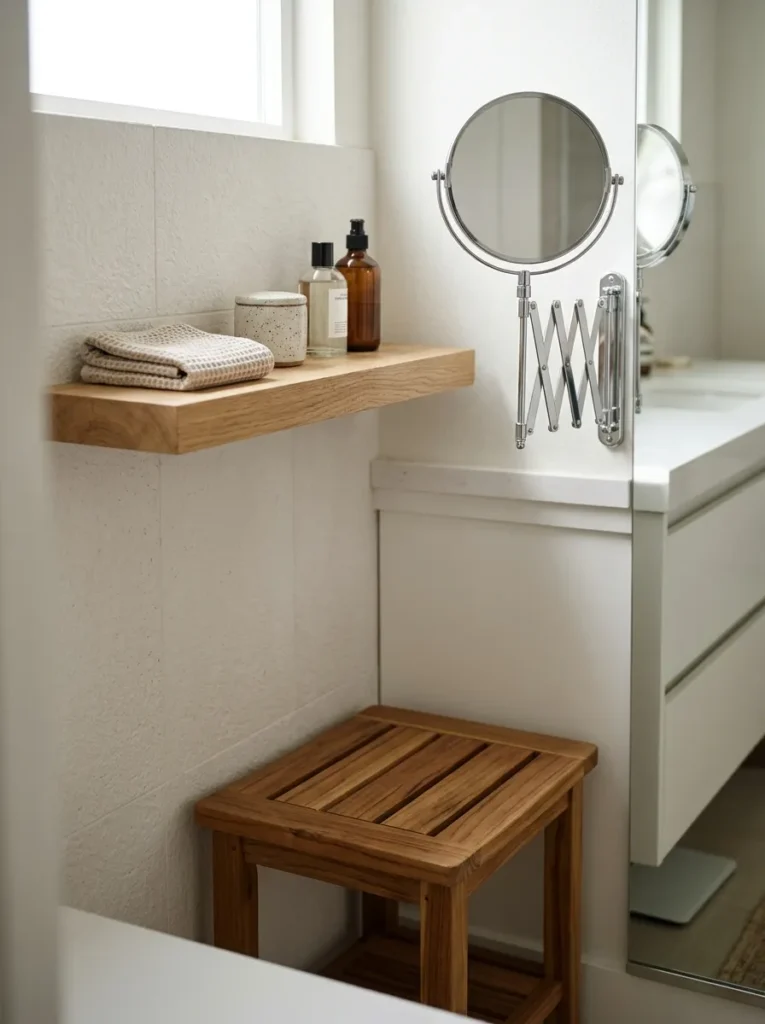
When only one of you shaves or does detailed skincare, a wall-mounted swing-arm magnifier on that side alone brings close-up clarity without eating counter space. Mount it at the outer edge of that person’s mirror so the arm folds flat against the wall when idle and never reaches over the partner’s basin. An extended arm pulls harder on the top screws than its weight suggests, so anchor into a stud or use anchors rated well above that weight.
Small-Space Tip: In a tight bathroom, choose a folding arm that rests flat against the wall so it never juts into the walkway.
Shop This Look
| Product | What to look for |
|---|---|
| Swing-arm magnifying mirror | Wall plate rated well above the unit’s weight; arm that folds flat; reach long enough to meet the face from the person’s usual stance |
| Small bath stool | Water-resistant; slip-resistant feet; narrow enough to tuck beside the vanity |
| Floating shelf | Anchored into a stud or with anchors rated for the load; sits within arm’s reach of the mirror |
Wood in a bathroom lasts or fails depending on a part of the frame nobody photographs: the back and the edges.
10. Sealed Wood and Rattan Frames That Survive Two Showers
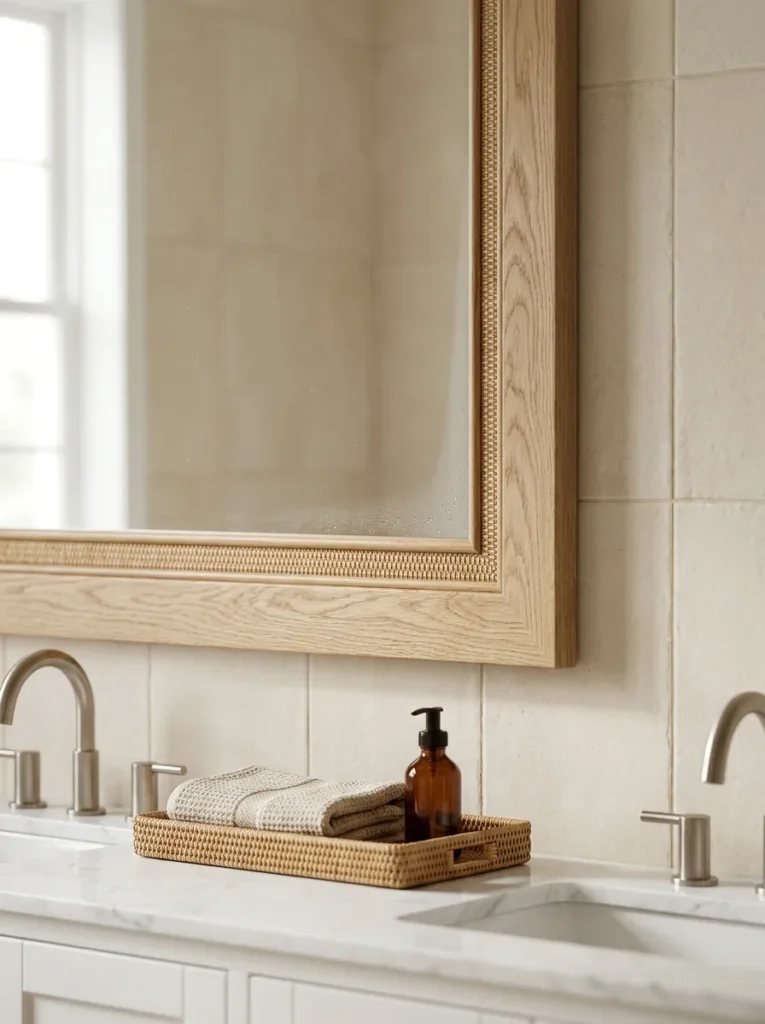
Check the back and edges of any wood or rattan-wrapped frame before the front, because moisture gets in where the finish stops. A frame sealed on every face handles two people’s showers far better than one finished only where it shows. Sealed oak with matte black hardware softens a tile-heavy room; choose metal or resin frames where ventilation is weak. Keep woven rattan out of direct splash range.
Leave the exhaust fan running for as long as the glass stays fogged. Frames dry sooner and the finish lasts longer.
11. Mock Up Both Mirrors Before Drilling
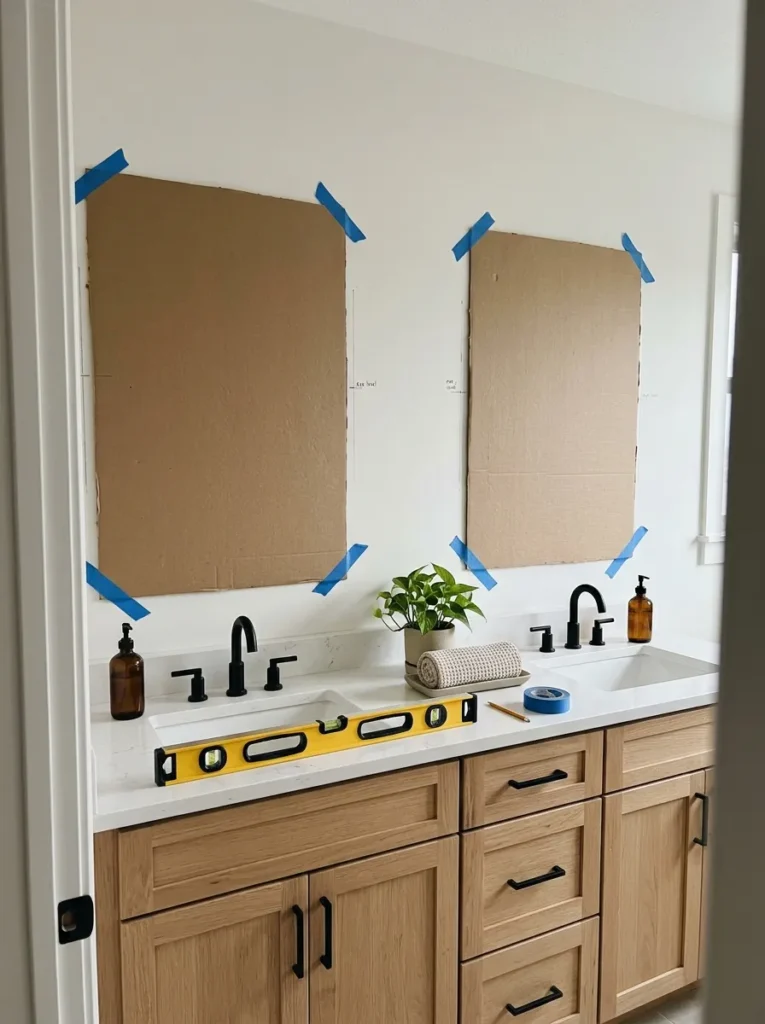
Drilling first and judging second is how a bathroom ends up with a second set of holes. Cut cardboard to each mirror’s size, tape it to the wall at the planned height, and live with it through one full morning routine. Stand at each basin, then check again from the doorway, where most people first see the mirrors. Most people skip this step and regret it.
✅ Mock-Up Checklist:
- [ ] Cut cardboard templates to each mirror’s exact size
- [ ] Tape them centered over each basin with a 4-inch gap between
- [ ] Mark each person’s eye level at their own sink
- [ ] Check the view from the doorway, then from both sinks
- [ ] Mark stud locations before drilling
12. Two Shapes, One Center Line
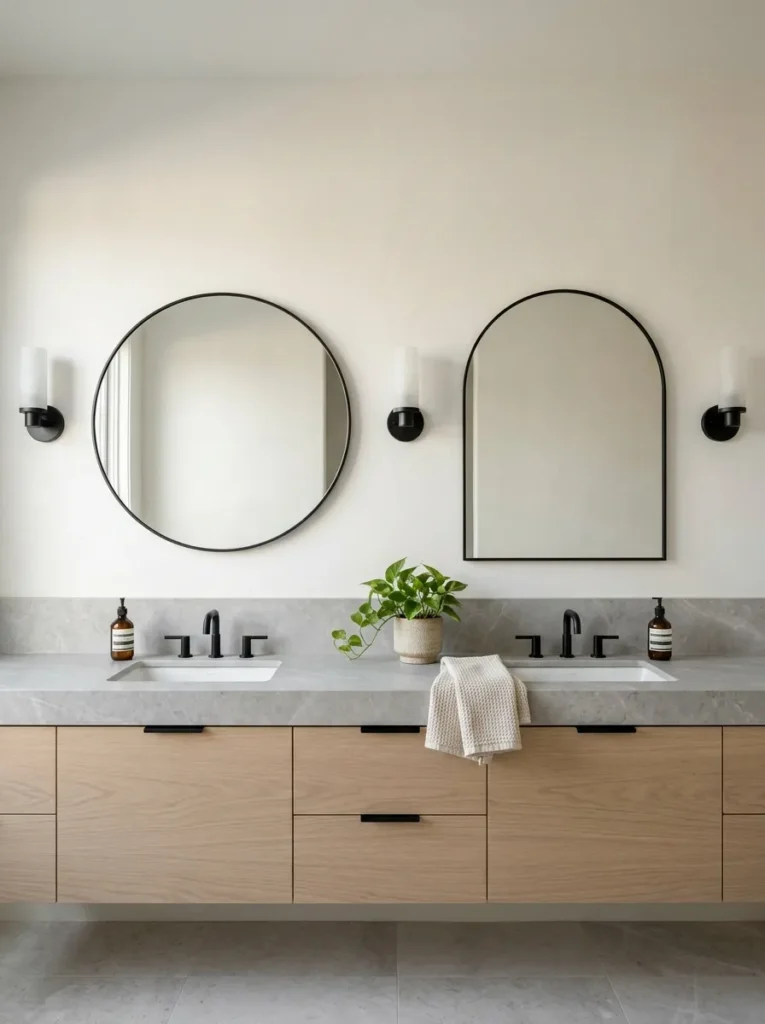
A round mirror on one side and an arched one on the other can look planned if two things match: the finish and the center height of the glass. Align both centers on the same horizontal line, and the shapes can differ freely, with the arch simply extending higher and lower than the circle. Keep frame width identical on both, since a thicker frame reads as the dominant mirror.
Quick Win: Order both frames from the same maker as a set, so finish and profile match even when the shapes don’t.
13. Pivot Mirrors That Tilt to Each Person’s Eye Level
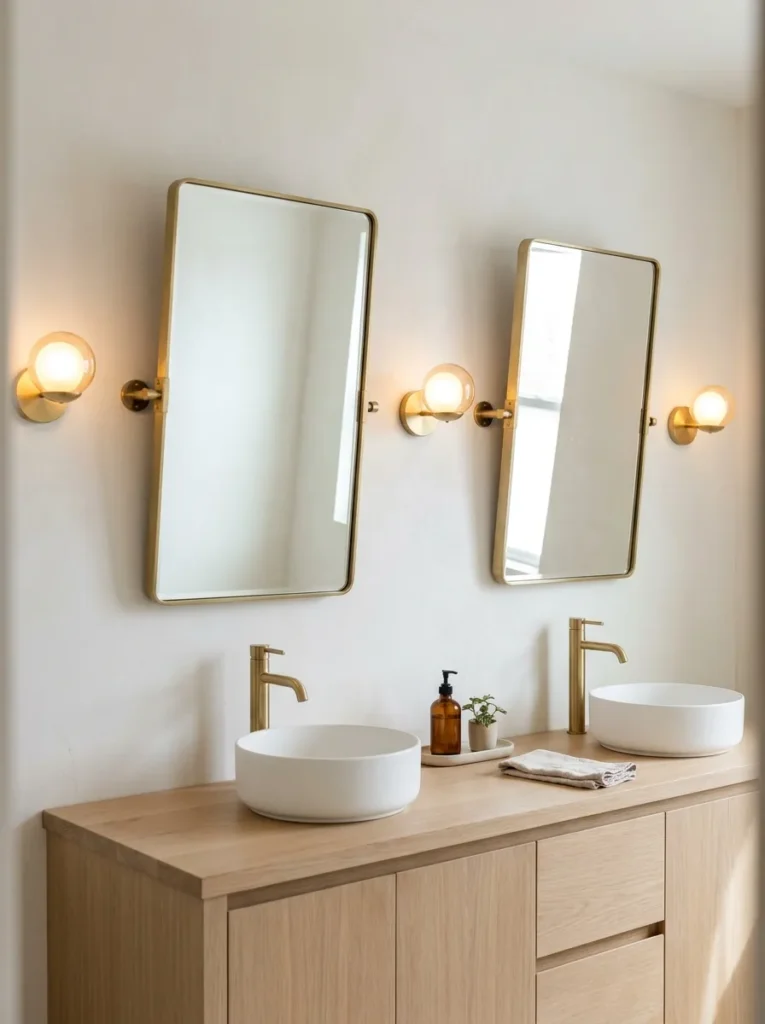
A pivot mirror hangs on side brackets and tilts a few degrees, so each person angles their own mirror to their eye level instead of living with a fixed height that suits only one of them. It is the main mirror, full size, not a magnifier, so it solves the height problem idea 2 tackles with tall vertical mirrors and idea 9 tackles with a swing-arm, but without giving either person a second mirror to reach for . Most tilt only a few degrees, about 5 to 8 degrees on the models retailers list, and that small movement is enough to shift the reflection between two eye levels a few inches apart.
Buy the pair in the widths from the sizing table in this post and mount the brackets at the shorter partner’s eye level, the same rule the sconce idea uses. Test the tilt before the final tightening, and check the mirror stays where it is set when you let go. Match the frame finish to the faucet, the way idea 4 does, and the pair reads as one set even though each mirror moves on its own. Expect about $65 to $250 for a standard-size tilting pivot mirror at Home Depot.
Measure the Vanity Before You Pick a Mirror
Before anything else, buy one matched pair of slim-framed mirrors, each about 4 inches narrower than its sink section. Sconce spacing, paint width, and every other decision hang off those two rectangles. The rule to size by is simple. Each mirror should be about 70 to 90 percent of its sink section, which works out to roughly 2 to 4 inches narrower than the section it hangs over. The table turns that rule into the widths to order for the three most common double vanities.
| Vanity width | Each mirror | Sconces |
|---|---|---|
| 48 in | 20 to 22 in | Two, one on each outer side |
| 60 in | 24 to 26 in | Three, an outer pair plus one shared centre sconce |
| 72 in | 28 to 32 in | Two pairs, or three with one shared centre sconce |
Mirror widths from Sheppard’s Glass, Vanity Mirror Size Guide, 12 August 2026. Sconce counts from Foundry Lighting, Vanity Light Size and Height Guide. Both checked 20 November 2026.
The most fixable beginner error is ordering the two mirrors a week apart. Frame finishes can differ between production runs, and a pair that matched on the website can hang visibly off side by side. Order both together, unbox them against the same wall, and compare them under the bathroom’s own light before mounting.
Three items that tend to sit well under $50: frosted apothecary jars for cotton pads and swabs, a plug-in warm-glow night light for late-night trips, and a water-resistant wall clock that keeps two schedules honest. Prices are guidelines, not quotes.
A full transformation takes a weekend for mirrors, paint, and a mock-up, with a few extra weeks if sconces or hardwired LED mirrors have to wait for an electrician. A starter version with matched mirrors and new bulbs runs about $150–$400 (approximate); a full-room version with sconces, paint, and electrician labor lands around $800–$2,500.
Before you order, run three checks in this order. Mark each person’s eye level with a dot of painter’s tape. Tape the mirror widths from the table on the wall and mark where each sconce will sit. Measure the gaps with a tape measure and confirm the backplate fits with clear space on each side. If any check fails, the mirrors are the wrong size, not the wrong style.
Frequently Asked Questions
Should double vanity mirrors be one wide mirror or two separate ones?
Two separate mirrors suit most couples, because each can be centered on a basin and sized to its user. One wide mirror makes sense in a narrow bathroom where gaps and sconces won’t fit. Separate mirrors also replace one at a time if damaged, while a single sheet means replacing the whole piece.
How high should mirrors hang above a double vanity?
Hang the bottom edge a few inches above the faucet and backsplash, and let the top clear the taller person’s eye level by a hand’s width. Mark both partners’ eye levels with tape before drilling. That’s a practical recommendation, not a rule, so the people using the vanity should decide the final height.
Can renters add vanity mirrors without drilling?
Lightweight mirrors on adhesive hanging strips rated for their weight work in many rentals, though checking the lease first is wise. Leaning a mirror on the backsplash with non-slip feet is another option. Skip heavy glass without proper anchors, since a falling mirror costs more than a deposit.
How much does it cost to upgrade double vanity mirrors?
A pair of basic framed mirrors often costs roughly $150–$400 in total (approximate). Adding sconces, a dimmer, or hardwired LED mirrors, plus an electrician’s time, can push a full-room job toward $800–$2,500. Prices vary by region and finish, so treat both as planning ranges.
Do I need an electrician for lighted mirrors?
Plug-in models usually don’t need one, but hardwired sconces and mirrors typically call for a licensed electrician, depending on local rules. Whichever you choose, look for a damp-location rating, and let local code and the product instructions decide the details.
Pick the Pair That Fits Your Light
Thirteen ideas, from a wall-to-wall mirror to a deliberately mismatched pair, land on one point: a shared vanity works when each side answers to its user’s height and habits. Begin with one change, not thirteen. Tonight, stand at each basin, mark eye level with a small dot of painter’s tape, and see how far the current mirror sits from it.
Finished, the room feels built for two people rather than one person plus a guest. Save these double vanity mirror ideas couples sharing a bathroom will love to a Pinterest board, so the mock-up and the shopping list are ready when the weekend comes.
Keep Exploring
- 10 Double Vanity Lighting Ideas That Flatter Every Face
- 9 Shared Closet Ideas for Couples Who Never Agree on Space
- 8 Small Shared Bathroom Storage Ideas That End Counter Clutter