12 Splurge-Worthy Bathroom Mirror Ideas for a Spa-Style Primary Bath
A bathroom mirror is the one piece of decor that also works as a light fixture, which is why it can justify real money. Here are 12 splurge-worthy bathroom mirror ideas for a spa-style primary bath, all built on one rule: pay for what the glass does to light and faces first, and let the finish follow.
Picture morning light crossing honed stone, doubling at the glass, and settling softly on skin. Warm bulbs glow instead of glare. Counters, towels and tile all look slower and quieter, as if the room had exhaled. In a spa-style primary bath the mirror does the work, and the best ones never ask to be noticed.
Quick Navigation
- Why Splurge-Worthy Bathroom Mirror Ideas Work So Well in a Spa-Style Bath
- Twelve Mirrors Worth the Money, Simplest Swap First, Biggest Statement Last
- Smoked-bronze glass
- Custom-width mirror
- Swing-arm magnifier
- Sconces at face height
- Unlacquered brass frame
- Slim floor-length mirror
- Recessed mirrored cabinet
- Mirror and window placement
- Honed stone frame
- Arched mirror
- Backlit halo mirror
- Edge-to-edge mirror wall
- How to Start Your Spa-Style Bathroom Mirror Transformation
- Frequently Asked Questions
- Ready to Create Your Dream Spa-Style Primary Bath?
Why Splurge-Worthy Bathroom Mirror Ideas Work So Well in a Spa-Style Bath
Spa-style rooms trade decoration for calm: warm whites, sand and stone gray, with honed travertine, teak, linen and brushed or unlacquered metal kept to a short list. Primary baths now serve as both dressing room and retreat, and the mirror carries both jobs.
The look works in compact baths too, as long as you size the glass and fix the light before anything else.
Style at a Glance
| Element | Stillness | Softness |
|---|---|---|
| Philosophy | Few shapes, edited hard | Light that flatters faces |
| Materials | Honed stone, matte glass | Linen, teak, warm metal |
| Color palette | Warm white, sand | Bronze, soft greige |
Twelve Mirrors Worth the Money, Simplest Swap First, Biggest Statement Last
1. Smoked-Bronze Glass That Warms Every Reflection
Smoked bronze glass reads as a soft shadow on the wall instead of a hard silver plane. Reflections come back warmer and a few notches dimmer, which tames the glare that glossy white tile throws around a primary bath.
Since the tint absorbs light, a windowless room needs stronger vanity lighting to compensate. Order a hand-sized sample first, because bronze can look gray at breakfast and copper by evening. Ask the supplier whether the glass has a safety backing film, which holds fragments together if it breaks. Best for glossy white rooms and cool north light.
Pro Tip: Hold the sample at the vanity in daylight, then again under your actual bulbs. If it turns muddy in either, step down to a lighter bronze.
2. A Custom-Width Mirror Cut to the Vanity
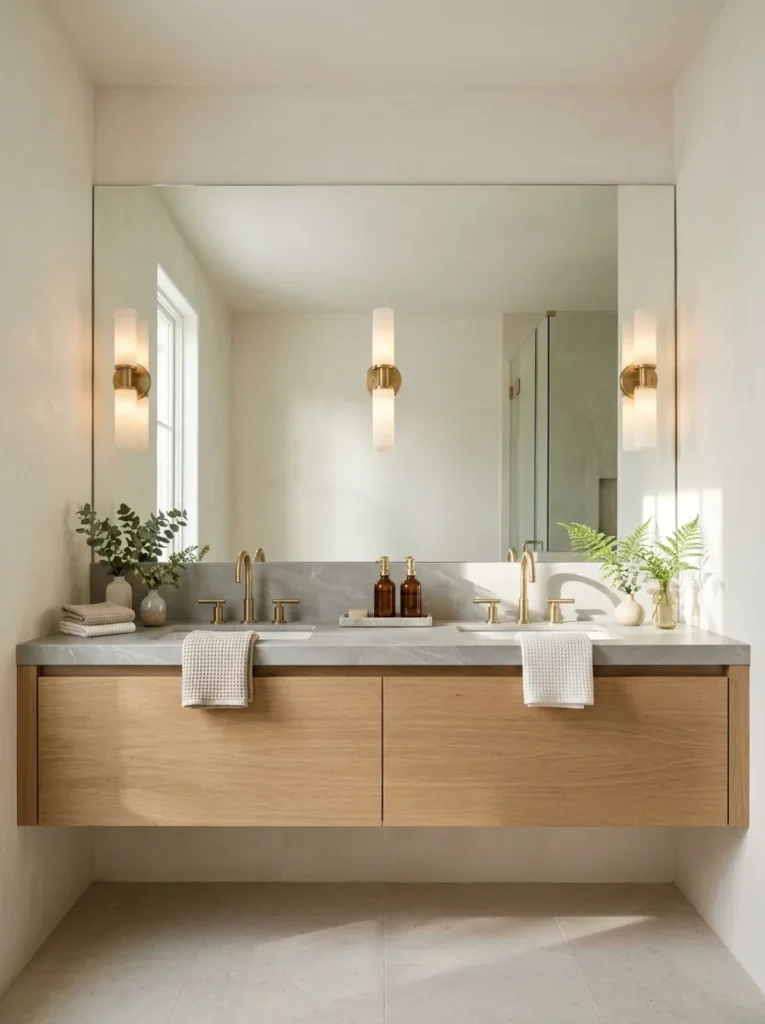
Standard mirrors come in standard widths, and vanities don’t, so the gap ends up as glass that either crowds the cabinet or floats too small above it. Custom-cut glass settles that, and it changes the wall’s proportions more than any other splurge here.
Stop the mirror 2–4 inches short of the vanity’s edge on each side. Center its height on the eye level of the tallest person using it, not on the wall’s midpoint, and make sure the lower edge clears the faucet and backsplash. Heavy glass needs a mounting plan: studs or hardware rated well above its weight, plus the glass shop’s advice on cleats. Best for vanities that fall between stock sizes.
✅ Before You Order Custom Glass:
- [ ] Measure the vanity width and mark where 2–4 inches in from each edge falls
- [ ] Mark the tallest user’s eye level on the wall
- [ ] Locate studs, outlets and switches the glass will cover
- [ ] Send the shop final width, height and edge finish
3. A Swing-Arm Magnifying Mirror for Close Work
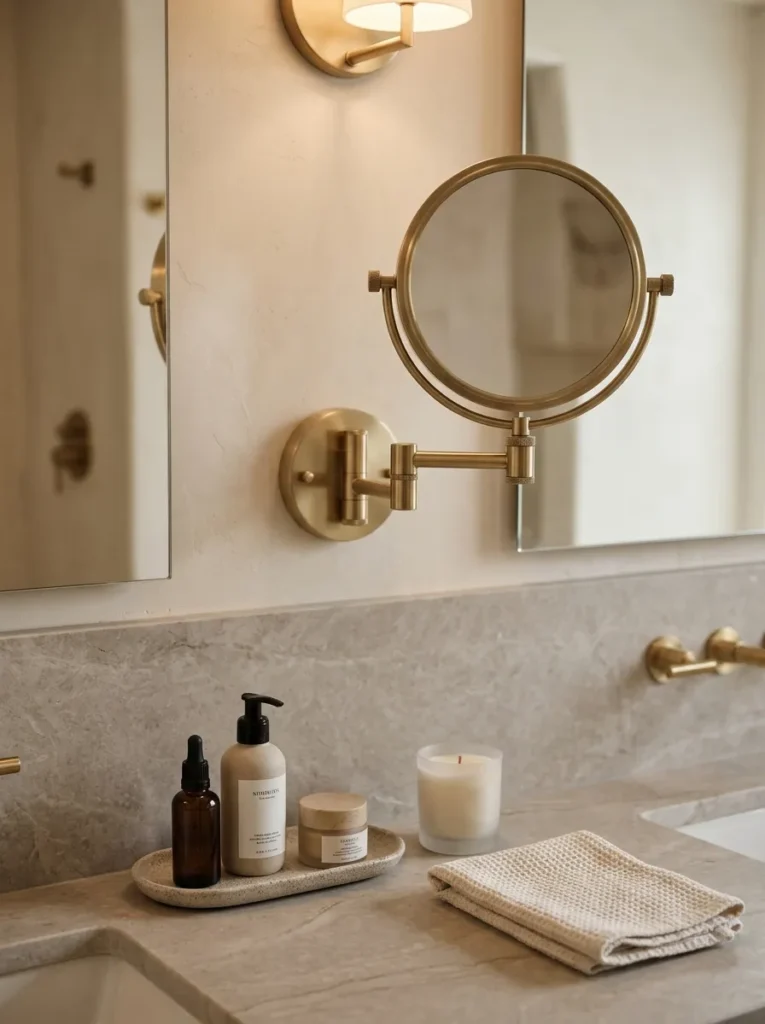
Start with where it mounts: a swing-arm magnifying mirror belongs at the end of the vanity, within arm’s reach of where you do skincare, rather than centered where it competes with the main glass. Pick a magnification you can use at a comfortable distance, since stronger lenses narrow the field and pull your face closer. A finish that matches the faucet makes the arm read as hardware instead of a gadget. Plug-in models should use a GFCI-protected outlet with the cord kept clear of the sink, while hardwired models are a licensed electrician’s job. Worth it for detailed skincare or makeup routines.
Styling Note: Fold the arm flat when you finish. Retracted against the wall, it reads as a small metal detail instead of clutter.
Next, the lamps: where sconces sit relative to your face, not the mirror’s edge, decides whether the glass flatters you or exposes you.
4. Sconces Set at Face Height Beside a Frameless Mirror
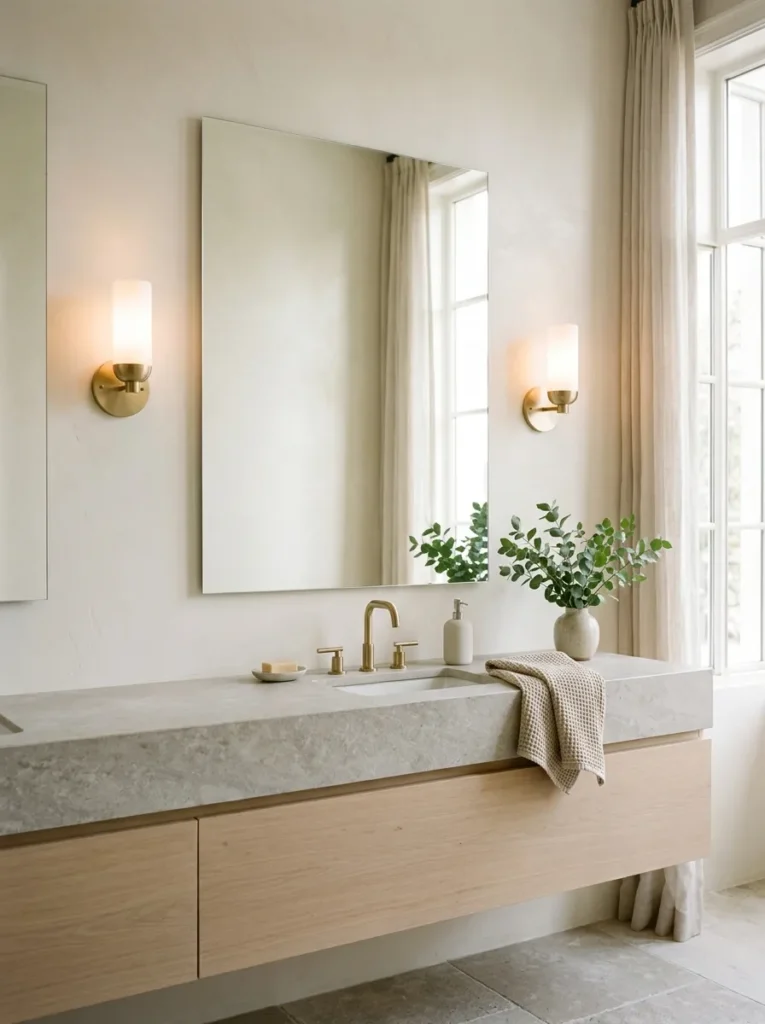
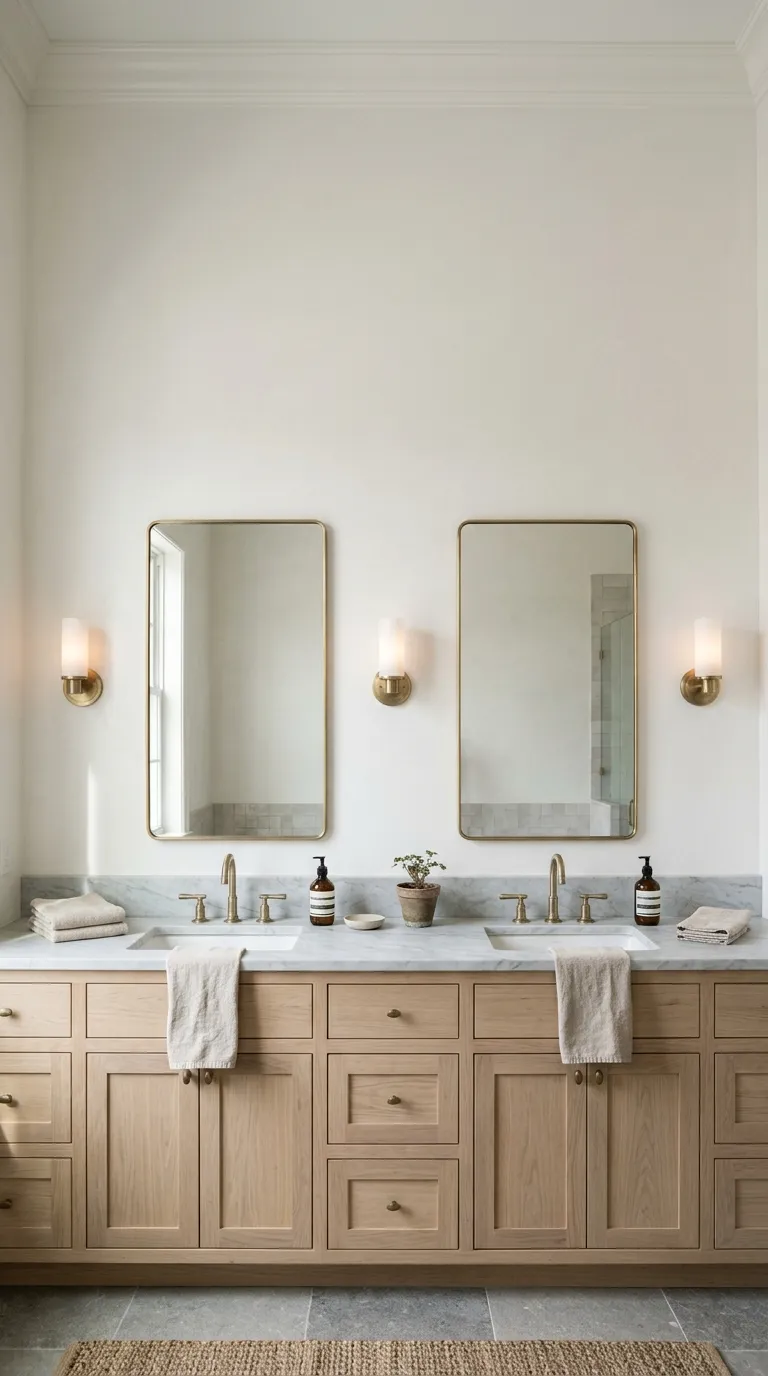
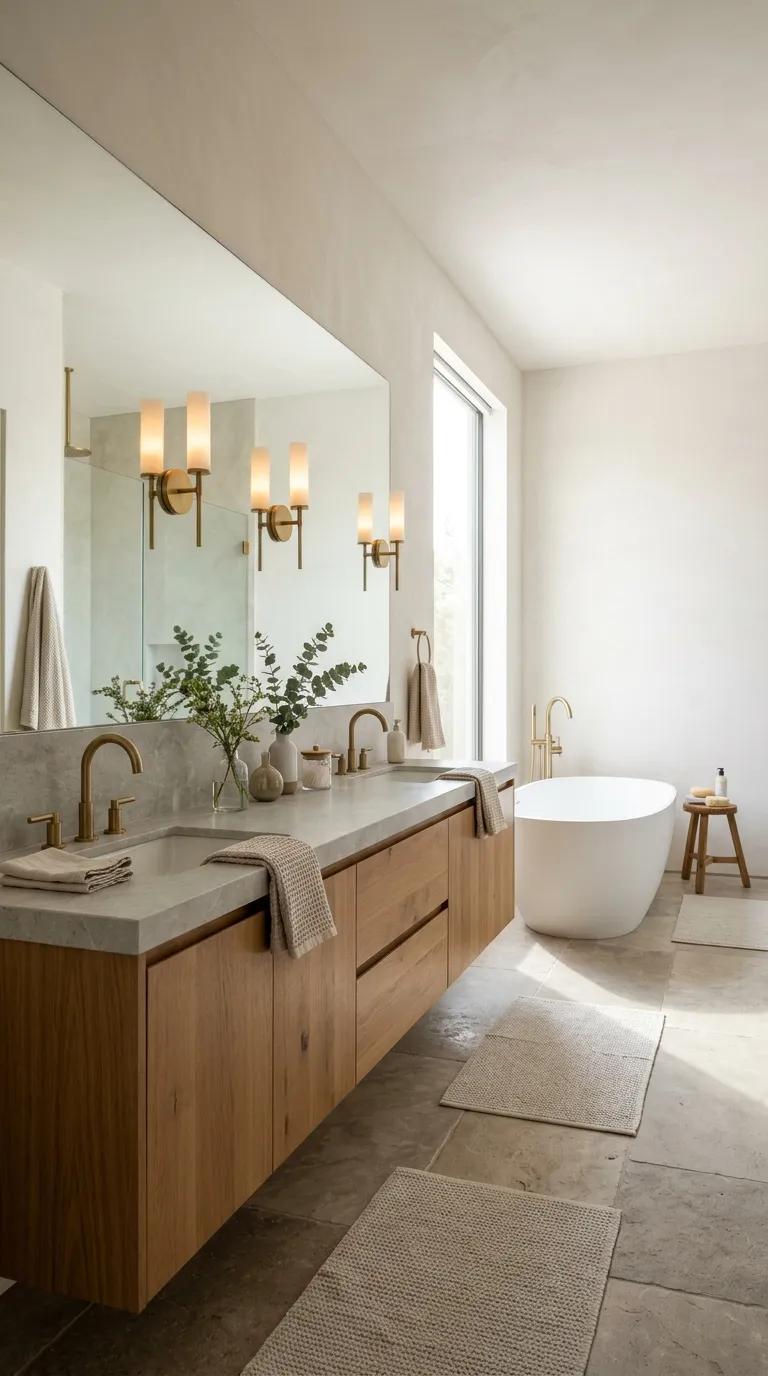
Light from the sides fills a face evenly, while light from above carves shadows under the eyes and nose, which is why a single overhead fixture can make an expensive mirror look unkind. Flank a frameless mirror with two wall sconces, mounted a few inches outside the glass and centered near eye level.
As a starting point that often lands around 60–66 inches from the floor, but the tallest user’s face should decide. Choose warm light around 2700–3000K with a CRI of 90 or higher. Fixtures near a vanity should be rated for damp locations at minimum, and hardwiring belongs to a licensed electrician. Right for any vanity wall with room on both sides of the glass.
Warning: Letting the existing junction box dictate sconce height is the costly error, because moving a box means opening the wall. Mark heights on the wall and stand at the vanity before anyone roughs in wiring.
Shop This Look
| Product | What to look for |
|---|---|
| Wall sconces rated for damp locations | Finish matching the faucet; a diffuser that hides the bare LED |
| Dimmer switch compatible with LED bulbs | Matched to the bulb type; lets you drop to a soft evening level |
| Warm-white LED bulbs | 2700–3000K and CRI 90 or higher |
5. An Unlacquered Brass Frame That Ages With the Room

Unlacquered brass opens bright, then darkens toward honey and brown as hands and humidity work on it, and a bathroom speeds that along. The shifting patina suits a spa-style room better than a chrome edge, which pulls the eye to the frame instead of the reflection. Choose a slim profile so the metal reads as a line rather than a border, and match the faucet or contrast with it on purpose.
Lacquered brass holds its color longer, but worn lacquer can leave blotches, so decide between change and consistency before ordering. Framed glass carries real weight: hang it from hardware rated above the listed weight, into studs or an anchor suited to your wall. Works for people who like a finish that ages.
6. A Slim Floor-Length Mirror in a Tight Dressing Corner
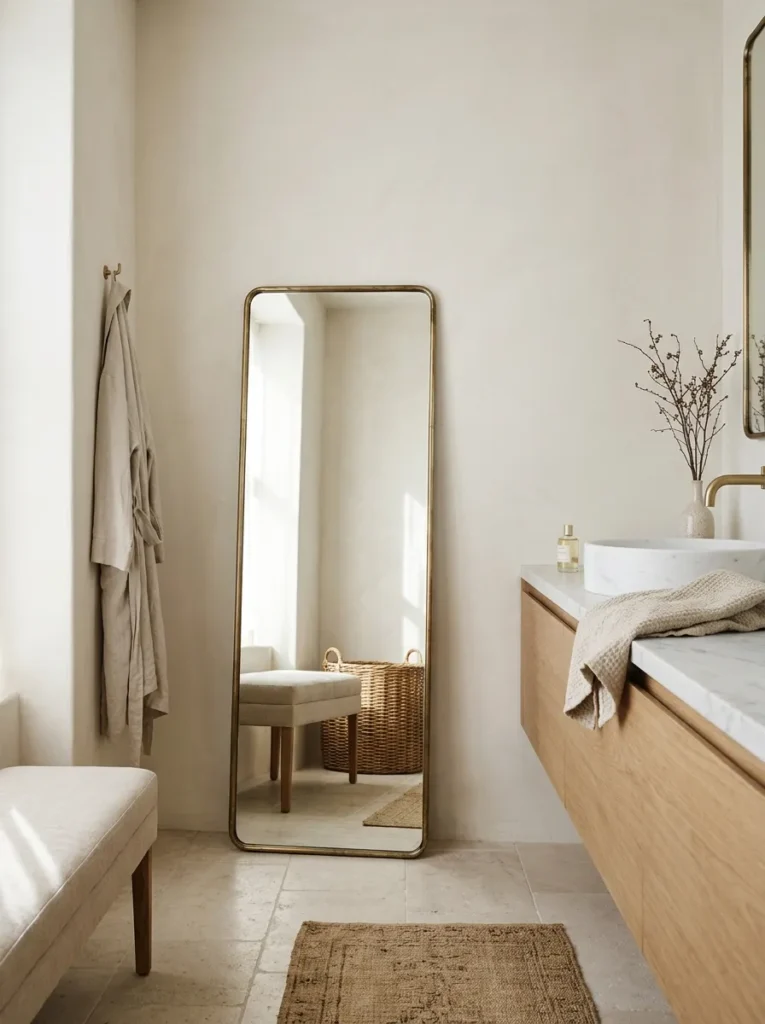
Not every primary bath has wall space left for a full-length mirror, but a slim leaning one needs only a foot or two of floor beside the tub or closet door. Choose a frame shallow enough to stay out of the walking line and tall enough that the top clears your head, so the reflection isn’t cropped.
Face it toward the window or vanity light rather than the toilet or a blank wall. It needs an anti-tip strap into a stud; a renter needs only one small screw hole, worth confirming with the lease. A fit for compact dressing corners.
Important: Leaning is not the same as secure. Tall glass rests its weight on a narrow bottom edge, so one bump from the side is enough to tip it.
Shop This Look
| Product | What to look for |
|---|---|
| Slim floor-length leaning mirror | Shallow frame; height that shows you head to toe |
| Anti-tip wall strap | Rated for the mirror’s weight; screw suited to your wall |
| Wall-mounted robe hook | Finish matching the faucet and sconces |
Idea 7 hides everything behind the glass, and the depth of the wall cavity, not the catalog photo, decides what actually fits.
7. A Recessed Mirrored Cabinet That Disappears Into the Wall
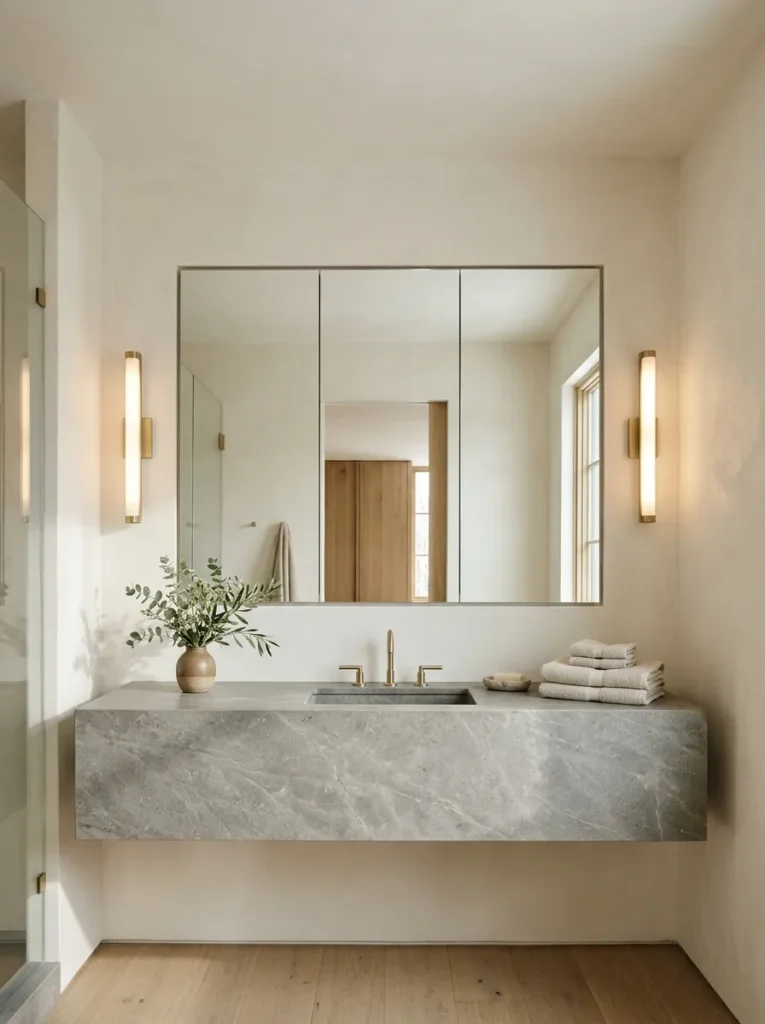
A surface-mounted cabinet sticks out and shadows the vanity wall; a recessed one sits flush, so the mirror reads as part of the wall itself. Opening a wall is a real project. Studs commonly sit 16 inches on center, but check yours, and confirm no pipes or wiring run through the cavity before anyone cuts.
The cavity’s depth, not the catalog’s claims, decides what the shelves can hold, so measure your tallest bottle first. Powered cabinets with lights or outlets need a licensed electrician. Best for owners already remodeling.
Shop This Look
| Product | What to look for |
|---|---|
| Recessed mirrored medicine cabinet | Depth that fits your wall cavity; a hinge side that opens toward the room; adjustable shelves |
| Clear acrylic organizer bins | Sized to the shelf depth so nothing blocks the door |
| Lidded glass jars | Wide mouths for cotton and swabs; they keep the shelves looking calm |
8. Placing the Mirror Where the Window Light Reaches Your Face
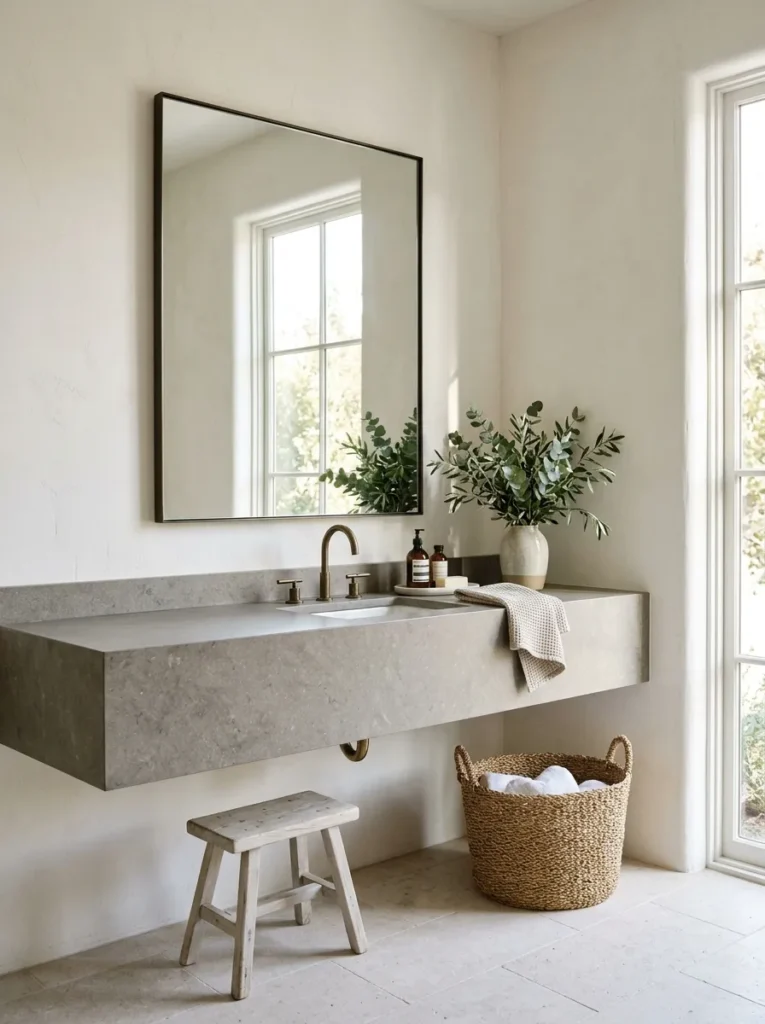
Light flatters a face best when it arrives from the front, so the vanity mirror belongs on the wall opposite the window or at a right angle to it, not beside it. Hung next to a window, the glass turns you into a silhouette against the brightest thing in the room.
Stand at the vanity, and from the tub too, and see what the mirror will actually repeat. A tree or open sky is worth doubling; a neighbor’s siding isn’t. Glass this size is heavy, so mount it into studs. Worth checking in every bath with a window.
Pro Tip: Hold a hand mirror at the planned spot in mid-morning and late afternoon. If window glare lands in the glass, shift the position or add a sheer.
9. A Honed Stone Frame for Quiet Texture
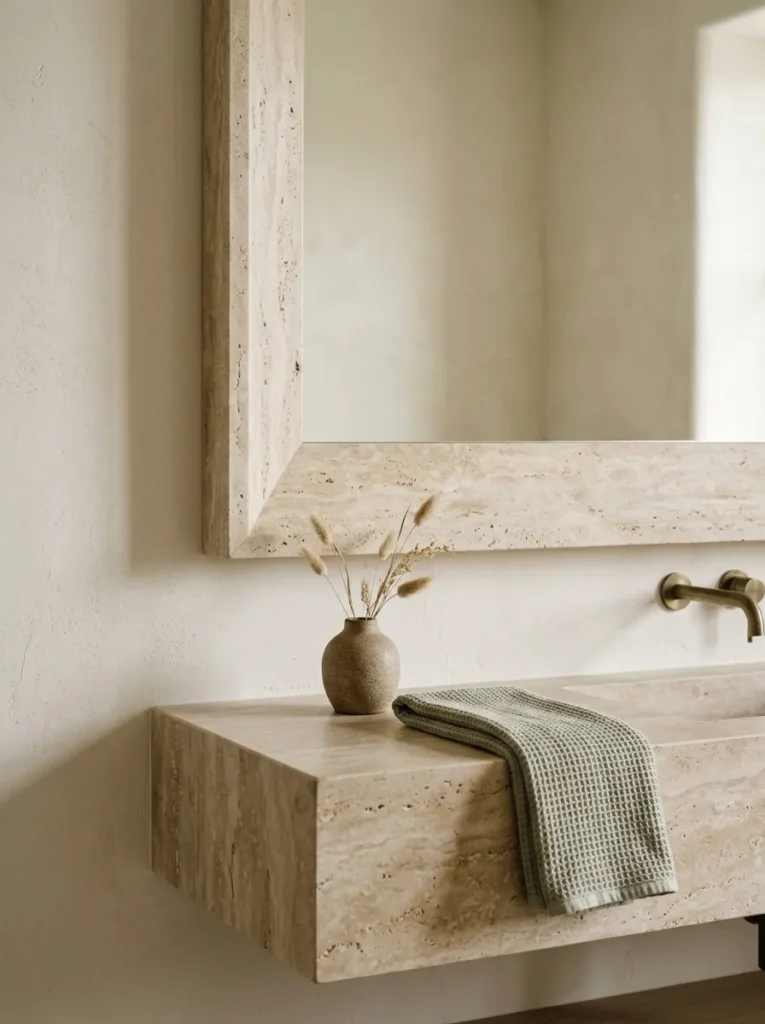
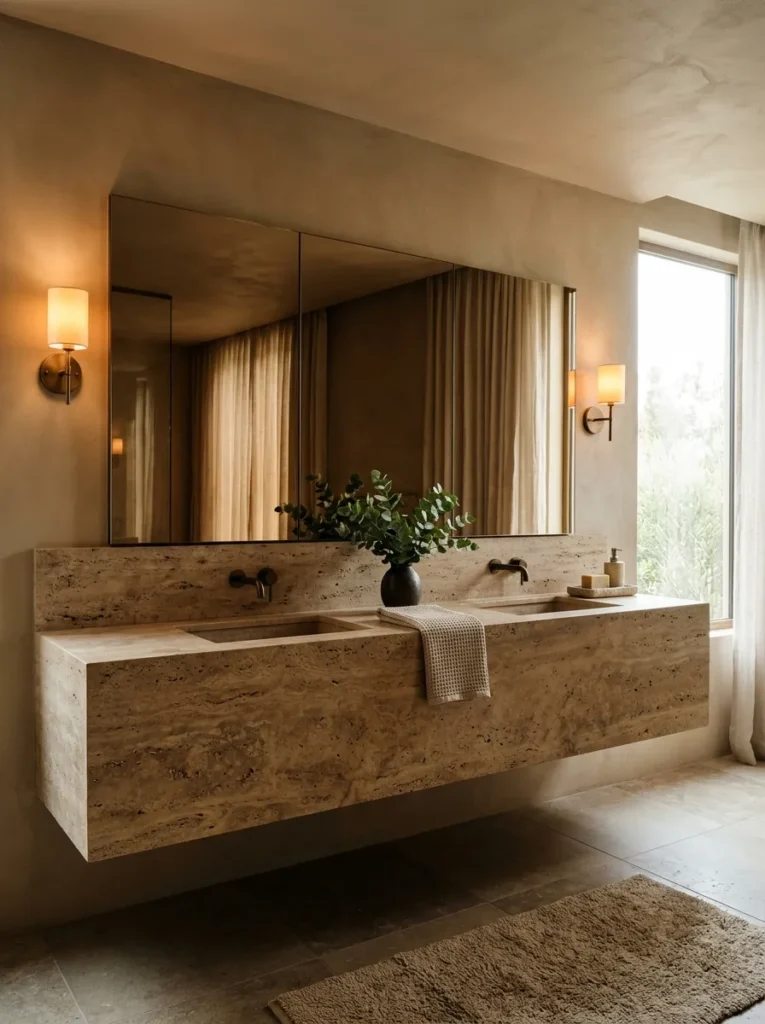
Honed travertine or limestone around the glass turns a mirror into stone architecture: matte, slightly irregular, quiet beside glossy tile. Stone is porous, so ask the maker how the piece is sealed and how to maintain it.
A stone frame also outweighs metal or wood by a wide margin, so get the finished weight in writing and mount into studs with hardware rated above it. Keep the mirror shape plain, since the stone already supplies the texture. Best for rooms with lots of tile that need warmth.
Important: Natural stone varies slab to slab, so a photo shows the style, not your piece. Request a sample or a photo of the actual slab before it’s cut.
Idea 10 borrows a shape the bathroom already owns, which costs nothing and fixes a room that feels pieced together.
10. An Arched Mirror That Echoes the Room’s Own Curve

Start by finding a curve the bathroom already owns: an arched doorway, a rounded niche, a curved window head. Repeat it in the mirror and the room starts to look drawn rather than assembled.
Size an arch’s width the way you would any mirror, stopping 2–4 inches short of the vanity’s edge on each side, and let height do the stretching, since a tall arch lifts a low wall. Center the apex over the sink with the flat base parallel to the counter. If nothing in the room is curved, one arch can look borrowed, so skip it. Best for bathrooms with at least one existing curve.
Observation
The counterintuitive part: a mirror adds depth only as far as the room it faces. Reflected objects appear as far behind the glass as they sit in front of it, so a mirror facing a tub six feet away shows the tub six feet “inside” the wall, while one facing a blank wall six feet away adds six feet of nothing. Before hanging large glass, stand where it will go and look at what it will repeat: tub, plant, window, art. If nothing deserves doubling, make the mirror smaller.
11. A Backlit Halo Mirror for Even, Shadow-Free Light
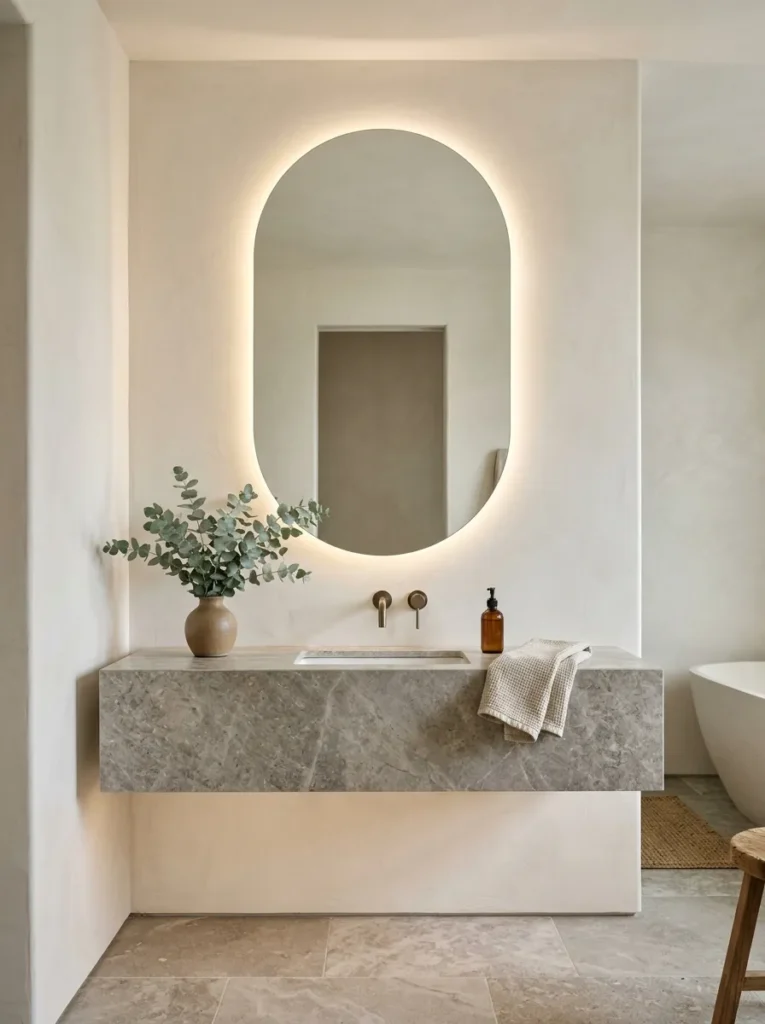
A vanity with no good spot for side lighting is where a backlit mirror earns its price: the glow sits behind the glass, spreading light across the face from the edges. Choose warm output, 2700–3000K, and a CRI of 90 or higher so skin tones read honestly.
Pick a model that dims, since full brightness at night feels clinical. Hardwired units need a licensed electrician, and the mirror should carry a listing for damp locations. If it includes a defogger, confirm that before buying. Best for vanities with no room for side lighting.
Warning: Settle the power feed location before the wall is tiled. Moving it afterward means cutting finished surface, and a cord draped across the sink or splash zone is not an acceptable shortcut.
Shop This Look
| Product | What to look for |
|---|---|
| Backlit LED oval mirror | Damp-location listing; warm 2700–3000K, CRI 90+; dimming |
| Floating stone or glass shelf | Narrower than the mirror; mounted into studs |
| Stone vanity tray | A size that holds daily skincare without crowding the counter |
12. An Edge-to-Edge Mirror Wall Behind a Floating Vanity

A frameless mirror running the width of the vanity wall and nearly to the ceiling erases the wall itself, and the room reads as deeper. Ask the glazier whether one panel or two is practical; a seam placed on the vanity’s centerline, behind the faucet, tends to disappear better than one landing beside a sconce.
Large glass calls for a professional installer, and trapped moisture can damage silvering at the edges, so good ventilation matters. Local code and your own measurements decide the final details. Best for primary baths with one clear vanity wall.
Small-Space Tip: In a compact bath, confine the mirror to the vanity zone and leave neighboring walls solid. A mirror on every side stops feeling serene.
How to Start Your Spa-Style Bathroom Mirror Transformation
The right first move is almost always the light, not the glass: swap the vanity bulbs for warm 2700K options with a CRI of 90 or higher, then judge every candidate mirror by what it does to a face under them before you judge the frame.
The most common beginner error is hanging the new mirror where the old one hung. Old screw holes mark someone else’s sightline. Mark your own eye level, tape the planned outline to the wall, and live with it for a day before committing.
Three finds help immediately: a plug-in warm-white night light for the vanity outlet, lint-free microfiber cloths made for glass, and a ribbed ceramic soap pump in a stone-like glaze. Prices vary by retailer, but all three typically sit well below $50.
A swap-level update (bulbs, a swing-arm mirror, a leaning floor mirror) fits in a weekend. Custom glass adds waiting time, so ask the shop for its lead time before scheduling anything else, and opening walls for a recessed cabinet or new wiring stretches into weeks. As rough planning figures, a starter round runs about $100–$400, while a full primary-bath upgrade with custom glass, lighting and electrician labor can reach into the thousands. Get local quotes.
Frequently Asked Questions
How wide should a bathroom mirror be above a vanity?
Stop the glass 2–4 inches short of the vanity’s edge on each side. That leaves a strip of counter visible, so the mirror looks fitted rather than crowded. Measure the vanity first, then check clearance for sconces or a swing-arm so nothing collides with the frame.
Which of these ideas work in a rental?
A leaning floor mirror, a plug-in swing-arm mirror and plug-in sconces ask the least of the walls. Recessed cabinets, hardwired backlit mirrors and anything that opens a wall need landlord approval at minimum. Even a leaning mirror should be strapped to a stud, so check your lease about small screw holes.
Is a backlit mirror worth the extra money?
It is worth it when the vanity has no good spot for side lighting, because the glow sits behind the glass and spreads evenly. Choose warm output at 2700–3000K, CRI 90 or higher, and a damp-location listing. Budget separately for an electrician if the unit is hardwired.
How do I protect a mirror from bathroom humidity?
Run the exhaust fan during and after showers, and keep standing water off the lower edge. Moisture is what attacks mirror silvering at the edges, so sealed edges and a framed or well-backed design help. Wipe splashes promptly, and avoid hanging older glass directly beside a shower.
Ready to Create Your Dream Spa-Style Primary Bath?
Twelve splurge-worthy bathroom mirror ideas cover a lot of ground: tinted glass, exact proportions, magnification, side lighting, living brass, slim floor glass, recessed storage, window position, stone, an echoing arch, a backlit halo and a full mirror wall. Spend first on how the mirror lights you, and treat the frame as the last decision.
Nothing here has to happen in one weekend, and a single sample of tinted glass held against your wall tonight is a legitimate first step. Done well, the room feels slower and softer each morning, as if the light had been tuned for you. Pin the two or three ideas that pulled you in so your shortlist is waiting when you start measuring.
Keep Exploring
- 10 Spa-Style Primary Bath Vanity Lighting Ideas That Flatter Every Face
- 12 Spa-Style Powder Room Mirror Ideas That Make Small Rooms Feel Calm
- 9 Spa-Style Bathroom Storage Ideas That Keep Counters Clear