10 Pet-Safe Crochet Wall Hangings for Homes With Cats
A pet-safe crochet wall hanging is one a cat can’t snag, swing from, chew apart or swallow, and that depends on stitch density, edges and hanging height far more than on the pattern. These 10 pet-safe crochet wall hangings for homes with cats each solve one specific risk, so you can make something soft and still leave the room without worrying.
Picture a wall of matte cotton, tightly worked, catching morning light without one thread hanging loose. Texture you want to touch. Nothing a paw wants to chase. Interesting to you, boring to the cat.
Jump To
- Why Pet-Safe Crochet Wall Hangings for Homes With Cats Make Such a Difference
- The Ideas, Safest Fixes First
- How to Start Your Pet-Safe Crochet Wall Hanging Transformation
- Ready to Create Your Dream Pet-Safe Crochet Wall Display?
Why Pet-Safe Crochet Wall Hangings for Homes With Cats Make Such a Difference
Crochet suits a cat household when the piece is flat, dense and fixed in place, because the risk comes from loose parts rather than the craft. Aim for tightly worked cotton or cotton-blend yarn in mid-tone, heathered shades, finished with firm edges instead of tassels. Cats that swallow string or yarn can end up needing emergency vet care, so every idea below removes something a cat could pull, chew or bat. Small rooms work too. One 12-inch panel hung with care does more than a large piece hung carelessly.
Quick Reference
| Best starting point | One flat, fringe-free 12-inch panel |
| Biggest impact area | Edges, hanging method and height |
| Budget to start | Roughly $15–$40 (approximate) |
| Time to complete | A few evenings per piece |
The Ideas, Safest Fixes First
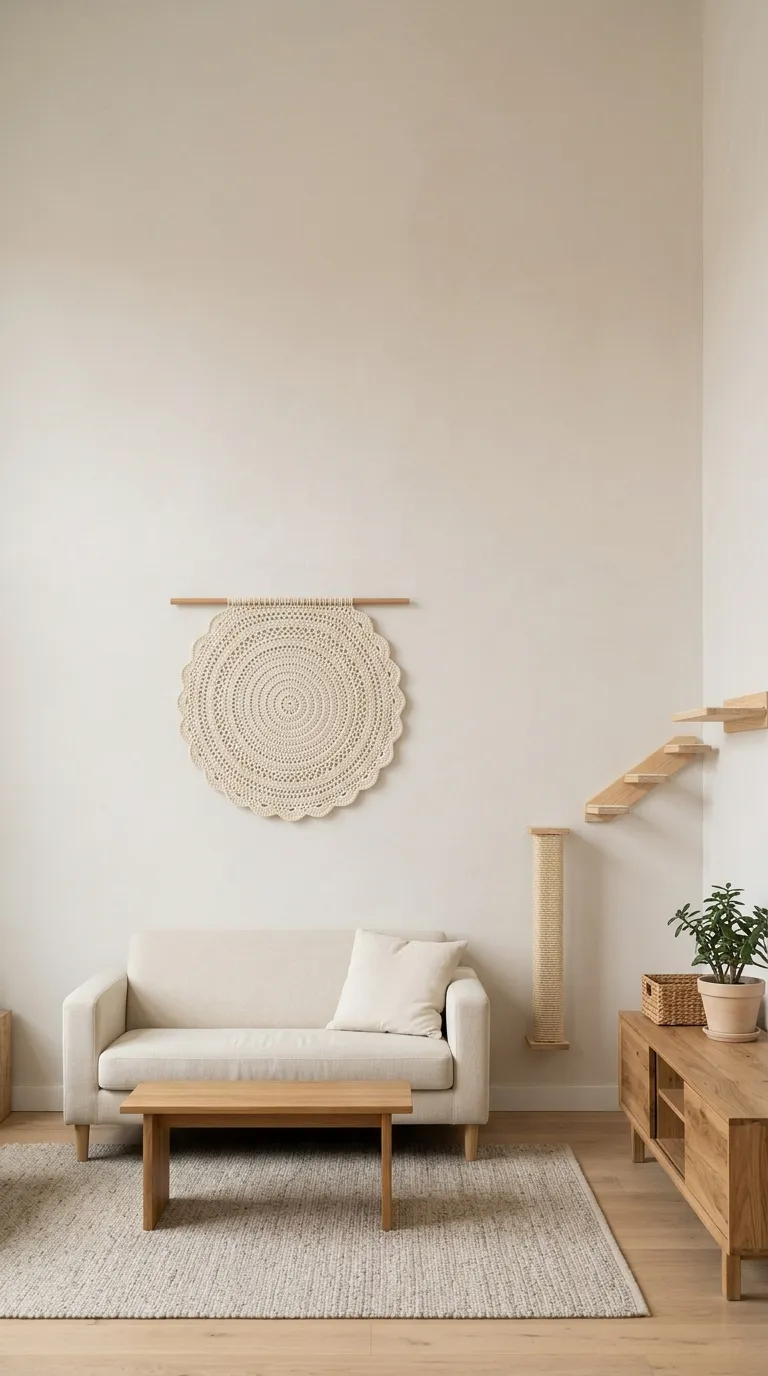
1. A Fringe-Free Round Mandala With a Scalloped Edge

Fringe is the default finish on a boho wall hanging, and it’s the first thing to cut. Tassels, pom-poms and dangling cords all read as prey to a cat, and they pull free in a single swipe. A scalloped shell edge worked into the final round gives the same soft outline with nothing loose to grab. Hang the mandala from a flat fabric tab sewn to the back, never a visible loop of yarn. A round shape suits first-timers best, since there are no corners to curl and no seams to split.
Quick Win: Converting a tasseled piece you already own? Unpick the knots that hold each tassel instead of snipping, then whip-stitch the open edge closed so cut ends can’t fray.
2. A Tight-Gauge Single Crochet Tapestry

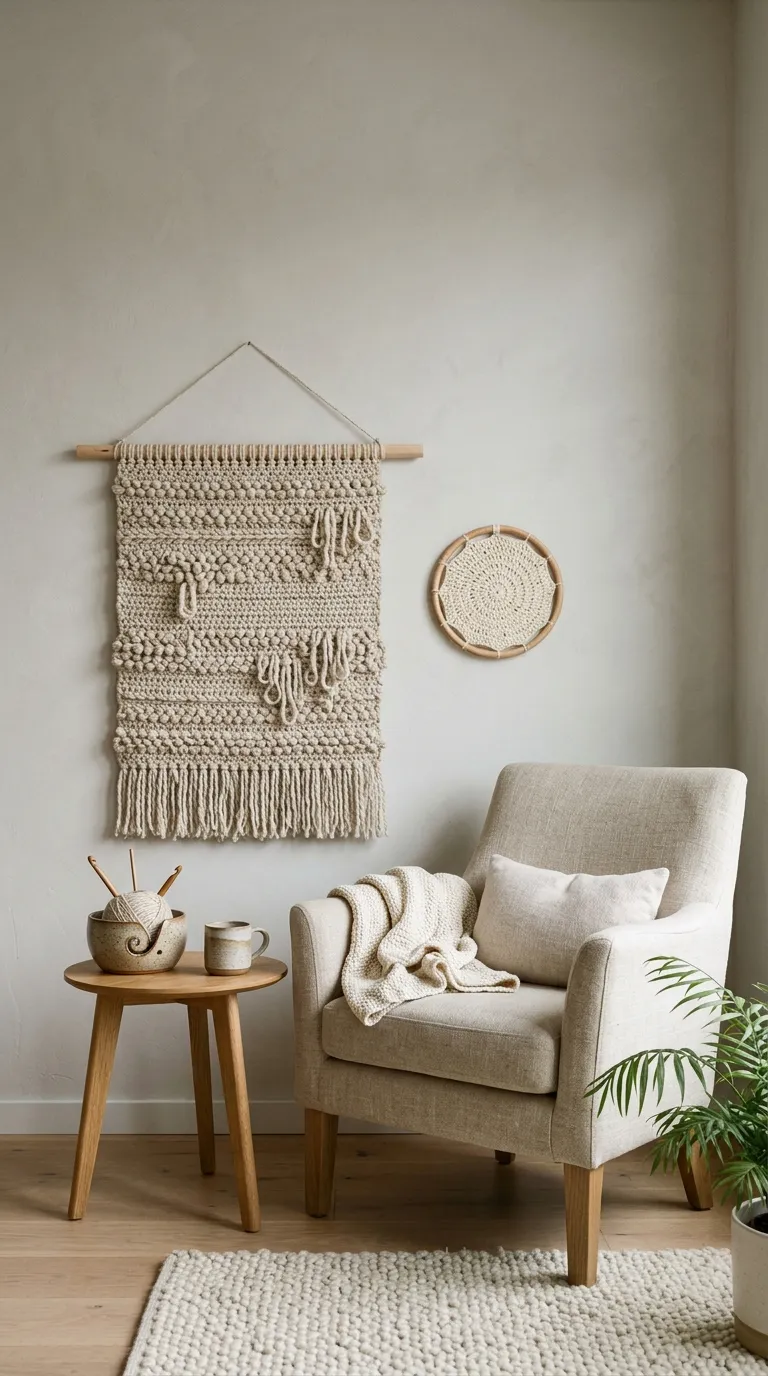
Go down one or two hook sizes from the one printed on the yarn label and work the whole panel in single crochet. The stitches pack tighter, the fabric stiffens, and a claw tip finds no gap to slip into. Test it by holding the finished panel up to a window. If daylight shows through the stitches, redo it with a smaller hook. Flat single crochet also beats lacy shell or granny-style openwork on a cat’s wall, where every open hole becomes a hook. This one is best for cats that scratch anything with texture.
Warning: Bouclé, chenille and loopy bobble stitches look cozy and give claws exactly what they want, a loop to hook. Choose smooth, plied yarn and get texture from flat ridges instead, such as single crochet worked in the back loop only.
3. A Narrow Panel Above a Console, Sized to the Furniture

Proportion makes a hanging look intentional. A panel about two-thirds the width of the console beneath it feels anchored, while one matching the full width looks like a rug on the wall. Set the lowest edge roughly 12 inches above the console surface. Standard styling advice says six to eight inches, but a cat treats a console as a launch pad, and the extra gap keeps the fabric out of casual reach from a seated cat. Keep the tabletop nearly bare, with keys corralled in a heavy tray. Best for entryways and hallways with short walls.
Shop This Look
| Product |
|---|
| Narrow wooden console table |
| Wide, shallow ceramic tray |
| Lidded woven storage basket |
Cream looks calm in every photo, then a black cat shows up. The next idea picks yarn the way a cat’s coat would.
4. A Heathered Mid-Tone Colorway That Hides Shed Fur

Black cat, white cat, tabby: the coat decides the yarn. Fur shows most against a color far from the coat, so a black cat leaves pale smears on cream while charcoal gray hides almost none. A white cat does the reverse. In mixed households, a heathered or marled mid-tone such as oatmeal, soft sage or warm gray tends to camouflage hair of every shade, because the yarn is already flecked. Skip pure white and deep black unless you enjoy lint rolling weekly.
Pro Tip: Press a clump of brushed-out fur onto a skein in daylight, then step back about three feet. If you can still spot it, pick a different shade.
5. A Cluster of Hoop-Framed Mini Pieces
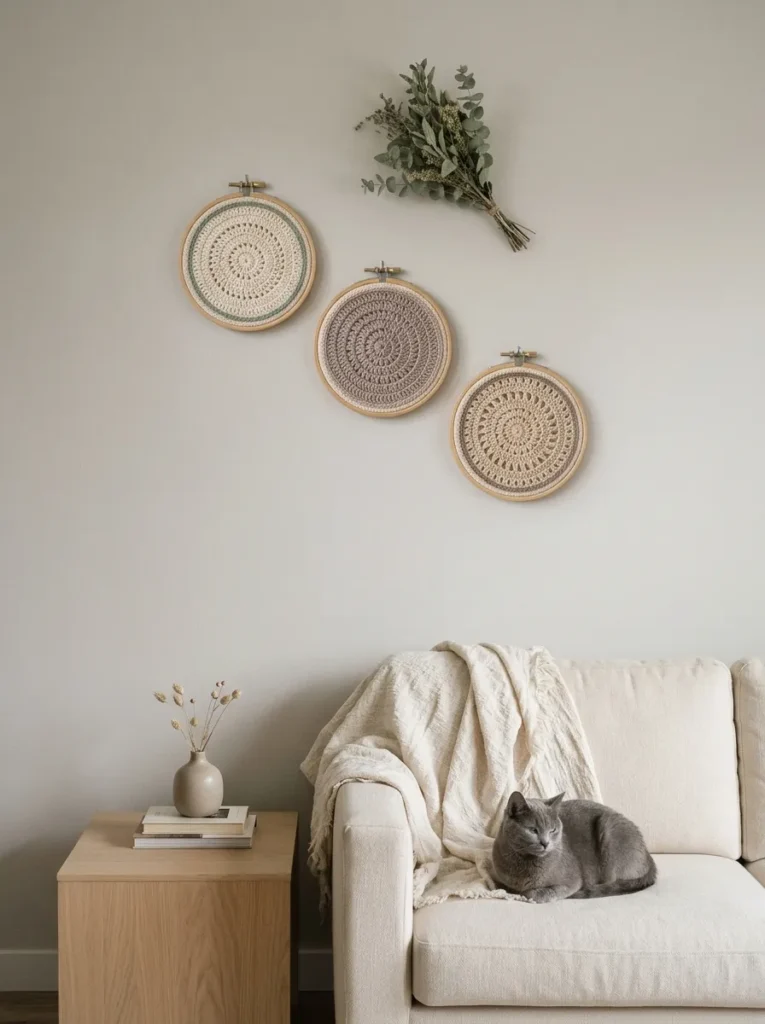
Three wooden hoops in different diameters, each holding a small crochet panel stretched drum-tight, make a cluster that looks collected rather than matched. Stretch the crochet over backing fabric and trim the excess behind the inner ring, which leaves no free edge for a cat to pull. Give each hoop its own nail so one knocked piece can’t drag the others down, and leave about two inches between hoops. A deep shadow box with a glass front goes one step further for a cat that treats every textile as a toy.
Styling Note: Work all three panels in one stitch family and vary the scale instead. Mixed stitches plus mixed hoop sizes read as clutter.
Shop This Look
| Product |
|---|
| Natural wood embroidery hoops in three diameters |
| Deep shadow box frame with a glass front |
6. A Sunlit Wall That Isn’t in the Sunbeam

Hanging a textile directly across from the biggest window is the usual instinct, and it backfires twice. Sun lightens dyed fiber over time, and the warm patch of floor below becomes the cat’s favorite nap spot, putting the cat at the hanging’s base. Hang the piece on the wall beside the window instead, where it gets daylight without the beam. The beam moves, though: winter sun sits lower and reaches deeper into the room, so check the wall in more than one season. Hand the sunbeam to the cat with a window perch.
Important: “Fade-resistant” on a yarn label is rarely backed by a number, and curtains or window film slow fading rather than stop it. Treat any dyed fiber near a window as something that will soften in color, and move it to a shadier wall once a year.
Shop This Look
| Product |
|---|
| Sheer linen-look curtain panels |
| UV-filtering window film |
| Window-mounted cat perch |
Adhesive strips are the renter’s default and the first thing a swatting paw peels off. A smaller, cleaner trick holds up better.
7. A Renter-Friendly Square Held by Nails, Not Adhesive

Rental leases and curious cats pull in opposite directions. Adhesive strips are what leases favor, and a cat’s paw tends to peel them. A small picture nail holds a light 12-inch panel without a cat being able to loosen it, and one small hole is generally easy to patch with spackle before moving out, though lease terms vary. Make the panel a flat square so it sits against the wall with no gap for a paw to hook behind. Hang from the top, then secure the bottom corners with two more small nails hidden under stitching so the panel can’t swing.
✅ CHECKLIST
Before It Goes on the Wall:
- [ ] Weave in every yarn tail in two directions
- [ ] Sew a flat fabric tab to the back for the top nail
- [ ] Mark the top nail and both bottom points with a level and pencil
- [ ] Tug each corner firmly to confirm nothing shifts
8. Machine-Washable Cotton Worked From a Washed Swatch

Hair, dander and dust settle into textiles on a cat’s wall, so washability is a safety feature as much as a convenience. Cotton and cotton-blend yarns labeled machine-washable can go through a gentle cycle in a mesh bag. Wool usually needs hand washing, and some cats fixate on chewing it. Cotton can shrink, so wash and dry your gauge swatch before starting the real piece and measure the change, then size the panel to the post-wash number. A good match for long-haired cats or anyone planning to wash every few months.
Important: A pleasant-smelling hanging isn’t a cat-safe one. Many essential oils, including some common in linen sprays and scented detergents, are harmful to cats, so wash with fragrance-free detergent and skip finishing sprays.
9. A Cat Silhouette Worked Into the Fabric, Not Added On
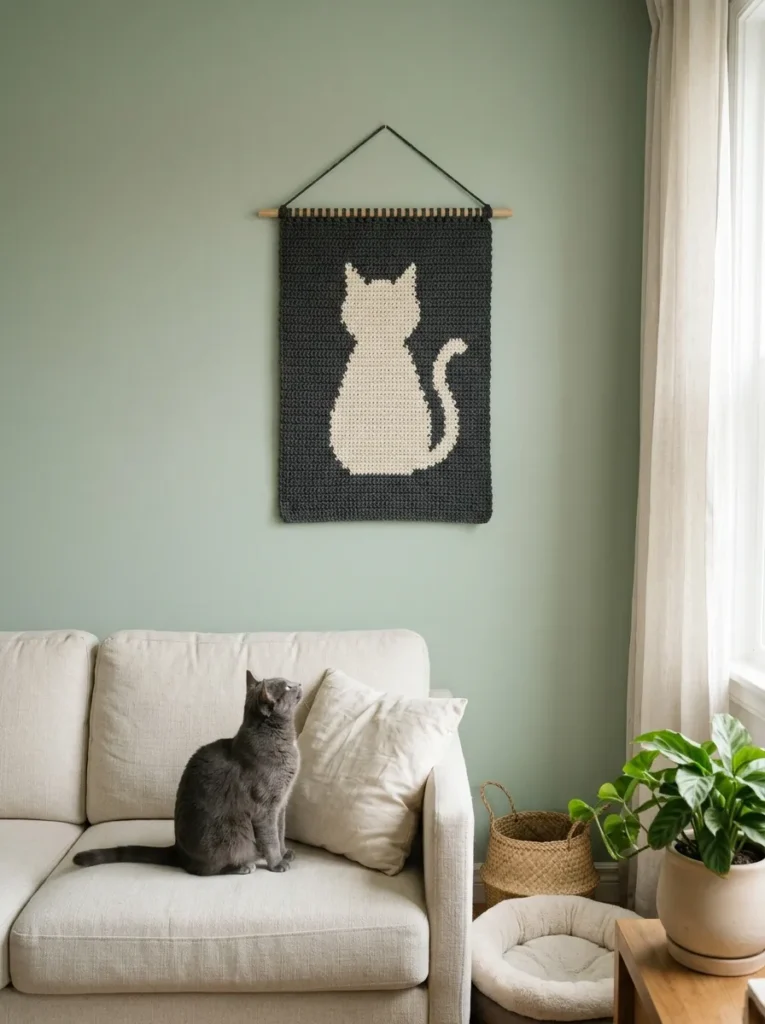
A cream cat silhouette on charcoal, worked flat into the panel itself, gives a cat-lover’s wall a focal point with nothing glued on. Skip plastic safety eyes, buttons and beads, any of which a determined cat can pry loose and swallow. Work the design in tapestry crochet instead, where the unused color is carried inside the stitches so no floats run loose across the back. Add facial details in back stitch using the same yarn. Best for gifts and for homes with kittens, where chewing is more common.
Budget Version: Two contrasting skeins of cotton yarn and a single flat picture hook is enough to make the whole piece for well under $100.
The last idea stops treating the cat as the problem and gives it a wall of its own.
10. A Dedicated Cat Wall Beside the Hanging

Mount two or three wall shelves in a staggered line that climbs away from the crochet piece, so the route leads the cat toward the far corner rather than past the hanging. Put a sisal scratching post at the base, since cats tend to stretch and scratch before they climb. Keep the hanging’s lowest edge at least 12 inches above the highest shelf, the same clearance as the console idea. Cats with a legitimate place to climb tend to leave the decorative wall alone, though no setup is a guarantee. Best for multi-cat homes and energetic young cats.
Pro Tip: Put a soft bed on the top shelf first. Cats pick comfortable elevated spots over bare wood, and a used perch teaches the route faster than any training.
Shop This Look
| Product |
|---|
| Wall-mounted cat shelf set |
| Vertical sisal scratching post |
| Low-profile cat bed sized for a shelf |
How to Start Your Pet-Safe Crochet Wall Hanging Transformation
Start here: one flat, fringe-free square panel, about 12 inches across, in firm single crochet and a heathered mid-tone cotton. It teaches the tight-gauge habit that every other idea depends on, and it’s small enough to rework if your cat proves it wrong.
The most common beginner mistake is weaving in yarn tails once and calling it done. A tail woven in a single direction works loose with the first swat, leaving exactly the loose thread you were avoiding. Weave each one in two directions through the stitches, then tug it.
Three items under $50 will cover almost everything: a skein of mid-weight cotton yarn in a heathered shade, a crochet hook one or two sizes smaller than the yarn label suggests, and a pack of small sawtooth picture hangers. All three sit in the budget aisle of any craft store.
Plan a few evenings per panel and a few weeks of evenings for a full wall of several pieces. A single starter panel costs roughly $15–$40 (approximate), while a full cat-wall setup with shelves and a post can reach a few hundred dollars. Panels and mounting are weekend jobs. Washing, rotating and re-checking edges is an ongoing habit.
Ready to Create Your Dream Pet-Safe Crochet Wall Display?
These 10 pet-safe crochet wall hangings for homes with cats cover edges, stitch density, color, light, layout and washable materials, so there’s an easy entry point whatever your wall looks like. Transformation here is incremental, and starting with one small panel is a completely valid way to begin.
Tonight, check any tassel or dangling cord already at cat height and remove it. The finished space should feel soft and settled, handmade without being hazardous. When you find the ideas you’d actually make, pin them and keep the wall plan close.
Keep Exploring
- 7 Ways to Hang Wall Art So Cats Can’t Reach or Knock It Down
- 9 Cat-Friendly Crochet Cushion and Throw Ideas for the Living Room
- 11 Cat-Safe Plants That Look Great Near Handmade Wall Decor