14 Luxury Blue Master Bathroom Ideas With a Soaking Tub
Blue only looks luxurious in a bathroom when the materials around it are doing real work: glazed tile with depth, stone with a honed surface, metal that warms with age. These 14 luxury blue master bathroom ideas with a soaking tub cover paint, tile, stone, lighting, and layout, so you can build the look in whatever order your budget allows.
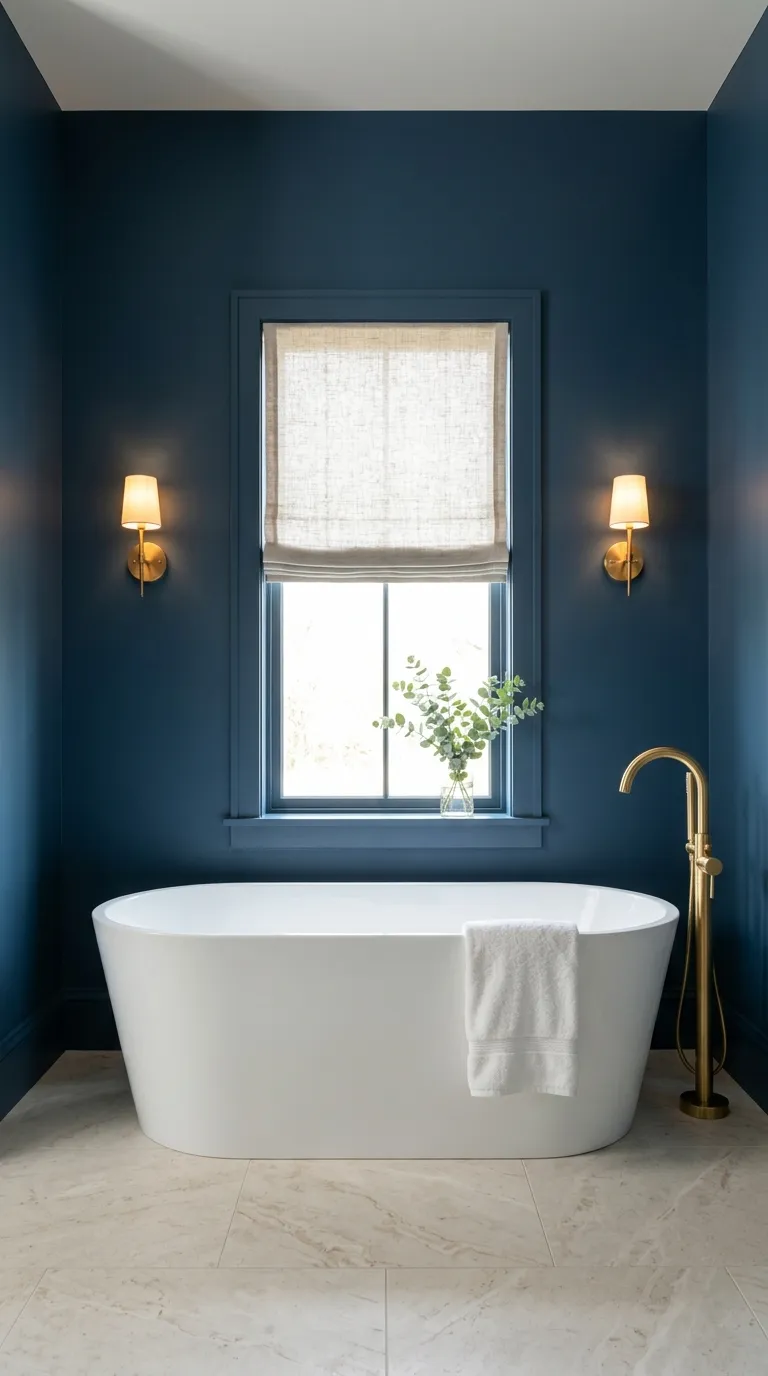
Picture walls the color of deep water and a white tub catching the last of the daylight. Brass glows at the edges. Steam softens every hard line, and the room goes quiet the moment the water settles. Hotel suite, minus the checkout.
Quick Navigation
- Why Luxury Blue Master Bathrooms Work So Well
- Fourteen Ideas, Starting With Paint
- How to Start Your Luxury Blue Master Bathroom Transformation
- Ready to Create Your Dream Luxury Blue Master Bathroom?
Why Luxury Blue Master Bathrooms Work So Well
Blue is the rare color that can sit at both ends of the bathroom spectrum: ink-dark and enveloping, or pale and watery. Luxury comes from pairing it with materials that carry their own depth, such as handmade glazed tile, honed stone, aged brass, and a white tub with a clean silhouette. Shop for blues with a gray or green undertone; they stay calm under warm bulbs, while violet-leaning ones turn plum. The look also works in a modest primary bath. Start with wall color and lighting, since both are cheap to change and shape everything else.
Style at a Glance
| Element | Deep & Moody | Pale & Spa-Like |
|---|---|---|
| Philosophy | Enveloping, suite-like drama | Open, washed with light |
| Materials | Honed stone, enamel, aged brass | Glossy ceramic, glass, polished nickel |
| Color palette | Navy, ink, midnight teal | Sea glass, mist, soft gray-blue |
Fourteen Ideas, Starting With Paint
1. Sea-Glass Blue Walls With Warm White Trim
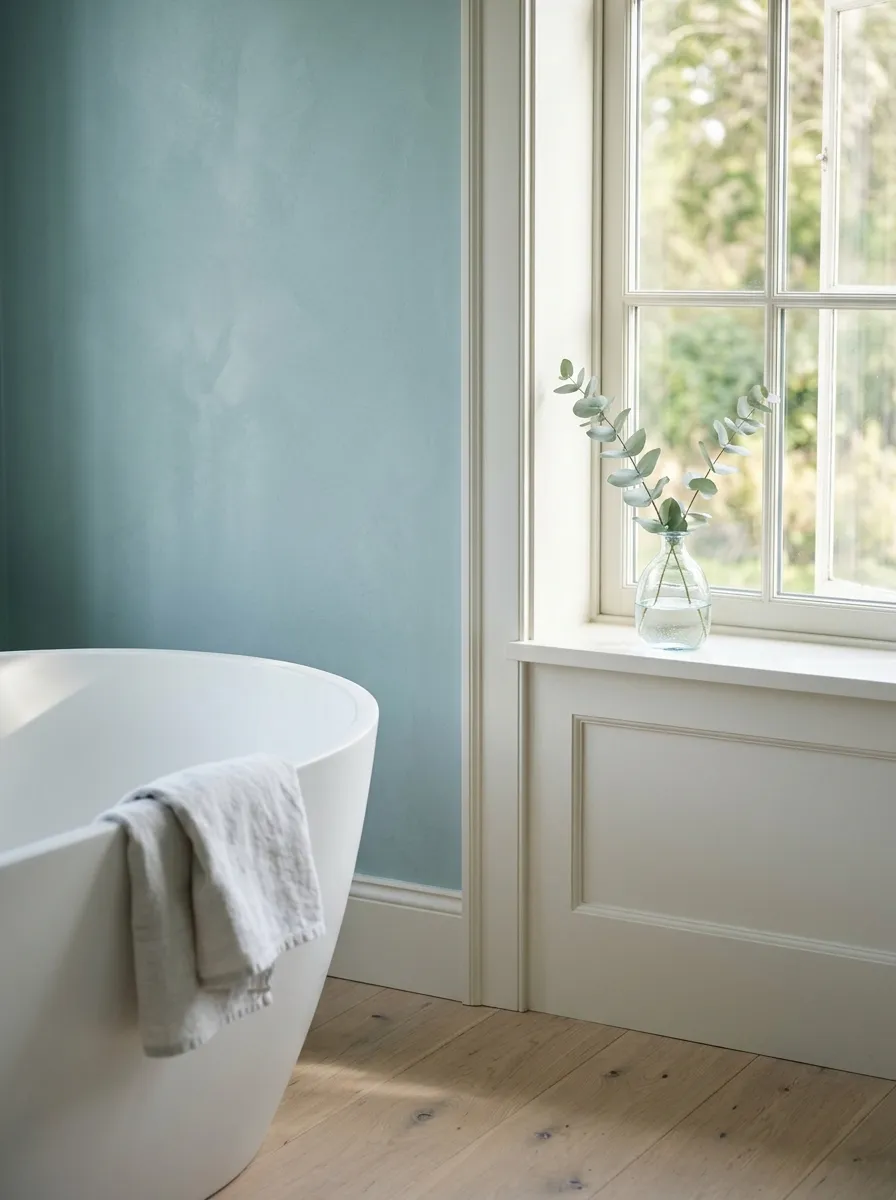
Think of water over pale sand: a blue with enough gray in it to stay quiet, trimmed in a warm white. Cool, never icy. Pale blues borrow heavily from the light in the room, so one can may look soft in a south-facing bath and read flat gray in a north-facing one. Paint a large sample and check it at breakfast, then again at night under the bulbs you plan to keep. Trim matters as much as the wall. A bright, cool white beside pale blue turns the room clinical; a warm white keeps it soft. Best for baths with a window and a tub meant to feel airy rather than dramatic.
Pro Tip: Put your sample on the wall the tub will sit against. Light bouncing off a white tub can shift a pale blue noticeably, so judge the color there, not by the door.
2. A Painted Blue Vanity With a Pale Stone Top
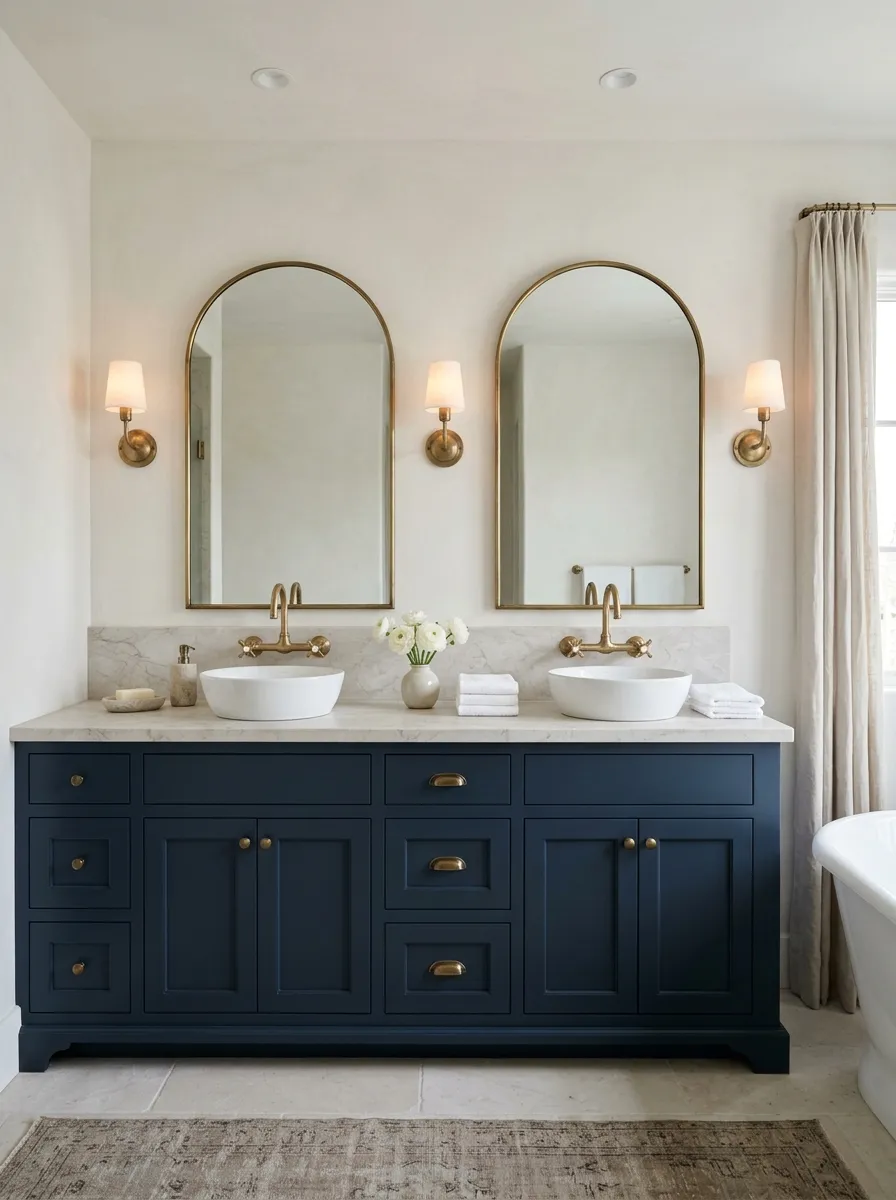
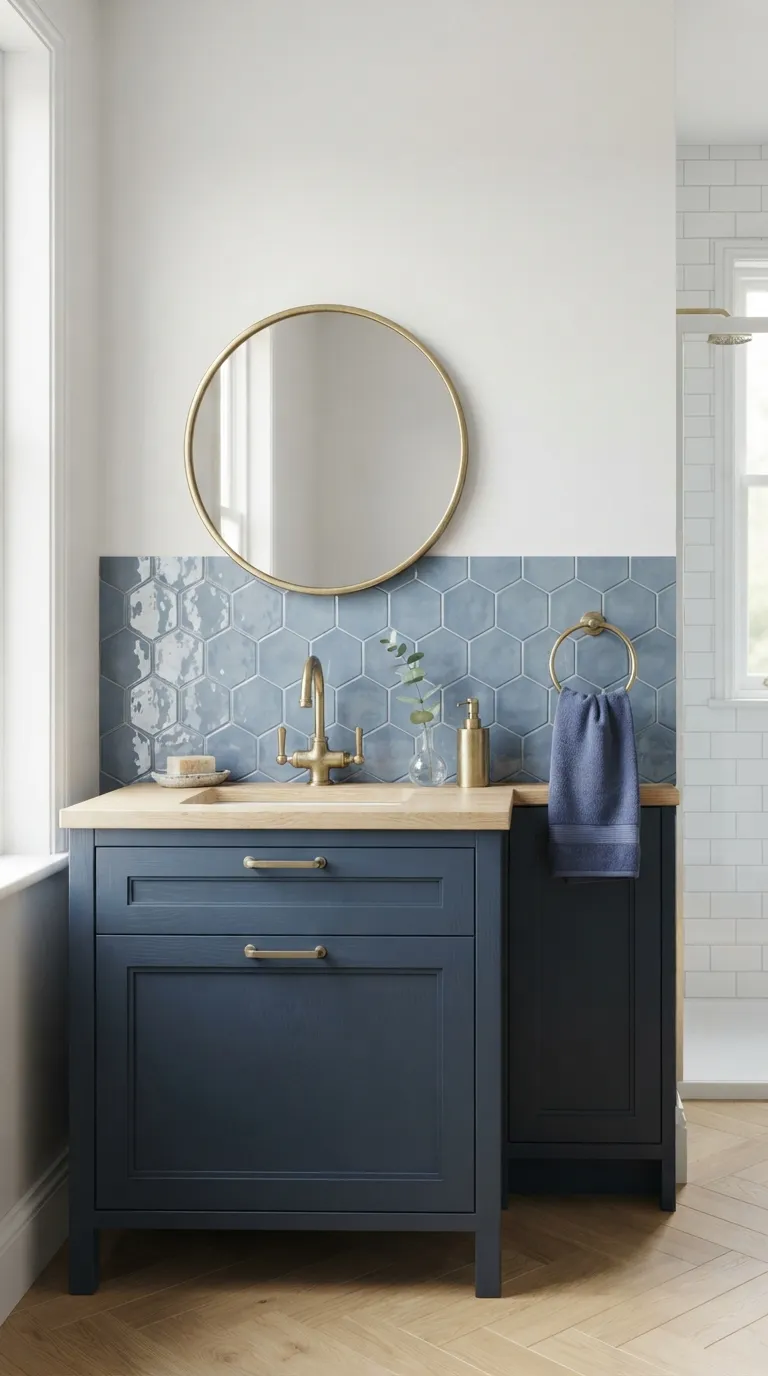
A saturated cabinet in a pale room works on contrast: dark base, light top, light walls around it. Choose a deep blue enamel for the vanity and take it one or two shades deeper than the wall color in the same family, so the room reads designed instead of matched. Top it with a pale stone-look surface veined in gray rather than warm beige, because warm veining against cool navy can look muddy. Raise the cabinet on visible legs or mount it floating, and a strip of floor shows underneath, which makes the vanity feel lighter. Best for couples sharing a double sink who want the vanity to carry the color.
Budget Version: Repaint a sound existing cabinet with cabinet-grade enamel and swap the pulls for aged-brass ones. Paint plus pulls often lands around $100 or less, though prices vary by region and brand.
Shop This Look
| Product |
|---|
| Deep blue double vanity with a stone-look top |
| Arched framed bathroom mirror |
| Widespread brass bathroom faucet |
| Aged-brass cabinet pulls |
3. Handmade-Style Blue Tile Around the Tub
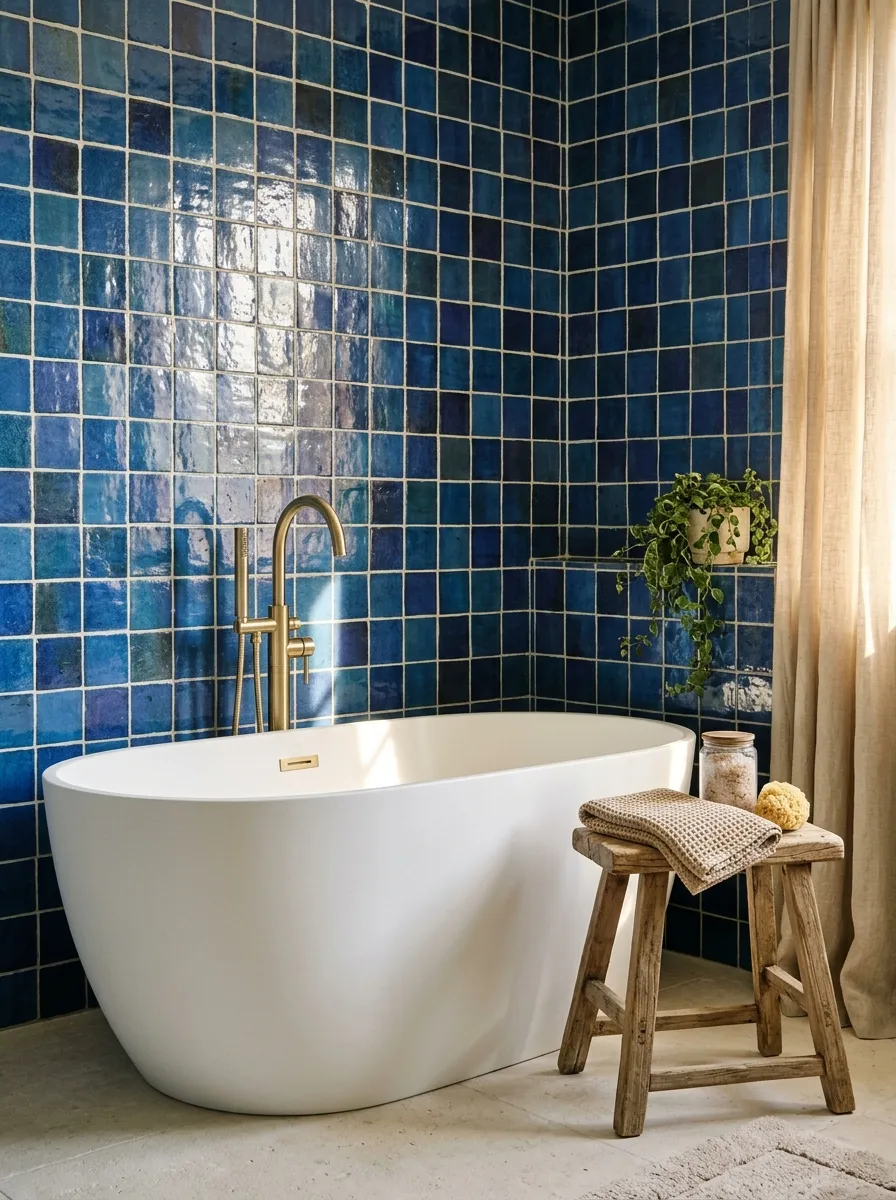
Start with the irregular part. Handmade-style glazed tile, often called zellige-style, varies in thickness and glaze, so color pools darker at the edges and flashes lighter on the faces. That variation is why it shimmers in window light and flat machine-made tile doesn’t. Run it from the tub deck up the wall behind the tub, and let the remaining walls stay painted. Irregular edges usually call for a slightly wider grout joint than precision tile, so confirm with your installer before ordering. Pick grout one shade deeper than the lightest tile, which turns the variation into depth. A good fit for anyone who wants texture without committing to a pattern.
✅ CHECKLIST Before the tile goes up:
- [ ] Mix tiles from several boxes so shade variation spreads evenly
- [ ] Dry-lay the first rows on the floor to judge the overall pattern of light and dark
- [ ] Test grout on a spare tile and let it dry fully before choosing
- [ ] Confirm the tile is rated for wet areas and ask whether it needs sealing
Blue walls can slide cold fast, and one choice that has nothing to do with paint decides whether they read as spa or waiting room.
4. Warm Sconces That Keep Blue From Going Cold
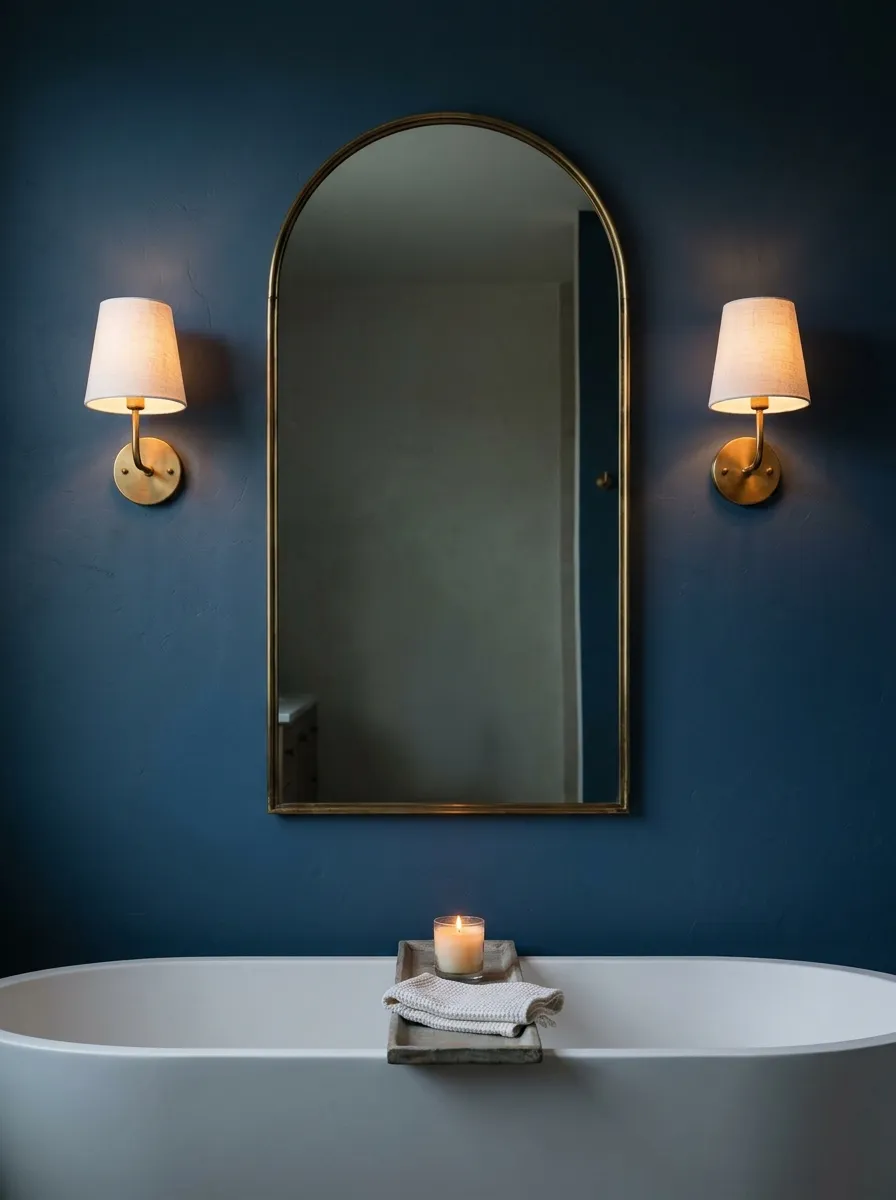
The default plan is a row of recessed ceiling lights. Over blue walls they cast shadows under the eyes and make the paint look a shade colder than the chip. Replace most of them with a pair of sconces flanking the mirror at roughly face height, and keep a dimmable overhead for the tub. Frosted or fabric-shaded glass spreads the light so it wraps the face instead of glaring. Bulbs around 2700K keep deep blues rich and give brass its glow. Worth doing for anyone who has ever disliked their reflection in a bathroom mirror.
Important: Warm does not mean accurate. Color temperature describes how amber a bulb looks; color rendering (CRI) describes how faithfully it shows color. Look for both a warm 2700K rating and a high CRI, with 90 or above a common benchmark, or the blue will look muddy whatever you paint.
5. A Heated Towel Rail With Tonal Blue Towels
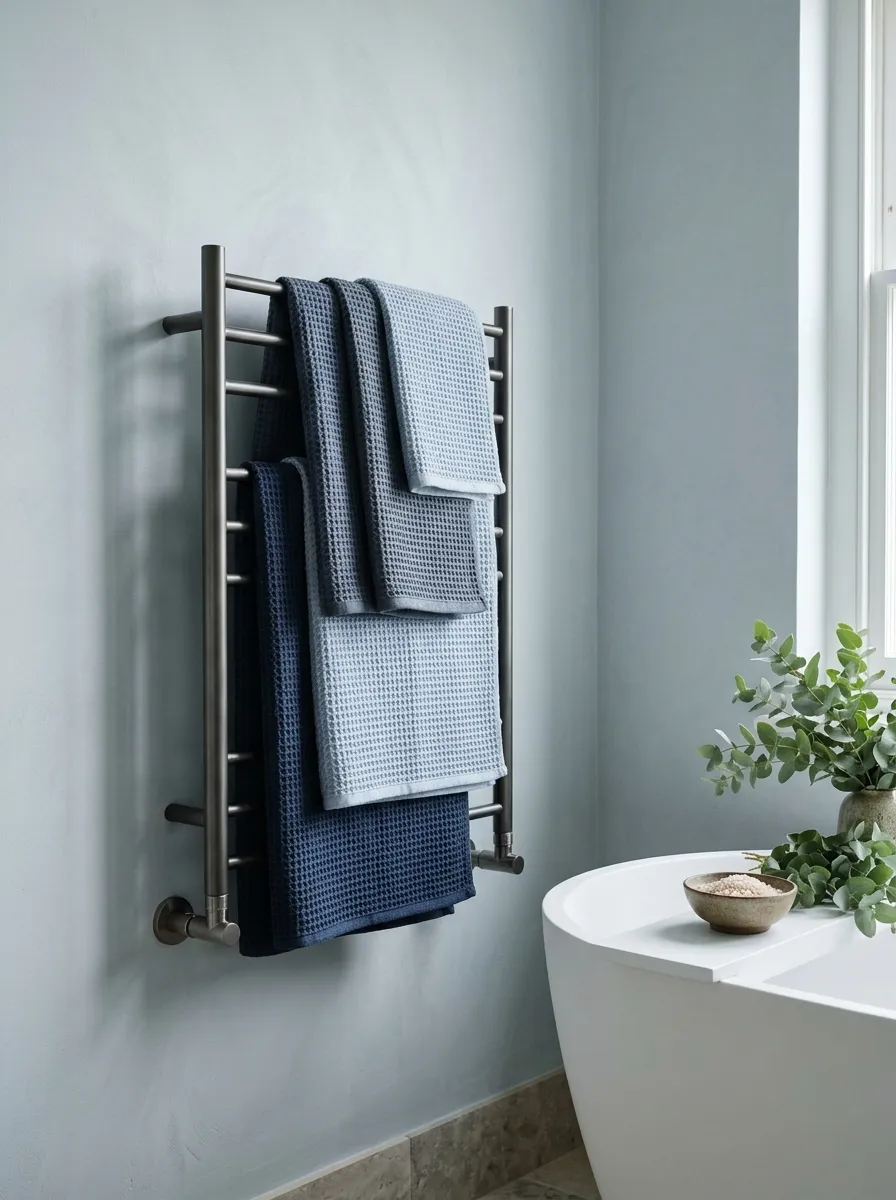
Built for anyone who wants the hotel moment without moving a single wall. A wall-mounted heated rail puts warm towels within reach of the tub, which matters most in a room whose color story is cool. Mount it within an arm’s length of the tub edge so stepping out and wrapping up is one motion. Plug-in models are the easiest retrofit; hardwired or hydronic ones, which connect to the home’s hot-water heating, need a licensed pro and some planning before walls close. Fill the rail with three blues from one family, such as slate, mid-blue, and navy, so the towels read as a gradient.
Styling Note: Alternate textures. Waffle weave next to flat cotton gives one blue two tones without adding another color.
Shop This Look
| Product |
|---|
| Wall-mounted heated towel rail |
| Bath towel set in tonal blues |
| Woven cotton bath mat |
6. Centering the Tub Under the Window
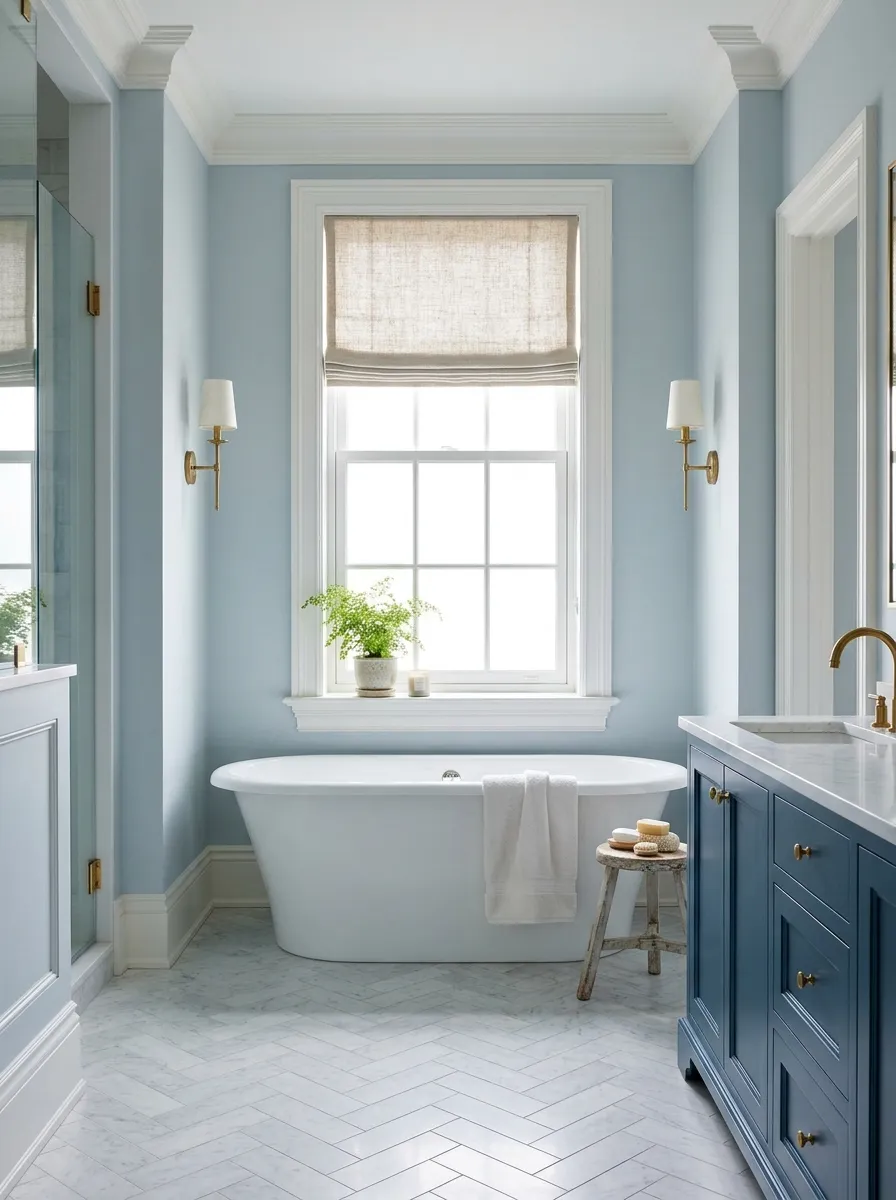
Symmetry plus light behind the subject is the oldest focal-point trick, and a freestanding tub centered under a window uses both. Center the tub on the window, not on the room, and check the sill height from a lying position: you want sky or treetops in view, not a wall of window frame. Leave about 30 inches of clear floor on the access side, a practical clearance for stepping in without bumping the vanity. Choose where the floor-mounted filler goes, head or foot, before the plumbing is roughed in; moving it afterward means opening the floor. Suits primary baths with at least one generous wall.
Warning: Check floor support before you buy. Water weighs roughly 8 pounds per gallon, so a 60-gallon fill is close to 500 pounds before you add the tub and a person. Ask a contractor or engineer about the joists, especially on an upper floor.
Next up: a single slab that removes nearly every grout line around the tub, and the one cleaning habit that dulls it.
7. A Blue-Gray Veined Stone Slab on the Tub Deck
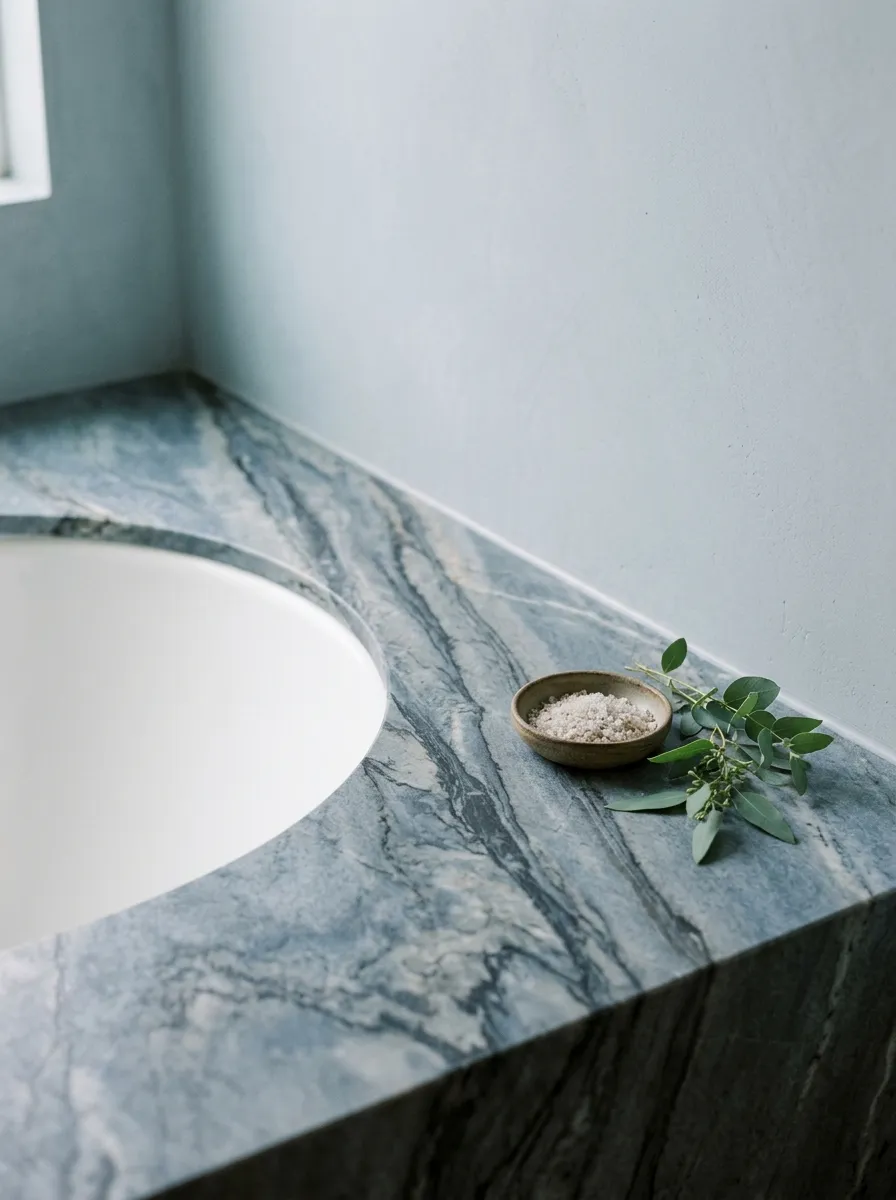
Imagine a single slab of blue-gray stone running up the tub wall and across the deck, its veining drifting like smoke with almost no grout lines to interrupt it. Marble and marble-look porcelain slab both deliver the effect. Natural marble etches when it meets acidic products, including some bath cleaners and vinegar, and a honed finish hides those marks better than a polished one. Porcelain slab skips the sealing and the etching, though veining can repeat visibly across large areas. Ask the fabricator to book-match the slabs behind the tub so the veining mirrors at the seam. Natural stone usually costs more; choose it if you accept the upkeep.
8. A Navy Accent Wall Behind the Tub
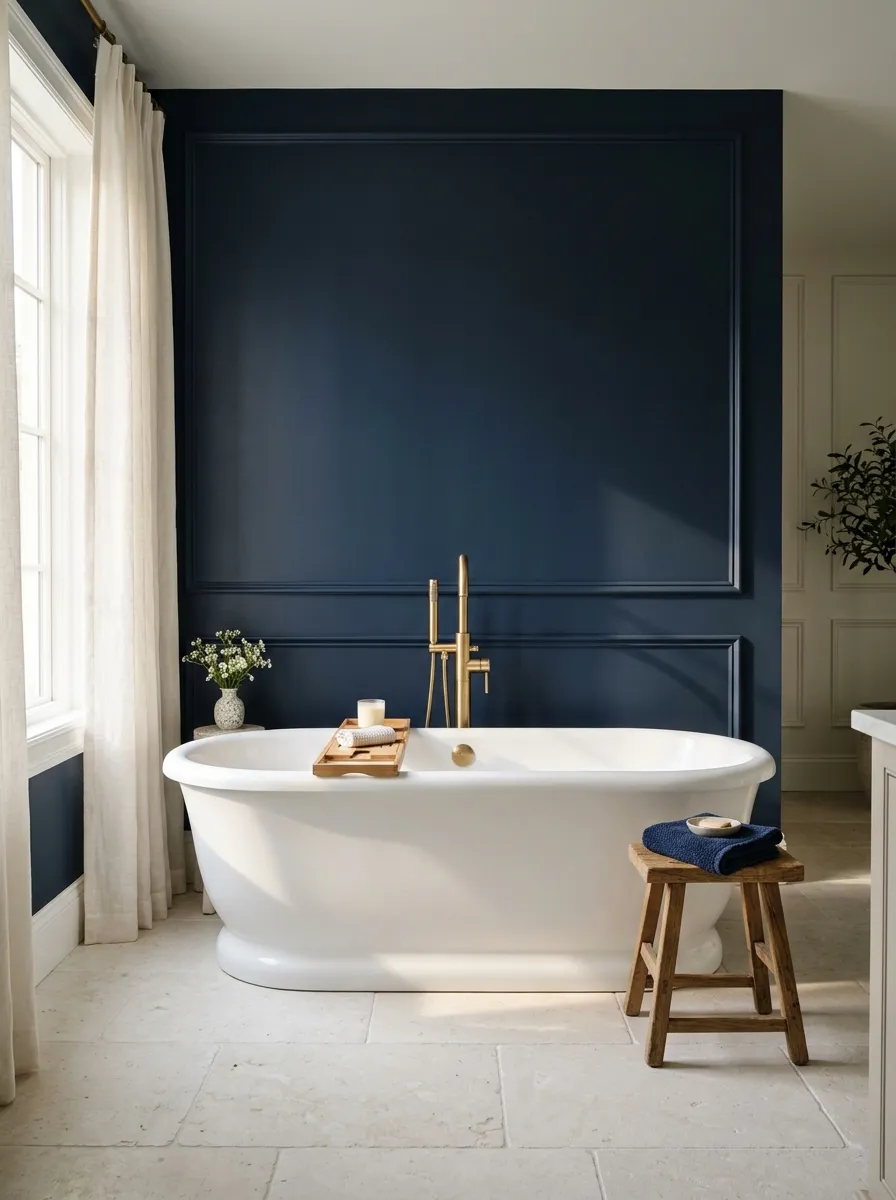
A white wall behind a white tub makes the tub vanish. Paint that one wall navy and the curves suddenly have an edge to push against. Pick a navy with a hint of green or black rather than violet, since purple-leaning navies can turn plum under warm bulbs. Stop the color at a clean inside corner; ending mid-wall looks like a mistake. Use a moisture-rated paint in satin or another low sheen, because deep colors show every roller mark in gloss. Ideal for rooms where the tub is the star and the other walls can stay light.
Pro Tip: Hold the swatch against the tub itself before buying. A navy that looks right beside trim can read purple next to a cool-white fixture.
9. An Alcove Soaking Tub in a Fully Tiled Blue Niche
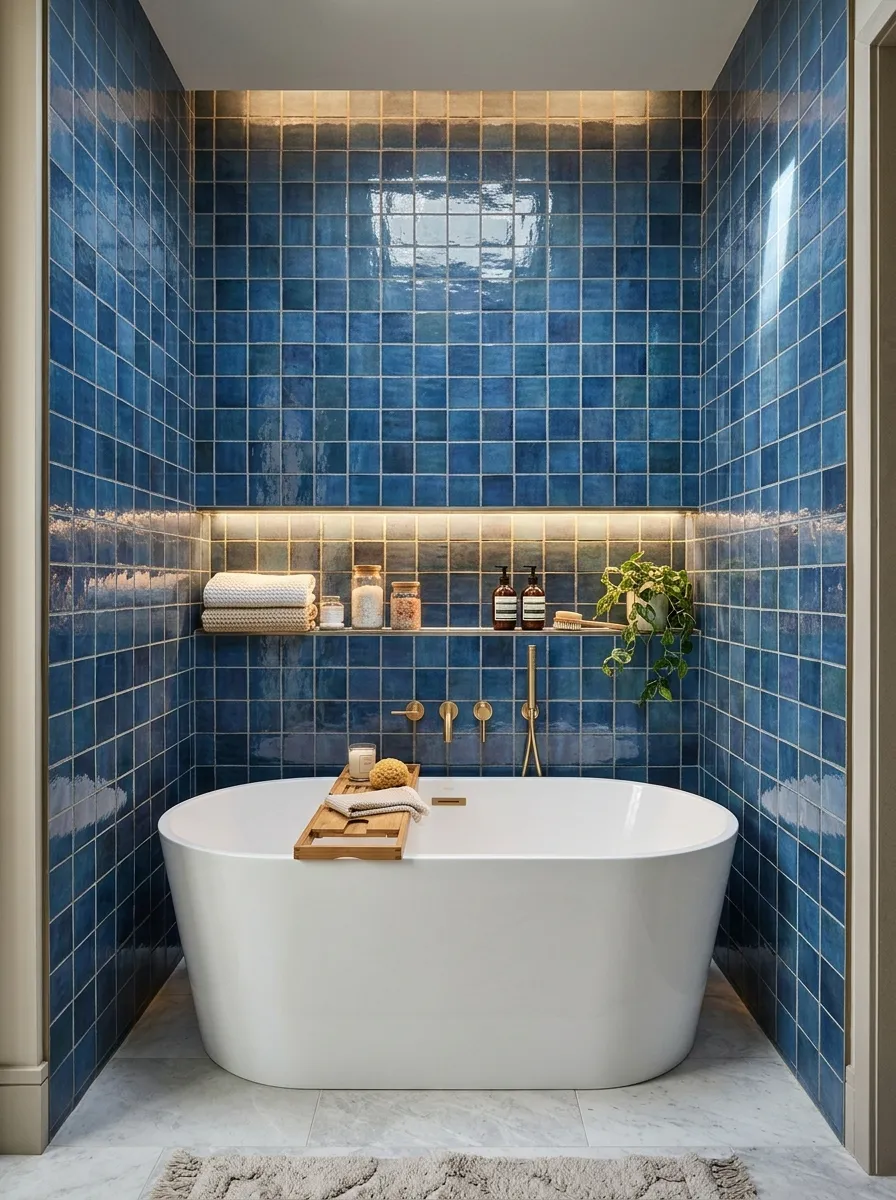
For a master bath short on floor, trade the freestanding tub for a deep soaking tub recessed into a three-wall alcove, a footprint in the 60-inch range. Tile all three walls in one blue, floor to ceiling, with no border or change of color, so the eye reads one continuous recess instead of a boxed-in tub. Swap the shower curtain for a fixed glass panel; fewer lines means more light. Shop for depth instead of length. A deeper basin adds soaking room without taking more floor.
Next: a bigger tub is not always a deeper soak, and the number that decides it sits below the rim, not at it.
10. A Freestanding White Slipper Tub as the Sculpture
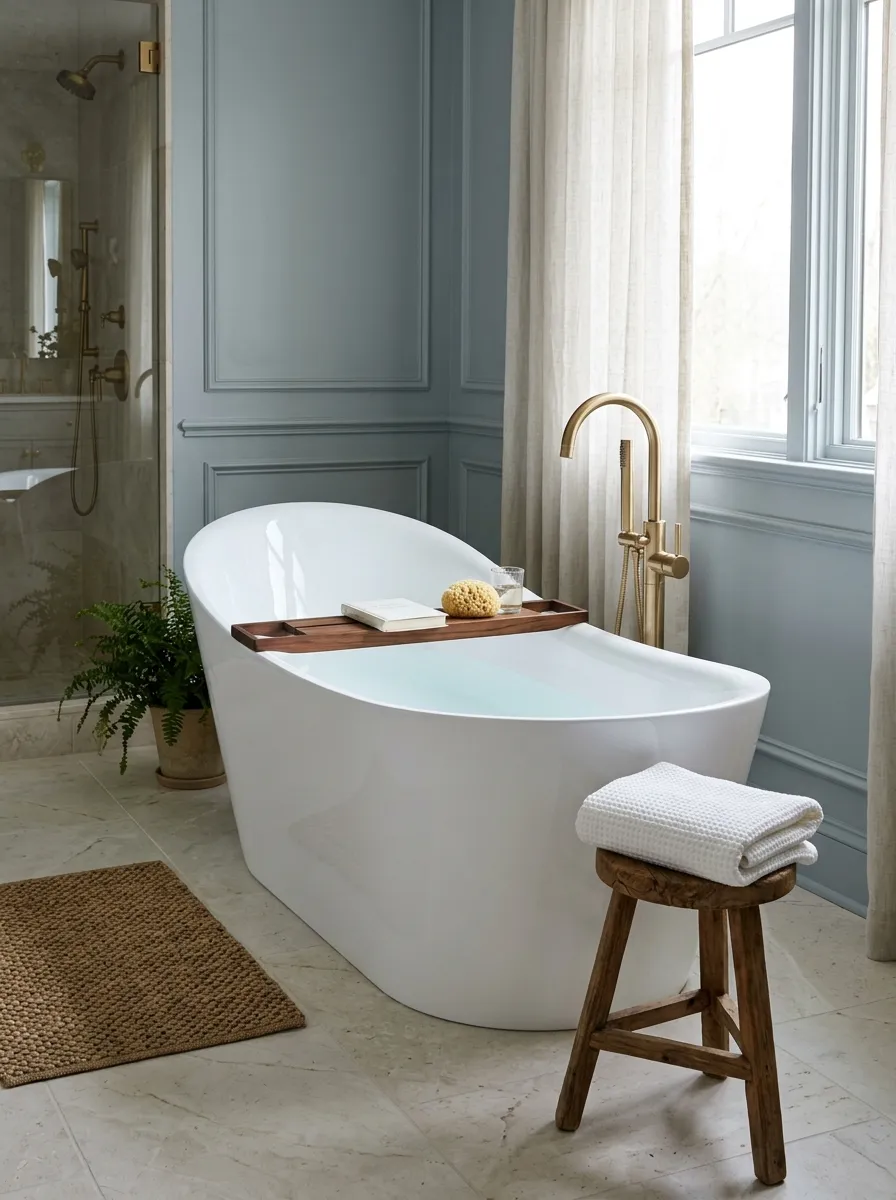
Choose the tub’s material first, because it decides the soak, the floor support, and the budget. Cast iron is heavy and holds heat the longest. Acrylic is light, warms quickly, and usually costs less. Whichever you pick, a slipper shape, where one end rises higher, lets you lie back instead of perching. Set the white tub against saturated blue and keep the area around it uncluttered. A pale form reads best against a deep backdrop. For anyone who wants the tub to look like furniture.
Important: Overflow height, not rim height, sets how deep the water gets. Compare the overflow position on spec sheets before choosing a tub sold as deep.
Shop This Look
| Product |
|---|
| Freestanding white slipper soaking tub |
| Floor-mounted tub filler |
| Teak bath caddy |
11. A Linen-Look Roman Shade Over a Frosted Lower Pane
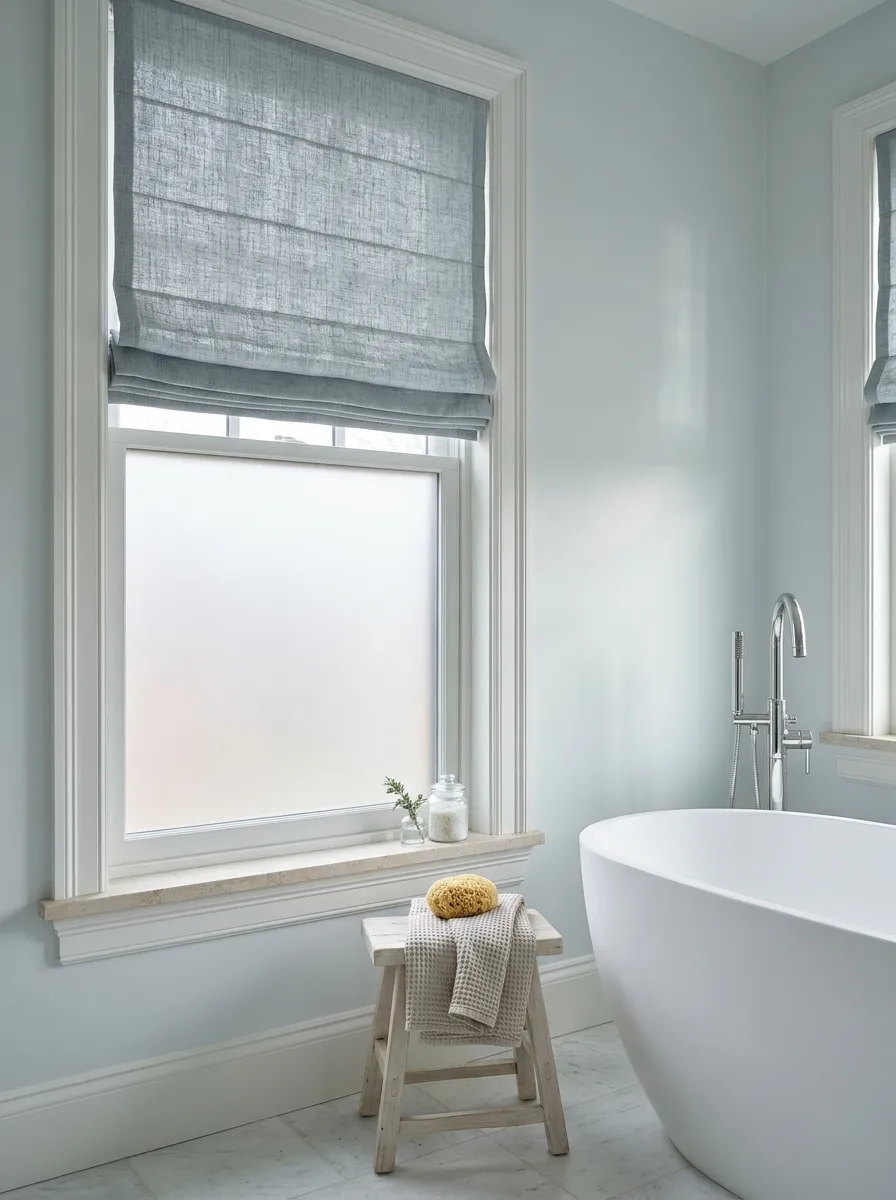
Privacy and light pull in opposite directions at a tub window, and layering resolves it. Frost the lower pane for privacy, then hang a light-filtering Roman shade in a blue-gray linen look so the upper glass keeps its sky. Mount the shade above the frame so the folds stack over the wall and not the glass when raised. Choose a fabric labeled for humidity or a polyester blend, since steam is hard on untreated natural fiber. Fits baths where a neighbor’s window sits across from the tub.
Quick Win: Cannot replace the glass? A removable frosted privacy film on the lower pane gives the same effect in an afternoon.
Shop This Look
| Product |
|---|
| Light-filtering Roman shade in a blue-gray linen look |
| Teak spa stool |
| Lidded glass apothecary jar |
12. Blue-and-White Pattern on the Floor Only
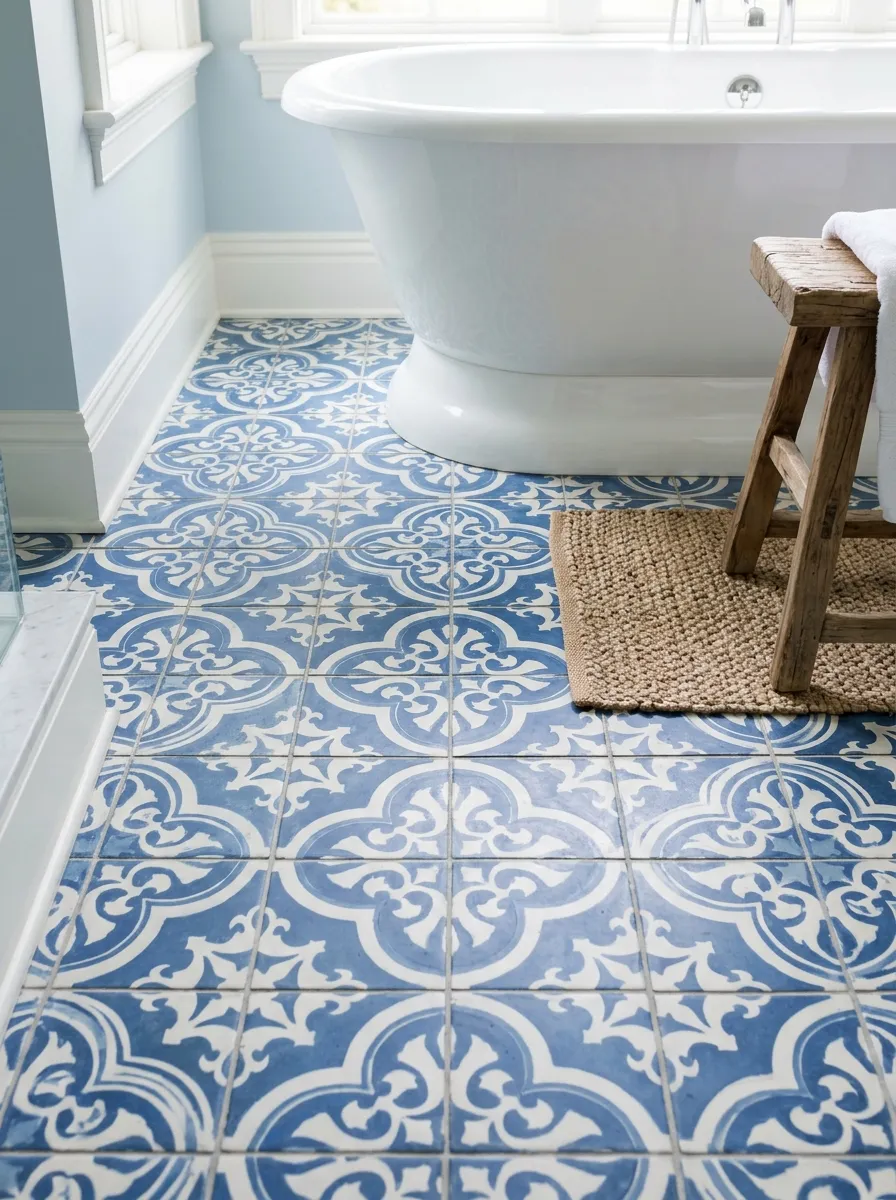
Blue-and-white encaustic-style floor tile gives the room pattern without dragging the walls into it. Keep the walls solid. Choose a design with a pale ground and blue motifs, since a darker floor shows water spots and dust faster. Specify a matte or textured finish suited to wet areas and check the slip rating the manufacturer lists, if any, because glossy patterned tile gets slick at the tub edge. Run the pattern right up to the tub’s base so the tub stands on it like a rug. Suits baths with plain walls.
The thing nobody mentions: a blue bathroom contains several whites, and they argue. A tub’s white is fixed at the factory and cannot be tinted, while trim paint, grout, and towels each lean warm or cool. Hold samples of all of them together in daylight before ordering, then match the paint and grout to the tub, not the other way around. The tub is the one white you cannot adjust.
The fifth wall almost nobody paints is the one you stare at while lying back in the water.
13. A Blue Ceiling Over the Tub
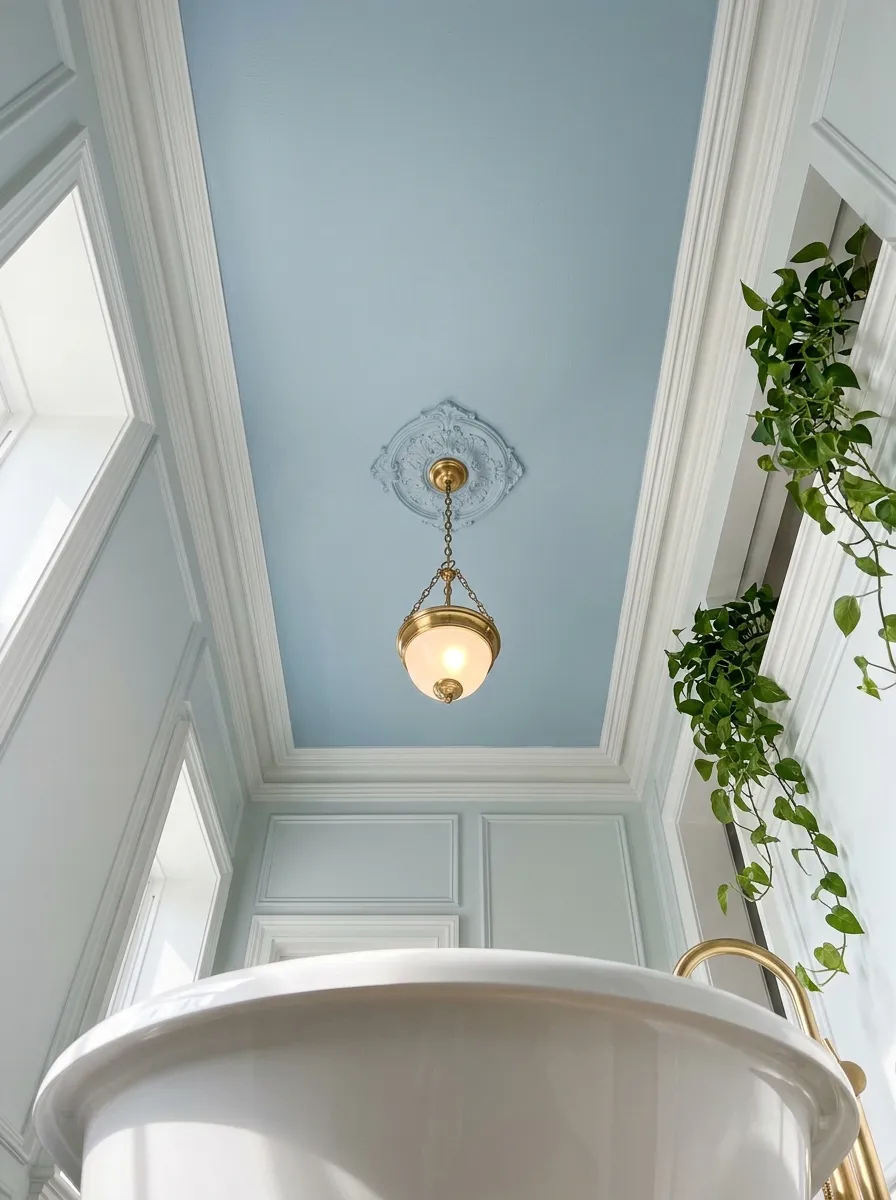
Most baths leave the ceiling builder-white, a hard lid that chops the blue off at the top. Lying back in a soaking tub, the ceiling is what you look at, so color belongs there. Take the wall blue one or two steps lighter for the ceiling, which wraps the room without making it feel lower. In a bathroom with a low ceiling, keep it lighter than the walls so the space does not compress. Choose a flat finish; it hides surface flaws that a sheen would flag.
Important: Flat ceiling paint is not automatically bathroom-safe. Choose a formula labeled for moisture or mildew resistance, and confirm the fan vents outside rather than into the attic.
14. A Glass Chandelier Over the Soaking Tub
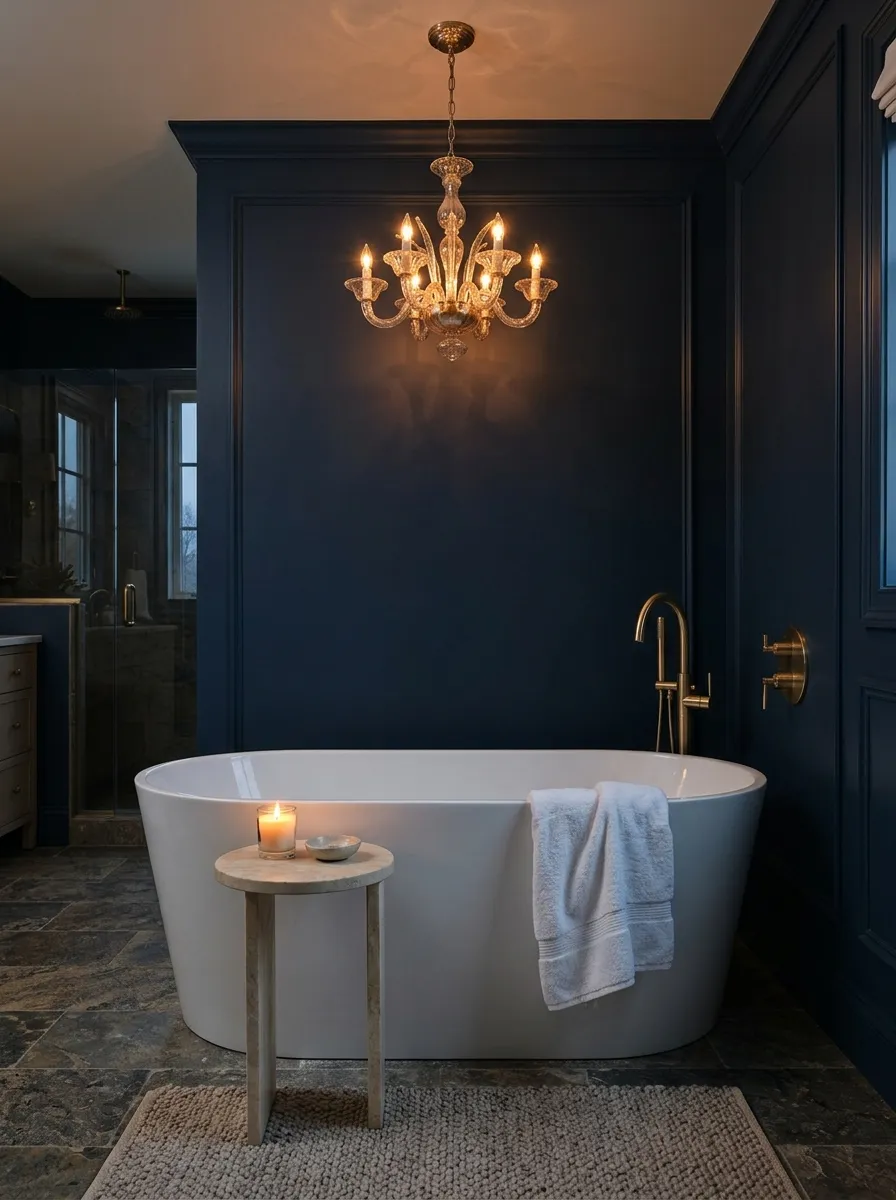
Start by hanging one fixture only. A small glass chandelier centered over the tub turns the soak into an event, and sized right it stays in scale. Choose a fixture labeled damp- or wet-rated, since a light above a tub sits in the moistest zone of the room, and have an electrician set the hanging height to local code. Put it on its own dimmer, separate from the sconces, so evening baths can run on chandelier light alone. Match its bulbs to the sconces at 2700K so the whole room glows one color. The finishing move for a primary bath that already has the bones.
Mistake to Avoid: Oversizing. A fixture sized for a dining room swallows a bathroom. As a practical proportion, keep its width to roughly half the tub’s length or less.
Shop This Look
| Product |
|---|
| Damp-rated small glass chandelier |
| Dimmer switch |
| Slim stone-look side table |
How to Start Your Luxury Blue Master Bathroom Transformation
The right first move is almost always the wall color. Pick a muted, mid-light sea-glass blue with a gray base, because every later choice (grout, towels, metals, tub white) gets judged against it. Walls are also the cheapest thing to redo if the first sample disappoints.
Before anything else, avoid choosing from a chip or a screen. A blue that looks calm online can shift under warm bulbs and beside a white tub. Fix it by sampling on the wall the tub will sit against and checking it morning and night under the bulbs you plan to keep.
Three items under $50 will change the room fast: a stoneware soap dish, a frosted ribbed-glass pump bottle, and a ceramic bud vase holding a few dried stems. Each typically lands well under that mark, though prices shift by region and brand.
Allow a weekend or two for paint, sconce swaps, towels, and accessories. A tile surround takes a week or two; a new tub, plumbing changes, and floor tile run several weeks to a few months. As approximate guidelines, a paint-and-accessories refresh can stay in the low hundreds, while a full master bath with a new soaking tub often runs well into five figures, depending on region, plumbing work, and finishes.
Ready to Create Your Dream Luxury Blue Master Bathroom?
These 14 luxury blue master bathroom ideas with a soaking tub cover color, materials, lighting, and layout, so there is a way in at every budget. Transformation is incremental, and one painted wall or one pair of sconces is a valid place to stop for now. Today, tape a large blue sample next to your tub and look at it again tonight under the lights. Finished, the room should feel like exhaling: quiet, warm at the edges, and slow. Save the ideas that stopped your scroll to a board, and build from there.
Keep Exploring
- 12 Navy and Brass Master Bathroom Ideas for a Hotel-Level Retreat
- 15 Blue and White Bedroom Ideas That Feel Calm Without Feeling Cold
- 10 Spa Bathroom Storage Ideas That Hide the Clutter