15 Ways to Make a Boring Tan Sofa Look Expensive
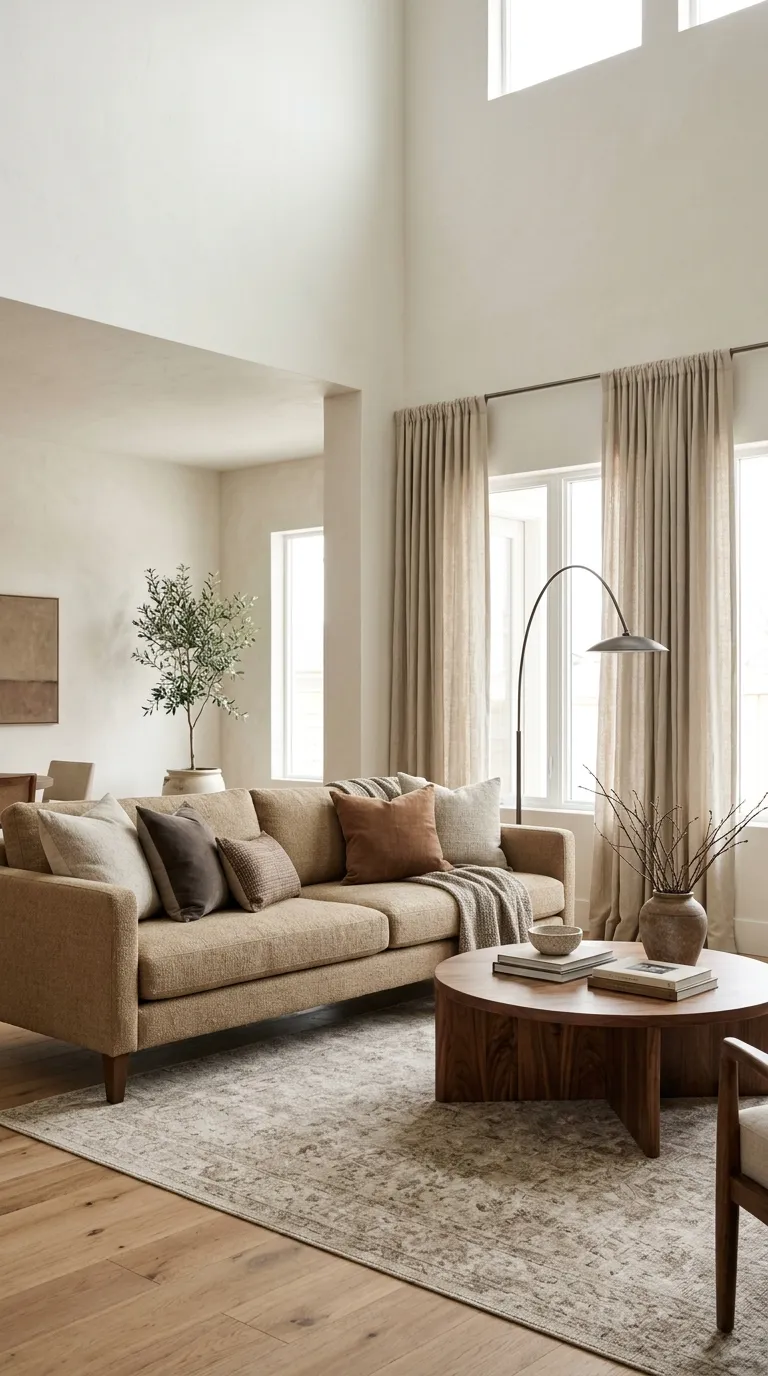
A tan sofa looks expensive when everything around it gives it something to push against, whether that’s texture, tone, or scale, and almost never because of the sofa itself. Below are 15 ways to make a boring tan sofa look expensive, each one a different kind of contrast you can add without replacing the couch.
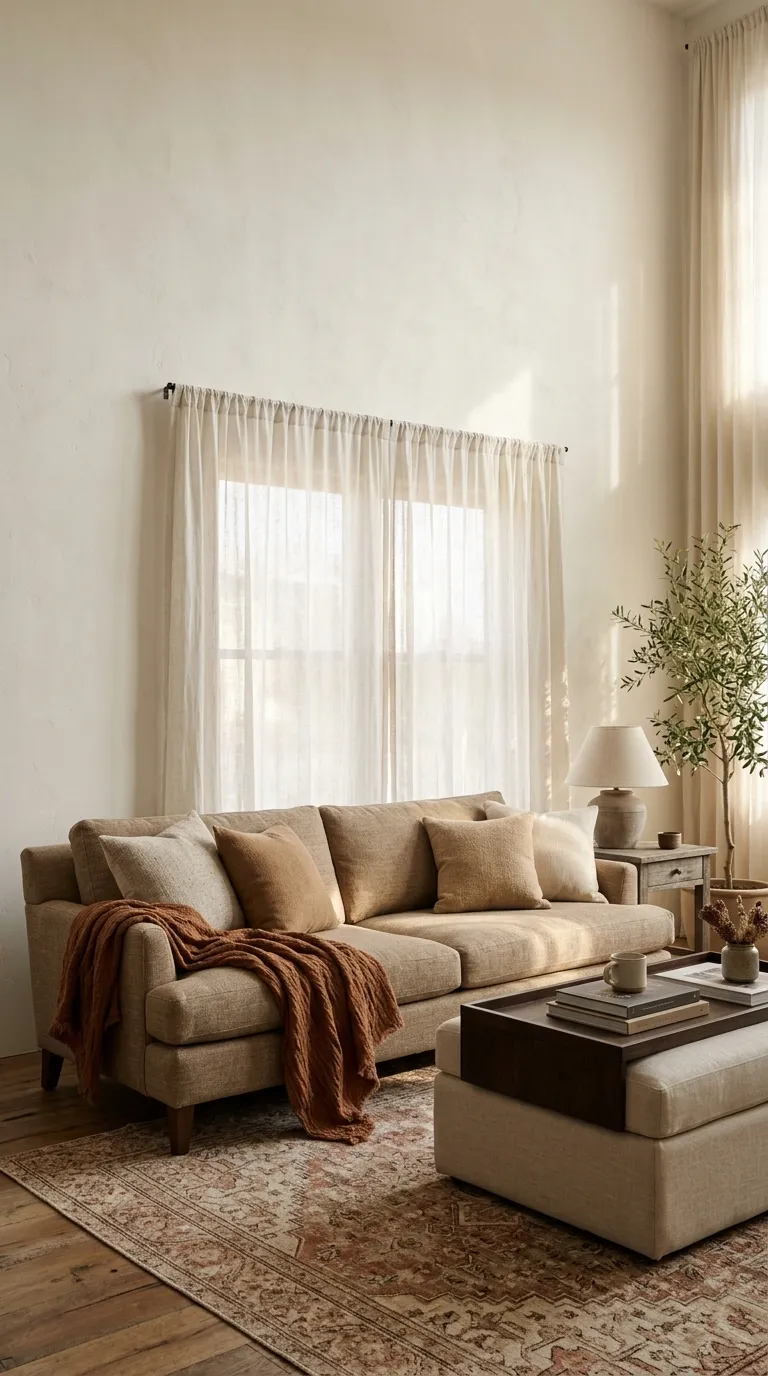
Picture the room afterward: low lamplight pooling on nubby fabric, a rug that anchors the whole seating area, curtains falling in long, straight folds. The sofa stops being the thing you apologize for and turns into the calm backdrop it was always meant to be. Everything nearby carries a little more weight and a little more depth. A neutral sofa only looks cheap when nothing else in the room is allowed to disagree with it.
Quick Navigation
- Why Making a Boring Tan Sofa Look Expensive Makes Such a Difference
- The Ideas, Quickest Wins First
- Overstuff the inserts until the corners stand up
- Remove pilling and steam out the creases
- Swap cool bulbs for warm ones
- Size the rug so the front legs sit on it
- Re-crown the seat cushions
- Hang curtains high and wide
- Match the wall’s undertone, then go deeper
- Swap stubby feet for tapered legs
- Layer three textures, not three tones
- Arc a floor lamp over the sofa arm
- Hang one large piece of art
- Choose a coffee table with visual weight
- Float the sofa and back it with a console
- Add height with a tall plant or branches
- Pair it with a chair that disagrees
- How to Start Your Tan Sofa Transformation
- Frequently Asked Questions
- Ready to Create Your Dream Neutral Living Room?
Why Making a Boring Tan Sofa Look Expensive Makes Such a Difference
A tan sofa is a neutral base in oatmeal, camel, or biscuit, usually upholstered in woven polyester, a linen blend, or bouclé. Its weakness is flatness: one mid-tone mass with nothing contrasting around it reads as the default option.
Rooms that look expensive lean on differences in texture, tone, and scale, and neutral upholstery absorbs all three easily. Small rooms gain the most from quick, low-cost changes, so start with pillows, bulbs, and fabric care before spending on furniture.
Quick Reference
| Factor | Answer |
|---|---|
| Best starting point | Fuller pillow inserts and warm 2700K bulbs |
| Biggest impact area | The floor and window zones around the sofa |
| Budget to start | Roughly $40–$120 (approximate) |
| Time to complete | One weekend for quick wins; about a month for the full set |
The Ideas, Quickest Wins First
1. Overstuff the inserts until the corners stand up
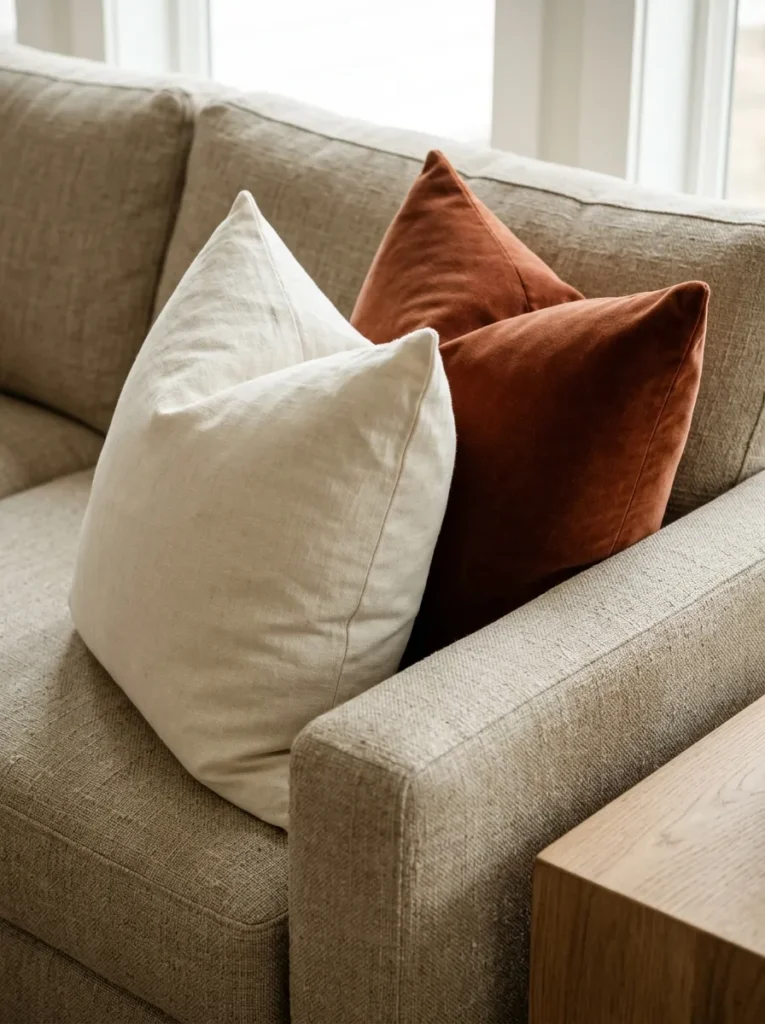
Flat, half-empty pillows are the fastest way to make a decent sofa look tired. Most covers arrive with inserts cut to the cover’s exact size, so corners collapse and seams show.
Buy inserts about two inches larger than the cover, such as a 20-inch insert in an 18-inch cover, and the fabric stretches taut with sharp, filled corners. Feather-blend inserts settle into a soft, deliberate slump, while polyester fill keeps a firmer outline with less fluffing. Best for owners of decent covers that sit badly.
Quick Win: Push the filling into the corners by hand before zipping, then press one shallow dent along the top edge so the pillow holds its outline instead of sagging in the middle.
2. Remove pilling and steam out the creases
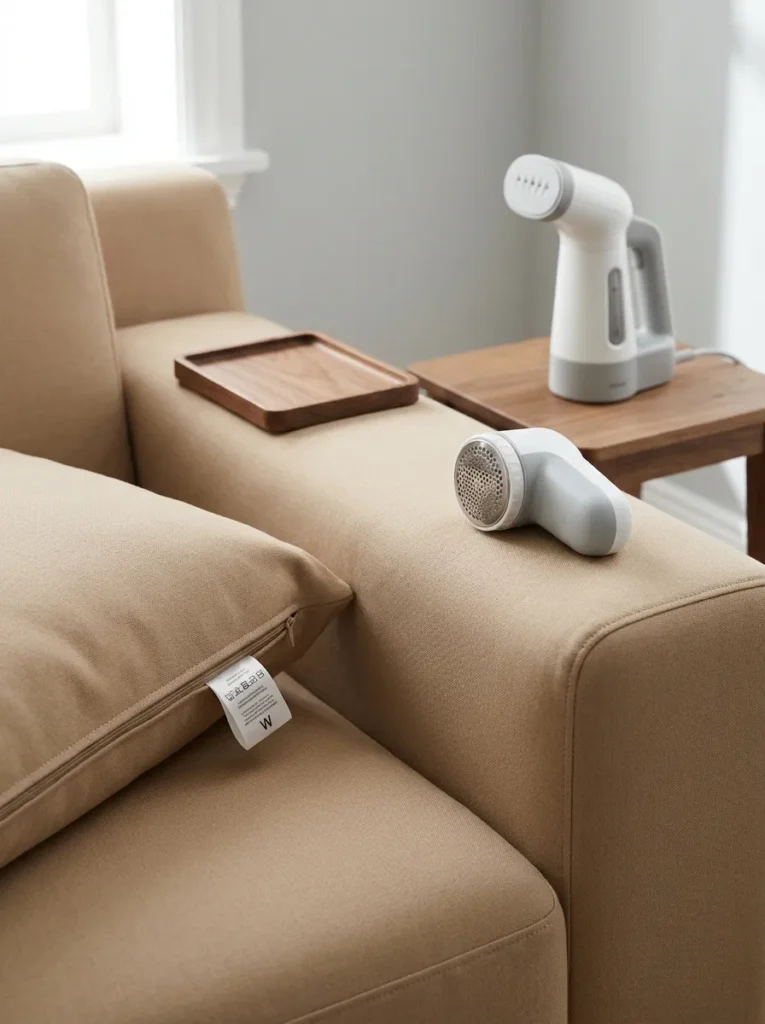
The method: Run a fabric shaver lightly over the seat, arms, and any pilled high-wear spots, then pass a handheld steamer over creased areas, keeping it moving so the hot nozzle never rests on the fabric. Check the cushion’s care tag first: W and WS codes tolerate water-based cleaning, while S and X mean leave the steamer alone.
What changes: Pilled fabric catches light unevenly and reads as old at a glance. A clean nap looks denser and more tailored.
Who it suits: Anyone with a sofa that is structurally fine but looks worn, especially one past its first few years.
Warning: Test the shaver on a hidden spot first. Looped or loosely woven surfaces like bouclé can snag, and that damage does not grow back.
3. Swap cool bulbs for warm ones
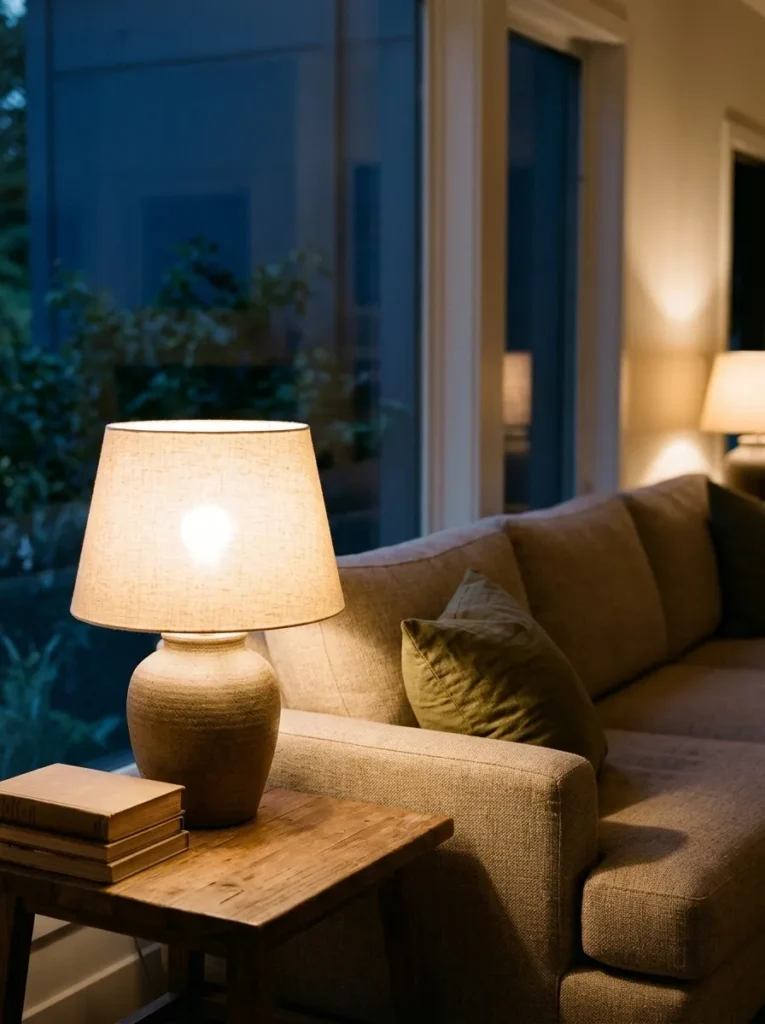
Tan fabric reflects whatever light reaches it, and cool bulbs turn it flat gray or sallow. Warm white around 2700K pulls the honey out of camel and oatmeal and lets seams fall into soft shadow instead of glare.
Choose bulbs with a color rendering index of 90 or higher so the fabric’s real color shows, and pick dimmable ones so evening light can drop low. Best for living rooms lit mainly by overhead fixtures. Stay at or under the maximum wattage printed on each lamp socket, and pair dimmable bulbs only with a dimmer rated for LEDs.
Mistake to Avoid: Mixing 2700K and 4000K bulbs in one room. The cooler lamp makes the sofa look like two colors depending on where you sit, so change every bulb at once.
Next comes the one purchase where buying smaller to save money is exactly what makes the whole seating area look cheaper.
4. Size the rug so the front legs sit on it
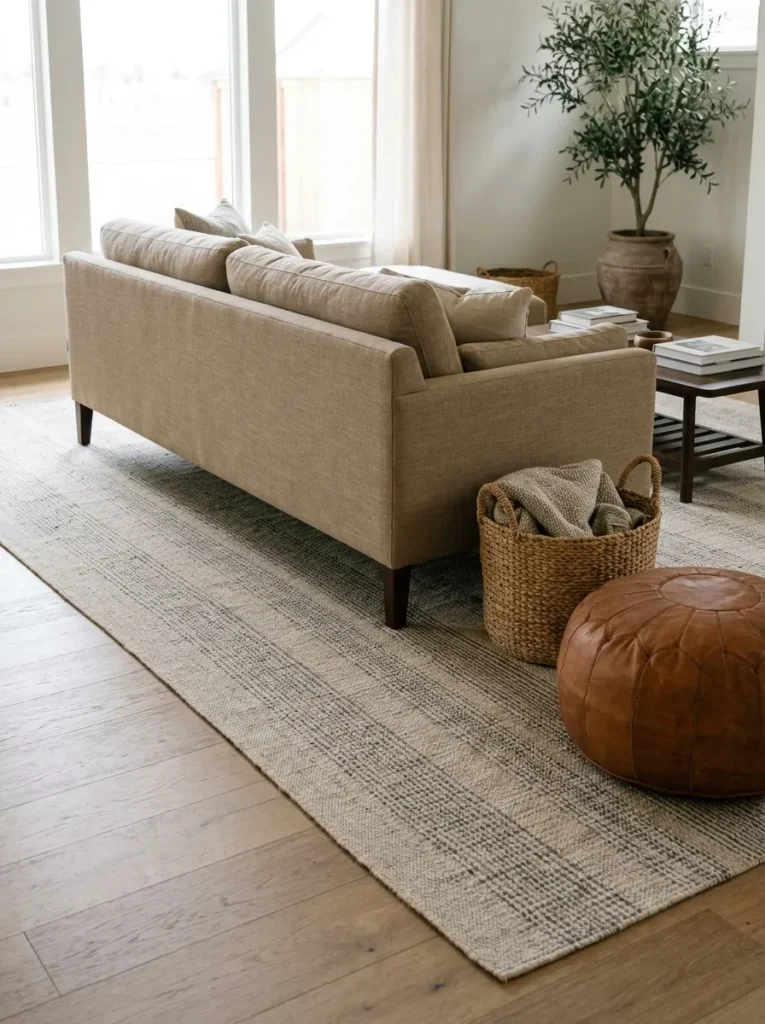
A sofa on bare floor with a small rug floating in front of it looks accidental. A rug large enough for at least the front legs of the sofa to rest on ties the seating into one zone. Aim for it to extend roughly six inches past each end of the sofa, which tells the eye the rug was chosen for the furniture.
Choose a different texture and a deeper or lighter tone than the sofa, in a low pile that keeps the coffee table stable. Best for rooms where the seating is scattered across bare floor.
Pro Tip: Mark the rug’s outline on the floor with painter’s tape and live with it for a day before ordering. Sizing looks different once furniture is standing on the footprint.
Shop This Look
| Product | What to look for |
|---|---|
| Large low-pile area rug | Wide enough to extend past both ends of the sofa; texture and tone distinct from the sofa |
| Leather or woven pouf | A seat height close to the sofa’s; sits fully on the rug’s edge |
| Woven storage basket | Wide enough to stand on the rug; holds throws out of sight |
5. Re-crown the seat cushions
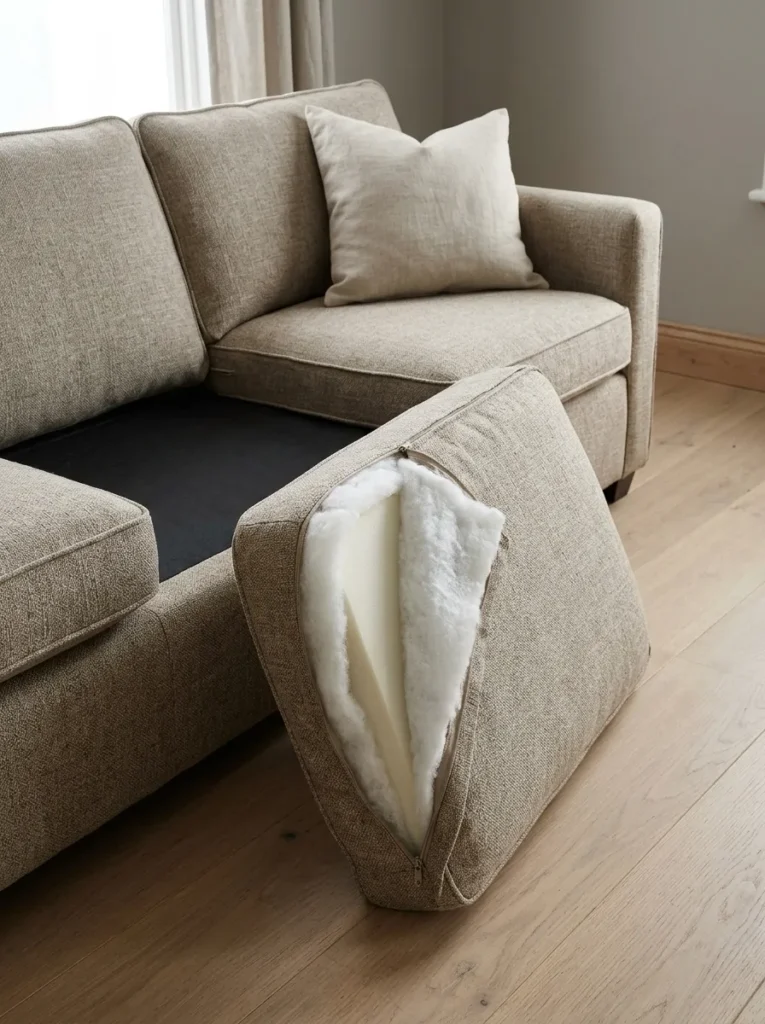
What you’ll see: Seat cushions with a gently domed top and sharp, defined edges, instead of a sagging middle and slumped corners.
Why it holds: A layer of polyester batting wrapped around the foam core adds loft and fills the cover out to its seams, so the fabric stays tight.
How to do it: Remove the cover, wrap the core in one layer of batting, and slide it back with the corners seated first.
Suited to: Sofas with a firm frame and tired cushions. If the foam has collapsed completely, replace the core instead.
✅ Cushion Refresh Checklist:
- [ ] Confirm the cover zips off and note the care tag
- [ ] Wrap the foam core in one layer of batting, trimming overlap at the corners
- [ ] Slide the core back in, seating the corners first
- [ ] Zip up, smooth the top, and set the cushion back with the seam facing the sofa back
6. Hang curtains high and wide
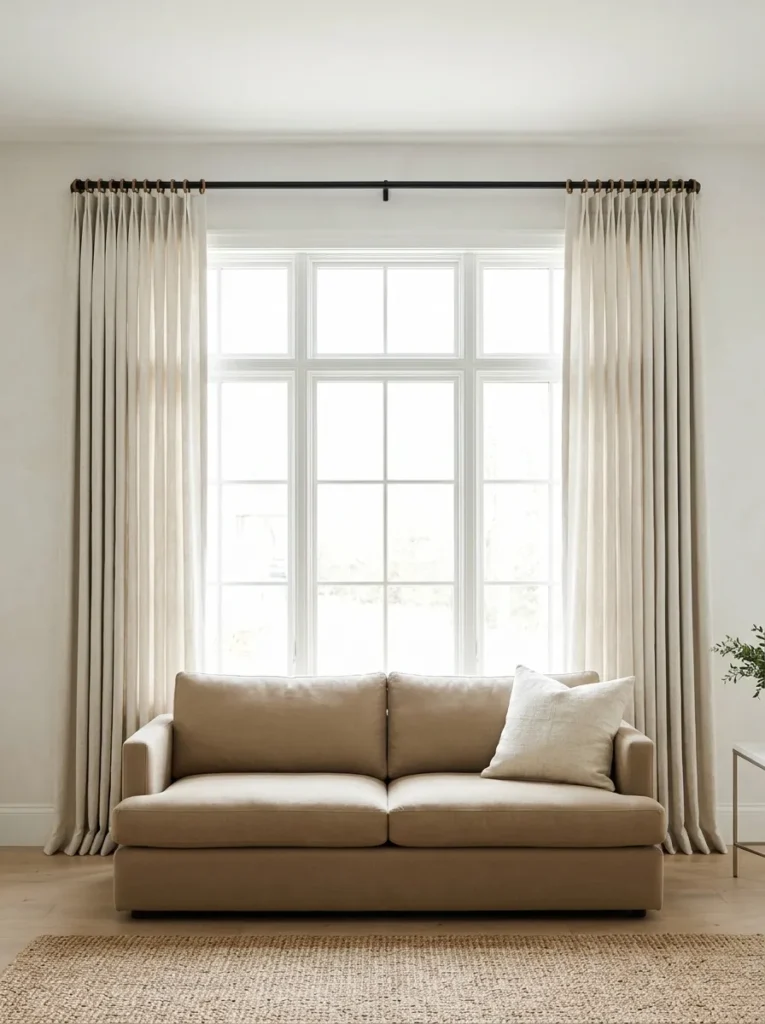
Curtains mounted at the window frame make the ceiling feel lower and the window feel smaller. A rod hung closer to the ceiling than to the frame lengthens the wall, and letting it extend past each side means open panels clear the glass and stop blocking light.
Choose lined panels in a linen weave about a tone off the sofa, with total panel width roughly twice the width of the window for full, even folds. Best for living rooms with a short-looking window wall behind or beside the sofa. Heavy lined panels pull hard on brackets, so screw them into studs or use anchors rated well above the load.
Important: Lining adds weight, which makes folds fall straight and hold their shape; unlined panels rarely manage it.
Shop This Look
| Product | What to look for |
|---|---|
| Lined linen-look curtain panels | Lining for weight; combined width about twice the window; length that just touches the floor |
| Wide curtain rod with brackets | Long enough to extend past both sides of the window; sturdy brackets plus a center support for wide spans |
| Curtain rings with clips | Finish matched to the rod; inner diameter that slides easily over it |
Next is a color change that costs one can of paint, and the shade you choose matters less than something hidden in the sofa itself.
7. Match the wall’s undertone, then go deeper
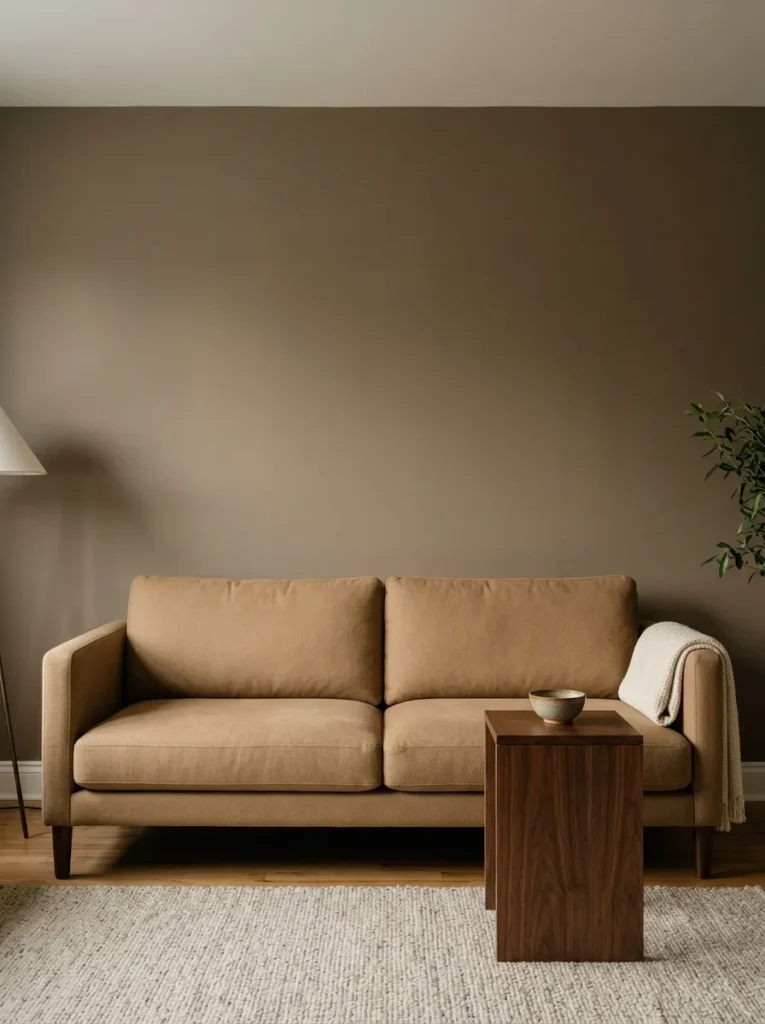
Tan is never just tan. Held against white paper in daylight, a sofa leans yellow, pink, or gray, and that undertone decides which wall colors flatter it. Paint the wall behind the sofa one or two steps deeper in the same undertone family, such as warm taupe or clay for a yellow-leaning tan, and the sofa gains a defined edge.
Test a large swatch in morning and evening light first. Best for rooms where cream or white walls make the sofa fade into the background. Renters can get a similar effect with removable wallpaper or a large fabric panel.
Budget Version: Paint only the wall behind the sofa which usually costs well under $100 (approximate).
8. Swap stubby feet for tapered legs
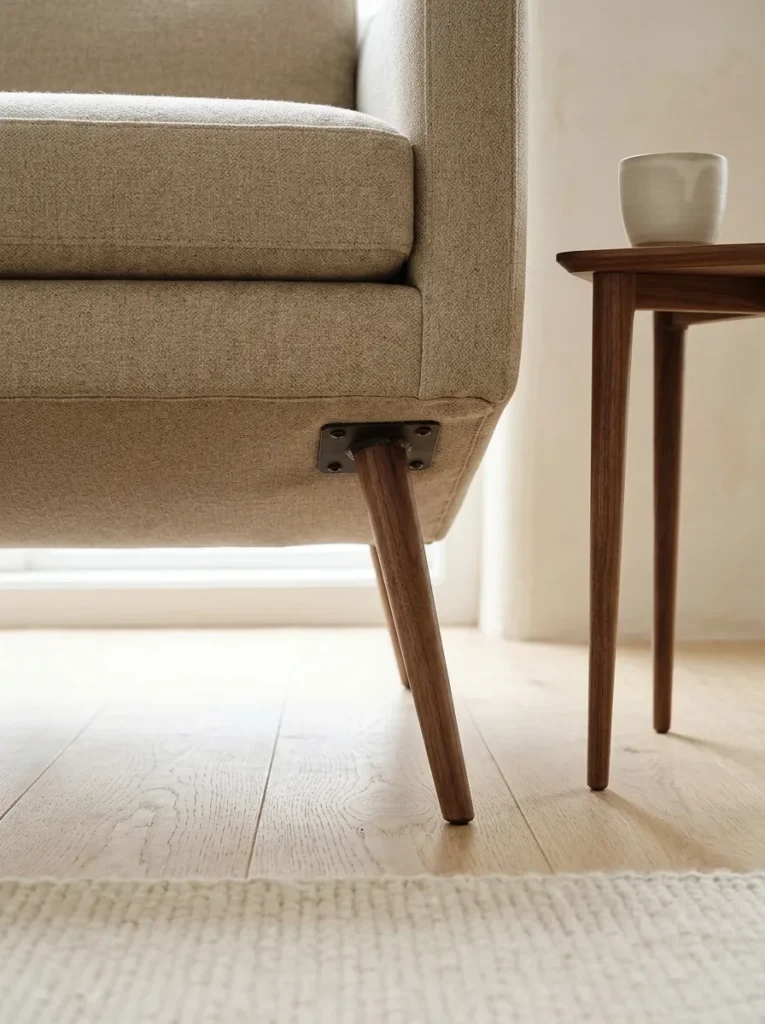
Who it’s for: Anyone whose sofa sits low on block or plastic feet and looks heavy because of it.
How: Unscrew the existing legs, identify the fitting (threaded bolt, hanger bolt, or mounting plate), and buy replacements with a matching connection.
Why it works: Visible floor under the frame breaks up the sofa’s mass, so it reads lighter and more tailored.
What you’ll see: Slim tapered wood or metal legs a few inches tall, in a finish that echoes the room’s wood tone or hardware. Confirm the stated load rating covers the sofa plus people, and tilt the sofa with a helper rather than lifting it alone.
Warning: Ordering legs before checking the fitting is the costly mistake. Thread diameters and plate styles vary, and a mismatch means wobbling legs or a return, so measure the existing bolt or plate first.
Shop This Look
| Product | What to look for |
|---|---|
| Tapered sofa legs | A finish that echoes the room’s wood or metal; a load rating that covers the sofa and its occupants; a fitting that matches yours |
| Bolt-on mounting plate set | Plate size and hole pattern that suit the sofa frame; included screws or bolts in the correct size |
| Slim side table | Leg finish matching the sofa legs; height at or just below the sofa arm |
9. Layer three textures, not three tones
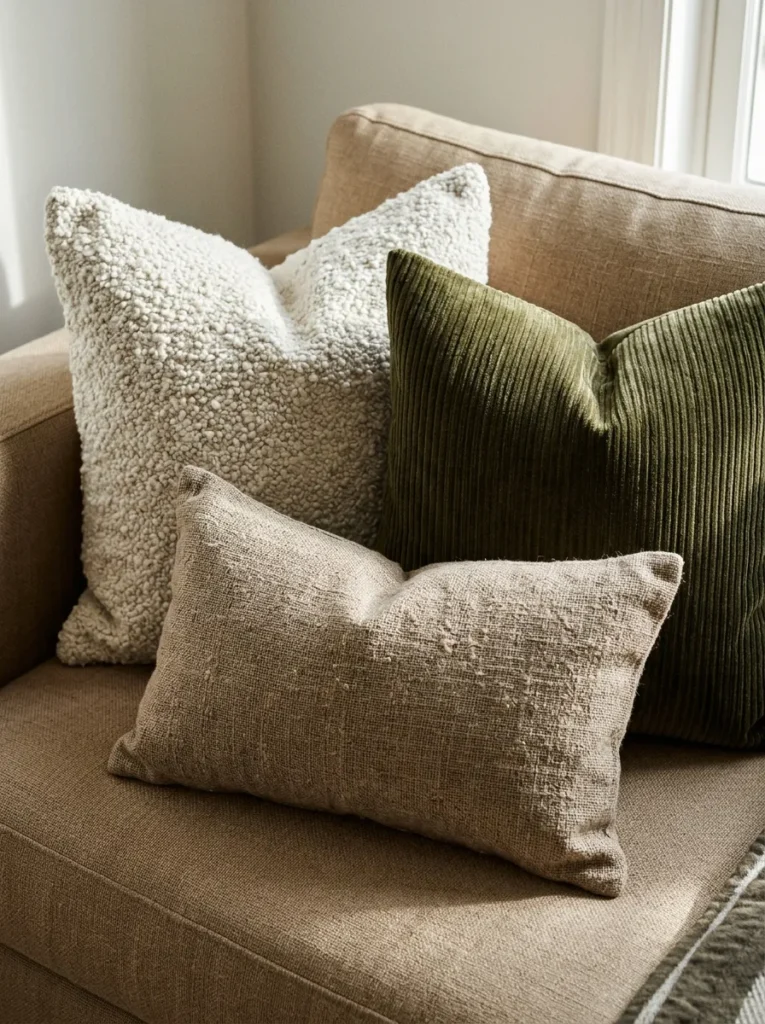
Picture a bouclé pillow beside a ribbed velvet one and a coarse linen lumbar, all inside the same warm-neutral range. Different surfaces catch light at different angles, so depth comes from texture rather than extra color. Vary the sizes too, with two larger squares at the back and a smaller or lumbar pillow in front. Best for tan-on-tan living rooms that look flat in photos.
Styling Note: Step back across the room. If you cannot tell two textures apart from there, swap one for a fabric with a more pronounced pile or loop.
The next idea needs one cord, one shade, and a position most people never try: arching over the end of the sofa rather than standing beside it.
10. Arc a floor lamp over the sofa arm
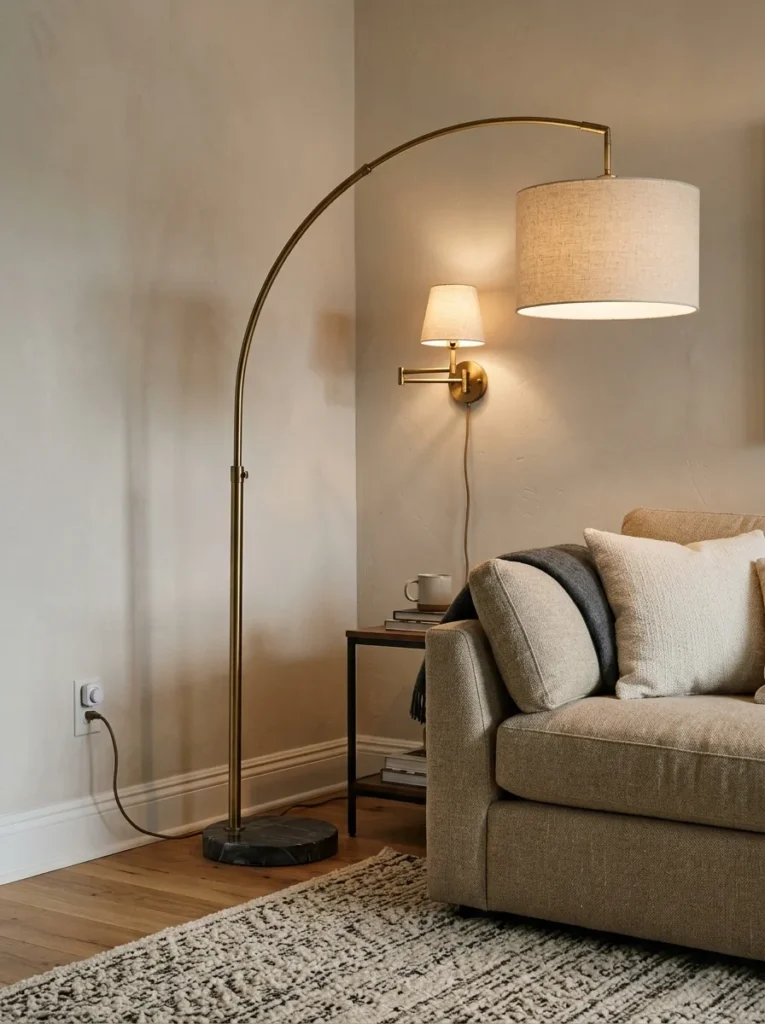
Set an arc floor lamp’s base behind or beside the end of the sofa so the shade hangs just over the arm. That places light at seated height, throwing soft shadows into seams and folds so the upholstery looks sculpted instead of flat.
Keep the shade’s lower edge near seated eye level to avoid glare. Add a plug-in sconce at a different height so the sofa area gets layers of light. Best for sofas pushed against a wall with no room for a side table. Route the cord along the baseboard rather than under the rug, and look for a listing mark from a recognized testing lab, such as UL or ETL, on the lamp and any dimmer.
Pro Tip: Choose a base heavy enough to counterbalance the arm; lightweight arc lamps tip when brushed.
Shop This Look
| Product | What to look for |
|---|---|
| Arc floor lamp | Weighted base; an arm long enough to reach over the sofa arm; a UL or ETL listing mark |
| Plug-in wall sconce | Swing arm; cord long enough to reach the outlet; takes a warm-white bulb |
| Inline plug-in lamp dimmer | Rated for LED loads; wattage rating above the lamp’s draw |
11. Hang one large piece of art
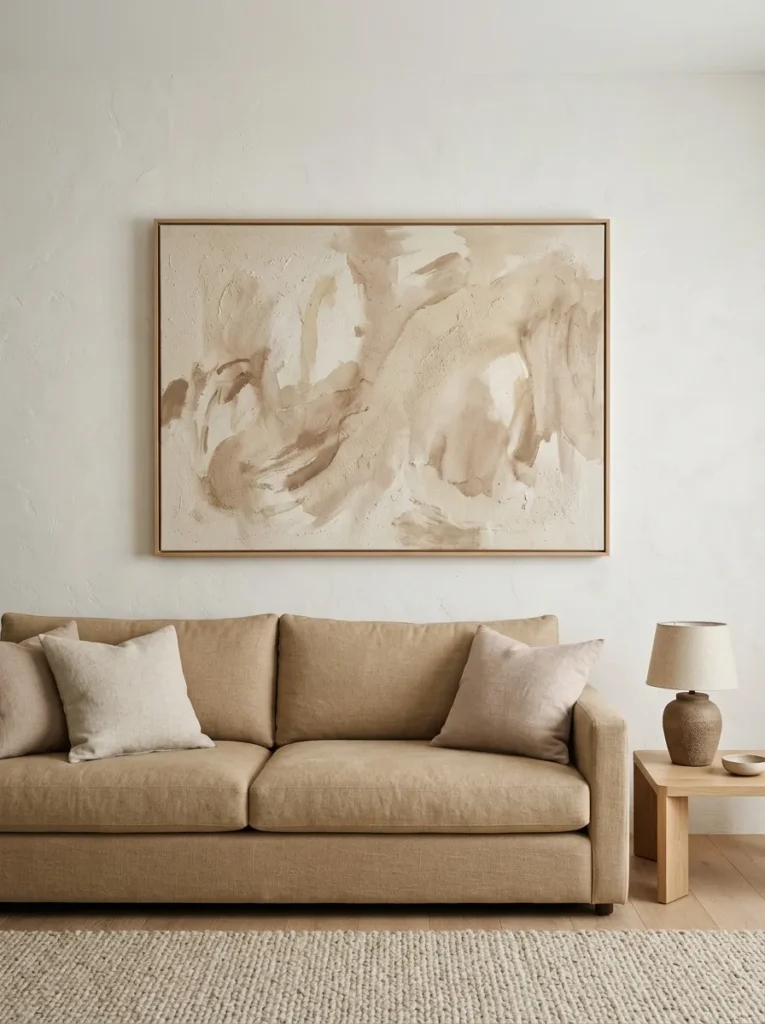
The fix: Hang one large piece of art roughly two-thirds the width of the sofa, with its bottom edge about six to ten inches above the back cushions.
Why it works: A single scaled piece anchors the sofa, while a scatter of small frames fragments the view.
Look for: Muted, textured artwork, such as a large abstract or tonal landscape, in colors that pick up accents elsewhere in the room.
Weight note: Heavy frames need screws into studs or anchors rated well above the frame’s weight, since a falling frame lands directly on the seat.
Suited to: Plain walls behind a sofa that currently fades into them.
Small-Space Tip: In a narrow room, choose one tall vertical piece to draw the eye upward instead of widening the wall.
12. Choose a coffee table with visual weight
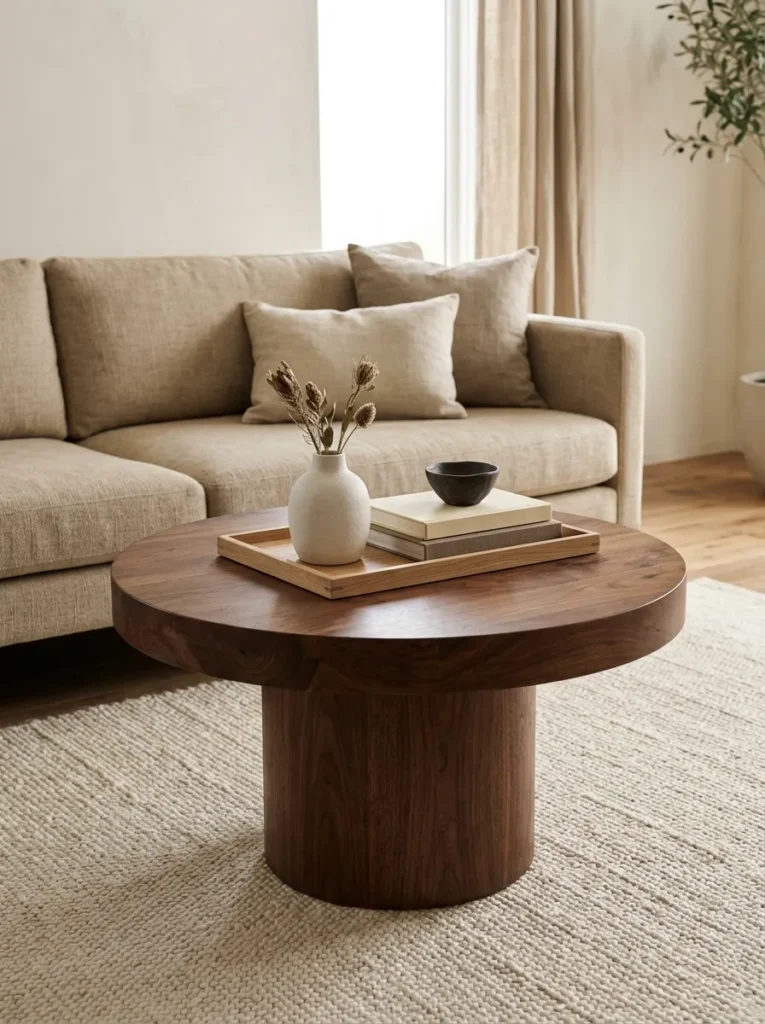
Thin legs under a glass top read as a placeholder next to a soft sofa. A table with real visual weight, such as solid wood, stone, or a dense metal frame, balances the upholstery’s softness. Aim for a height level with the seat cushions or slightly lower, and leave about 16 inches between the table edge and the sofa so legs and drinks have room. Best for sofas that dominate the room visually.
Styling Note: Group three objects of different heights on a tray, one tall, one low, one organic.
Shop This Look
| Product | What to look for |
|---|---|
| Solid-looking coffee table | Heavy material such as wood, stone-look, or metal; height level with or slightly below the sofa seat; rounded corners if the walkway is tight |
| Wooden serving tray | Large enough to hold three objects with space to spare; a raised edge |
| Ceramic vase | Matte finish; tall enough to add height without blocking sightlines |
The next change costs nothing but effort, and it only works if you stop treating the wall as the sofa’s natural home.
13. Float the sofa and back it with a console
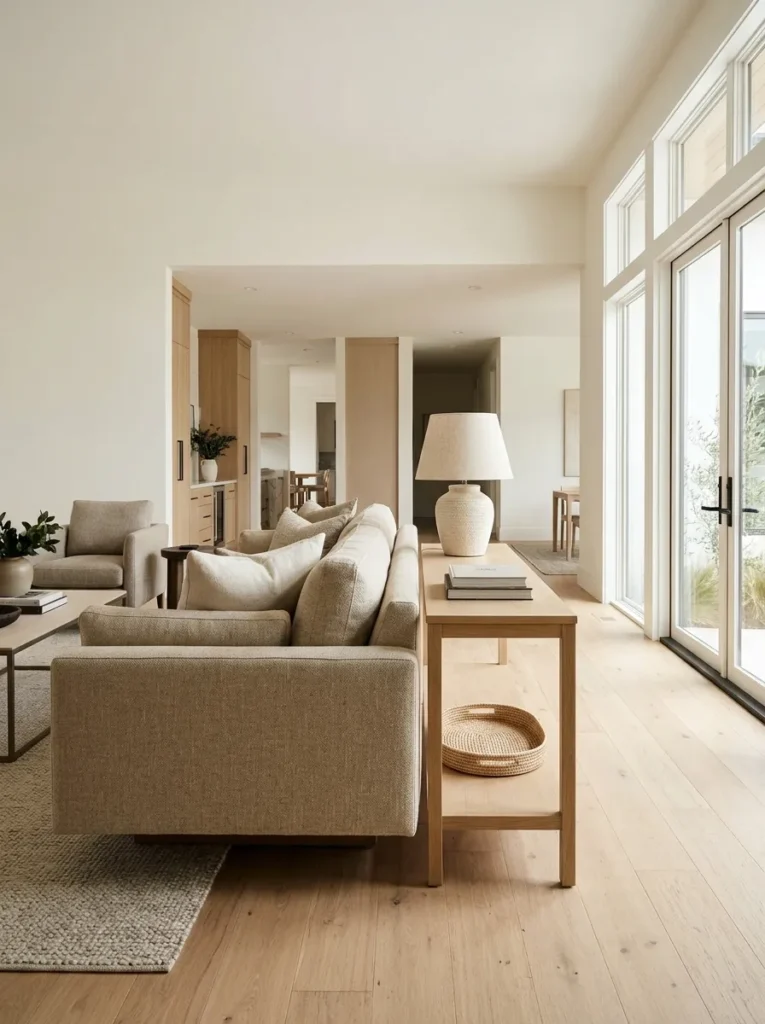
If the sofa is pushed flat against a wall, the arrangement looks like a waiting room. Pulling it forward turns the seating into a deliberate zone, and a narrow console table behind it finishes the back. Leave roughly three feet of walkway behind the sofa so people can pass without turning sideways. Best for open-plan rooms and wide rooms where the sofa can mark the edge of a zone; in a narrow room, bring the sofa forward only a few inches and skip the console.
Important: Keep the console a few inches lower than the sofa back, or the two read as one blocky wall.
Observation
Easy to get backwards: the pillows closest to your sofa’s color make it look cheapest. Tan beside near-tan highlights every small difference in dye and fade, so the set reads as mismatched rather than coordinated. A pillow that sits clearly lighter or darker, such as deep olive, chocolate brown, or a visibly pale bone, reads as a decision.
14. Add height with a tall plant or branches
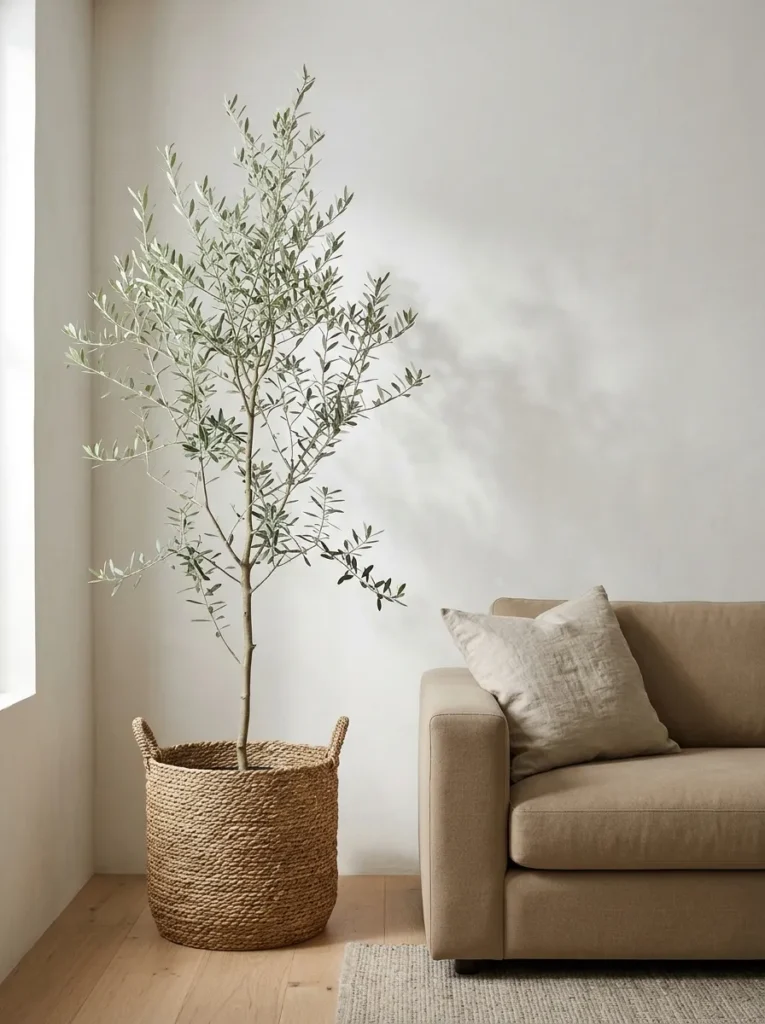
Look: A tall leafy plant or a vase of bare branches at one end of the sofa, its silhouette rising above the arm.
The reason it works: Irregular organic shapes break up the sofa’s straight lines and add living contrast to a palette of woven and upholstered surfaces.
How to place it: Set it where the sofa meets open wall, in a basket or ceramic pot sized to the plant’s height.
Care note: Tall plants need bright, indirect light, so check the window position before buying. Faux stems with weighted bases suit darker corners.
Budget Version: Cut branches from a garden or buy a bunch of eucalyptus or olive stems and stand them in a heavy ceramic or glass vase, which costs far less than a mature tree (approximate).
15. Pair it with a chair that disagrees
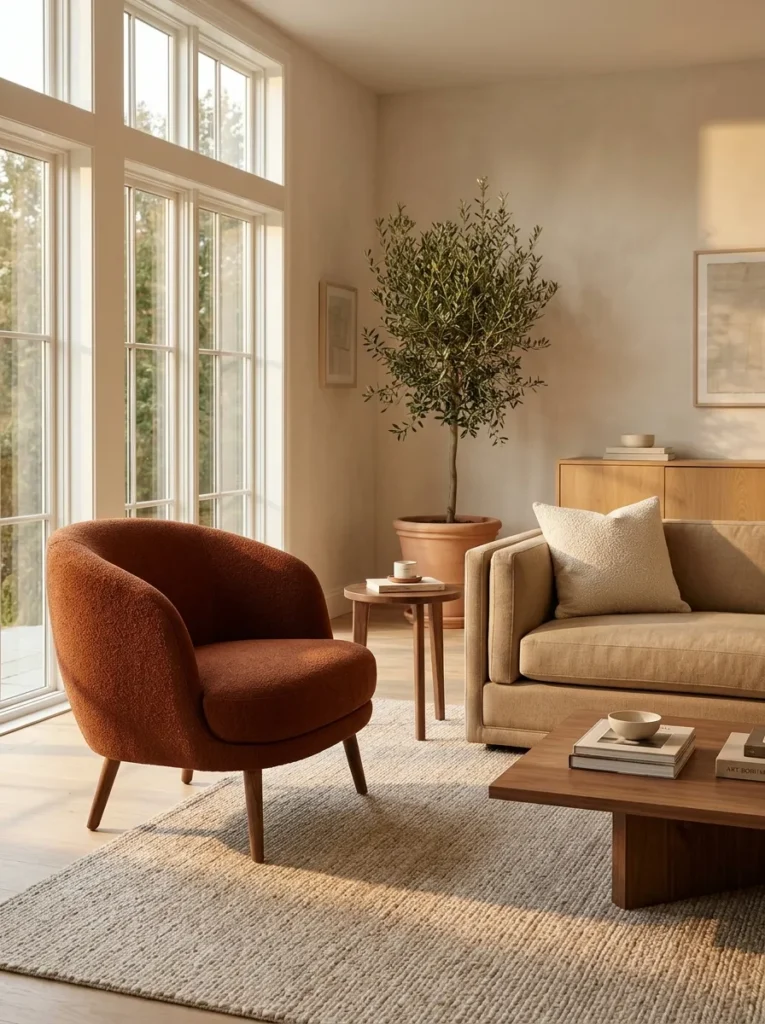
A matching chair makes a set; a chair that differs in both color and shape makes a room. Pick an accent chair in deep rust, olive, or dark navy with a curved or sculpted silhouette to answer the sofa’s boxy lines, and angle it toward the sofa so the pair forms a conversation zone. Keep its seat height within a couple of inches of the sofa’s. Best for rooms where the sofa is the only large piece and one side feels empty.
Small-Space Tip: Choose an armless or swivel chair with exposed legs so it takes up less visual and floor space.
How to Start Your Tan Sofa Transformation
The right first move is almost always the pillow inserts: a pair of feather-blend inserts sized two inches above the covers you already own costs little and changes the sofa’s silhouette within minutes. Every idea in this article works by adding contrast, so begin with the changes that give the sofa texture and shape to push against.
Before buying anything else, identify the sofa’s undertone. A cool gray pillow beside a yellow-leaning tan makes the fabric look dingy, and a warm rust pillow beside a pink-leaning tan can turn muddy. Hold white paper against the sofa in daylight, name what you see, and buy every other color with that in mind.
Three items under $50 cover most of the quick wins: a fabric shaver, a pack of dimmable 2700K LED bulbs, and a pair of feather-blend pillow inserts. Each usually lands well under that mark.
A starter set takes one weekend and roughly $40–$120 (approximate). The rug, curtains, legs, and paint are the slower jobs, so plan on about a month for a full transformation. A complete room with a rug and coffee table typically runs roughly $600–$2,000 depending on size and materials (approximate).
Frequently Asked Questions
What color pillows look best on a tan sofa?
Deeper earth tones such as olive, rust, and chocolate brown work best, with one pale cream or bone for contrast. Hold white paper beside the sofa in daylight to find its undertone, then match the pillows to it. Mix at least two textures so color is not the only thing doing the work.
Can I make my tan sofa look more expensive in a rental?
Yes. Pillows, bulbs, a floor lamp, a rug, a coffee table, and leaned art are all removable. For walls, use removable wallpaper or an oversized leaning piece instead of paint or drilling unless your lease allows it, and keep the original sofa legs so you can swap them back.
How much does it cost to improve a tan sofa’s look?
Starter changes run roughly $40–$120, while a full set of upgrades usually lands around $600–$2,000 (approximate). The spread depends mostly on rug and coffee table size. Do the inexpensive swaps first and live with the room for a week before deciding what else to buy.
Should I replace a tan sofa or just style it?
Style it first if the frame is solid and the seat still supports you. Replace it if the frame creaks, the cushions bottom out, or the fabric is torn. A new sofa in the same tan would recreate the problem, because the room around it is what needs contrast.
Ready to Create Your Dream Neutral Living Room?
Fifteen ideas covering inserts, bulbs, rugs, curtains, walls, and a statement chair all answer to one working rule: give the neutral something to answer to, one new contrast at a time. You can make a boring tan sofa look expensive in a single weekend with the quick wins, then keep layering as budget allows, and a single pillow swap is a valid place to begin.
Today, change the bulbs or measure the floor where a rug would sit. When the room is finished, it should feel settled and quietly layered, somewhere you sit down without thinking about the couch. Pin the ideas that matched your room so they are easy to find when you are ready for the next step.
Keep Exploring
- 11 Ways to Style a Beige Sectional So It Looks Intentional
- 9 Ways to Make a Plain Bedroom Look More Expensive
- 12 Pillow Combinations That Make Any Neutral Sofa Look Layered