10 Calming Crochet Wall Hangings for a Meditation Corner
A crochet wall hanging works like a soft focal point: it gives the eye one calm place to land so the mind can stop scanning the room. These 10 calming crochet wall hangings for a meditation corner cover height, color, fiber, light, and layout, so the corner works the second you sit down.
Picture warm cream stitches catching low evening light. Cotton that feels dry and faintly rough under your fingertips. A wall that stays quiet even when the house doesn’t. Texture, slow and still.
Jump To
- Why Calming Crochet Wall Hangings Make Such a Difference in a Meditation Corner
- The Ideas, Starting With the Mistakes That Break the Calm
- How to Start Your Meditation Corner Transformation
- Ready to Create Your Dream Meditation Corner?
Why Calming Crochet Wall Hangings Make Such a Difference in a Meditation Corner
Crochet builds dense, hand-looped texture that sits closer to soft sculpture than to a flat print, so a single piece can quiet a hard wall. For a meditation corner, stay with undyed or lightly dyed cotton, linen-blend yarn, and soft wool in cream, oatmeal, sage, and stone. Many practice corners share a room with a bed or desk, which makes low-key, tactile decor the easier choice over anything loud. Small spaces work well: one correctly hung piece beats five scattered ones, so fix height and scale before buying anything else.
Quick Reference
| Best starting point | One piece hung at seated eye level |
| Biggest impact area | The wall directly facing your seat |
| Budget to start | About $30–$120 (approximate) |
| Time to complete | An afternoon to hang; weeks if you crochet it yourself |
The Ideas, Starting With the Mistakes That Break the Calm
1. Hang It at Seated Eye Level, Not Standing Eye Level

Most people hang a crochet piece the way they’d hang a framed print, with the center near standing eye level. On a wall you’ll face from a cushion, that puts the focal point above a relaxed gaze, and you end up tilting your head up each time you open your eyes. Lower it.
For floor-cushion seating, start with the center of the piece near 36 inches from the floor. For a chair or bench, start closer to 45 inches. Sit in your real posture, have someone hold the hanging against the wall, and adjust until it sits just ahead of your gaze. Cushion thickness changes everything, so measure from your own seat, not from a chart.
Important: Common art-hanging guidance centers pieces around 57 inches from the floor, and that figure assumes someone standing. Treat 36 and 45 inches as starting points for seated viewers, then sit and test before you mark the wall.
2. Keep Every Yarn Within One Tonal Family
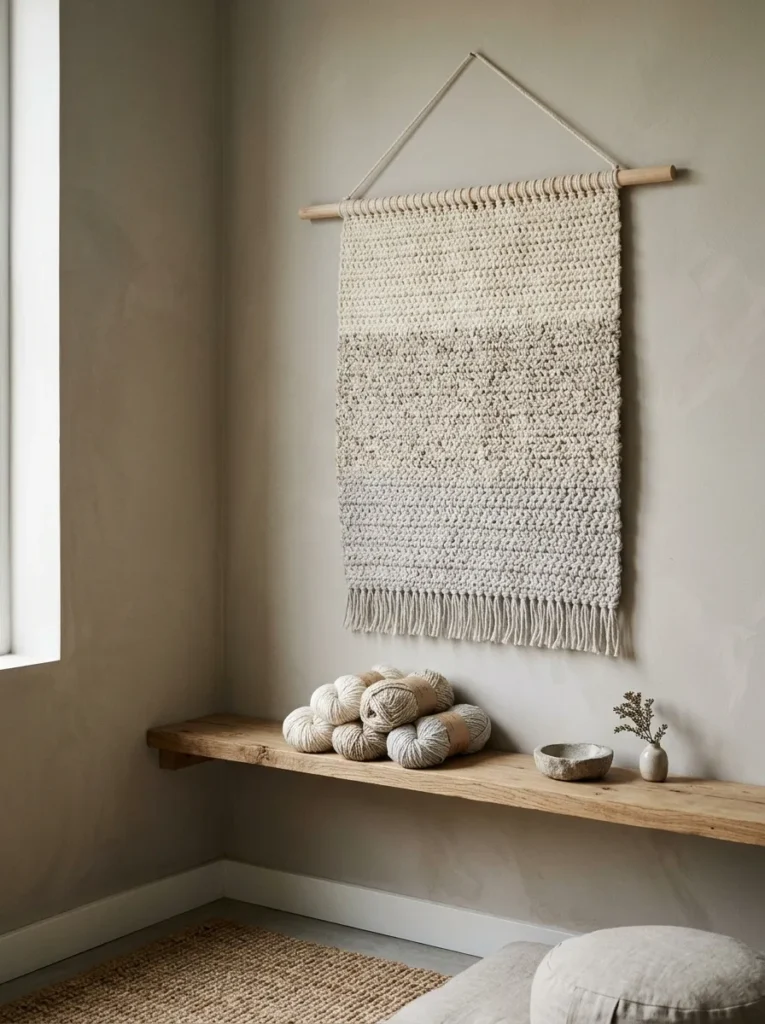
Calm is mostly a contrast problem. Eyes snap to edges where light meets dark, so navy stitches against cream keep the gaze moving even when the pattern is simple. Keep every yarn in one family, within two or three steps of each other: ecru to oatmeal to pale stone, or sage to pale sage to gray-green.
Undertone does more damage than shade. A cool gray-green hanging on a warm yellow-beige wall turns muddy. Hold a skein against the wall in daylight before committing, and lean toward stone and soft gray on cool walls, cream and oatmeal on warm ones. Most people skip this check and regret it.
Styling Note: Recheck the colors after sunset. Warm evening bulbs push cream toward yellow, and the match you approved at noon can drift.
3. Choose an Open-Mesh Cotton Hanging That Lets the Wall Show Through
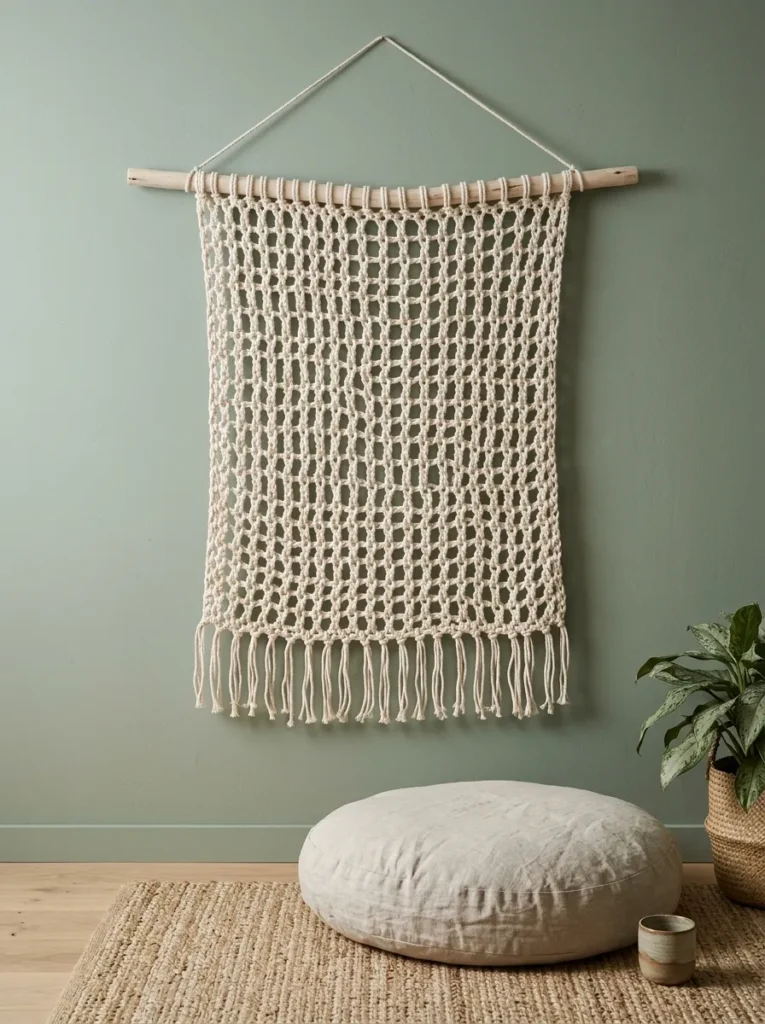
Picture a loose net of cotton loops with the wall color visible through every gap. Solid crochet is visually heavy; mesh keeps the wall in the picture, so a 30-inch piece still feels light. Pick natural chunky cotton cord in cream and pair it with a wall a shade or two deeper, such as muted sage, so the mesh reads like a drawn pattern.
Cotton has little spring-back, so heavy open mesh tends to sag over time. Hang it from a full-width rod rather than one nail, and re-level after the first week. A fit for small rooms or darker walls, where a solid panel would feel like a blanket pinned to the plaster.
Pro Tip: Photograph the hanging on your phone and switch the photo to black and white. If the pattern vanishes, the wall and cord are too close in lightness; go a shade deeper on the wall or choose a slightly darker cord.
Get the Look
| Product |
|---|
| Open-weave cotton crochet wall hanging in cream |
| Chunky natural cotton cord for making your own mesh |
A sheer crochet panel turns see-through at night with the lamps on, and the fix costs less than the panel.
4. Hang a Lace-Weight Panel Over the Window Glass
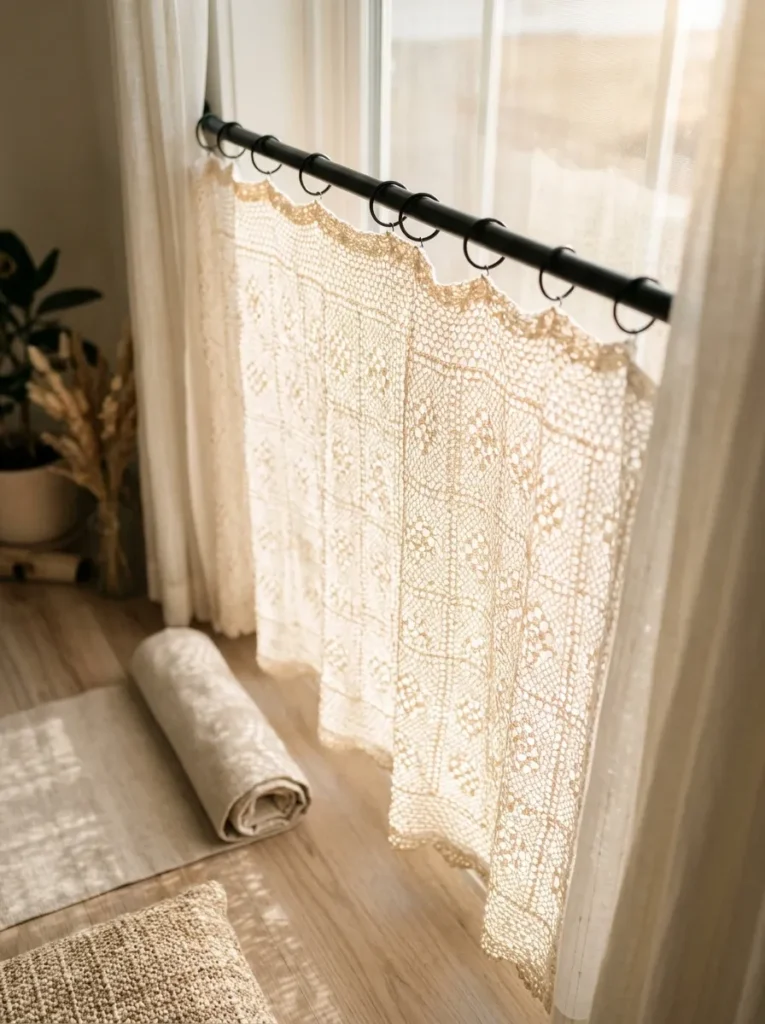
Mount a slim rod just above the window frame, hang a lace-weight crochet panel from it, and let daylight pass through the stitches. Patterned shadow drifts across the floor and cushion as the sun moves, which gives the corner a slow-changing focal point without adding anything to the wall.
Choose pale cream cotton. Strong direct sun can fade dyed yarn over time, and undyed or very light fibers show it least. One catch: any sheer reads transparent at night when the room is lit and the glass is dark, so back it with a light-filtering roller shade for evening sessions. Right for corners beside a window where wall space is short.
Get the Look
| Product |
|---|
| Lace-weight cotton crochet window panel in cream |
| Light-filtering roller shade in white or off-white |
| Slim matte-black curtain rod |
5. Size the Hanging to the Altar Shelf Beneath It

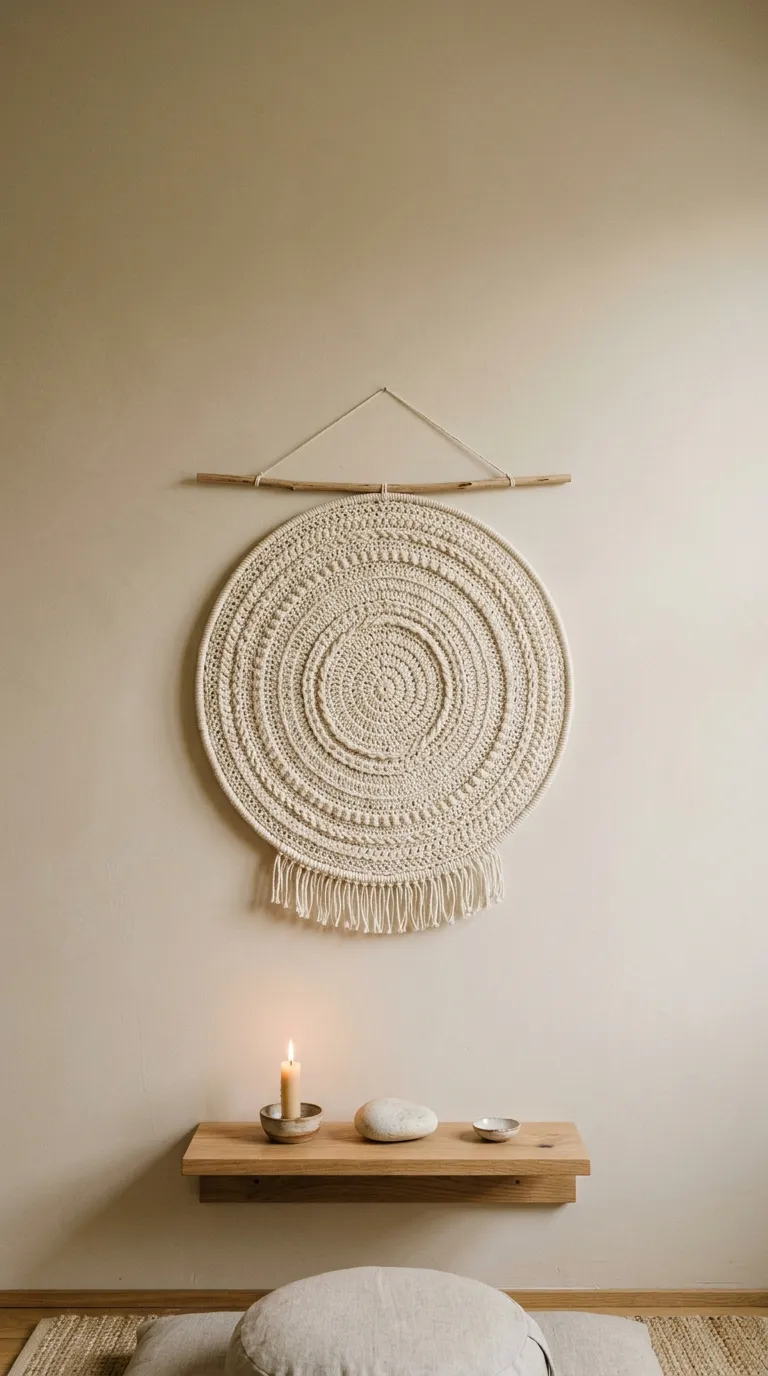
A hanging floats awkwardly until something sits beneath it. Pair it with a low floating shelf and use a common guideline: make the piece roughly two-thirds the width of the furniture below. On a 36-inch shelf, that means a 24-inch round, with its bottom edge about 8 inches above the shelf surface.
Mount the shelf about 16 inches off the floor and the center of that 24-inch piece lands close to the 36-inch seated line from idea one. The shelf gives the singing bowl a home and the hanging an anchor, so the two read as one composed corner rather than separate objects. Best for corners with a bare wall and room for a small altar surface.
Warning: Keep open flames and incense well away from the hanging. Cotton burns and acrylic yarn melts and drips, and a small shelf puts the flame close to the fiber. Leave at least a foot of clear gap as a practical minimum, or swap in flameless candles.
Get the Look
| Product |
|---|
| Floating shelf in light oak |
| Singing bowl with striker and small cushion |
| Set of flameless LED candles |
6. Hang Three Narrow Panels as One Even Triptych

Three narrow panels in the same stitch read as a single calm unit, provided the gaps are identical. Odd numbers settle faster than pairs because the middle panel gives the eye a center to rest on. Keep every gap to 2–3 inches (pick one number and hold it) and keep all panels the same height, even if the stitch pattern changes. Graded tones from idea two work well here: pale, medium, pale.
Uneven gaps are the usual failure. A quarter inch off shows up fast on a plain wall, so template everything before you drill. Good for anyone with a wide, empty wall and a taste for order.
✅ Hang a Triptych Level:
- [ ] Cut three paper templates the size of each panel
- [ ] Tape them up with equal 2–3 inch gaps and check the top edge with a level
- [ ] Sit on your cushion and slide the set until the middle panel sits on your seated center line
- [ ] Mark the nail points through the templates, then hang the real panels
Slide one lamp a foot to the side of the next piece, and a flat hanging gets a shadow in every stitch.
7. Light the Stitches from the Side with a Low Lamp

Texture only shows when light skims across it. Lit from the front, a chunky-stitch hanging reads as a pale slab. Place a warm lamp low and to one side, roughly 12–18 inches from the wall as a starting point, and every loop throws its own small shadow.
Pick a warm-white bulb (packaging often lists around 2700K or lower) and put the lamp on a dimmer, since a corner used mostly in the evening needs light that turns down easily. Stick with LED, which runs cooler than old incandescent bulbs, so the lamp can sit close to fiber. Best for thick, high-relief stitches that look flat in daylight.
Get the Look
| Product |
|---|
| Paper-shade floor lamp |
| Warm-white dimmable LED bulb |
| Inline cord dimmer switch |
8. Finish a Wood-Rod Hanging with Bead-Weighted Fringe
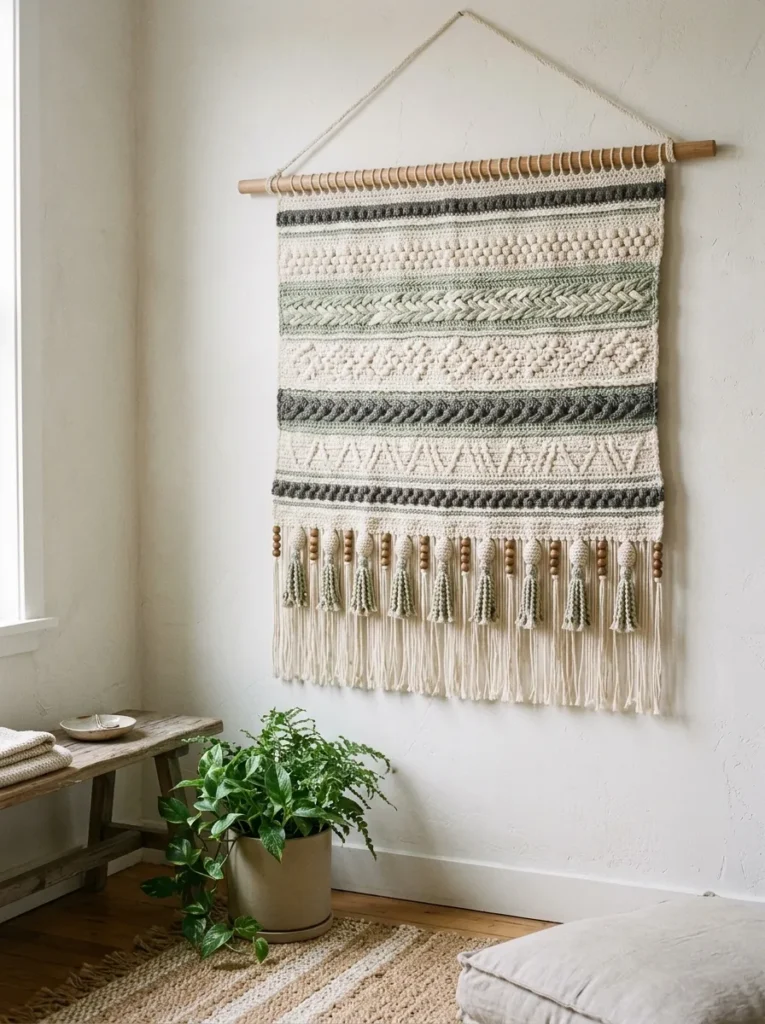
Suited to anyone who wants texture without pattern, and who meditates with eyes soft or half open and needs the wall to stay uneventful. Thread one large-hole wood bead onto each fringe strand and knot beneath it. Weight pulls the strands straight, so the fringe hangs in clean vertical lines instead of curling.
Hang the piece from a hardwood rod on a suede cord loop, and match that wood to the shelf or cushion frame. One wood tone in the corner keeps things quiet. Keep fringe away from vents and open windows, because moving strands turn into a distraction rather than a focal point.
Pro Tip: Buy a few extra beads and test-thread one strand first. Hole sizes vary, and finding out a bead won’t slide on is cheaper before you cut all the fringe.
Get the Look
| Product |
|---|
| Natural hardwood hanging rod with end caps |
| Large-hole wooden beads in a natural finish |
| Tan suede cord for the hanging loop |
9. Run a Tall Narrow Runner Up an Alcove Wall
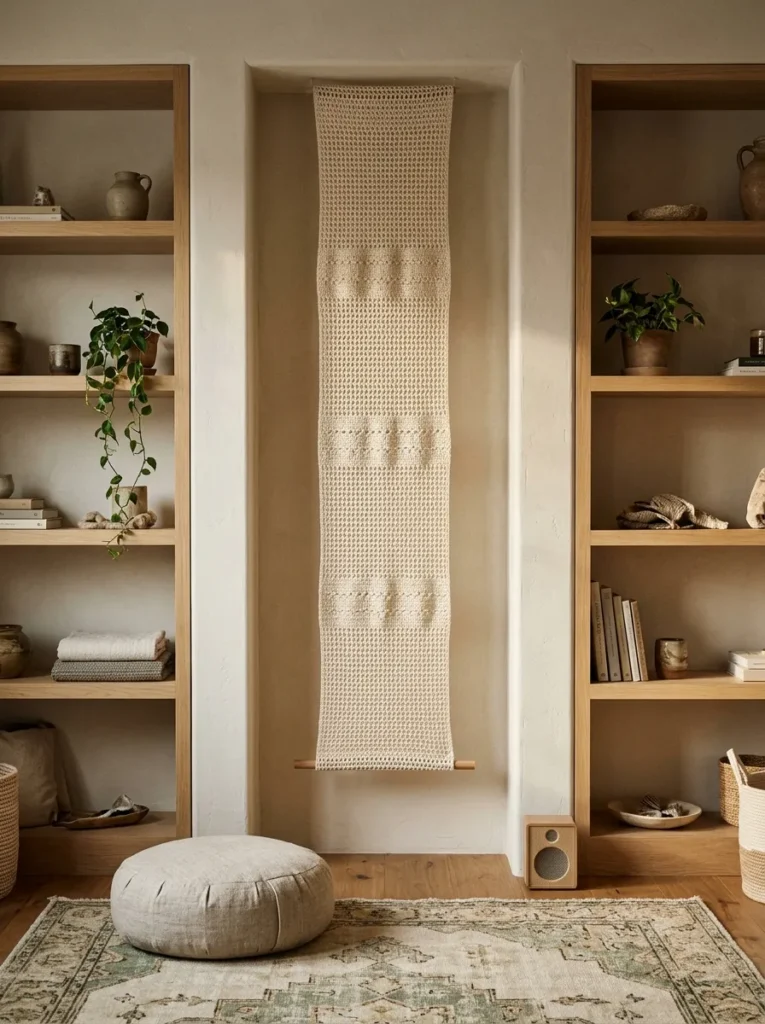
The default for a tight corner is a small square piece on a single nail, which makes a small space feel smaller. Go vertical instead. A runner about 14–18 inches wide and roughly 4 feet long, hung so its bottom edge sits near 12 inches off the floor, centers right at the 36-inch seated line and pulls the eye up the wall.
Renters can skip the drilling: a spring tension rod across an alcove holds the piece with no holes. Check the rod’s weight rating against your hanging, since dense crochet weighs more than it looks. Made for low ceilings, closet nooks, and bedroom corners.
Budget Version: Under $100, pair a spring tension rod with a runner crocheted from a few skeins of cotton yarn, or a secondhand woven or crochet table runner turned vertical.
One piece, nothing else on its wall: the empty space around it does half the work.
10. Let One Deep-Relief Piece Own the Whole Wall
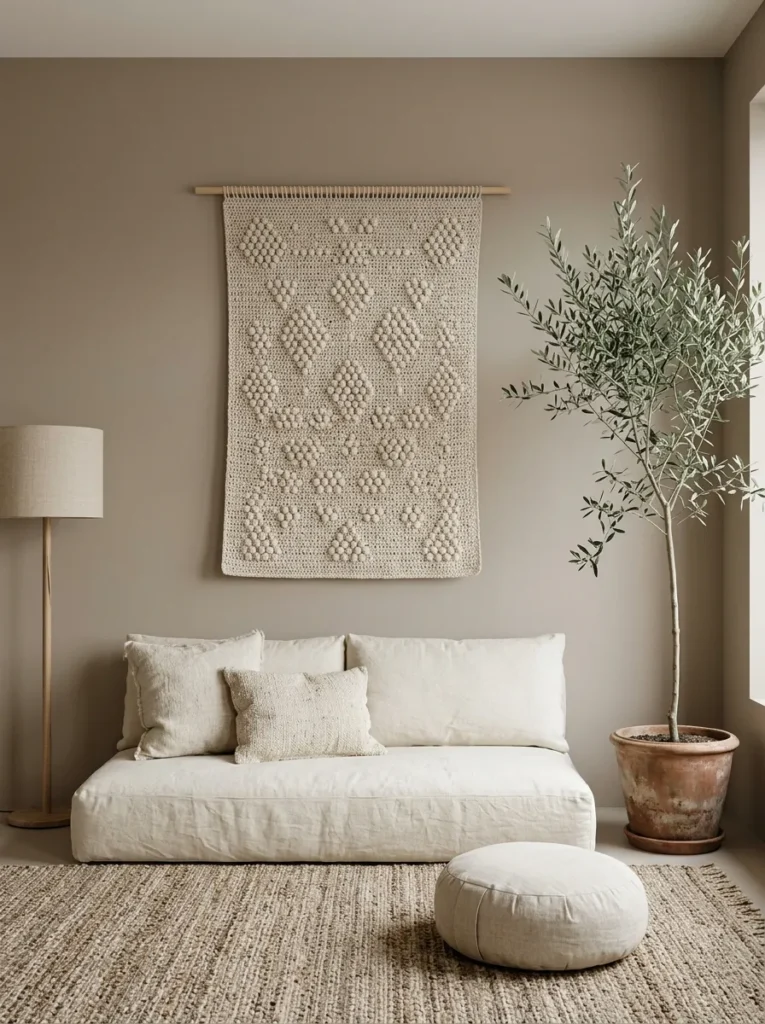
Waffle and bobble stitches build ridges you can read from across the room. With nothing else nearby, the eye settles on them and stays. Leave at least half the piece’s width as bare wall on each side, as a starting point, and resist adding a shelf or a second print.
Pick a wool-blend yarn for weight and a soft matte surface, and keep the color a single tone. It’s the boldest move on the list and the quietest result. Fits a spacious wall and anyone who prefers one strong idea over several small ones.
Important: A single hanging is decoration, not acoustic treatment. It may soften a bare room’s echo a little, but rugs, curtains, and bookshelves do far more.
How to Start Your Meditation Corner Transformation
Start here: one oatmeal or cream hanging, hung at seated eye level, on the wall you’ll face. Before any lamp or shelf, that single piece fixes height, palette, and wall relationship, and every later purchase gets judged against it.
The usual beginner mistake is buying the piece before measuring the wall. A 12-inch hanging on a 6-foot wall looks like a coaster. Cut a paper template at the size you’re considering, tape it up, and live with it for a day before ordering.
Three items that often land under $50: a round buckwheat-hull zafu cushion, a flat cotton floor mat, and a linen-blend throw for cooler mornings. Prices vary by seller, so treat that as a guideline, and choose all three in cream, oatmeal, or stone to match the hanging.
Expect an afternoon and roughly $30–$120 for a starter corner: one hanging, one cushion, and a measured hanging height. A full corner with a shelf, lamp, and window layer runs closer to $200–$450 (approximate) and spreads across a few weekends. Hanging, lighting, and shelf installs are weekend jobs. Crocheting a large piece yourself is a weeks-long project.
Ready to Create Your Dream Meditation Corner?
These 10 calming crochet wall hangings for a meditation corner cover height, color, fiber, light, and layout, so there’s an entry point for a closet alcove or a full wall. Transformation can stay small: one hanging at the right height already changes how the corner feels.
Today, sit where you meditate and mark 36 inches on the wall with a pencil. Finished, the space should feel hushed and unhurried, with a wall that lets your eyes settle instead of work. Save your favorite ideas to a Pinterest board so they’re waiting when you’re ready to start.
Keep Exploring
- 12 Small Meditation Corner Ideas for Bedrooms and Apartments
- 8 Textured Wall Hangings for a Calm Living Room
- 9 Wall Paint Colors That Make a Wellness Corner Feel Quieter